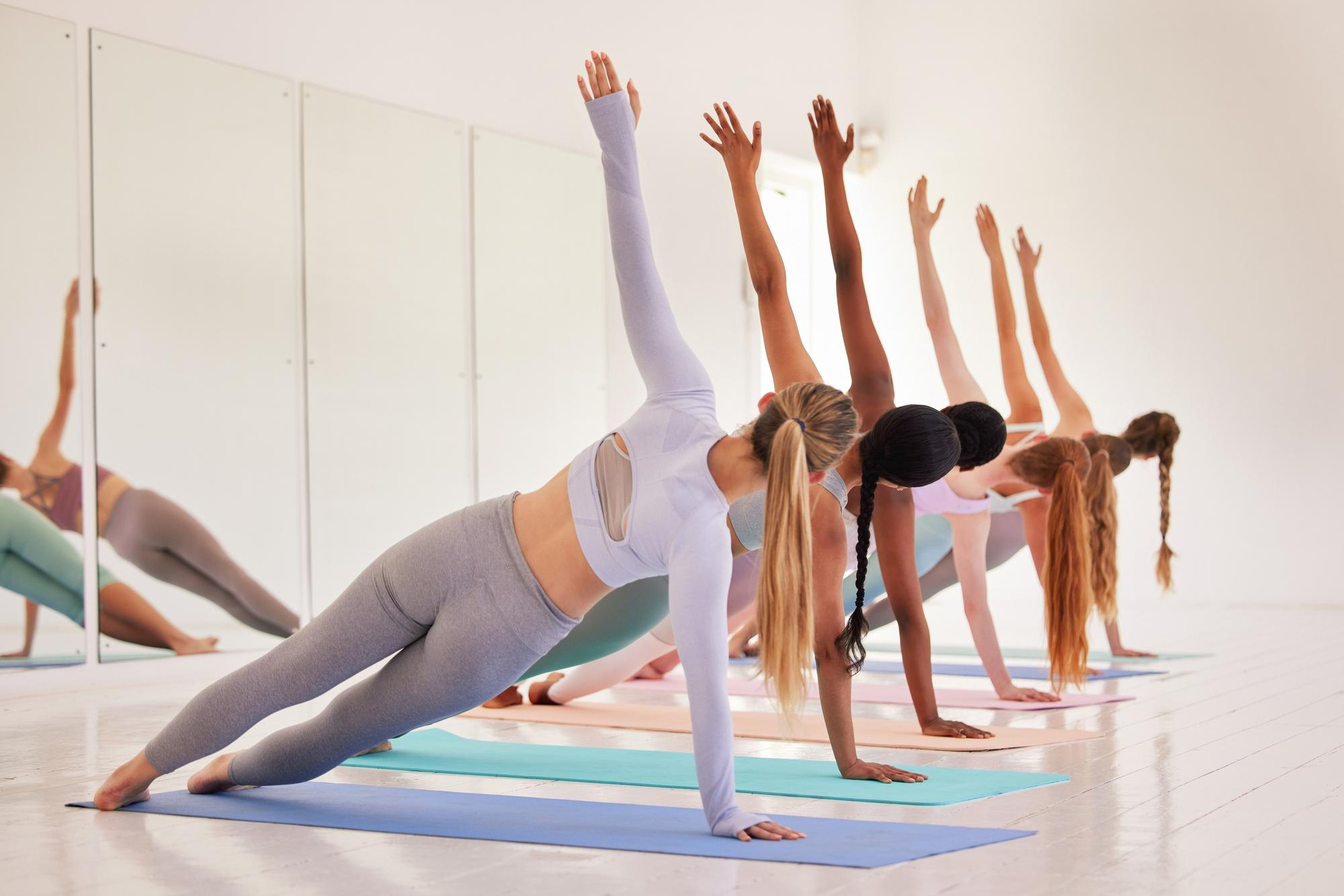
Pilates is a full-body exercise method built around controlled movement, steady breathing, and a strong, stable center. You can practice it on a simple mat or on specialized spring-resistance equipment like the reformer, and either path can meet you where you are — whether this is your first week of moving on purpose or your five-hundredth class this year. This guide answers the question beginners ask most: what is Pilates, and where should you start?
We’ll walk through where the method came from, what a first class typically looks like, how mat work differs from reformer work, and the principles that separate solid Pilates form from just moving around on a mat. Along the way you’ll pick up the vocabulary instructors use without needing a translator, plus answers to the questions FashionPilates readers ask most often.
The quick answer
So, what is Pilates? It’s a system of controlled, full-body exercises built around a strong center, precise movement, and coordinated breathing. Joseph Pilates developed the method in the early twentieth century, and instructors still teach a version of it today on a padded mat or on specialized spring-resistance equipment such as the reformer. Most people can start at a beginner level regardless of age or flexibility, since a good instructor modifies movements rather than expecting everyone to do the same thing. The short version: it’s a low-impact way to build core strength, improve posture, and move with more control, and you don’t need any equipment to try your first session.
- Origin: developed by Joseph Pilates, who opened his first studio in New York City in 1926.
- Formats: Mat Pilates (bodyweight, floor-based) and equipment-based Pilates (reformer, chair, Cadillac).
- Built on six core principles: concentration, control, centering, precision, breath, and flow.
- Who it suits: most adults, with modifications available for injury, pregnancy, or limited mobility — check with a doctor first if you have a health concern.
- What it isn’t: a guaranteed body-transformation program or a substitute for medical treatment.
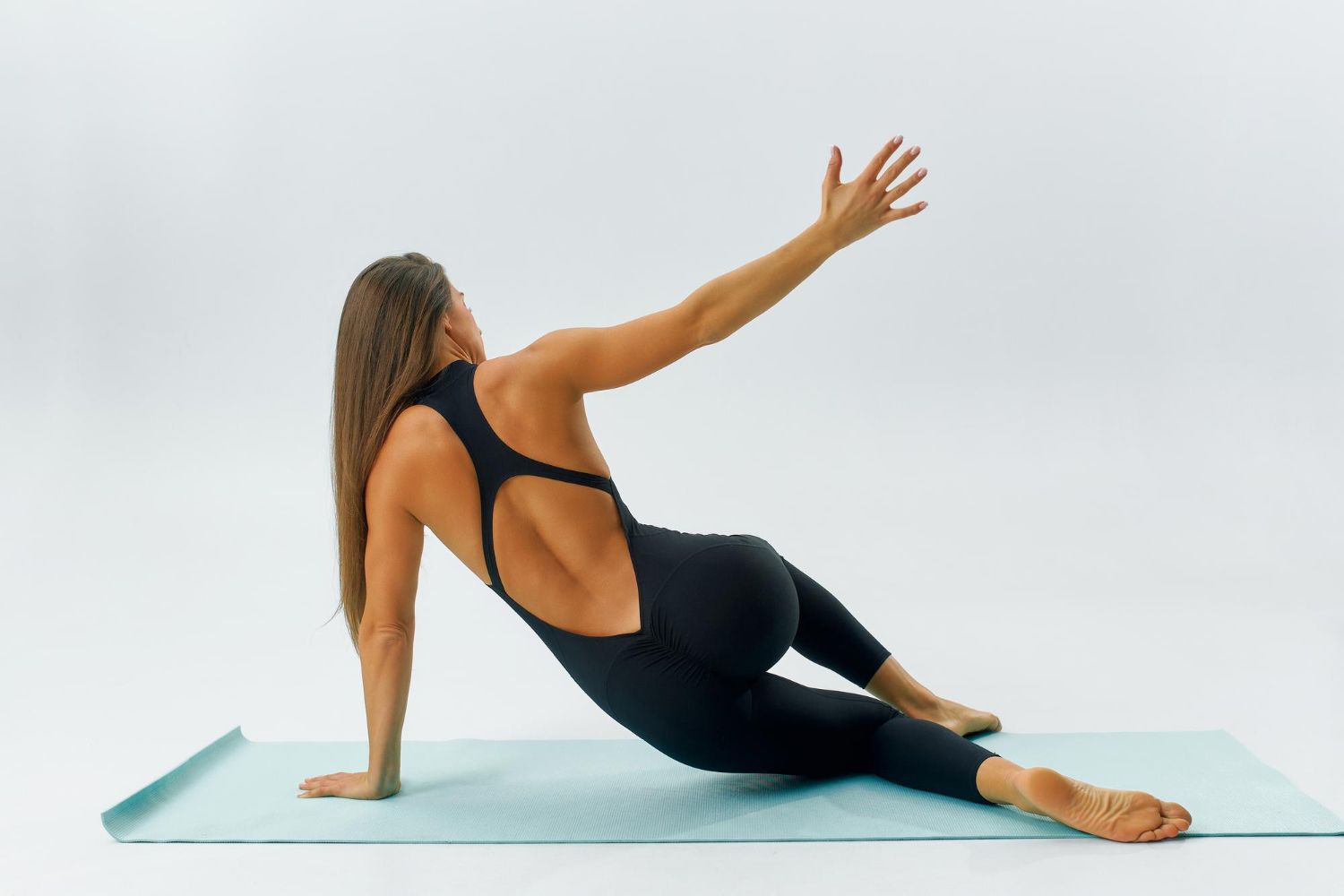
What is Pilates?
Joseph Pilates was born in Germany in 1883 and spent much of his early life working to overcome his own health problems through gymnastics, boxing, and other physical training. While interned in England during World War I, he began developing exercises for fellow internees, reportedly rigging bed springs to create resistance — an early version of what became the reformer. He called his complete system Contrology, built on the idea that the mind should direct the body’s movement rather than the other way around, and he continued refining it for the rest of his life.
In 1926, Pilates and his wife Clara opened a studio in New York City. Their early clients included dancers and performers who needed a training method that built strength without the repetitive strain their work caused, and the practice slowly spread through that community before reaching the wider public over the following decades.
The core idea hasn’t changed much since then. Rather than isolating one muscle at a time, Pilates asks you to move your whole body with intention, starting from your center — often called your Powerhouse — and radiating out through your arms and legs. That’s a different approach from, say, a biceps curl, and it’s part of why a Pilates class can feel unfamiliar the first time, even to people who already exercise regularly.
How Pilates spread beyond that first studio
Joseph Pilates died in 1967, and for years afterward his method stayed relatively niche, passed down through a small group of his original students — often called the “Elders” — who each emphasized slightly different parts of his teaching. The method reached a much wider audience starting in the 1990s, as fitness culture broadened beyond gyms and aerobics studios.
A 2000 federal court ruling played a real role in that growth. A New York studio owner had trademarked the word “Pilates” and spent years threatening other instructors with legal action for using it. In October 2000, a U.S. District Court judge ruled that “Pilates,” like “yoga” or “karate,” was a generic term for a method of exercise rather than a trademark, and ordered the registration canceled. That decision is a big part of why thousands of independent studios, teacher-training programs, and equipment makers — including the classical and contemporary lineages you’ll read about below — can all legally call what they teach “Pilates” today.
Key terms you’ll hear right away
A few words come up in nearly every Pilates class, and knowing them ahead of time makes that first session considerably less confusing. Our full Pilates FAQs & Glossary coverage builds out the complete list; these are the ones you’ll likely hear before you’ve even finished your first exercise.
- Powerhouse: the muscles of your abdomen, lower back, hips, and glutes — the “center” most Pilates movement starts from.
- Neutral spine: a spine position that keeps its natural curves instead of flattening or overarching.
- The Hundred: a classic warm-up exercise involving 100 counted breaths with the legs and upper body engaged.
- Contrology: Joseph Pilates’ original name for his complete method.
- Reformer: a spring-loaded machine with a sliding carriage, used for resistance-based Pilates.
Most Pilates teachers, regardless of studio or certification, organize their teaching around six principles drawn from Joseph Pilates’ own writing. They aren’t exercises themselves — they’re the qualities that turn a basic movement into an actual Pilates exercise.
| Principle | What it means in practice |
|---|---|
| Concentration | Staying mentally present in the movement instead of going through the motions. |
| Control | Moving deliberately, with no momentum or flailing limbs. |
| Centering | Initiating movement from your Powerhouse rather than your arms or legs. |
| Precision | Placing your body correctly rather than doing more repetitions sloppily. |
| Breath | Coordinating inhales and exhales with specific phases of each movement. |
| Flow | Linking exercises smoothly rather than stopping and resetting between each one. |
These principles show up throughout the rest of this guide, and they’re the backbone of the Pilates Technique & Form section below. Taken together, that’s the real answer to “what is Pilates?” — not a single move, but a whole way of moving.
Pilates for beginners
Starting anything new comes with a small mental tax, and Pilates is no exception — the equipment names alone (Cadillac, Wunda Chair) sound like they belong in a furniture catalog, not a fitness studio. The good news is that a well-run beginner class is built for exactly this moment, and you’re not expected to arrive already knowing any of it, including a tidy answer to “what is Pilates?”
What to expect in your first class or session
Plan to arrive ten to fifteen minutes early if you’re visiting a studio for the first time. That gives you time to fill out a health questionnaire, meet your instructor, and mention any injuries or limitations before class starts — information a good instructor will actually use to modify exercises for you, not just file away.
A beginner mat class usually opens with a short warm-up, moves through foundational exercises like the Hundred and pelvic curls, and closes with gentle stretching. A reformer session follows a similar arc, but your instructor will spend extra time explaining the machine’s straps, springs, and footbar before you do much else. Either way, expect to hear the word “breathe” a lot more than you’re used to in a workout class.
Don’t expect to look graceful. Most beginners wobble through their first Hundred, lose track of which way is “neutral spine,” and mix up left and right at least once. That’s completely normal, and it says nothing about whether Pilates is right for you. Everyone in that room was a beginner once, including the instructor.
How a typical class is structured, start to finish
Most beginner mat and reformer classes run 45 to 55 minutes, which is long enough to cover a full sequence without leaving you sore for a week. A typical session opens with two to five minutes of breathing and gentle warm-up movement, then moves into foundational exercises — things like the Hundred, pelvic curls, and leg circles — that wake up your Powerhouse before anything more demanding is asked of it.
The middle of class usually builds in intensity, layering in exercises that combine strength and coordination, before tapering back down. The last five to ten minutes are typically reserved for stretching and a brief cool-down, often lying flat with your eyes closed for a minute at the end — a small, deliberate pause that a lot of first-timers find is their favorite part once they stop being surprised by it.
Private or semi-private sessions follow a looser version of this same arc, adjusted in real time to what your body needs that day. Group classes stick closer to a planned sequence, simply because an instructor is watching several people at once. Cost is worth asking about early: studio classes typically run more per session than a general gym membership, partly because reformers are expensive to buy and maintain, and many studios offer a discounted intro package specifically so you can test the format before committing to full-price membership pricing.
What you actually need to get started
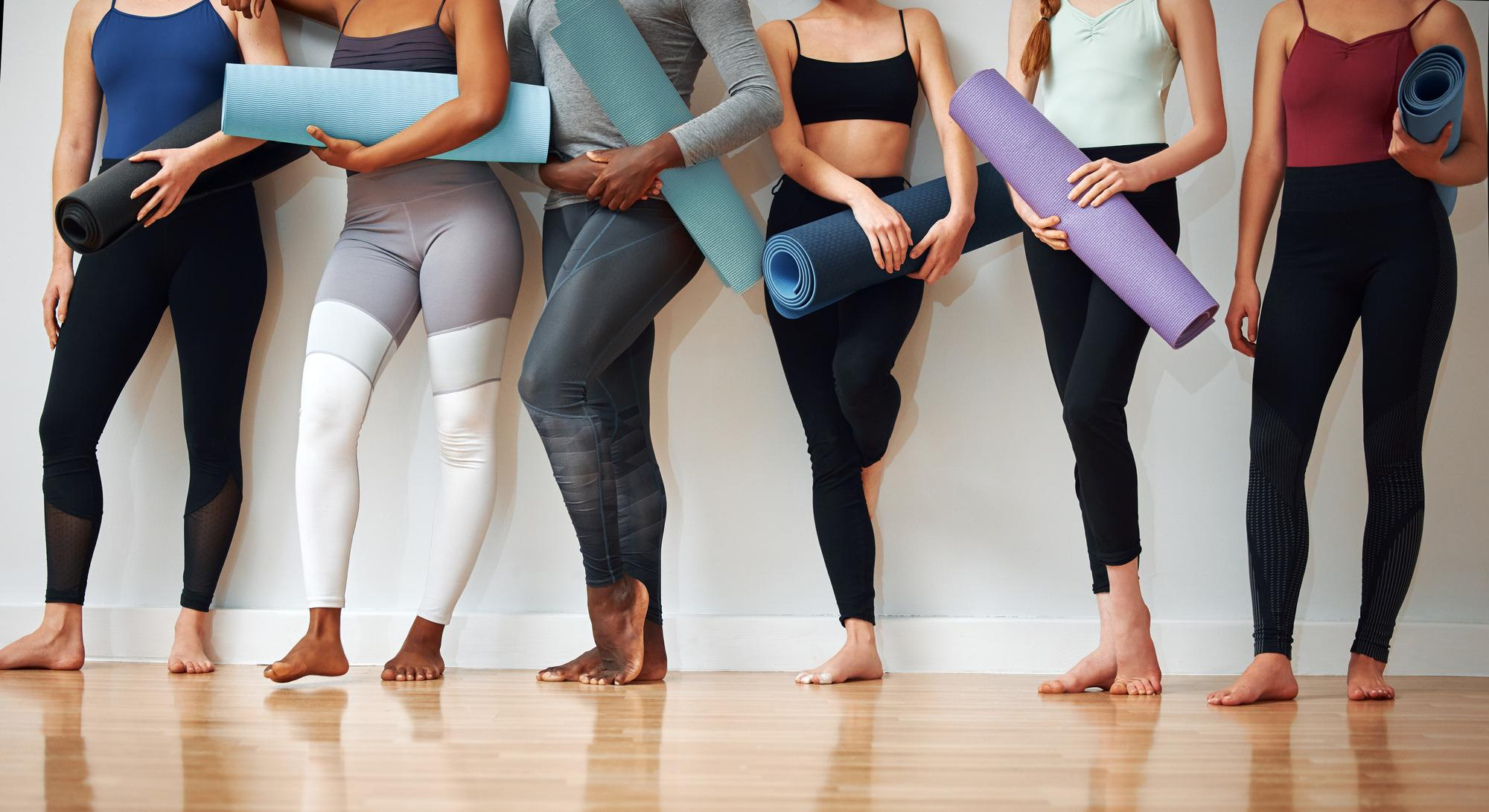
You do not need special clothing, a home reformer, or an expensive pair of grip socks before your first class. Fitted, comfortable clothing that lets an instructor see your alignment — think leggings or fitted shorts, plus a top that won’t ride up during floor work — is genuinely enough. Many studios do ask for grip socks specifically, since bare feet or regular socks can slip on the equipment, so check the studio’s policy before you go; that’s the fine print worth reading before you show up in cotton crew socks and get turned away at the front desk.
If you’re trying Pilates at home first, a basic exercise mat with reasonable cushioning is the only real requirement. Save the props, resistance bands, and Pilates ring for later, once you know whether the format clicks for you. FashionPilates’ equipment and fashion coverage can help once you’re ready to invest, but that decision comes after you’ve tried it, not before.
Common beginner questions and misconceptions
New students tend to worry about the same handful of things, so let’s clear a few up early. “Pilates is just stretching” undersells it — a well-taught class builds real strength and control, even though the movements can look gentle from across the room. On the flip side, “Pilates is too hard for me” usually means someone tried an advanced reformer class as their first exposure; a genuine beginner class is paced very differently.
Another common mix-up: treating Pilates and yoga as interchangeable. They share some values, like breath awareness and mind-body focus, but Pilates is built around precise, repeatable exercises tied to specific muscle groups, while yoga centers on held poses and, often, a broader spiritual framework. Neither is objectively better — they’re just different tools, and plenty of people do both.
One more misconception worth retiring: you do not need to already be flexible, strong, or “in shape” before your first class. Pilates is designed to build those qualities, not to require them up front, and a genuine beginner class is built for people who don’t have them yet. If you can get down to the floor and back up — using a chair or wall for support if needed — you have enough to start.
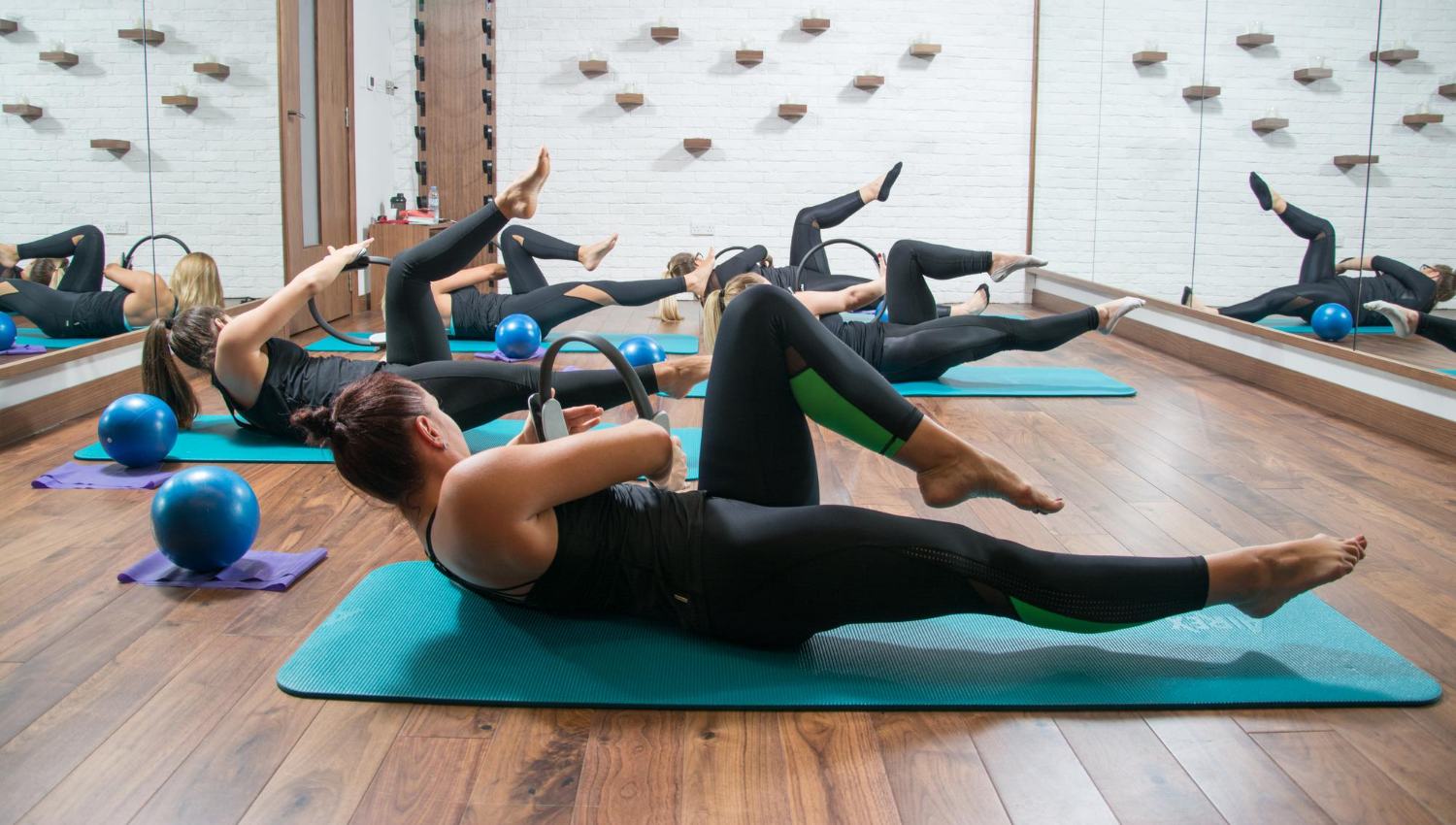
Pilates methods & styles
You now have a working answer to “what is Pilates?” in general. Once you’ve tried a beginner class or two, though, you’ll notice that “Pilates” isn’t one single thing — it’s a family of related approaches that share a philosophy but differ in equipment, pacing, and how closely they stick to Joseph Pilates’ original sequence. Here’s how the major distinctions actually break down.
Mat Pilates vs. Reformer Pilates
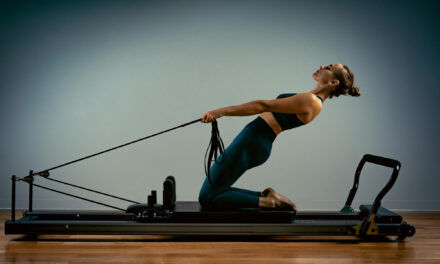
Mat Pilates uses your body weight as resistance, sometimes with small props like a ring or resistance band, and it requires nothing but floor space. Reformer Pilates adds a sliding carriage, adjustable springs, and a set of straps and bars, which lets an instructor fine-tune resistance for each exercise and each student.
| Factor | Mat Pilates | Reformer Pilates |
|---|---|---|
| Equipment needed | A mat; optional small props | A reformer machine |
| Typical access | Home, gym floor, or studio | Studio, or a home reformer owner |
| Resistance source | Body weight and gravity | Adjustable springs |
| Cost to try | Low — free class videos are common | Higher — studio class pricing or equipment purchase |
| A good first choice if… | You want to test the format cheaply | You want more built-in support and feedback |
Neither format is more “authentic” than the other — Joseph Pilates designed exercises for both the mat and his equipment from the beginning. Your budget, access to a studio, and personal preference matter more here than any claim about which one is superior.
The other apparatus you’ll hear about
The reformer gets most of the attention, but Joseph Pilates designed several other pieces of equipment that some studios still use regularly. The Cadillac, also called the trap table, is a raised platform with an overhead frame of bars and springs, used for both beginner-friendly supported exercises and advanced suspension work. The Wunda Chair is a compact box with a spring-loaded pedal, useful for balance and single-limb strength work in a smaller footprint than a reformer.
You may also encounter the Spine Corrector, a curved, barrel-shaped prop that supports specific spinal stretches, and the Ladder Barrel, a taller barrel with rungs for exercises that combine flexibility and control. None of these are required to get real benefit from Pilates — plenty of dedicated practitioners never touch anything but a mat and, occasionally, a reformer — but recognizing the names helps when a studio’s class schedule lists a “Cadillac flow” and you’re deciding whether to book it.
Classical Pilates vs. contemporary Pilates
Classical Pilates follows Joseph Pilates’ original sequence of exercises in a fixed order, taught largely the way his first-generation students learned it. Contemporary Pilates keeps the same underlying principles but incorporates newer research on biomechanics and rehabilitation, and instructors often reorder or adapt exercises to fit an individual student’s needs.
If you like structure and a class that plays out the same way each time, classical Pilates tends to feel more predictable. If you’d rather have an instructor adjust things around an old knee injury or a tight back, contemporary Pilates usually offers more built-in flexibility. It’s worth a closer look at both if a studio near you offers each, since the practical difference is easier to feel than to read about.
Other formats you might encounter
A few more variations show up often enough to mention. Clinical or rehabilitative Pilates is typically taught by a physical therapist and tied to a specific injury or condition. Group reformer classes fit several machines into one room for a gym-like, instructor-led session. Fusion classes blend Pilates with yoga, barre, or general strength training, and app-based or online programs let you practice on your own schedule — FashionPilates’ Pilates Lifestyle coverage digs into how those platforms compare. Pre- and postnatal classes are another common variation, taught by instructors with specific training in pregnancy-safe modifications and usually kept separate from general beginner classes for that reason.
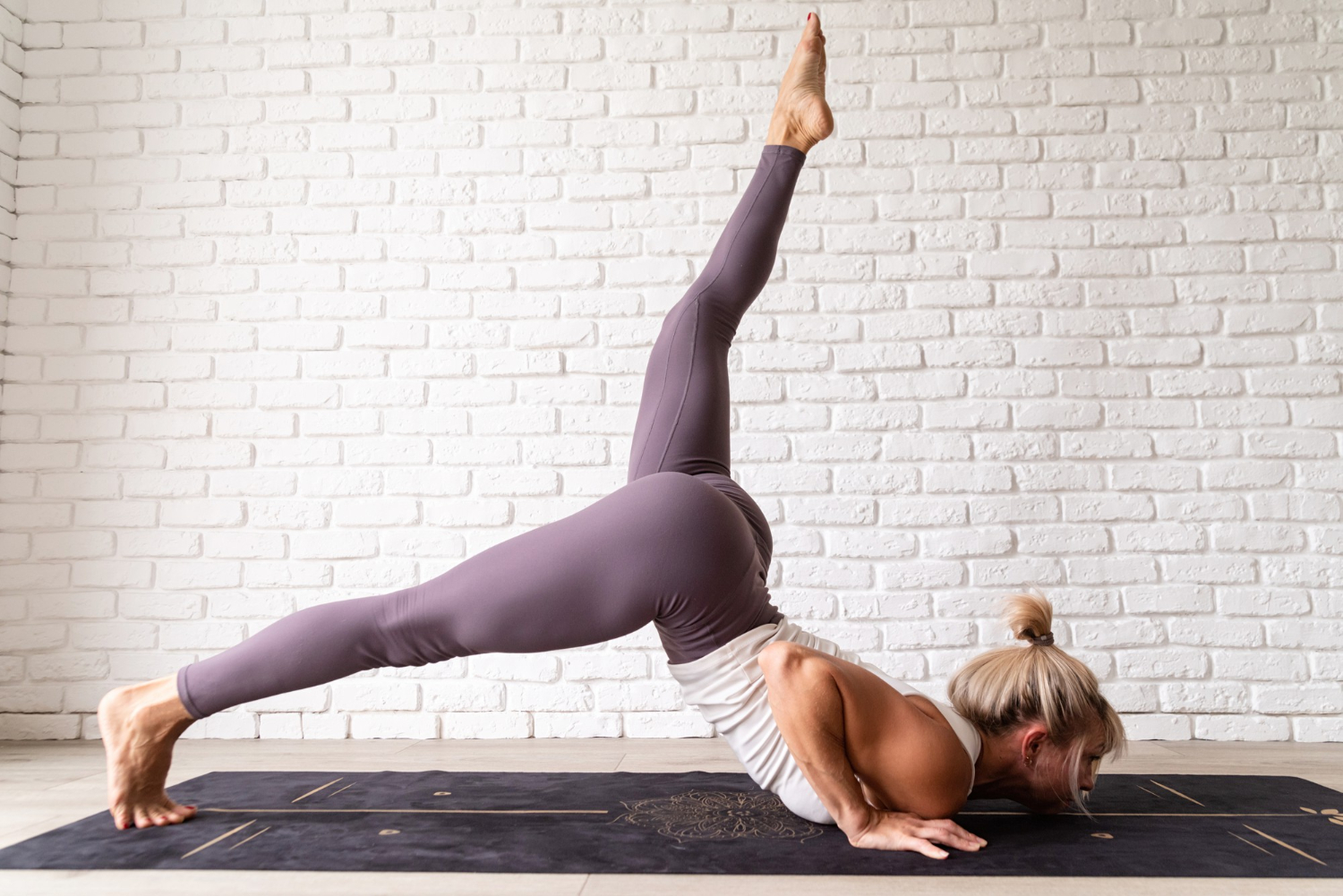
Pilates technique & form
Good Pilates form isn’t about being flexible or having visible abs — it’s about moving with the kind of control the six principles describe. This section breaks down what that actually looks like, plus the cues you’ll hear most often.
The core principles behind good form
Breath comes first, even before movement. Most Pilates exercises pair a specific breathing pattern with a specific phase of the movement — exhaling on the effort, for instance — and that coordination is part of what makes the exercise work, not an optional add-on.
Centering means every movement starts from your Powerhouse. Before you lift a leg or reach an arm, you engage your deep abdominal muscles first, then move the limb from that stable base. Skip this step and an exercise stops being Pilates; it just becomes a generic stretch with extra steps.
Alignment matters as much as effort. An instructor correcting your shoulder position or pelvis tilt mid-exercise isn’t nitpicking — poor alignment is one of the more common ways people strain their neck or lower back during a workout that’s supposed to protect both.
Precision also means the repetition count on the class handout is a guideline, not a scoreboard. Five well-controlled repetitions of an exercise, performed with correct alignment and full breath coordination, do more for you than fifteen rushed ones — a fact that surprises people used to counting reps as the main measure of a good workout. If your instructor stops you at five instead of the printed ten, that’s precision working as intended, not a shorter workout.
Common form cues and what they actually mean
Pilates instructors lean on a specific vocabulary, and translating it early saves you from nodding along while quietly confused.
- “Find your neutral spine”: let your lower back keep its natural, slight curve instead of pressing flat into the mat or arching away from it.
- “Scoop” or “hollow” your abs: draw your lower belly in and up, toward your spine, without holding your breath.
- “Lengthen through the crown”: imagine the top of your head reaching away from your tailbone, which keeps your neck from compressing.
- “Imprint your spine”: gently press your lower back into the mat, usually to protect it during a leg-lowering exercise.
- “Stack your joints”: keep shoulders over wrists, or hips over knees, so weight travels straight through a joint instead of at an angle.
Signs you should modify or stop a movement
Normal Pilates fatigue feels like muscle effort — shaking, a burning sensation in the muscle you’re working, or genuine tiredness by the end of a set. Sharp pain, joint pain, numbness, or dizziness are different signals, and they mean stop, not push through. A good instructor would rather you modify a movement than grit your teeth through one that’s hurting you.
If you’re pregnant, postpartum, recovering from surgery, or managing a chronic condition, talk with your doctor before starting Pilates and let your instructor know your situation before class. Reformers, in particular, can be adjusted significantly, and an instructor who knows your history can set springs and positions accordingly instead of guessing.
It’s also worth learning the difference between productive discomfort and a warning sign over time, not just within a single class. A new exercise can feel hard in a way that eases as your body adapts over a few sessions; a movement that consistently produces the same sharp pain in the same spot is telling you something different, and repeating it while hoping it improves on its own usually backfires. If a specific exercise bothers you every time, say so — a good instructor has a modification ready, and asking isn’t a sign that you’re not trying hard enough.
None of this technique guidance replaces an instructor watching you move in real time, which is part of why in-person feedback — even just once or twice — tends to accelerate progress more than any article can. Video calls and recorded classes can teach you the shape of an exercise, but they can’t feel whether your spine actually stayed neutral or your weight silently shifted onto one hip. If you’re practicing primarily from videos, an occasional in-person session is often enough to catch habits that are hard to see in yourself.
Common beginner mistakes and how to fix them
A few habits show up in almost every beginner class. None of them are a big deal once you know to watch for them.
- Holding your breath during effort. It’s an easy habit to fall into, and it usually shows up as a slightly panicked expression that makes you look like you’re solving long division in your head. Fix: match your exhale to the hardest part of the movement, even if it feels exaggerated at first.
- Rushing through the Hundred. Speeding up doesn’t make the exercise more effective — it just tires your neck out faster. Fix: slow the pace and prioritize the breath pattern over the count.
- Forcing flexibility you don’t have yet. Straining to touch your toes on day one risks your lower back for no real benefit. Fix: bend your knees or use a strap, and let your range of motion improve gradually.
- Skipping the warm-up. Jumping straight into intense core work on cold muscles raises your injury risk. Fix: treat the first few minutes of class as non-negotiable, even when you’re in a hurry.
- Tuning out instructor cues. It’s tempting to go on autopilot once you know the general shape of an exercise. Fix: keep listening — cues about breath and alignment usually matter more than the exercise’s name.
- Buying a full kit before your first class. It’s tempting to stock up on props and matching sets before you know whether the format clicks for you. Fix: borrow or buy the bare minimum for class one, then shop once you know what you’ll actually use.
- Comparing your day-one form to an instructor’s demo. An instructor has years of repetition behind their version of an exercise; yours won’t match it today, and that gap isn’t a problem to solve immediately. Fix: judge your form against your own last session, not against someone else’s highlight reel.
Choosing your path through Learn Pilates
Not every reader needs the same thing from this guide, so here’s a short map of where to go next in FashionPilates’ Learn Pilates coverage, depending on what’s actually stumping you today. Think of the four sections below less like a syllabus and more like four doors into the same room — useful to know about, not required to open in order, and each one adds a little more to your answer to “what is Pilates?” beyond the basics.
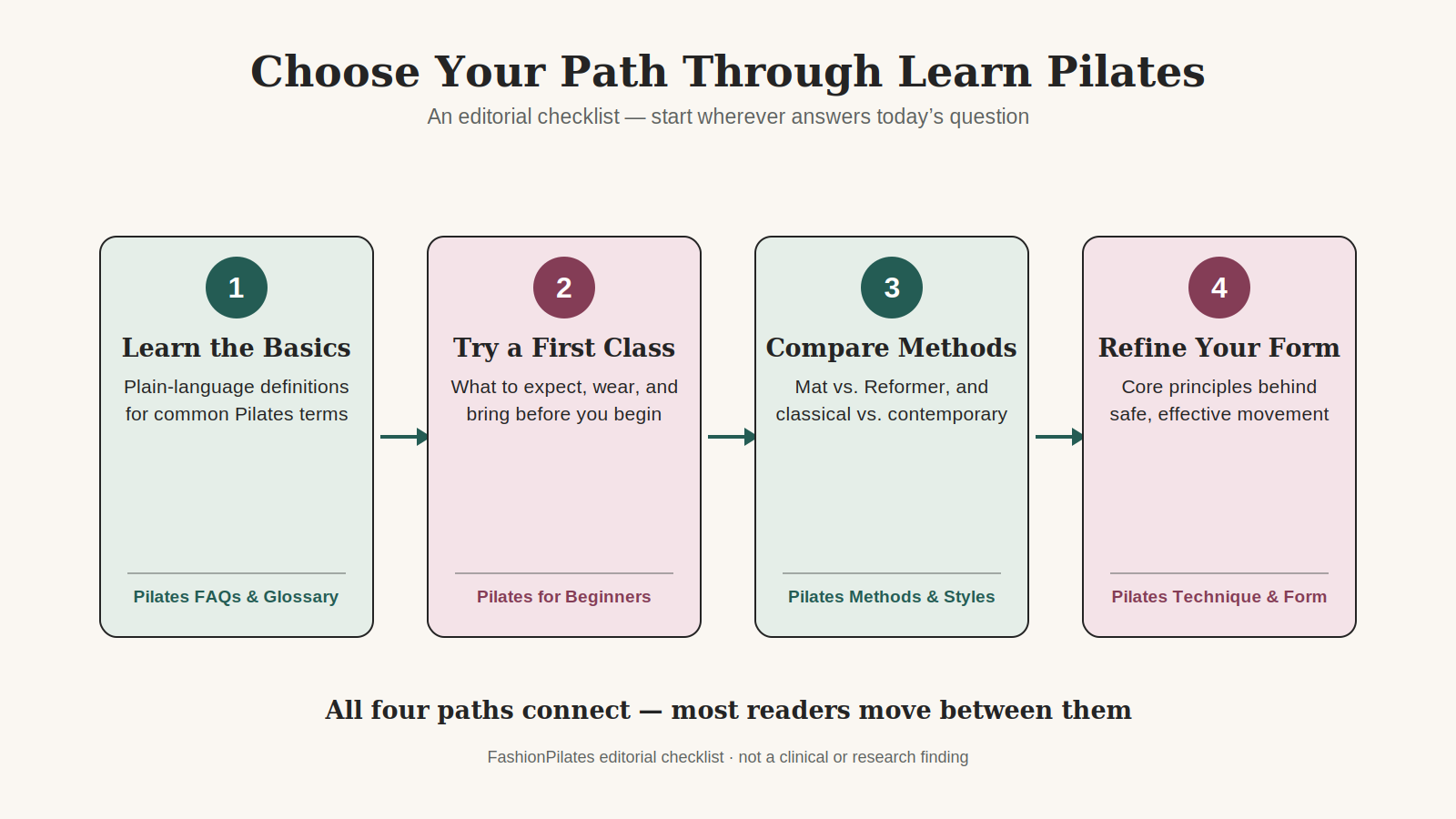
Choose Your Path Through Learn Pilates
Complete text equivalent of the infographic above:
- Learn the basics — plain-language definitions for common Pilates terms. See: Pilates FAQs & Glossary.
- Try a first class — what to expect, wear, and bring before you begin. See: Pilates for Beginners.
- Compare methods — Mat vs. Reformer, and classical vs. contemporary. See: Pilates Methods & Styles.
- Refine your form — core principles behind safe, effective movement. See: Pilates Technique & Form.
Takeaway: all four paths connect, and most readers move between them rather than following them in strict order.
If you’re still parsing terminology, our Pilates FAQs & Glossary coverage builds out the full vocabulary list beyond the handful of terms above. If you haven’t booked a first class yet, the Pilates for Beginners section covers studio etiquette, what to wear, and how to pick a class level. If you’re deciding between a mat practice and a reformer studio membership, or between a classical and contemporary teacher, the Pilates Methods & Styles section goes deeper into each comparison. And if you’ve already started but want your form to actually hold up under fatigue, the Pilates Technique & Form section is built for that stage.
None of these sections are strictly sequential — plenty of readers bounce between them depending on the week. Once you’re ready to build a routine or shop for equipment and gear, FashionPilates’ Pilates Workouts, Pilates Equipment & Gear, and Pilates Fashion coverage pick up from here.
Your practical next step
Pick one specific action instead of trying to absorb everything at once. If you haven’t tried Pilates yet, look up a beginner mat or reformer class within the next week — a single trial class answers “what is Pilates?” better than another hour of reading ever will. If you’ve already started, choose one cue from the Pilates Technique & Form section above and focus on just that one thing during your next session.
Progress in Pilates tends to be quiet rather than dramatic — better balance on the reformer, an easier time finding neutral spine, one more controlled repetition than last month. Give it a few consistent sessions before deciding whether it’s for you, and resist the urge to judge the whole method by a single class that happened to be rushed, overcrowded, or just an off day.
Frequently asked questions
What does “Pilates” mean, and how do you pronounce it?
Pilates is named after its founder, Joseph H. Pilates, rather than being a translated word with a separate meaning of its own. The correct pronunciation is puh-LAH-teez, not “pie-lates,” a mix-up common enough that most instructors have stopped correcting people out loud. Joseph Pilates originally called his complete system Contrology, and the shorter name became the popular term only after his death in 1967. If you mispronounce it in your first class, you’ll be in good company — plenty of longtime students got it wrong before someone finally set them straight.
Is Pilates a good workout for absolute beginners?
Yes, Pilates is generally a solid choice for absolute beginners, especially compared with higher-impact workouts that assume existing fitness. A properly taught beginner class paces exercises slowly, explains terminology as it goes, and offers modifications for different ability levels. The main risk isn’t the method itself but accidentally landing in an advanced class, which can feel discouraging and raise injury risk. Look specifically for a class labeled “beginner” or “fundamentals,” and tell your instructor it’s your first time so they can adjust accordingly.
What’s the difference between Pilates and yoga?
Pilates centers on precise, repeatable exercises built around core strength and controlled movement, while yoga centers on held poses, often within a broader spiritual or meditative framework. Both practices value breath awareness and mind-body connection, which is part of why people sometimes conflate them. Pilates classes typically move at a steadier pace with more repetition, while yoga classes often hold positions longer and place more emphasis on flexibility and stillness. Many people practice both, since the two complement rather than replace each other.
How often should a beginner practice Pilates?
Two to three sessions per week is a common starting point for beginners, though even one weekly class builds noticeable familiarity with the movements. Consistency matters more than frequency at first, since your body needs repeated exposure to learn cues like neutral spine and centered movement. Some beginners prefer one studio class per week supplemented with a short home mat routine on other days. Listen to your body and add rest days if you notice unusual soreness beyond normal muscle fatigue.
Do I need special equipment to start Pilates at home?
No, you don’t need special equipment to start Pilates at home — a basic mat with reasonable cushioning is enough for most beginner routines. Many foundational Mat Pilates exercises use only body weight, so props like a Pilates ring or resistance band are optional additions rather than requirements. If you’re drawn to reformer-style resistance, some studios offer trial packages before you consider a home reformer, which is a significant investment. Our Pilates Equipment & Gear coverage compares mat options and props in more detail once you’re ready to shop.
Is Pilates safe during pregnancy or with a chronic health condition?
Pilates can often be adapted for pregnancy, postpartum recovery, and many chronic conditions, but you should talk with your doctor before starting and choose an instructor experienced with your specific situation. Certain classical exercises aren’t appropriate during pregnancy and need modification or substitution, which is where a qualified instructor’s training matters most. General guidance like this can’t replace individualized medical advice, since conditions and pregnancies vary considerably from person to person. Tell your instructor about your situation before class begins so they can adjust equipment settings and exercise selection accordingly.
What is the “Powerhouse” in Pilates?
The Powerhouse is Joseph Pilates’ term for the group of muscles around your abdomen, lower back, hips, and glutes that most Pilates movement initiates from. Think of it as your body’s stable center, similar to what other fitness disciplines call your “core,” though the Pilates version includes a slightly broader set of muscles. Nearly every exercise in the method asks you to engage your Powerhouse before moving your arms or legs, which is part of what distinguishes Pilates from a generic bodyweight workout. Instructors often cue this with phrases like “scoop your abs” or “draw your belly button to your spine.”
How long before I notice results from Pilates?
Many beginners notice small changes, like improved balance or an easier time finding neutral spine, within two to four weeks of consistent practice. More visible changes, such as noticeably improved posture or core strength, typically take longer and depend heavily on how often you practice and your starting fitness level. Pilates results tend to be gradual rather than dramatic, so tracking specific improvements — like holding a plank longer or feeling steadier on one leg — is more useful than expecting a sudden transformation. If you don’t notice any change after a couple of months of regular practice, a private session can help identify whether your form needs adjusting.
Can I do Pilates every day?
You can do gentle Pilates most days of the week, but daily intense sessions aren’t necessary or, for most beginners, advisable. Your muscles need recovery time to actually get stronger, and skipping that recovery tends to raise injury risk rather than speed up results. A common approach is two to four dedicated sessions per week, with optional light stretching or breathing work on other days. If you love the daily habit, alternate between more and less intense sessions rather than pushing hard every single day.
What’s the difference between clinical Pilates and a regular studio class?
Clinical Pilates is typically taught one-on-one or in small groups by a physical therapist and is built around a specific injury, surgery recovery, or diagnosed condition rather than general fitness. A regular studio class is designed for a broader range of healthy adults and doesn’t require any referral or diagnosis to attend. Clinical Pilates sessions usually cost more per session and are sometimes covered in part by health insurance as physical therapy, while studio classes are billed as fitness services. If you’re recovering from an injury or surgery, ask your doctor whether clinical Pilates makes more sense than a general class, at least to start.
Sources and editorial notes
This guide is desk research and editorial synthesis — no products are reviewed or recommended, and no claim here relies on hands-on testing or a first-person account. The sources below informed the article; each entry notes which part of the guide it supports.
- Encyclopaedia Britannica, “Pilates” — supports the history of Joseph Pilates’ early life, his WWI internment, and the origin of Contrology in “What is Pilates?”
- Pilates Method Alliance, “History of Pilates” and PMA, “About the Pilates Method” — support the 1926 New York studio opening and its early dance-community clientele.
- Pilates.com, “The Pilates Lawsuit” — supports the 2000 federal court ruling described in “How Pilates spread beyond that first studio.”
- Power Pilates, “Classical vs. Contemporary Pilates” — supports the classical-versus-contemporary distinction in “Pilates methods & styles.”
- Cleveland Clinic, “Pilates 101: What It Is and Health Benefits” — supports the guidance on adapting Pilates for pregnancy, postpartum recovery, and chronic conditions in “Pilates technique & form.”
FashionPilates tip: you don’t have to look like you belong in the room before you walk into it. Comfortable clothes, a willingness to ask “which way is neutral spine again?,” and a mat under you are the whole entry requirement. The vocabulary, the balance, and the quiet confidence are what the practice gives you — not what you need to bring with you on day one.