
Direct answer: The best Pilates mat under 100 dollars is usually a dense, closed-cell foam mat around 10 mm (3/8 inch) thick and about 72 inches long, firm enough that it does not flatten beneath your spine. Official listings from Merrithew and Gaiam show mats of that type at roughly $25 to $42, while thinner, grippier mats from brands such as Manduka and Jade run from about $50 to $100. Choose thickness and length first, material and surface second, and brand last.
This guide is for anyone shopping for a physical mat to use at home or to bring to a class, from a first purchase to a replacement for a worn-out one. It is a research-based comparison built on manufacturer specifications, published prices and category criteria; we did not conduct hands-on testing, so nothing here is a ranking of how mats feel. Prices and stock change often, so treat every dollar figure as a snapshot from October 7, 2026 and check the current listing before you buy.
What a Pilates mat needs to do
Before comparing a single product, it helps to be clear about the job. A mat is the only piece of equipment in a Mat Pilates session, which makes it easy to overspend on features that do not matter and underspend on the one that does.
Why Pilates asks more of a mat than yoga does
Pilates and yoga both happen on the floor, but they lean on the mat in different ways. The differences explain why a mat that is perfect for a standing flow can be a poor choice for a roll-up.
The spine-on-the-floor problem
Much of the Pilates repertoire is performed lying on your back, and several classic movements roll the spine up and down along the mat one segment at a time. One online Pilates platform’s mat review makes the same point, noting that the mat should cushion the spine and that mats thinner than about half an inch, which includes many yoga mats, may not cushion rolling exercises well; you can read its reasoning in this Pilates mat guide from Pilates Anytime. That is the core test for any mat in this article: how does it feel under your tailbone and the bumps of your spine?
Grip matters, but in a different place
Yoga mats are designed around traction for hands and feet in standing and weight-bearing poses, which is why grip dominates their marketing. In Pilates you do plenty of planks, side planks and leg-pull variations where hands and feet need to stay put, so you still want a surface that does not skate across the floor. The difference is proportion: in a typical Mat Pilates session, you spend far more time lying, sitting and rolling than balancing on one foot, so cushioning and stability usually outrank maximum stickiness. If your routine is mostly floor work, grip is a tiebreaker rather than the headline.
How to define the best Pilates mat under 100 dollars
The phrase “best” only means something once you set the rules. Here is how this guide handles it, and why the price ceiling is looser than it looks.
What “under $100” should include
A sticker price is not the same as what you pay. The listing may exclude sales tax, shipping may be added below a free-shipping threshold, and some colors or lengths of the same mat sit at different prices. One Merrithew mat listing, for example, notes that the item does not qualify for free shipping, which is the kind of detail that can nudge a bargain toward the budget line. A practical rule is to aim for a listed price of about $80 or less if you want the final total to land comfortably under $100, and to compare the same size and color across stores.
Why a lower price is not automatically a worse mat
Pilates is one of the few areas of fitness gear where a modest price can buy exactly what the movement needs. Official listings in this guide show 10 mm closed-cell foam mats priced between roughly $25 and $42, while a premium rubber mat can cost several times that. The extra money tends to buy grip, durability, a branded surface or a sustainability story, which are real benefits but not the same as spinal cushioning. That is why this guide treats the best Pilates mat under 100 dollars as a set of trade-offs rather than a single winner. Expect to pay for what you will actually use and skip the rest, a policy that also works for most pricey accessories.
Thickness, density and length
These three specifications decide whether a mat works for your body and routine. They are also the ones product pages describe most inconsistently, so it pays to know what the numbers mean.
Thickness in millimeters and inches
Thickness is the headline number on most listings, and it is expressed in different units depending on the brand. Knowing the common bands makes comparison much faster.
The three thickness bands
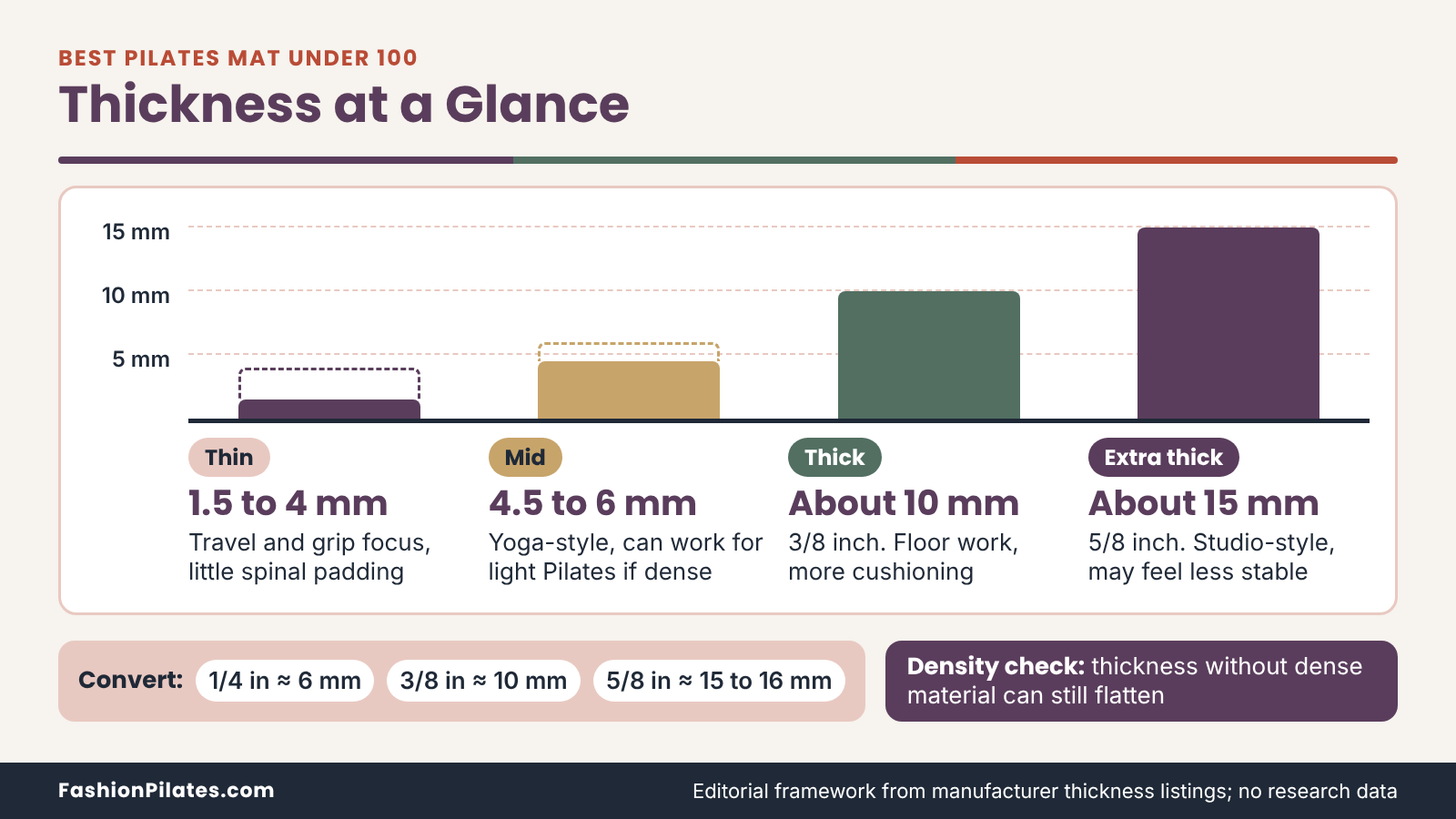
Mats cluster into three rough groups. Thin mats, about 1.5 to 4 mm, are made for travel or grip and offer little spinal padding. Mid-range mats, about 4.5 to 6 mm, are the typical yoga thickness and can work for light Pilates if the material is dense. Thick mats, about 10 mm and up, are what many Pilates-oriented brands sell for floor work, and thicker versions near 15 mm exist for studios. Merrithew, the maker of STOTT PILATES equipment, has described a 10 mm mat as its signature choice for Pilates and a 15 mm model for professional studios in an older equipment newsletter, so treat that as a manufacturer’s viewpoint rather than a rule.
A quick conversion guide
Brands do not agree on units, which can make a 3/8-inch mat look different from a 10 mm one when they are practically the same. As a rule of thumb, a quarter inch is roughly 6 mm, three-eighths of an inch is roughly 10 mm, a half inch is a little under 13 mm, and five-eighths of an inch is about 15 to 16 mm. Balanced Body’s EcoWise Pilates Mat page, for example, lists 3/8 inch (1 cm), while Merrithew’s Pilates Express Mat page lists 10 mm (0.4 inch). Convert before you compare, and you will not mistake a 6 mm mat for a thick one.
Density and the bottoming-out problem
Thickness only tells you how much material is under you, not how that material behaves under load. Density is the missing half of the story.
What density means in plain English
Density is how tightly packed the foam or rubber is. A dense mat pushes back and keeps its shape under your weight, while a low-density mat compresses easily and can flatten under the hardest points of your body. Product pages rarely publish a density figure, so you usually have to infer it from the material, the weight of the mat and the manufacturer’s description of its cushioning. A heavier mat of the same size and thickness often contains more material, though weight alone is not proof of quality.
How to spot a mat that will bottom out
Bottoming out means you feel the floor through the mat at the pressure points, typically the tailbone, the back of the head and the shoulder blades during rolling exercises. You cannot test this online, so use a proxy. Read the product page for words like “closed-cell” or “dense,” check whether reviews on the retailer’s site mention flattening after a few weeks, and, once the mat arrives, press a knuckle into it and watch how quickly it springs back. If a mat stays dented or you can easily feel the floor beneath it, use the return window rather than hoping it will break in.
Length and width
A mat that is too short is a quiet nuisance: your head or feet drift onto bare floor in the middle of an exercise. Sizing is simple to check and easy to get wrong.
Match length to your height
Lie down on your floor, extend your arms overhead, and measure from fingertip to heel. Your mat should be at least as long as that, with a few inches to spare, because Pilates often runs from fully extended to rolled up and back. Many yoga-style mats are 68 inches long, including Merrithew’s 6 mm Pilates and Yoga Mat and Gaiam’s 6 mm Essentials mat, while Pilates-oriented mats often run 72 inches, as Gaiam’s 10 mm Fitness Mat and Merrithew’s Pilates Express Mat do. For anyone approaching six feet tall, that four-inch difference is not trivial.
Width and the room you actually have
Standard widths range from about 23 to 26 inches. A wider mat offers a little more margin for side-lying work and for arm positions that stray from center, but it also takes more floor and may not fit narrow spaces between furniture. Before you decide that wider is better, roll your current mat or a towel out in the spot you plan to use and note what is nearby. If a mat’s edge will touch a couch leg or a doorway, the wider option is a theoretical benefit and a practical annoyance.
Materials and surfaces
Once thickness and length are settled, material determines how the mat grips, wears, smells and cleans. The same sticker price can buy very different materials, so it is worth learning the four you will see most.
The common mat materials
Mat listings tend to use shorthand such as NBR, PVC or TPE. Here is what each means for a buyer and where the official pages back it up.
Closed-cell foam: NBR and PVC
Closed-cell foam is made of tiny sealed bubbles, which is why it resists soaking up sweat and wipes clean easily. NBR is a synthetic rubber foam; Gaiam’s 10 mm Fitness Mat page lists NBR, and Merrithew’s Pilates Express Mat page lists NBR closed-cell foam. PVC foam is the other familiar option, and Merrithew’s 6 mm Pilates and Yoga Mat page describes its PVC foam as free of phthalates and heavy metals. Both families are lightweight and inexpensive, which is exactly why they dominate this price range.
Natural rubber, TPE and the latex question
Natural rubber mats, such as Jade’s, are valued for grip and a dense feel, but they come with a caution. Jade’s Harmony mat page says the mat is natural rubber and advises people with latex allergies to avoid contact, and its Extra mat page carries a similar warning. TPE, the material Manduka lists for its begin mat, is a latex-free synthetic. If you or someone in your household has a latex allergy, the Mayo Clinic explains that latex allergy can cause reactions ranging from itching and hives to severe breathing problems, so ask a clinician before using a natural rubber mat.
Surface texture and cleaning
The surface determines how a mat feels under the skin and how easily it fights sweat. Care instructions are the quiet differentiator that decides how long a cheap mat stays pleasant.
Ribbed, smooth and dual-textured surfaces
A textured surface adds traction for hands and feet, while a smooth side can feel more comfortable for rolling and for bare skin. Merrithew describes its Pilates Express Mat as dual-textured, ribbed on one side and smooth on the other, and Gaiam’s Fitness Mat lists non-slip ridges. Manduka describes its begin mat as reversible with two usable surfaces. If you often practice in socks, a smoother side may feel better, and if you practice barefoot with sweaty palms, you might prefer the ribbed side up. A dual-textured mat lets you decide per session instead of committing at checkout.
A realistic cleaning routine
Manufacturers agree on the basics, even where their details differ. Merrithew advises wiping its mat with diluted mild soap and water, rinsing thoroughly, drying it completely and storing it away from direct sun and heat, and cautions against rolling it while damp or applying tape. Gaiam’s Essentials mat page suggests airing out a new mat for two to three days, spot cleaning with a damp cloth and mild detergent in cold water, drying flat and avoiding prolonged sun. Do the wipe-down after sweaty sessions and let the mat dry before rolling it; a mat that smells fine in week one can become a gym-bag science project in week six.
What $100 actually buys
Under a hundred dollars is a wide band, and the best purchase for $30 differs from the best purchase for $90. Thinking in tiers keeps you from comparing apples with premium rubber.
Three price tiers and what to expect
The figures below come from official product and collection pages checked on October 7, 2026. They are snapshots, not promises, and the list prices may differ by color or size.
Under $30: the thick, simple floor mat
In this tier you find basic foam mats, and Gaiam’s 10 mm Fitness Mat was listed at $24.98 with a carry strap and a care guide, while its 6 mm Essentials Yoga Mat was listed at $19.98. For Pilates floor work, the thicker foam is the more relevant of the two. The trade-off is that low-priced foam may compress faster and offer less grip when slick with sweat, so the price is best treated as the cost of finding out whether you will keep up the habit. If you are unsure you will practice weekly, this is the least regrettable place to start.
$30 to $100: where choice opens up
This band offers a mix of Pilates-specific foam mats and premium yoga-style mats. Merrithew’s Pilates Express Mat was listed at $41.99 and its 6 mm Pilates and Yoga Mat at $33.99, while Manduka’s begin mat was listed from $50 to $62 depending on color, and Jade’s Extra mat at $79.95. Here you pay for better surface engineering, longer guarantees or specific materials. Manduka states a lifetime guarantee for the begin mat, and Gaiam does for the Essentials mat, which is worth reading in full before treating it as a promise.
The table below puts the tiers side by side so you can see the trade-offs in one place.
| Tier | Typical listed examples | What it tends to buy | Watch for |
|---|---|---|---|
| Under $30 | Gaiam 10 mm Fitness Mat ($24.98); Gaiam 6 mm Essentials ($19.98) | Thick foam and basic grip, often with a strap | Faster compression, thinner warranty detail, odor to air out |
| $30 to $60 | Merrithew 6 mm Pilates and Yoga Mat ($33.99); Merrithew Pilates Express Mat ($41.99); Manduka begin mat (from $50) | Pilates-oriented sizing, dual surfaces or branded surface design | Shipping thresholds, shorter 68 inch lengths on some models |
| $60 to $100 | Manduka begin mat (up to $62); Jade Extra mat ($79.95); Jade Harmony 68 inch mat ($99.95) | Dense natural rubber or premium synthetics, longer guarantees | Latex warnings, higher prices after tax or size upgrades |
Hidden costs and slippery price claims
The advertised price rarely tells the whole story, particularly during sales events. A few habits keep the final number honest.
Shipping, tax and size upgrades
Start with the size you need, not the price of the smallest option. Jade’s Harmony mat is listed at $99.95 for the 68 inch length and $109.95 for the 74 inch length, so a taller buyer crosses the line simply by choosing the longer mat. Add tax and any shipping fee, and a $95 mat can end up at $105 at checkout. Decide your ceiling as the final total and work backward, instead of assuming the sticker price tells you the outcome.
Why a sale price is not a reason to buy
A mat that was “$200 now $99” is not a better mat than one that was always $60; it is a better story. Compare mats by thickness, density, length and material, and treat discounts as a pleasant bonus. Also note that listings change: during research, one Merrithew listing for a 4 mm mat showed as temporarily out of stock and an older 15 mm Deluxe Pilates Mat listing was marked discontinued. Always check the current listing rather than trusting any roundup, including this one, for price and availability.
A shortlist checked against official pages
The mats below are named because their specifications and prices appeared on the manufacturer’s own product or collection page on October 7, 2026. This is a criteria-led shortlist built from published specifications, not a ranking and not a report on how any mat feels in use. Where a manufacturer does not publish a price, the guide says so instead of guessing.
Thick foam mats built for floor work
If your routine is mostly rolling, lying and sitting, this is the category that fits most closely. Both mats here are 10 mm closed-cell foam at 72 inches long.
Merrithew Pilates Express Mat
Merrithew’s product page lists a 24 by 72 inch mat, 10 mm (0.4 inch) thick, weighing 1.8 pounds, in NBR closed-cell foam with a ribbed side and a smooth side and integrated Velcro straps. It was priced at $41.99 and shown as in stock when checked. Its “express” name hints at portability rather than a lesser build, though Merrithew’s separate STOTT PILATES matwork equipment page lists the Express mat’s thickness as 3/8 inch with slightly different width and length figures. That small mismatch is a good reminder to trust the individual product page and to confirm dimensions at checkout.
Gaiam Fitness Mat, 10 mm
Gaiam’s Fitness Mat page lists a 24 by 72 inch mat, 10 mm thick, in NBR with non-slip ridges, a carry strap and an included exercise guide, at $24.98. Gaiam describes it for floor work in general, including stretching and strength exercises, not for Pilates specifically, so treat it as a general-purpose thick mat that suits Pilates-style floor work. The page does not give a weight, and no warranty terms appeared in the page content reviewed, which is worth knowing if you like to compare those details. For a first mat or a spare for guests, the numbers make it difficult to ignore.
Thinner, grippier mats for mixed practice
These mats are closer to yoga thickness. They make more sense if you alternate Pilates with standing practice, carry your mat to class, or prefer a firmer feel.
Merrithew 6 mm Pilates and Yoga Mat and Gaiam Essentials
Merrithew’s 6 mm Pilates and Yoga Mat lists a 24 by 68 inch size, PVC foam, a carry strap and a $33.99 price, and the page notes a 30 day return policy for unused items in original condition. Gaiam’s Essentials Yoga Mat is also 6 mm and 68 inches, in latex-free PVC at $19.98. At 6 mm, both can work for gentle Pilates but sit near the thinner edge of what Pilates-focused sources recommend for spinal cushioning, so they may suit shorter or lighter sessions better than long rolling sequences.
Manduka begin, Jade Extra and Jade Harmony
Manduka’s begin mat lists 5 mm of latex-free TPE, 68 by 24 inches, 2.5 pounds and a lifetime guarantee, from $50 to $62 depending on color. Jade’s Extra mat lists 4.5 mm natural rubber with a polyurethane surface, 26 by 71 inches and $79.95, and the Harmony lists 3/16 inch (about 4.8 mm), natural rubber, and $99.95 for the 68 inch length. None of the three pages mentions Pilates, so they are yoga-style mats that some people choose for grip and durability. As a point of reference, Manduka’s PRO 6 mm mat was listed from $125 on its page, so the premium end of this category sits outside the budget.
Studio-brand mats that do not publish prices
Some of the most Pilates-specific mats come from equipment makers that sell mostly through studios, and those makers tend not to print prices on their pages. That makes them harder to include honestly in an “under $100” article.
Balanced Body EcoWise and Aeromat
Balanced Body lists its EcoWise Pilates Mat at 72 by 23 inches and 3/8 inch thick, free of latex, PVC and chloride, with a textured surface, and its Aeromat at 5/8 inch in closed-cell foam with a non-porous skin. Neither page shows a price; both direct buyers to a local representative. Because a price cannot be confirmed from the official page, this guide cannot say they fall under $100. If you want this class of mat, ask a retailer or your studio for a quote and compare it to the thickness and size figures above.
STOTT PILATES Deluxe Pilates Mat
The STOTT PILATES matwork page lists a Deluxe Pilates Mat at 5/8 inch in closed-cell foam, 23.5 by 72 inches, and states that prices are available via downloadable price lists rather than on the page. An older Merrithew product page for a 15 mm Deluxe mat in blue was marked discontinued, with a former list price of $70, so availability and price clearly shift over time. If you find a 5/8 inch studio-style mat advertised under $100, check that the retailer is selling the current version and that the dimensions match the manufacturer’s page.
This table collects the verified specifications in one place so you can scan across them.
| Mat | Thickness | Listed size | Material | Listed price (check current listing) |
|---|---|---|---|---|
| Merrithew Pilates Express Mat | 10 mm | 24 x 72 in | NBR closed-cell foam | $41.99 |
| Gaiam Fitness Mat | 10 mm | 24 x 72 in | NBR | $24.98 |
| Merrithew Pilates and Yoga Mat | 6 mm | 24 x 68 in | PVC foam | $33.99 |
| Gaiam Essentials Yoga Mat | 6 mm | 24 x 68 in | PVC, latex-free | $19.98 |
| Manduka begin | 5 mm | 24 x 68 in | TPE, latex-free | $50 to $62 by color |
| Jade Extra | 4.5 mm | 26 x 71 in | Natural rubber with PU surface | $79.95 |
| Jade Harmony | 3/16 in | 24 x 68 or 74 in | Natural rubber | $99.95 (68 in); $109.95 (74 in) |
| Balanced Body EcoWise Pilates Mat | 3/8 in | 23 x 72 in | No latex, PVC or chloride | Not shown; contact representative |
| Balanced Body Aeromat | 5/8 in | 23 x 72 in | Closed-cell foam | Not shown; contact representative |
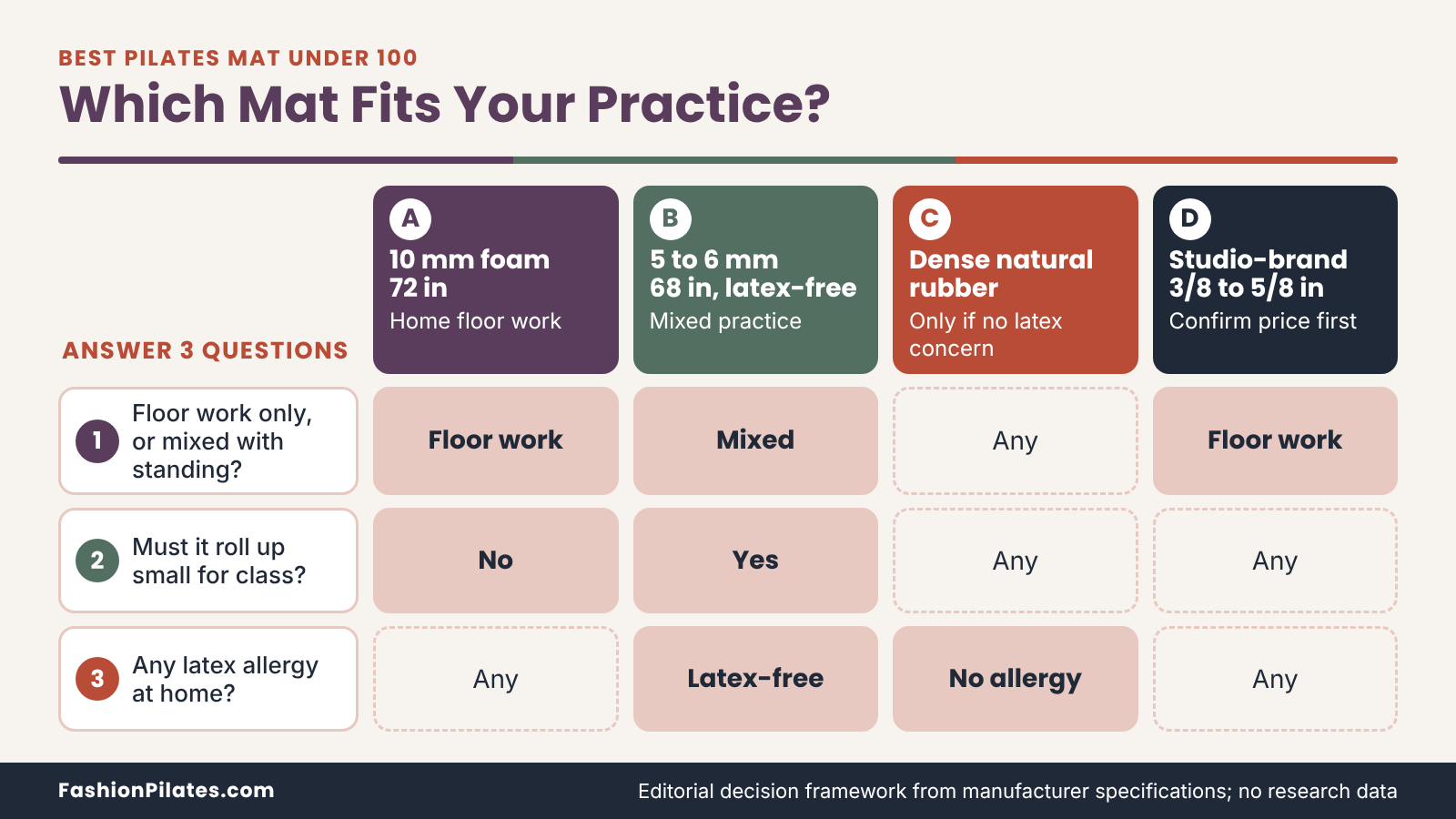
The next table turns the same information into a quick “best for, not ideal for” guide, so you can match a mat type to your situation.
| Mat type | Best for | Not ideal for |
|---|---|---|
| 10 mm closed-cell foam, 72 in | Home floor work, rolling exercises, tall users, sensitive tailbones | Long standing sequences on carpet, tiny storage spaces |
| 5 to 6 mm latex-free mat, 68 in | Mixed Pilates and yoga, carrying to class, firmer feel | Long rolling sequences if your spine needs more padding |
| Natural rubber mat, 4.5 to 5 mm | Strong grip, durable surface, practicing barefoot | Anyone with a latex allergy, outdoor use, long sun exposure |
| Studio-brand 3/8 to 5/8 in mat | Studio-style cushioning at home, duplicating a class mat | Shoppers who need a confirmed price under $100 |
Matching the mat to your floor, body and space
Two shoppers can buy the same mat and have opposite experiences, because the surface under the mat and the body on top of it matter as much as the foam. This section turns the specifications into decisions.
Your floor surface
Your floor changes how a mat grips, how much cushioning you need and how stable you feel. The same 10 mm mat behaves differently on hardwood than on a plush rug.
Hardwood, tile and laminate
On a hard, smooth floor, a mat does the cushioning job alone, which is where thicker closed-cell foam earns its keep. The risk on smooth floors is sliding, particularly during transitions from lying to sitting, so look for a textured underside or a mat with a high-friction base. Merrithew’s older equipment newsletter pointed to thicker Pilates mats as a good match for hard floors. If the mat slides, try a thin non-slip underlay or a shelf liner beneath it, test it before a full session, and avoid anything bulky that creates an uneven edge.
Carpet and rugs
Carpet already provides some give, so a very thick foam mat on top can feel wobbly, especially when you balance on hands or sit tall for exercises that ask for stability. A mid-thickness, dense mat usually behaves better on carpet than a soft, extra-thick one, because the carpet is already adding compression. If your carpet is plush, place the mat flat, smooth any ripples before you start and consider moving your practice to a firmer room for balance-heavy exercises. Check for sliding at the corners, since a mat can drift across a carpet pile when you push through the heels.
Your body and routine
A mat is personal equipment, so the right choice depends on your body, your routine and how often you will use it. Few guidelines are universal, but some are common-sense starting points.
Sensitive spots and who should ask first
People with a tender tailbone, sensitive knees or bony spine often prefer more padding, which points toward the 10 mm class. A mat is not a treatment, though, and it should not be used to push through pain. If you have pain, numbness, a recent injury, osteoporosis or are pregnant or postpartum, check with a qualified clinician or Pilates professional before choosing exercises, and note that this article is general education, not individual medical advice. Stop any exercise that causes sharp pain, dizziness or numbness.
How often you practice
Frequency changes what you should buy. The Centers for Disease Control and Prevention recommends that adults do muscle-strengthening activity on at least two days per week, according to its adult activity guidance, and Mat Pilates can be one way to meet it. If you plan two or three sessions per week, a mat that stays dense and clean matters more than a first-week bargain. If you are still deciding whether the habit will stick, the cheapest 10 mm foam mat is a reasonable test, and beginner Mat Pilates workout can help you decide how to start.
Space, storage and travel
A mat that never gets used because it is awkward to store is a poor purchase at any price. Think through where it lives and how it moves.
Storage in small homes
Thicker mats take more room when rolled, and they can be stiff to roll tightly the first few times. Measure the closet shelf, the space behind a door or the corner where the mat will sit, and remember that a mat stored upright in a corner may curl at the edges over time. Merrithew advises storing its mat away from heat and sunlight and warns against putting items on top, so avoid stacking anything heavy on a rolled mat. If your space is tight, choose a mat with a built-in strap, since it keeps the roll compact and simple to grab.
Carrying to class or traveling
For commutes and studio visits, weight and roll size matter. Merrithew lists its Pilates Express Mat at 1.8 pounds, and Manduka lists its begin mat at 2.5 pounds, while Jade lists both of the mats above at about 5 pounds. A 10 mm mat is lightweight but bulky; a 5 mm mat is thinner but may weigh more, depending on material. Check whether your studio provides mats first, since many do, and if so a travel-sized or foldable mat may be unnecessary. This guide covers the physical product; for the method itself, see Mat Pilates basics for beginners.
Common mistakes and how to avoid them
Most disappointing mat purchases come from a handful of predictable errors. Knowing them in advance is cheaper than a return shipment, and several can be avoided before you ever add the mat to your cart.
Mistakes before you buy
The shopping stage is where the biggest errors happen, because specifications are easy to skim and brand names are easy to trust. Two opposite mistakes cover most of them.
Choosing thin because it looks premium
A slim, high-end rubber mat photographs beautifully and carries a reassuring price, which makes it tempting as a do-everything option. For Pilates floor work, though, a mat that is only 4 to 5 mm thick may leave your tailbone and spine less padded than a 10 mm foam mat costing a fraction as much. If you love the grip of a premium mat, consider buying it for standing work and keeping a thicker mat for rolling. The fix is simple: write your thickness target down before you browse, and let that number, not the photography, filter the options.
Choosing the thickest mat and losing stability
The opposite mistake is assuming more cushioning is always better. The online Pilates platform review cited earlier cautions that thicker mats can feel unstable, and that is easy to picture when you balance on your hands in a plank or sit on the edge of a soft surface. Extra-thick studio-style mats, around 5/8 inch, are often designed for a firm floor and for rolling work, and they can feel wobbly if your routine includes lots of standing and balance. If your sessions include both, a 10 mm mat is often a reasonable compromise, and dense foam helps keep it from feeling mushy.
Mistakes after you buy
Even a good mat can turn into a bad one through neglect. The care steps are dull, which is exactly why people skip them.
Skipping the air-out, wipe and dry routine
New foam and PVC mats often arrive with a noticeable smell, and manufacturers say so: Gaiam suggests airing out its Essentials mat for two to three days, and Jade advises airing out new rubber mats too. After sweaty sessions, wipe the surface and let it dry fully before you roll it up, since Merrithew specifically warns against rolling its mat while damp. A damp mat in a closed bag is a recipe for odor, and it is far easier to prevent than to fix. Keep a small spray bottle of diluted mild soap and water with your mat so the habit costs you thirty seconds.
Ignoring wear until the mat stops doing its job
Mats do not announce when they have worn out. Signs to watch for include permanent dents where your hips and shoulders go, a surface that has gone slick or flaky, edges that curl and refuse to lie flat, and a smell that does not leave after cleaning. Sun and heat can hasten damage, as several manufacturers warn, so avoid leaving a mat in a hot car or by a sunny window. If you can feel the floor through the mat during rolling exercises, that is the practical signal to replace it, regardless of its age.
Your pre-purchase checklist
You now have the criteria, the verified examples and the common traps. This final section turns them into an order of operations you can follow in about ten minutes.
A short decision process
Good buying decisions follow a sequence. Doing the steps in the right order saves you from falling for a color before you check the length.
Five steps in the right order
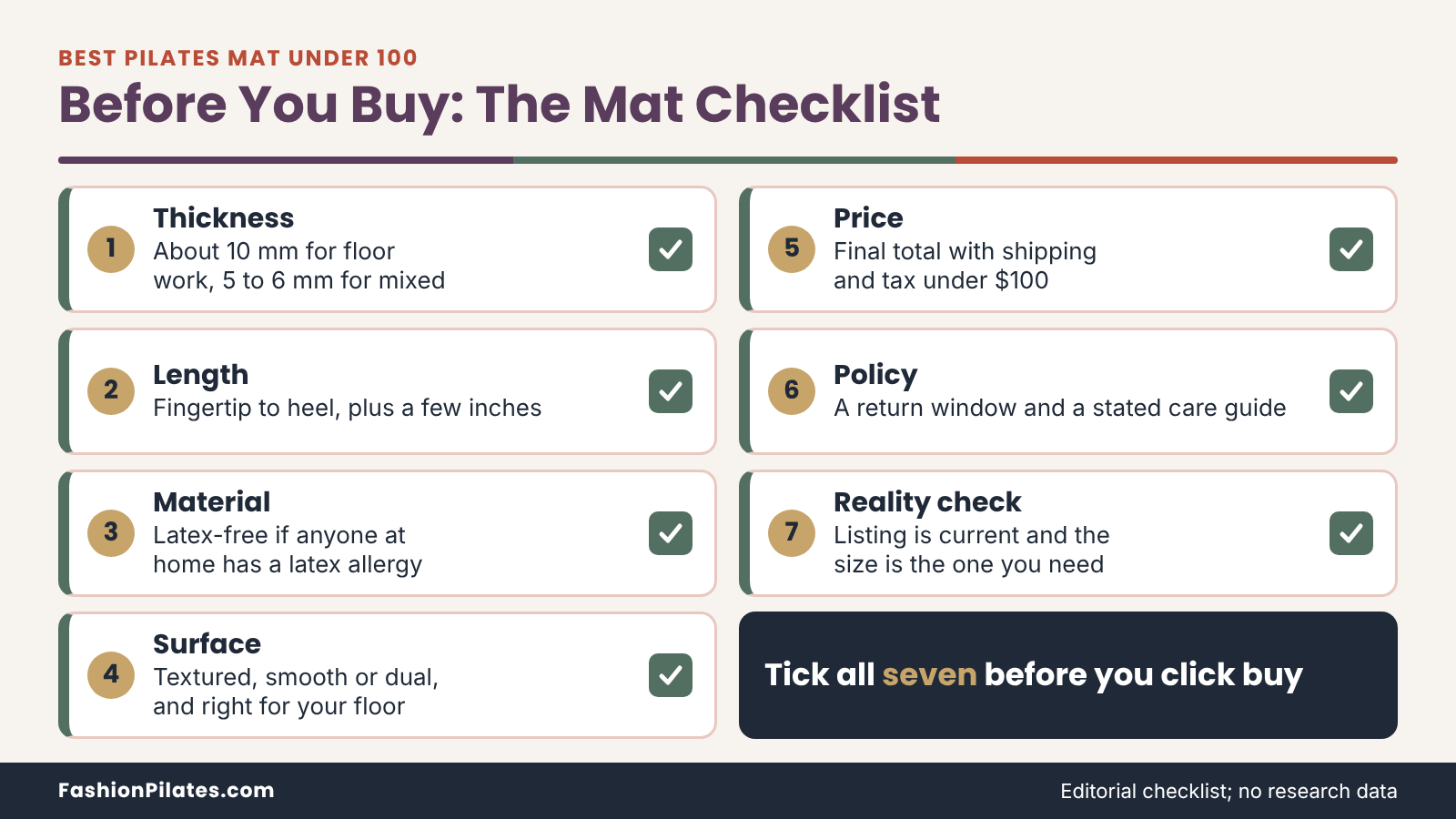
First, measure your height as fingertip to heel and add a few inches to find your minimum length. Second, pick a thickness band: around 10 mm for mostly floor work, 5 to 6 mm for mixed practice. Third, rule out materials that conflict with your household, such as natural rubber when latex is a concern. Fourth, compare the final price, including shipping and tax, against your ceiling. Fifth, read the product page for a care guide and return policy. For help linking the purchase to your plan, see our Pilates Mats & Flooring hub and the home Pilates studio guide.
Check returns, then check them again
Since you cannot test cushioning online, a return window is the closest thing you have to a trial. Merrithew’s page for its 6 mm mat describes a 30 day return policy for unused items in original condition, which is the kind of detail to look for, and also the kind of detail that may change. Before buying, find the retailer’s own policy, note whether return shipping is free and whether a mat you have unrolled counts as used. Unroll the mat on arrival, lie on it for a few minutes and decide while the packaging is still intact.
The table that follows condenses the process into questions you can answer from any product page.
| Question | What to look for | Red flag |
|---|---|---|
| Is it thick enough? | About 10 mm for floor work, or 5 to 6 mm for mixed practice | No thickness listed, or only a vague word like “premium” |
| Is it long enough? | Fingertip-to-heel measurement plus a few inches | Length missing, or 68 inches for a tall user |
| Is the material suitable? | Stated material and any latex notice | Natural rubber when latex is a concern |
| Is the price real? | Current listed price, final total with tax and shipping | A “was” price that never seems to change |
| Can you return it? | A stated return window and care guide | No policy, or final sale |
When to spend more, or less
The right budget depends on how the mat will be used. Some situations justify going toward the top of the range, and others do not.
Signs a mat has outgrown its role
You may be ready to move up if you practice several times a week, your current mat slips or compresses, or you want a specific feel you have found in a studio mat. Moving up does not have to mean breaking the $100 line; the shortlist above shows mats with long guarantees and dense materials under that ceiling. If you are tempted by a premium mat that costs well over $100, such as Manduka’s PRO line, ask what specific problem it solves that a cheaper mat does not. If you cannot answer in one sentence, wait.
Fix the problem before replacing the mat
Sometimes the mat is fine and the setup is the issue. A sliding mat may need a non-slip layer or a cleaner floor, and a mat that feels thin may be paired with a folded towel under the hips for a particular exercise. If your goal is gliding work on slippery floors, consider whether you really need a different mat or small props, and see Pilates sliders buying guide before you buy more equipment. For the bigger picture of why this style of practice keeps growing, our Mat Pilates trend explainer covers the movement, while this guide stays with the physical mat.
Frequently Asked Questions
Is a 6 mm yoga mat good enough for Pilates?
It can be good enough for gentle sessions, but it may not be ideal for long rolling sequences. A 6 mm mat gives less cushioning under the spine than the roughly 10 mm foam mats that Pilates-focused brands sell. Density matters as much as thickness, so a firm 6 mm mat can feel better than a soft, cheap one. If you feel the floor through the mat at your tailbone or shoulder blades, step up in thickness. Pair any thinner mat with sensible exercise choices and speak to a qualified instructor if you have specific concerns.
How thick should a Pilates mat be?
Many Pilates sources point to roughly half an inch, which is close to 10 to 13 mm. The online Pilates platform review cited above calls about half an inch a good thickness, and Merrithew has described a 10 mm mat as its signature Pilates choice. Thicker studio mats of 5/8 inch exist and suit firm floors. Go thicker if you want more padding and thinner if stability matters more. Whatever you choose, density and your floor surface change how it feels.
Can I use a yoga mat for Pilates?
Yes, many people do, particularly when the mat is dense and at least 5 to 6 mm thick. The main compromise is cushioning during exercises where you roll along your spine. Yoga mats are often built for grip and portability instead of padding. If you already own one, try it for a few sessions before spending more. Replace it only if your tailbone, hips or shoulders feel uncomfortable on it.
What length of Pilates mat do I need?
Choose a mat that is at least as long as your fingertip-to-heel measurement while lying down with your arms extended, plus a few inches. Many yoga-style mats are 68 inches long, while Pilates-oriented mats are often 72 inches. Taller people usually benefit from the longer size. Check that the listed length matches the size you are buying, because some brands offer several lengths at different prices. A short mat can leave your head or feet on bare floor during exercises.
How do I clean a Pilates mat?
Wipe it with a damp cloth and a little mild soap, then rinse and let it dry completely before rolling it up. Merrithew suggests diluted mild soap and water with a thorough rinse, and Gaiam suggests spot cleaning with mild detergent in cold water. Avoid soaking the mat, as Manduka cautions for its begin mat. Keep it out of direct sun and heat, which several manufacturers warn can damage mats. Always follow the care guide that came with your specific mat.
Do I need a latex-free mat?
You do if you or someone in your home has a latex allergy. Natural rubber mats such as Jade’s carry a manufacturer warning for people with latex allergies. Latex allergy reactions can range from mild itching to serious breathing problems, according to the Mayo Clinic. If you are unsure, ask your clinician before using a rubber mat. Synthetic foams and TPE mats are usually listed as latex-free, but confirm this on the product page.
How long does a budget mat last?
There is no reliable lifespan that applies to every mat, because wear depends on how often you practice, how you clean and store it and what material it is. A daily user will wear out a mat faster than someone practicing weekly. Watch for dents that do not recover, a slick surface, curling edges and persistent odor. Some brands offer guarantees, but terms differ, so read them before relying on one. Treat a mat as consumable gear and plan to replace it when it stops cushioning you.
Is it worth spending more than $100 on a mat?
For most people practicing at home, probably not, because the cushioning that matters for Pilates is available for far less. Premium mats add grip, durability and brand features, which can be worth it if you practice daily or hate replacing gear. Before upgrading, identify the problem you want to solve, such as slipping or flattening. If a cheaper mat solves it, keep your money. If you still want a premium mat, check that its thickness and length match your routine.


Trackbacks/Pingbacks