Direct answer: The pilates boomerang exercise is an advanced classical Mat Pilates sequence. You sit with your legs extended and crossed at the ankles, roll back over your spine, open and switch the legs overhead, roll up into a balanced V, fold forward, and finish with an arm circle. Most teachers introduce it only after a student can control the Teaser and the Roll Over, and usually with an instructor watching.
This guide is for Mat Pilates students who keep hearing the name and wonder what it asks of the body, for people deciding whether it belongs in their practice, and for anyone curious about how a rolling, crossing, balancing movement holds together. As part of our Pilates technique and form guides, it maps the movement, the prerequisites, the preparation exercises, and the situations where skipping it is the smarter choice. It does not teach the exercise from text, and no article can.
A note on method: this is a research-based explainer built on published instructor tutorials, professional-organization pages, and health-agency guidance. The FashionPilates team did not perform or test the exercise for this piece. Everything here is general fitness education, not individualized medical advice, and stopping at sharp pain, dizziness, numbness, or tingling is always the right call.
What the Boomerang Is and Where It Comes From
Before any mechanics, it helps to know what kind of exercise this is and where it lives in Pilates history. The Boomerang is not a standalone trick. It is a late-sequence piece of the classical Mat repertoire, and its position tells you a lot about what it expects from you.
What the pilates boomerang exercise is in plain English
Think of it as four small skills stitched into one flowing movement. You roll backward over the spine, switch the legs while they are overhead, roll forward again into a balanced position, and then fold over the legs before finishing with the arms. Each piece is manageable on its own. The difficulty is doing them in a row without momentum doing the work.
A rolling, crossing, balancing sequence
ClassPass describes the Boomerang as a dynamic, advanced Pilates mat exercise tied to hip stability, a rolling spinal massage effect, and abdominal strength, and it states plainly that the movement is not recommended for people new to Pilates (ClassPass movement guide). Pilatesology, an online Pilates education library, rates it advanced and gives its goal as control paired with flow. Notice what both descriptions share: neither promises a quick payoff, and both treat it as something you grow into.
Why instructors call it a combination movement
Pilatesology also says the exercise puts together all of the Pilates principles and requires a deep connection to the powerhouse (Pilatesology exercise page). The powerhouse is the Pilates term for the center of the body: the abdominals, the muscles around the pelvis and lower back, and the hips working as one unit. In the Boomerang that unit has to stay engaged while the legs travel, the spine rolls, and the breath keeps pace. That is why teachers treat it as an integration test rather than an isolated abdominal drill.
Where it sits in the classical Mat order
Joseph Pilates published his original Mat exercises in a 1945 book, Return to Life Through Contrology. Knowing where the Boomerang falls in that list explains why it is considered advanced.
Position 29 of the original 34
The publisher listing for the book describes it as presenting his original 34 mat exercises with instructions and illustrations (Pilates.com book page). Published lists of those 34 exercises place the Boomerang at number 29, after the Side Bend and before the Seal, with the Crab, the Rocking, the Control Balance, and the Push-Up closing the series (Alo Moves guide to the original 34). Different schools reorder and rename pieces, so treat the number as a historical landmark rather than a rule.
Why late placement matters
In a classical class the Boomerang arrives after the spine has been warmed, rolled, stretched, and strengthened by dozens of earlier exercises. Those earlier movements are the real preparation. If you try the Boomerang cold, or in a short routine that skips the groundwork, you lose the context that makes it reasonable. The same logic applies to a contemporary class: a teacher who programs it will usually build toward it with rolling and balancing work first. For the broader method behind that ordering, see what Contrology means.
How the Sequence Fits Together
This section is a map, not a lesson. It shows how published descriptions break the movement into stages so that the exercise stops feeling like a blur when you watch a teacher demonstrate it. It deliberately leaves out the repetition counts, exact angles, and hands-on corrections you would need to actually perform it.
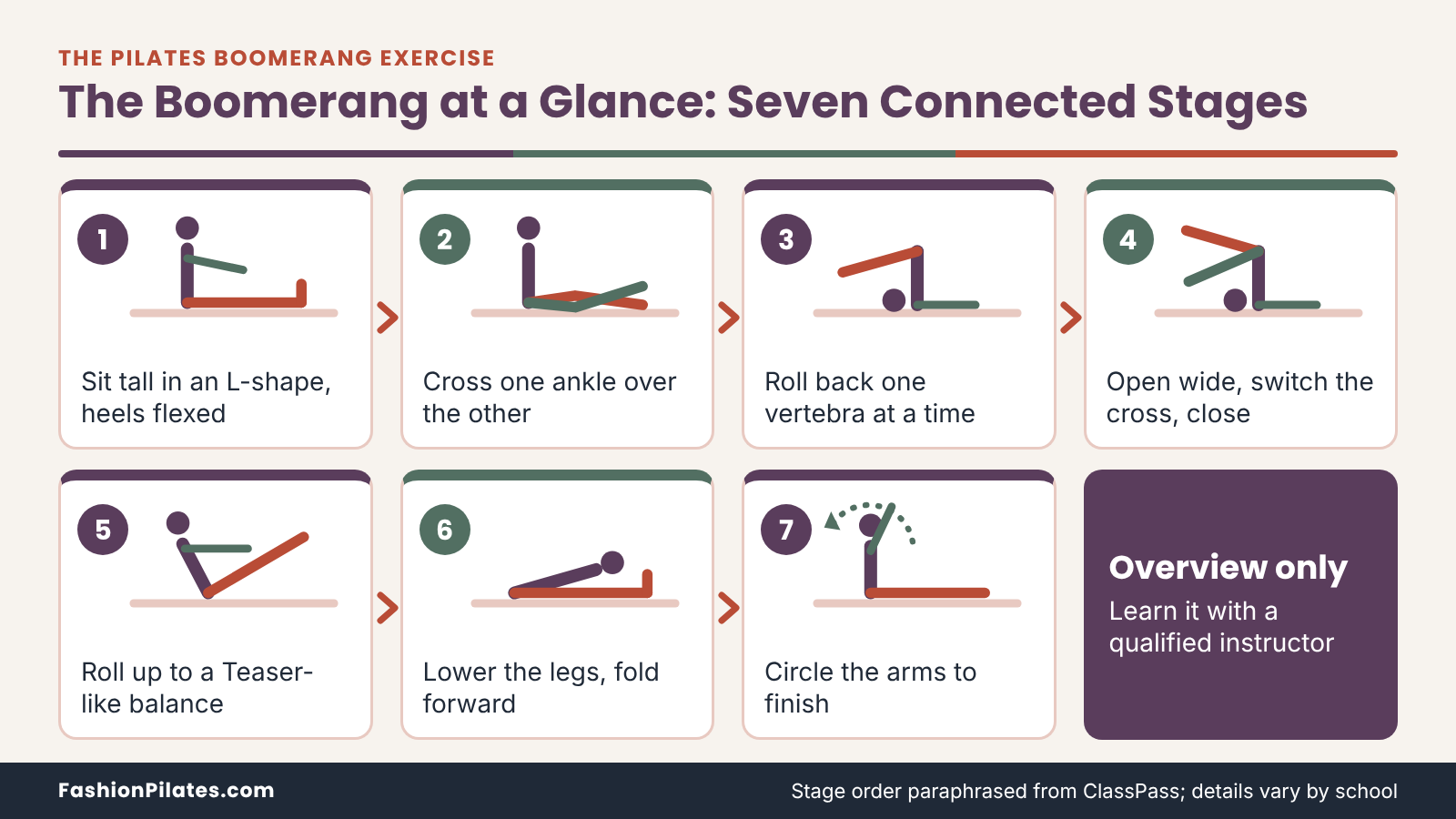
The movement in seven stages
ClassPass breaks the exercise into seven steps, and Pilates Anytime and Pilatesology describe the same arc in slightly different words. The stages below paraphrase that shared structure.
Stages one to three: shape, cross, and roll back
The sequence starts seated tall with the legs extended in front, forming an L-shape with the torso. One ankle crosses over the other, and the heels are flexed, meaning the toes are pulled back toward the shins (ClassPass). From there the body rolls backward one vertebra at a time until the hips are stacked over the shoulders. The shape of the legs is supposed to hold through the roll, which is harder than it sounds because the natural instinct is to let the knees soften as the legs get heavy.
Stages four to seven: open, return, balance, and finish
At the top of the roll the legs open wide and switch the ankle cross, then close again. The body rolls back up into a balanced position, often described as roughly a 45-degree angle, much like a Teaser. The legs then lower while the torso folds forward over them, and the arms circle to finish. Monica Wilson, in a Pilates Anytime tutorial, adds that the exercise alternates slow controlled sections with quicker ones, and that the arms press into the mat for stability during the roll (Pilates Anytime exercise page).
What changes between schools and teachers
If two instructors teach the Boomerang differently, that does not mean one of them is wrong. Pilates has classical lineages that preserve the original order and form closely, and contemporary approaches that adapt the work to modern anatomy knowledge. The sources behind this guide already disagree on small details, which is itself a useful lesson.
Angles, tempos, and repetition counts
One source describes rolling until the hips sit over the shoulders, another describes rolling to about 90 degrees, and others focus more on the L-shape than on a specific number. Tempo differs too: some teachers want a slow roll and a snappy leg switch, others want smooth continuity. Repetition counts vary by school and by student, and a published number from one tutorial is not a prescription for you. The right dose is whatever your teacher assigns after seeing how you move.
Hand positions and the arm finish
Wilson describes starting with the palms on the mat beside the hips, pressing the arms into the mat during the roll, then clasping the hands behind the tailbone during the fold before circling the arms overhead at the end. ClassPass summarizes the ending as circling the arms forward. These are variations of the same idea: the arms support the roll, then help lengthen the spine at the finish. A teacher may also change the hand position to protect a shoulder or wrist, which is a sensible adaptation rather than a shortcut.
Breath and rhythm
Breathing is the part of the Boomerang that gets the least attention in short clips and the most in good teaching. It is also where the sources are thin, so this section stays modest about what can be said from text.
What the published tutorials say about breath
Wilson’s tutorial gives one simple pattern: inhale to start the motion and exhale to complete it. The Pilatesology page, by contrast, does not spell out a breath pattern in the summary reviewed for this guide. Gaps like that are common in written descriptions of advanced Mat work. A breath cue is easy to state and hard to apply, because the right moment to exhale depends on how fast you move and what your teacher wants the abdominals to do at that point.
Why breath cues differ and what to do about it
Classical and contemporary teachers often assign breath differently, and neither approach is inherently wrong. What matters is that you keep breathing at all. Holding the breath during a loaded, curled shape tends to raise tension in the neck and jaw, which is the opposite of the control the exercise is trying to build. If you are unsure which pattern to follow, ask your teacher to name it explicitly and stick with that pattern until it feels automatic, rather than switching cues between videos.
Prerequisites Before You Try It
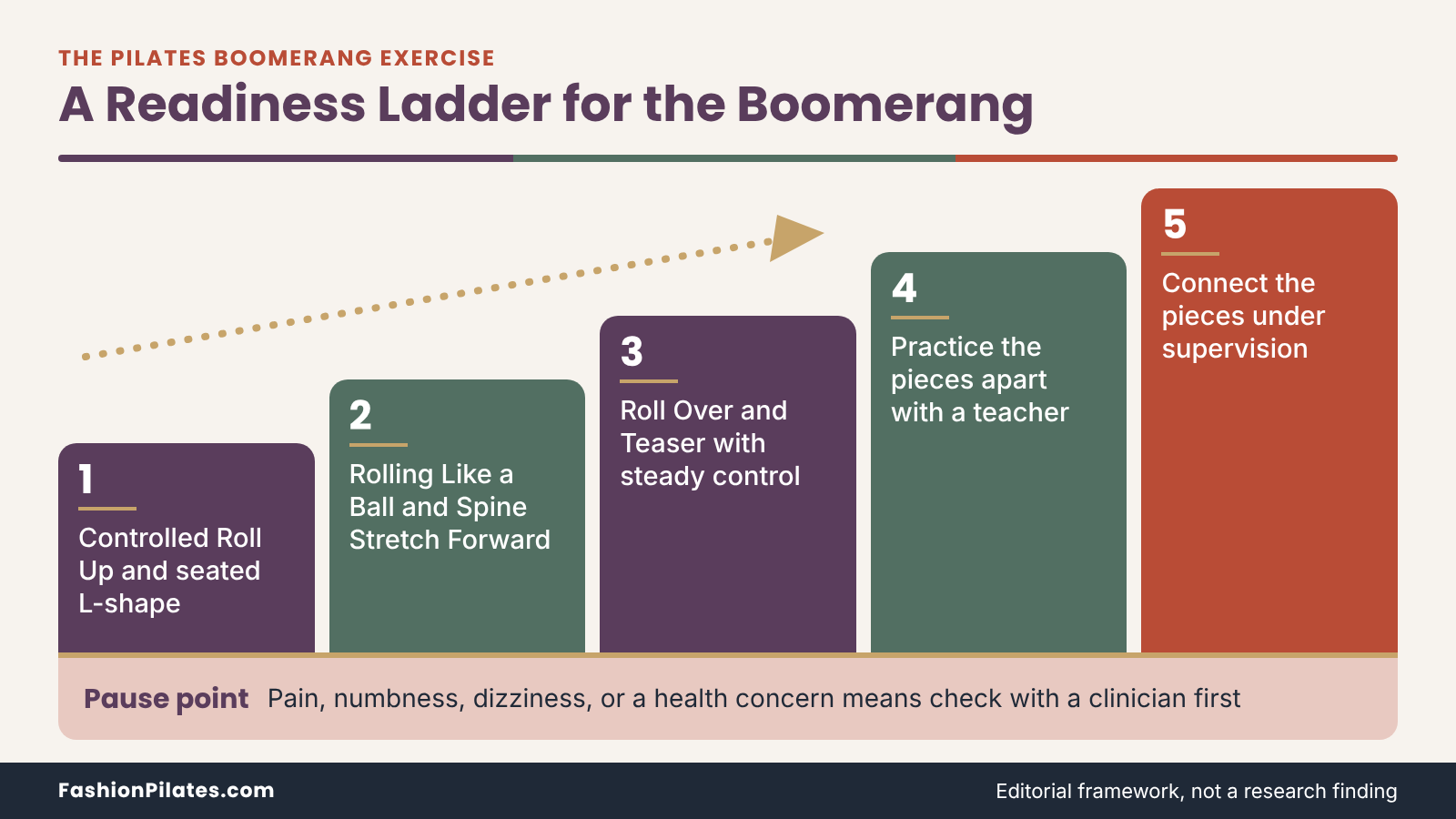
Every source consulted for this guide says the same thing in different words: do not start here. (Pilates vocabulary is confusing enough without a movement named after a toy that comes back to you, so consider this your reminder that the name promises nothing about ease.) The Boomerang is a graduation exercise, and the prerequisites are less about a certain number of months in Pilates and more about specific, observable skills. Here is what those skills look like, and if you are still building basics, start with Pilates for beginners guide.
Strength and control prerequisites
The first group of prerequisites is about whether your trunk can steer the movement or whether momentum is steering you. Teachers tend to check this long before they mention the Boomerang by name.
Powerhouse and abdominal control
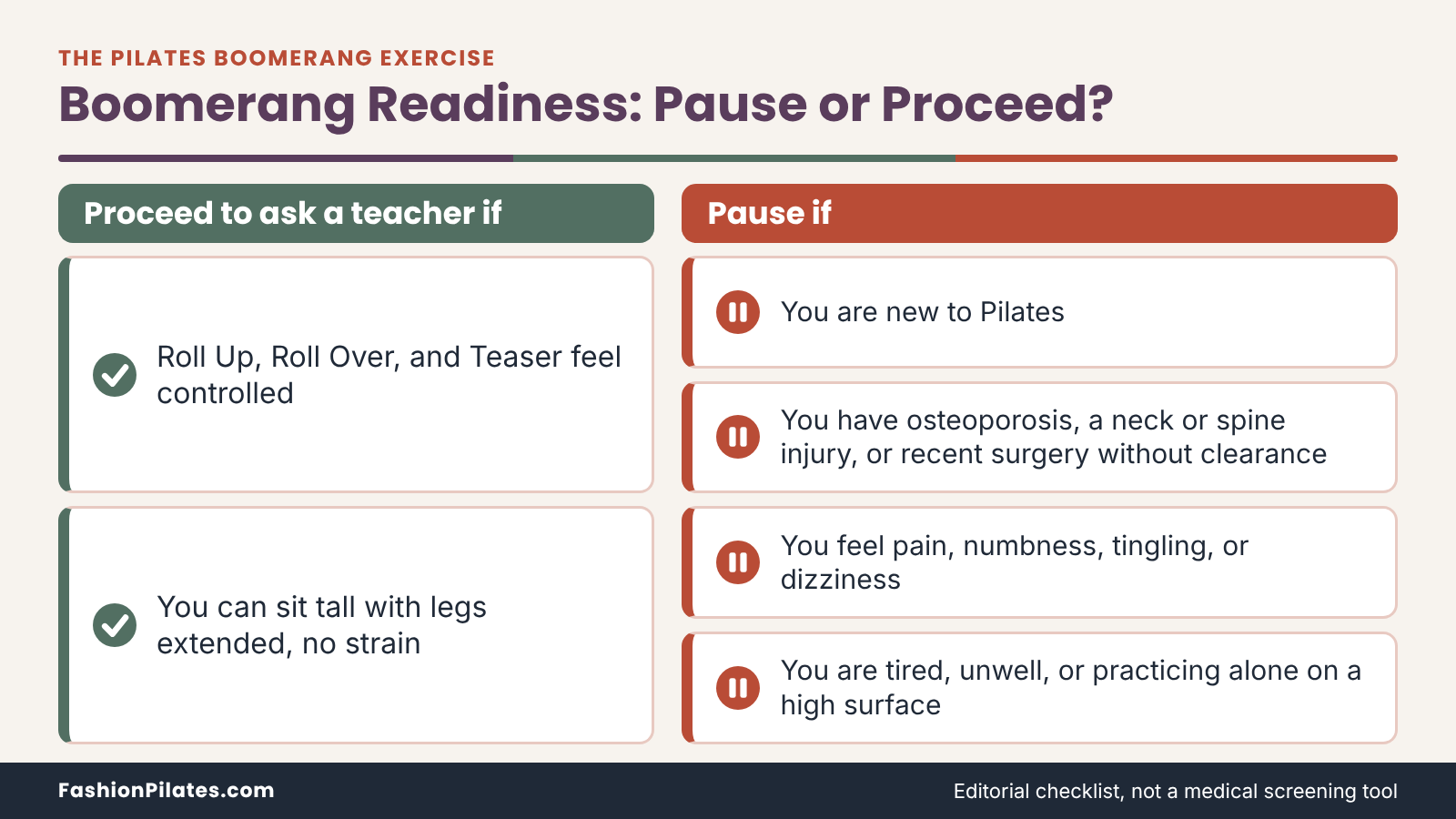
Pilatesology says the Boomerang requires a deep powerhouse connection, and Wilson describes using the deep abdominals to avoid flinging the body backward. In practical terms, that means you can hold a curled shape under load without gripping the neck or holding your breath. A simple self-check is whether your Roll Up is smooth in both directions with no jerk at the bottom or the top. If it is not, the Boomerang will exaggerate every wobble, because the legs add weight at the end of a long lever.
The Teaser and Roll Over benchmark
Wilson says in her Pilates Anytime tutorial that the Boomerang should only follow successfully performed intermediate exercises such as the Teaser and the Roll Over (Pilates Anytime tutorial). That is a useful, concrete benchmark. The Teaser tests whether you can balance on the sitting bones with the legs and torso lifted. The Roll Over tests whether you can bring the legs overhead and return with control. The Boomerang asks for both skills in one sequence, plus a leg switch in the middle.
Mobility and comfort prerequisites
Strength is only half of the picture. The Boomerang also asks the body to tolerate certain positions, and if a position is uncomfortable before the movement begins, the movement will not improve it.
Hamstrings and the seated L-shape
The sequence starts from a tall seated position with the legs extended, which several sources call an L-shape. If your hamstrings and lower back make that seat feel like a fight, you will arrive at the roll already compromised: the pelvis tips back, the spine collapses, and the first stage is spent compensating. Teachers sometimes have students sit on a folded towel or work with bent knees in preparatory drills to learn the shape without straining. That is a legitimate way to build toward the full form, not a lesser version of it.
Neck, wrists, and the spine’s tolerance for rolling
Wilson cautions that the exercise is unsuitable for people with neck and spine injuries. Rolling places load through the upper back and neck at the point where the hips lift overhead, and the wrists and shoulders work as stabilizers when the arms press into the mat. If rolling exercises such as the Roll Over already irritate your neck, take that as information. The Boomerang is not a good place to test whether a sore spot will settle down.
The table below turns the prerequisites into a quick self-check you can bring to a teacher.
| Skill | What it looks like | Why the Boomerang needs it |
|---|---|---|
| Controlled Roll Up | Smooth articulation up and down with no jerking and no neck strain | The Boomerang repeats rolling control with heavier legs |
| Roll Over | Legs travel overhead and return without momentum or pressure on the neck | The leg switch happens in the overhead position |
| Teaser | Balance on the sitting bones with a steady torso and legs | The mid-sequence balance is Teaser-like |
| Seated L-shape | Tall spine with extended legs, without collapsing the lower back | The starting position sets up every later stage |
| Neck and shoulder comfort | No pain or tingling when rolling or pressing the arms into the mat | The arms and neck stabilize the roll |
| Breath coordination | Steady breathing while holding a curled shape | Wilson describes inhaling to start and exhaling to complete the motion |
Who Should Skip or Modify It
Advanced does not mean dangerous for everyone who tries it, and it does not mean harmless for everyone who is strong. It means the exercise has features that make it a poor fit for certain bodies and situations. The goal of this section is to help you notice when a conversation with a clinician or qualified Pilates professional should come first.
Conditions that call for a clinician or instructor first
No list can be complete, and nothing here replaces a conversation with your own healthcare provider. These are the situations most often flagged in published guidance.
Osteoporosis, osteopenia, and spinal flexion
The Boomerang involves rolling back through the spine and then folding forward over the legs, which are forms of spinal flexion, or rounding. Pilates Australia, a professional association, notes in its article on osteoporosis that deep spinal flexion, such as in Rolling Like a Ball, and extreme rotation should generally be avoided because they may raise fracture risk (Pilates Association Australia on osteoporosis). If you have osteoporosis or low bone density, ask your clinician before attempting this exercise, and do not assume a teacher will know your diagnosis unless you tell them.
Neck and spine injuries, recent surgery, pregnancy, and postpartum
Wilson’s tutorial says to avoid the exercise with neck or spine injuries. Beyond that, anyone with a recent surgery, an acute injury, a chronic condition affecting the spine or circulation, or who is pregnant or postpartum should get clearance from a clinician before trying rolling work on the back. The Young Women’s Health Pilates guide recommends checking with a healthcare provider if you have serious back injuries, joint problems, or pregnancy (Young Women’s Health guide to Pilates). Teachers can then adapt around that guidance instead of guessing.
Days to skip even if you are ready
Readiness is not permanent. Some days a movement you can do is still a movement you should not do.
Fatigue, illness, and dizziness
Pilates Australia’s safety article, published in March 2026, says injuries tend to occur when exercises are progressed too quickly, when balance challenges exceed a participant’s capability, or when supervision is limited (Pilates Association Australia on safety). A tired body has less capacity for control, and the Boomerang is a control exercise. If you are sick, light-headed, or running on very little sleep, choose a gentler rolling drill and save the Boomerang for another day.
Pain, numbness, and other stop signals
Stop if you feel sharp pain, tingling, numbness, dizziness, or pressure in the neck. Do not try to work through those sensations by changing the angle or speed, because the sensation is the message. The same guide puts it simply: start slowly, listen to your body, and stop if you feel pain or strain. If a symptom lingers after you stop, that is a conversation for a clinician rather than a Pilates teacher.
The next table summarizes who should check in first, what the concern is, and what to ask.
| Situation | Why caution is common | What to ask |
|---|---|---|
| Osteoporosis or low bone density | The sequence includes deep spinal rounding, which professional guidance advises avoiding | Which spinal movements are safe for my bone density? |
| Neck or spine injury | Rolling places load through the upper back and neck | Is any rolling or overhead leg work appropriate right now? |
| Recent surgery or acute injury | Loaded trunk work may conflict with healing | When can I resume abdominal and rolling exercises? |
| Pregnancy or postpartum | Lying on the back and strong trunk flexion may not suit every stage | Which Mat exercises are appropriate at this stage? |
| Chronic conditions | Balance, circulation, or joint limits may change the risk | Are there movements or positions I should avoid? |
| New to Pilates | Sources agree it is not recommended for beginners | What should I learn first, and in what order? |
Preparation and Regression Exercises
If the prerequisites tell you what to be able to do, preparation exercises are how you get there. Good Pilates progressions break a complicated movement into pieces and let each piece become boring before the next is added. That is the opposite of how social media clips present advanced exercises, where the piece you see took a long time to look effortless.
Preparation exercises that build the pieces
The drills below are commonly taught building blocks in Mat Pilates, not a prescribed program. Which ones you need, and in what order, is a decision for you and your teacher.
Seated and rolling preparation
Rolling skills are the foundation. The Roll Up teaches you to articulate the spine up and down without momentum. Rolling Like a Ball teaches you to hold a rounded shape and rock without the neck taking over, which is why it is commonly placed before more demanding balance work. The Spine Stretch Forward builds the seated, tall-to-round-to-tall control that the Boomerang uses when it folds forward over the legs. If your rolling tends to come from momentum, spend your time here, not on the exercise you saw in a clip.
Teaser and leg-control preparation
One classical Mat resource notes that the Teaser comes after earlier skills such as the Roll Up, Rolling Like a Ball, and the Open Leg Rocker, and that the leg-lowering variations are only available once the double straight leg work is controlled rather than swinging (Online Pilates Classes on Teaser variations). That principle carries over. If your legs swing when you try to control them, the Boomerang’s overhead leg switch will swing too. Teasers with bent knees, one leg at a time, or with the hands supporting behind the thighs are common stepping stones that teachers use to build control gradually.
Regressions an instructor may use
A regression is a simpler version of an exercise that keeps the idea but lowers the demand. ClassPass says modifications exist for beginners and for people with a weak lower back, though it does not spell them out. That is a sign the exercise is meant to be adapted, so here are the kinds of changes teachers commonly consider.
Shortening the range and slowing the tempo
One adaptation is to roll back only part of the way and return, so that the legs never go overhead. Another is to move slowly enough that any momentum becomes obvious. Slowing down is not an easy mode, because it removes the swing that helps you cheat. A teacher may also ask you to work on one piece at a time, like the rolling shape, until the movement feels solid before the next stage is added.
Separating the pieces
Instructors sometimes teach the Boomerang in parts: the roll back and return without the leg switch, then the leg switch without the full roll, then the balance and fold as a separate drill. Because the exercise is four skills stitched together, practicing them apart helps you figure out which one is the weak link. If the legs wobble during the switch, you work on that. If the fold collapses, you work on that. Once each piece is steady, they can be reconnected.
Learning It With an Instructor
Several sources in this guide point the same way: this is an exercise to learn in person. Pilatesology and Pilates Anytime host demonstration videos, and those can show you what the movement looks like. They cannot see your neck, your pelvis, or the moment your control runs out. A teacher can.
Choosing a qualified teacher
Not every Pilates class has someone who is comfortable teaching advanced classical work. Choosing a teacher is a real decision here, and it deserves a little homework.
What credentials do and do not tell you
In the United States, the National Pilates Certification Program awards the title Nationally Certified Pilates Teacher and lists a directory of certified teachers, continuing education, and ethical guidelines (National Pilates Certification Program). A credential is evidence of training standards, not a guarantee of a good match. Training programs differ, and a teacher who is excellent at beginner group classes may not teach advanced rolling work. Ask about both the credential and the experience.
Questions to ask before you book
Useful questions are plain: Do you teach the Boomerang, and in what style? How do you decide whether a student is ready? What do you do if I am close but not there yet? How do you adapt it for a neck or back that is touchy? A thoughtful answer includes assessment and progression. If the answer is a flat yes with no questions about your history, that tells you something. Pilates Australia notes that safety depends on appropriate progression, supervision, instructor education, and professional judgment.
Making the most of a lesson
A lesson goes better when the teacher has the full picture and the environment is set up properly.
Telling the teacher what is going on
Harvard Health recommends arriving early to tell your instructor about concerns, and says an experienced instructor can tailor Pilates to your needs (Harvard Health on Pilates). Take that further for advanced work. Mention past injuries, surgeries, bone density results, pregnancy or postpartum status, and any neck, back, wrist, or shoulder history. Be specific about what you have been cleared to do. A teacher cannot adapt around information they never hear.
Surface and setup
Wilson advises practicing the Boomerang on a low surface such as a yoga mat or a tower mat, and describes doing it on a high table as very dangerous. Rolling puts the upper back on the surface, so a mat that is too thin may press on the spine, and one that is too squishy can make balance unstable. For help weighing thickness against stability, see how to choose a Pilates mat. Clear a generous space around the mat as well, because a roll that goes sideways needs room.
The next table compares the main ways people learn advanced Mat work, using general trade-offs rather than rankings.
| Format | Best for | Not ideal for |
|---|---|---|
| Private session | Individual assessment, injury history, and step-by-step progression | Anyone who wants frequent practice on a tight budget |
| Small group Mat class | Steady practice with some individual feedback | Beginners who need hands-on corrections before progressing |
| Large group class | Experienced students who know their own limits | Anyone learning a new advanced exercise for the first time |
| Online video or app | Reviewing a movement you are already learning with a teacher | First-time learning, because no one can see your neck or spine |
| Workshop or intensive | Focused work on advanced sequences with a knowledgeable teacher | Students without the foundational skills |
Practicing between lessons
What you do on your own between sessions matters as much as the lesson itself, provided you practice the right things. For a movement like this, that mostly means the building blocks and not the full sequence.
What belongs in home practice
A sensible home routine focuses on the prerequisites: rolling control, seated posture, Teaser preparation, and breath coordination. Keep sessions short enough that your form stays crisp, and stop each drill while it is still tidy rather than pushing until it falls apart. Use a surface your teacher has approved, and leave the full Boomerang for lessons until your teacher gives the go-ahead. Practicing a half-learned advanced movement alone mostly rehearses its mistakes.
Keeping notes that help your teacher
A few lines after each practice go a long way: which drill felt steady, which felt shaky, whether your neck or lower back complained, and what you want to ask next time. Teachers can only respond to what they see in the room, and a short log lets you report patterns that a single lesson would not reveal. If the same discomfort shows up in three sessions in a row, that is a pattern worth raising early, with your teacher and, if it persists, with a clinician.
Common Mistakes and Quality Cues
Teachers watch for a handful of patterns when a student works on the Boomerang. The sources in this guide name some of them directly, such as flinging the body backward or losing abdominal engagement, and the rest are watch-points that apply to most rolling and balancing work. Think of them as things to ask your teacher about, not as a checklist for self-diagnosis in a mirror.
Mistakes in the roll
The roll is the first place control either shows up or does not. Because it happens early, errors here tend to carry through the rest of the sequence.
Flinging instead of controlling
Wilson warns against flinging the body back and says the movement requires deliberate control and engagement of the deep abdominal muscles. The fling is tempting because it gets you into the overhead position faster, and it hides weak control behind speed. The quality cue is the opposite: the roll should look like the spine is placed down one vertebra at a time, with the same smoothness on the way up. A teacher may ask you to slow the roll to a pace where you cannot fake it.
The neck taking over
When the abdominals run out of strength, the neck often steps in. Signs include the chin jutting, the head pressing into the mat, the jaw clenching, or a feeling of pressure in the throat. Any of those is a signal to end the attempt and tell your teacher. Wilson says the exercise is unsuitable with neck injuries, so neck strain is not something to push through for the sake of finishing the sequence.
Mistakes in the transitions and finish
The middle and end of the sequence have their own pitfalls, mostly involving speed and balance.
Rushing the leg switch
The leg opening and switch is described as a quick action, and quickness invites sloppiness. Common problems include letting the legs drift apart unevenly, dropping the heels, or losing the hips-over-shoulders position as the legs open. The cue is crisp and controlled rather than fast. Because tempo differs between schools, ask your teacher which rhythm they want, and do not copy the tempo from a video made by someone with a different training background.
Collapsing the balance and fold
After the roll up, the body has to hold a Teaser-like balance before lowering the legs and folding forward. A collapsed chest, a rounded lower back that slides backward, or a thud on the sitting bones are all signs that the Teaser skill is not ready yet. That is useful information, not failure. It tells you to go back to Teaser preparation for a while, which is exactly where the progression map says to go.
The table below lists what teachers commonly watch for and what the fix usually involves, so you can ask better questions in a lesson.
| Watch-point | What it can look or feel like | What to ask |
|---|---|---|
| Flinging the roll | Speed and swing replace abdominal control | Can we slow the roll and shorten the range? |
| Neck strain | Chin jutting, jaw clenching, pressure in the throat | Should I stop and work on a preparation exercise instead? |
| Wobbly leg switch | Uneven legs, dropped heels, loss of the stacked position | Can we practice the switch as a separate drill? |
| Collapsed balance | Chest sinks, lower back slides, landing with a thud | Is my Teaser ready for this? |
| Holding the breath | Tension and a flushed face during the hold | Where in the sequence should I inhale and exhale? |
Practice Planning and What the Evidence Says
Once you and a teacher agree the Boomerang is on the table, the next questions are where it lives in a week of practice and what research can and cannot tell you about it. The honest answer to the second question is shorter than most blog posts suggest.
Where it fits in a practice
A single exercise is not a program. It is one item in a session, and the session sits inside a week.
Placement within a session
Following the classical logic, the Boomerang belongs after thorough warming and rolling work, not as an opening move. A teacher may place it later in a Mat class once the spine, hips, and abdominals are warm and the earlier rolling exercises have been done. To see how rolling and control work is built up in an easier setting, browse beginner Mat Pilates workout, and keep the Boomerang out of any routine where you would be rushing.
Measuring progress without chasing the full version
The most useful progress markers are the skills underneath the exercise. Can you roll up with less momentum than last month? Does your Teaser hold longer with a steadier torso? Is your neck comfortable throughout? Those markers matter more than whether you can perform the full Boomerang, and they carry over into everything else you do. For a way to track that kind of change, see how to measure Pilates progress as a beginner. The CDC suggests adults include muscle-strengthening activity on at least two days a week (CDC adult physical activity guidelines), and a Mat practice can be one way to meet that general guideline, with or without this exercise.
What the research does and does not say
There is a decent body of research on Pilates in general and, as far as this research-based review found, no study that isolates the Boomerang. No one has yet been paid to roll back and forth in a lab for the sake of science, so any claim that this specific exercise produces a specific result deserves a skeptical eyebrow.
What general Pilates research suggests
A Cochrane-based review summarized by the American Academy of Family Physicians looked at Pilates for chronic low back pain across 10 randomized trials with 478 participants. It found that Pilates was associated with less pain than minimal intervention, while results against other exercise were inconclusive or showed no clear advantage, and it rated the evidence as low to moderate quality (American Family Physician summary). That is evidence about supervised Pilates programs, not about one advanced movement, and it should not be read as a reason to attempt the Boomerang with back pain.
Safety context and its limits
Pilates Association Australia, in a March 2026 article, describes Pilates as having one of the lower injury risks among commonly practiced activities, with an estimated 0.6 to 1.0 injuries per 1,000 hours, and attributes problems mostly to rapid progression, balance demands beyond a participant’s capability, or limited supervision (Pilates Association Australia). There are limits. The source is a professional association, the figures are estimates, Australia lacks national Pilates injury surveillance data, and nothing is specific to advanced rolling exercises. Take it as reassurance about supervised, well-progressed practice, not as proof that any individual exercise is safe for any individual body.
Frequently Asked Questions
Is the pilates boomerang exercise okay for beginners?
No, the sources consulted for this guide consistently describe it as an advanced exercise. ClassPass says it is not recommended for students new to Pilates, and a Pilates Anytime tutorial says to learn intermediate exercises such as the Teaser and the Roll Over first. Beginners get more from foundational rolling, balance, and breathing work. A teacher can tell you when the progression makes sense for your body.
How long does it take to be ready for the Boomerang?
There is no standard timeline, and the sources focus on skills rather than months. You are closer to ready when your Roll Up, Roll Over, and Teaser feel controlled and comfortable. Some people reach that point after a long time of steady practice, and some never need to. Your teacher is the best judge of readiness because they can watch how you move.
Which muscles does the Boomerang work?
Published descriptions point to the abdominals and inner thighs, along with hip stabilizers and the muscles that control the spine during the roll. Pilates Anytime lists abdominals and inner thighs as the focus, and ClassPass mentions hip stability and abdominal strengthening. Describing a rolling movement as a spinal massage is common in Pilates language, but it is a teaching image rather than a measured effect. Muscle involvement varies from person to person.
Can I learn the Boomerang from an online video?
Videos are useful for seeing the movement and hearing cues, but they are a weak way to learn it for the first time. No video can notice neck strain, a collapsing balance, or an uneven leg switch. Monica Wilson also advises practicing on a low surface because high tables are dangerous for this exercise. Use videos to review what a teacher has already taught you.
Is the Boomerang safe if I have back pain?
That depends on the cause and your clinician’s advice, so ask before trying it. Wilson says to avoid the exercise with neck or spine injuries, and professional guidance advises caution with deep spinal flexion for people with osteoporosis. Research on Pilates for chronic low back pain looked at supervised programs, not this specific movement. If any position brings on sharp pain, tingling, numbness, or dizziness, stop right away.
What is the difference between the Boomerang and the Teaser?
The Teaser is a separate classical exercise built around a balanced V position on the sitting bones. The Boomerang borrows a Teaser-like balance in the middle of a longer sequence that also includes a roll back, a leg switch overhead, a forward fold, and an arm circle. That is why teachers want the Teaser under control first. Learning the Teaser does not mean you are ready for the Boomerang, but it is a necessary building block.
Do I have to do it in the classical order?
No, but the classical order shows why the exercise comes late. In published lists of the original 34 Mat exercises, the Boomerang sits at number 29 after many rolling, stretching, and strengthening movements. Contemporary classes may reorder or adapt exercises, and different schools use different details. What matters is that your body is prepared by the time you reach it.
How often should I practice the Boomerang?
There is no research-based answer for this single exercise, so follow your teacher’s guidance. Advanced pieces typically appear inside a larger session rather than on their own. The CDC suggests at least two days of muscle-strengthening activity per week for adults, but that guideline covers your whole routine and not one movement. If the exercise leaves your neck or back sore, tell your teacher and scale it back.