
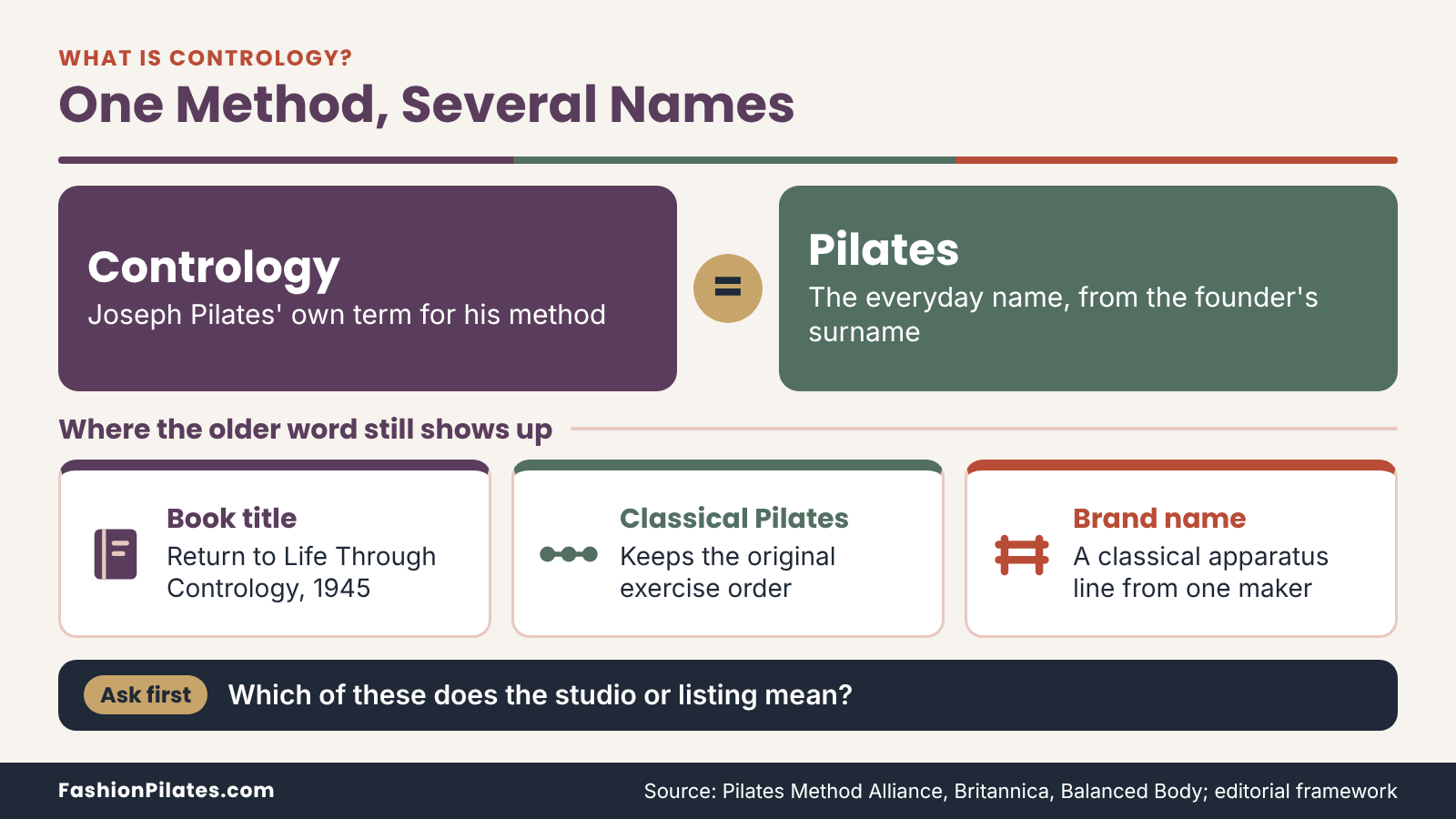
Direct answer: Contrology is the name Joseph Pilates gave to his own exercise method, the one nearly everyone now calls Pilates. He used the word to describe movement guided by the mind, performed with control rather than momentum, and he put it on the cover of his 1945 book. Today the term mostly signals the original, classical approach to the method.
This explainer is for readers who have run into the word on a book cover, a studio menu, or an equipment listing and want a plain-English answer. It covers where the word came from, how the original mat sequence was organized, how classical and contemporary teaching differ, what research can and cannot say, and who should take extra care. It is a research-based, expert-informed overview built on published histories, official health pages, and published reviews. We did not conduct hands-on testing or visit studios, and our descriptions of the original book come from secondary sources rather than a page-by-page reading. Everything here is general fitness education, not individualized medical advice.
What Contrology Means
Start with the word itself, because it is easy to assume it names a separate workout. It does not. It names the same lineage of exercise that studios sell under the Pilates label, seen through the eyes of the person who built it.
The word and its meaning
Two small questions sit under the big one: where the term came from, and what Pilates himself meant by it.
Where the term comes from
Joseph Pilates coined the word for his method, and the PilatesAnytime history of the method describes it as his answer to what he saw as the physical decline of modern life. Read plainly, the word pairs “control” with the “-ology” ending that English uses for fields of study, so it works out to something like the study or science of control. That reading is our own plain-English gloss rather than a dictionary entry, but it matches how the method is taught: control is the point, and everything else is built around it. The term appears on the cover of Return to Life Through Contrology, published in 1945, which Wikipedia’s Pilates entry summarizes as describing the art of controlled movements.
What it meant to Pilates himself
According to the PilatesAnytime history, Pilates framed the method as the coordination of body, mind, and spirit through conscious control over each movement. The Gratz Pilates explainer puts the same idea in modern terms, saying the mind should guide and organize movement through the whole body and that careless, disconnected exercise misses the point. Notice the emphasis. Nothing in either description is about burning a certain number of calories or sculpting a particular shape. The aim, as these sources present it, is coordinated, deliberate movement, and that emphasis explains most of what you will see in a classical class.
Contrology versus Pilates: one method, two names
If the method is the same, why do two names float around? A little history and a little marketing, in roughly equal measure.
Why Pilates became the everyday name
Britannica’s Pilates entry lists it as the former name of the discipline, which now carries the founder’s surname. The Pilates Method Alliance, the professional association for the field, describes the term as Joseph Pilates’ term for his method and credo. The sources we checked do not lay out a single moment when the label switched, so we will not invent a tidy origin story. What they do show is that the surname stuck, and that in October 2000 a federal court in New York ruled “Pilates” a generic term for an exercise method rather than a protected brand, a point we return to in the FAQ. The same association says it was established in 2001, after that ruling opened the term to everyone. The practical effect for readers is that nobody owns the everyday word, so a studio can call a class Pilates whether or not its teachers follow the founder’s original order. That is exactly why the older word has picked up a second life as a quality signal, and why it deserves a follow-up question rather than blind trust.
Why you still see the word today
Three situations keep the word alive. Book listings still carry it, because the 1945 title does. Classical studios use it, or the phrase “classical Pilates,” to signal fidelity to the original order of exercises. And at least one equipment maker uses it as a product-line name: Balanced Body’s classical apparatus collection is described on its official site as classical apparatus based on Joseph Pilates’ original designs. So when you see the word, ask which of the three you are looking at. A dry aside seems fair here: the field has managed to give one method at least three names, which is more branding than most spin classes attempt.
A short glossary of the terms around it
Four phrases travel with the word, and mixing them up is the most common stumble. Classical Pilates means teaching that keeps the founder’s exercise order and equipment designs. Contemporary Pilates means teaching that draws on the same method but adapts the selection, sequence, and props to the student or to newer research. Mat work means the floor exercises, which need little more than a mat and your own body weight. Apparatus means the spring-based machines and furniture-like pieces, such as the Reformer, that the founder designed.
Two more are worth a line. An instructor is the person leading your session, and instructor training varies by program, so it is fair to ask about it. A studio is simply the business that runs classes, and its taste in terminology may or may not match the sources cited here. When a listing blends these terms, treat it as a prompt to ask a question rather than as a guarantee of anything. Clear labels save you from paying for a class that turns out to be nothing like what you pictured.
Does the label change what happens in your body? Not by itself. A label tells you what a studio intends, and intention is only half the story. Two studios that both say “Pilates” on the door can run very different classes, and a studio that says “classical” can still range from gentle and patient to brisk and demanding. What reliably shapes your experience is the teacher’s training, the class size, how closely they watch you, and whether they adapt movements to the person on the mat. The vocabulary is a useful first filter, but the trial class is where you find out whether the filter worked.
The Story Behind the Name
A method named by its founder makes more sense once you know the founder’s path. The outline below draws on the Pilates Method Alliance’s published history, with a few details checked against other sources.
From Mönchengladbach to New York
Pilates did not start as a fitness brand. He started as a physically curious kid who grew into an adult obsessed with how bodies should move.
Early life and physical culture
According to a history page hosted on the National Pilates Certification Program site, Joseph Hubertus Pilates was born on December 9, 1883, in Mönchengladbach, Germany, and became an advocate of “physical culture,” the early twentieth-century movement that paired exercise with mental discipline. Wikipedia adds that his father was a gymnast and his mother a naturopath, which is useful background without being proof of anything. Treat childhood details like these as color rather than causation. They explain the vocabulary he grew up around, not why the method took the shape it did.
Internment and the idea of a system
The same history says Pilates traveled to England in 1913 and, when war broke out in 1914, was interned on the Isle of Man as an enemy alien. There he is said to have led daily exercise routines for fellow detainees, a camp of well over twenty thousand people by that account. A popular story says he rigged bed springs to create resistance equipment. The PilatesAnytime history notes that this tale cannot be confirmed, and we agree it is best repeated with a caveat. What is on firmer ground is that his thinking about systematic, repeatable exercise took shape around this period.
The studio years and the two books
Once in the United States, the method acquired a home address, a business partner, and eventually a bibliography.
New York, Clara, and the dancers
The same history says Pilates immigrated to the United States in April 1926 and settled in New York, where he met Clara Zeuner, who became his teaching partner and studio manager. It also says dancers including Martha Graham and George Balanchine studied with him, which helps explain why the method took root in dance training. The Pilates Method Alliance says he died in October 1967 at age 83, and that its mission includes carrying forward the teachings of both Joseph and Clara. Credit to Clara is not decorative. Several sources frame the work as a partnership, and a history that only names the man tells half the story.
Your Health (1934) and Return to Life (1945)
Pilates published two books. Your Health appeared in 1934, and Return to Life followed in 1945. The PilatesAnytime history calls the second the definitive guide to his mat work and says it argued that modern civilization impairs physical fitness, with his method offered as the remedy. Hold that last claim at arm’s length. It is a mid-century argument from a passionate founder, not a research finding, and the book itself should be read as a primary historical source rather than a clinical manual.
What the Method Teaches
Strip away the studio décor and the vocabulary, and the method is a set of ideas about how to move. Those ideas have been summarized in slightly different ways by different teachers, which is worth knowing before you memorize any single list.
The principles, as teachers list them
Ask five instructors for the principles and you may hear five slightly different lists. That is not a sign anyone is wrong.
Six, seven, or nine?
The PilatesAnytime history names six principles: breath, concentration, centering, control, precision, and flow. The Gratz Pilates explainer lists seven: concentration, control, precision, coordination, breath, flow, and centering. Wikipedia notes that versions of the method are based on up to nine. The overlap is large, and the differences are mostly about whether coordination gets its own line. Treat these lists as teaching summaries that organize the original ideas for modern students, not as a legal checklist. If your instructor uses a different set, you are not being misled; you are meeting a different school’s phrasing.
What the principles look like in a class
Principles are abstract until you feel them in a body. Take the opening exercise of the classical mat order, the Hundred, in which the arms pump in short beats while the breath follows a set pattern. In that single movement an instructor might cue breath (a rhythm for inhaling and exhaling), concentration (keeping count without drifting), control (arms moving without the ribs flaring), and precision (the same pump size on every beat). None of that is about doing more. It is about doing the same small thing accurately for a long time, which, as anyone who has felt a slow hold start to shake knows, is humbling in its own way.
Quality over quantity
The most consistent theme across classical sources is that fewer, better repetitions beat many sloppy ones.
Fewer repetitions, more precision
Balanced Body’s classical Pilates page, which is a manufacturer source and so worth reading with that in mind, says the approach favors fewer repetitions done with more precision and describes the philosophy as “less is more.” That matches how many instructors cue a class: a handful of well-organized repetitions rather than a race to a high count. The practical takeaway for a newcomer is reassuring. You do not need to keep up with the person on the next mat. You need to understand what each movement is asking and perform it as cleanly as you can.
Philosophy versus evidence
It helps to keep two buckets apart. One bucket holds the founder’s philosophy: the unity of body, mind, and spirit, the call for conscious control, the belief that modern life weakens us. The other holds measurable outcomes, such as strength, balance, flexibility, or pain scores, which researchers can test. A philosophy can be inspiring and still be untested. Later in this guide we look at what controlled studies of Pilates-style exercise do and do not show, and the short version is that they study the exercise, not the founder’s worldview.
The Original 34 Exercises and Their Order
The book is most often remembered for its mat sequence. Teaching sources such as PilatesAnytime describe it as 34 exercises in a deliberate order, and that order is a large part of what “classical” means.
What is in the book
Think of the sequence as a lesson plan more than a menu. You are not supposed to pick favorites and skip the rest.
The list in book order
PilatesAnytime reports that Return to Life provides the complete mat list and its order, and it prints the sequence as follows. The table groups the numbers into rough stretches so the list is easier to scan. The groupings are our editorial convenience, not the author’s headings.
| Numbers | Exercises, in order |
|---|---|
| 1 to 7 | The Hundred, Roll Up, Roll Over, One Leg Circle, Rolling Like a Ball, Single Leg Stretch, Double Leg Stretch |
| 8 to 14 | Spine Stretch Forward, Open Leg Rocker, Corkscrew, Saw, Swan, One Leg Kick, Double Leg Kick |
| 15 to 21 | Neck Pull, Scissors, Bicycle, Shoulder Bridge, Spine Twist, Jack Knife, Side Kick |
| 22 to 28 | Teaser, Hip Twist, Swimming, Leg Pull Front, Leg Pull Back, Side Kick Kneeling, Side Bend |
| 29 to 34 | Boomerang, Seal, Crab, Rocking, Control Balance, Push Up |
Note that some of these names have variants. “Scissors” appears as High Scissors in some listings, and “One Leg Circle” is sometimes written as Single Leg Circles. Different schools also describe the same movement with different arm positions and breath cues, so the names are a map, not a script.
Why the order matters
The PilatesAnytime article says Pilates arranged the exercises so that one prepares the next. In practice that means early movements warm the spine and trunk, and later ones ask for more strength and balance. A classical-versus-contemporary comparison from Power Pilates, an educator and equipment company, says classical teaching follows a fixed, systematic sequence set by Joseph Pilates. Whatever you think of that rigidity, it explains why a classical teacher may not simply swap a favorite exercise in. The sequence is treated as a designed whole.
Reading the list as a modern exerciser
Seeing 34 names in a row can be intimidating, so a few perspective points help.
Foundations versus advanced work
Not every item on the list is a starting point. Some, such as the Hundred or the Single Leg Stretch, show up in many beginner classes in modified form. Others, including Teaser, Control Balance, and Boomerang, ask for substantial strength, mobility, and coordination and are generally taught after foundations are in place. That is an editorial reading of how studios commonly progress students, not a rule from the book. Power Pilates says each classical exercise has beginner-to-advanced expressions within the repertoire, which is a helpful reminder that a name on the list is not a single fixed difficulty. For one of the later items in detail, see Pilates boomerang exercise.
Why not to teach yourself from the list
A printed list of names tells you almost nothing about how to perform the movements safely. Several of them involve rolling over the spine, loading near the neck, or holding balance on a small base. Those are the kinds of positions where an instructor’s eyes and hands matter, and where modifications exist for good reasons. If the list has made you curious, the sensible step is to find a qualified teacher and begin with a beginner-appropriate class, not to try the late-sequence exercises from photographs. Our Pilates for beginners guide is a better place to start.
Classical Versus Contemporary Teaching
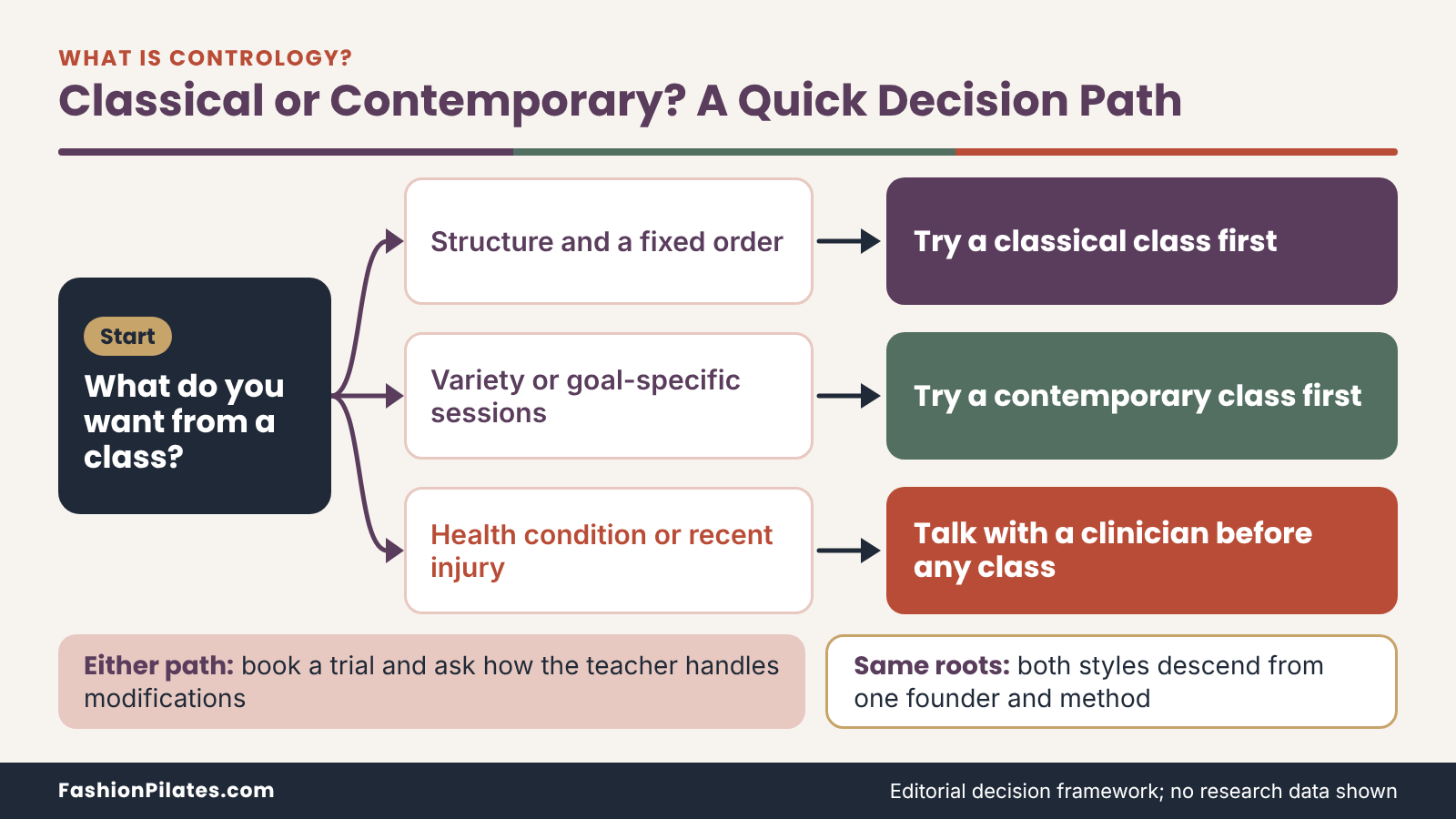
When people search for contrology, many are really asking whether they should look for a classical studio. The honest answer is that both approaches descend from the same source, and the right pick depends on your goals, your history, and your teacher.
Two ways of teaching one lineage
Both camps share the same founder. They differ mainly in how tightly they hold to his original design.
What classical studios keep
According to the Power Pilates comparison, classical teaching keeps the exercise order, the original apparatus designs, and a view of the method as complete as designed, with faithful transmission as the goal. Balanced Body’s classical page describes the same priorities: the order of movements, the breathing techniques, and the use of equipment stay true to the original system. If you value a clear, consistent structure and a direct line back to the source, that continuity is the draw. Expect classes that feel more predictable from week to week, which some people find calming and others find repetitive.
What contemporary studios change
The same Power Pilates comparison says contemporary teachers select and sequence exercises around client needs and may add modern variants and props such as resistance bands and foam rollers, treating the method as a living framework that evolves with research and practice. A Romanian journal article comparing the two directions reaches a similar conclusion in theory, noting that contemporary work is adapted according to recent research and offers more flexibility for clinical settings. That article is a theoretical comparison with no participant data, so it describes a difference in philosophy rather than proving one approach works better. Both of these descriptions come from people with a stake in the field, so read them as perspectives, not verdicts.
Choosing between them
You do not have to pick a tribe for life. A trial class in each style teaches you more than any article can.
When classical suits you
Classical teaching tends to suit people who like structure, enjoy learning a defined repertoire, and want to understand the method as its founder organized it. It can also appeal if you are curious about the history and want your practice to connect to it. It is less obviously suited to someone who needs frequent substitutions around an injury, or who gets bored when the plan repeats. Ask the studio how they handle modifications. A good classical teacher can describe how they adapt an exercise within the system and when they would hold a student back from a movement.
When contemporary suits you
Contemporary teaching tends to suit people who want variety, who are working around a specific limitation, or who prefer a class built around a particular goal such as mobility or strength. It can also feel more approachable for a first visit, since instructors have latitude to adjust on the spot. The trade-off is that “contemporary” covers an enormous range, and the training behind it varies widely. If you have a health condition, the real safeguard is not the label but a teacher who asks about your history and a clinician who knows it too.
The table below puts the two approaches side by side so you can compare them at a glance.
| Question | Classical | Contemporary |
|---|---|---|
| Exercise order | Follows a fixed sequence set by Joseph Pilates | Chosen by the teacher to fit the client or class goal |
| Equipment | Original apparatus designs | Original apparatus plus modern variants and props |
| Modifications | Made within the classical repertoire | Often substituted or adapted to client ability |
| Outlook | Method viewed as complete as designed | Method viewed as a framework that evolves |
| Best for | Readers who want structure and a direct tie to the source | Readers who want variety or goal-specific classes |
| Ask about | How they modify movements and who decides when you progress | Teacher training and how they plan a class |
The Mat, the Apparatus, and the Product Name
Another source of confusion is that the same word can describe the exercise, the equipment, or a product line. Sorting those apart saves time and money.
Mat first, then machines
The original book is a mat book, but the founder was also an inventor, and the two bodies of work developed side by side.
Mat work in the book
Britannica says the regimen was practiced largely in a prone, supine, or seated position on a mat. In plain English, that means lying on your front, lying on your back, or sitting, with the floor and your own body weight providing most of the challenge. That is why mat work is so portable and why it remains the usual entry point. If you want a gentle taste of that style at home, a short routine such as our beginner Mat Pilates workout shows how modern teachers adapt it.
The apparatus family
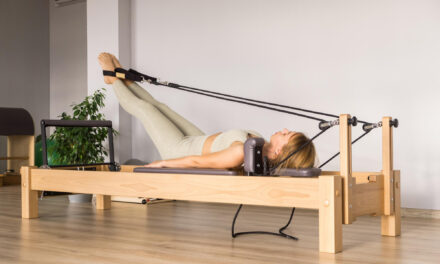
The classical pages from Balanced Body list the Reformer, Cadillac, Wunda Chair, and Barrel as the core apparatus, and say these tools provide resistance, assist with alignment, and promote deeper engagement of the muscles. The history from the National Pilates Certification Program site adds that Pilates developed what became the Universal Reformer in Germany in the years after World War I, and that his brother Fred helped refine it in the United States. Yes, one of those is called a Cadillac, and no, it will not get you to the studio. For how the sliding carriage machine works, see what is reformer Pilates, and for the part your feet push against, see Pilates footbar explained.
When contrology is a product name
Here the word stops being a history lesson and becomes a shopping filter, so a little care pays off.
The Balanced Body collection
On its official site, Balanced Body presents Contrology as a classical equipment line based on the original designs of Joseph Pilates, listing reformers, a Cadillac, chairs, towers, a barrel, and related props. The company says it worked with Jay Grimes on a design meant to restore the original feel and function. Whether any particular model fits your space or budget is a question for the manufacturer’s current listing, so check the current listing for specifications and pricing before you plan around anything. We have not tested the equipment, and nothing here is a recommendation of one line over another.
Reading the word on listings and class names
A practical rule: if “Contrology” appears on a class schedule, assume the studio is signaling a classical approach and ask what that means in practice. If it appears on a product page, check whether it names a brand line or simply describes the style of apparatus. If it appears alongside the phrase “Pilates mat” in a shopping context, remember that the physical mat is a separate topic from the exercise method. Our best Pilates mats under $100 guide covers the product side, so you can keep the method and the gear straight in your head.
What Research Says and Does Not Say
Studies test exercise programs, not names. When researchers write about Pilates, they are rarely testing the 1945 sequence in its original order, and the studies below should be read with that in mind.
Evidence about Pilates, not the name
Two published reviews offer a useful, sobering reality check. Neither is specific to classical teaching, and both come with limits.
Muscle strength
A 2022 systematic review in Heliyon, “Is pilates better than other exercises at increasing muscle strength?”, pooled 11 randomized trials with 689 participants, mostly adults without musculoskeletal limitations. It found no statistically significant difference between Pilates and other exercise for dynamic, isometric, or resistance strength, and both groups improved. The authors graded the certainty of the evidence as very low to low, noting small samples and varied programs. In plain terms, Pilates appears to build strength about as well as other reasonable exercise in these studies, but the studies are not strong enough to crown a winner.
Low back pain
A Cochrane review, “Pilates for low back pain”, included 10 trials and 510 participants with non-specific chronic low back pain. It reported low to moderate quality evidence that Pilates was more effective than minimal intervention for pain and disability, but no clear advantage over other forms of exercise. The reviewers said the choice to use Pilates may reasonably rest on personal preference and cost. If you live with back pain, that finding is neither a cure promise nor a reason to avoid movement. It is a prompt to talk with a clinician about what kind of exercise suits your situation.
Reading wellness claims with care
Because the method has a founder with big ideas, marketing around it can sound grander than the research behind it.
How to treat the book’s big claims
The 1945 book was written by an enthusiast, in an era with different standards for health claims, and secondary summaries describe it as making sweeping arguments about modern life and fitness. You can value it as a historical document and a statement of principles without treating its promises as established fact. When a studio or caption leans on the founder’s authority to claim a health result, ask what evidence sits behind it today. Good teachers are usually comfortable saying that a movement may support strength, control, or mobility without promising a transformation.
Where activity guidelines fit
For context, the CDC’s adult activity guidance recommends at least 150 minutes of moderate-intensity activity a week, or an equivalent combination with vigorous activity, plus muscle-strengthening activity on at least two days a week that works all the major muscle groups. Whether a given class contributes to those strengthening days depends on how demanding it is and which muscles it works. It is reasonable to ask your instructor how a class fits into a broader week that also includes some aerobic movement, and to check with a clinician if you have a health condition that affects exercise.
Who Should Take Extra Care
Any exercise can be a poor match for a particular person at a particular time. The classical mat sequence deserves a specific note because it is full of rolling, curling, and lying on the back.
Movements that call for caution
This section is general fitness education, not individualized medical advice. If any of it describes you, check with a qualified clinician or Pilates professional before starting.
Spinal flexion and rolling
A poster from the Bone Health and Osteoporosis Foundation and American Bone Health, “Do It Right”, advises people with osteoporosis to avoid forward bending, including the Pilates Spine Stretch, to avoid extreme spinal twists, and to avoid crunches. Several items in the classical order involve exactly those actions in some form, and rolling exercises place the body weight close to the neck. That does not make the exercises bad; it makes the right teacher and the right modifications important. If you have osteoporosis or low bone density, a recent spinal or neck problem, or a history of disc issues, get individual guidance first and tell any instructor up front.
Pregnancy and postpartum
The CDC’s guidance for pregnant and postpartum women says to consult your doctor about whether and how to adjust activity, and suggests avoiding activities that require lying flat on your back after the first trimester. Because so many classical mat exercises begin or happen on the back, that point matters here. Pregnancy and postpartum classes exist, and a prenatal-trained instructor can adapt positions, but the starting move is a conversation with the clinician who is following your pregnancy or recovery.
How to start safely
A few habits lower the odds of a bad first week more than any piece of equipment will.
What to tell your clinician and teacher
Bring a short list: recent surgery, current or old injuries, pregnancy or postpartum status, bone density results, dizziness or blood pressure concerns, and any other chronic condition. Tell the instructor before class, not mid-set, so they can plan modifications. A teacher who responds with curiosity and a plan is a good sign. One who says “just push through” is a reason to find a different studio. The table below summarizes common situations and where to take the question.
| Situation | Why classical mat work may need adapting | Who to ask first |
|---|---|---|
| Osteoporosis or low bone density | Forward bending, deep twists, and crunch-type actions are often advised against | Your clinician, then an instructor experienced with bone health |
| Pregnancy or postpartum | Many exercises are done lying on the back or load the abdomen | The clinician following your pregnancy or recovery |
| Recent surgery or acute injury | Rolling, loading, and twisting can stress healing tissue | Your surgeon, physician, or physical therapist |
| Neck or disc concerns | Rolling and head-lifted positions place load near the neck | A clinician, then an instructor who can modify |
| Dizziness or blood pressure issues | Position changes and breath holds can affect how you feel | Your clinician |
Signs to stop
Stop the movement and ask for help if you feel sharp pain, dizziness, numbness or tingling, chest discomfort, or shortness of breath that is out of proportion to the effort. Ordinary muscular effort and a bit of shaking are normal; pain that feels wrong is not. Tell your teacher, rest, and contact a clinician if symptoms persist or worry you. If you ever feel unwell in a way that seems urgent, seek medical care rather than waiting for the class to end.
How to Explore It Without Overcommitting
If the history has made you curious, the next step is practical: find a teacher, ask good questions, and give yourself a low-stakes first month.
Finding a class or teacher
The word on the sign matters less than the person leading the room. A few questions sort the options quickly.
Questions to ask a studio
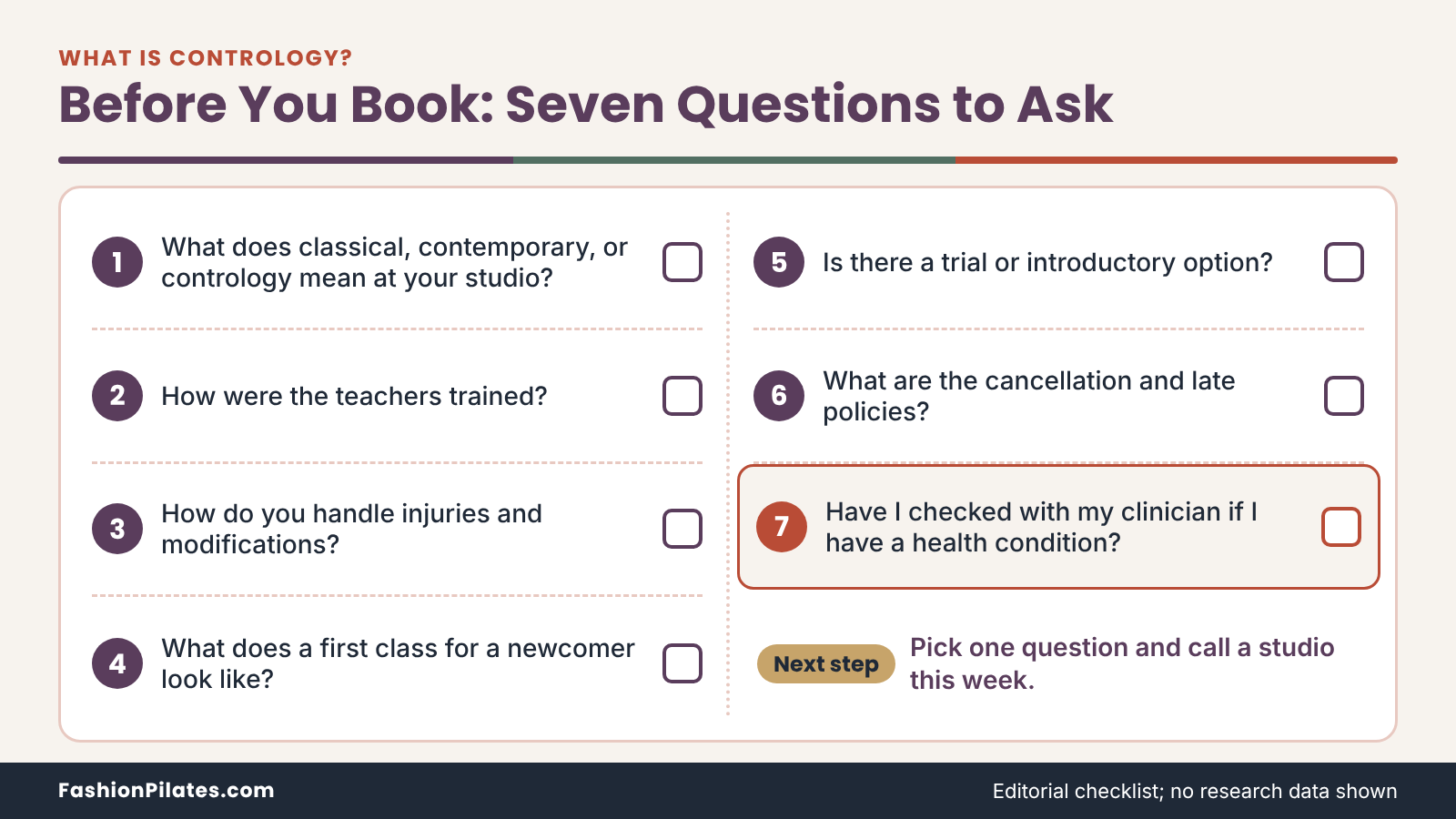
Before booking, ask what the studio means by classical, contemporary, or contrology, because the terms are not standardized from one studio to the next. Ask how the teachers were trained, how they handle injuries and modifications, and what a first class for a newcomer looks like. Ask whether there is an introductory or trial option, and read the cancellation terms before you pay. A studio that welcomes these questions is usually one that expects you to stay a while, and one that bristles at them is telling you something too.
Online or in person
Online classes can introduce the vocabulary and the flow of a session at lower cost and with more flexibility. In person, a teacher can see your alignment and adjust a cue before a habit sets in, which matters most for movements involving rolling or balance. Neither is automatically better. A reasonable approach for a newcomer is to take at least a few in-person sessions to learn the foundations, then add online practice if it fits your life. We compare the trade-offs in online Pilates vs studio classes.
A simple first month
A modest plan beats a heroic one. The outline below is an editorial suggestion for healthy adults who have cleared exercise with a clinician where needed, not a prescription.
Weeks one and two
Book one or two beginner-level sessions per week, in whatever length your studio offers. Treat these as orientation. Your jobs are to learn the names of the basic positions, notice how breathing is cued, and see how the teacher handles modifications. Leave the late-sequence exercises alone and let your teacher decide when you progress. Afterward, jot down two or three lines: what felt clear, what felt confusing, and what the teacher asked you to remember. Short notes beat vague impressions when you compare classes later.
Weeks three and four
Repeat the sessions that suited you, and try one class in a different style if you are curious. Ask your teacher for one specific thing to practice, such as a breathing pattern or a starting position, and practice only that between classes. At the end of the month, compare notes. If you enjoyed the structure of a classical class, keep exploring it. If you preferred variety, contemporary may fit better. The table below turns the month into a quick schedule you can adapt.
| Weeks | Focus | What to do | What to note |
|---|---|---|---|
| 1 to 2 | Orientation | One or two beginner sessions a week; ask about modifications | Breath cues, basic positions, teacher style |
| 3 | Repeat and compare | Repeat the class you liked; try a different style once | Which structure feels easier to follow |
| 4 | Decide | Ask for one thing to practice; review your notes | Whether to continue, switch, or pause |
Frequently Asked Questions
What is contrology in Pilates?
Contrology is the name Joseph Pilates gave his exercise method before it became widely known by his surname. He used it to describe coordinated, controlled movement guided by the mind. The term appears in the title of his 1945 book. Today people often use it to mean the original, classical form of the method. It does not refer to a separate workout.
Is contrology the same as Pilates?
Yes, in the sense that both words point to the same method. Britannica lists it as the former name of the discipline now called Pilates. The difference is mostly about emphasis, because the older word tends to signal the classical approach and the original exercise order. A studio that uses the word may or may not teach in a strictly classical way, so it helps to ask what they mean. The word alone does not tell you the quality of the teaching.
Who created the method?
Joseph Pilates developed it, and he was born in Mönchengladbach, Germany, in 1883. According to the Pilates Method Alliance, he moved to the United States in 1926 and built his work there with his partner Clara. Histories describe his ideas taking shape over many years, including time in England during World War One. He published two books, in 1934 and 1945. He died in 1967.
Why did Joseph Pilates choose that name?
He wanted a name that stressed control of movement and the coordination of body and mind. Sources describe the term as his word for conscious control over every movement. The name reflects his belief that careless, disconnected exercise misses the point. Our reading is that the word pairs control with the ending used for fields of study. The sources we checked do not give a single dated moment when he chose it.
Is contrology the same as classical Pilates?
The two terms overlap heavily, and many sources use them almost interchangeably. Classical Pilates generally means teaching that keeps the original exercise order and the original apparatus designs. Some manufacturers and studios use the older word as a label for that approach. Contemporary Pilates, by contrast, lets teachers select and adapt exercises more freely. Neither label guarantees quality, so a trial class remains the best test.
How many exercises are in the original mat sequence?
Teaching sources describe 34 mat exercises in the original book. They begin with the Hundred and end with the Push Up, in a set order. That order is meant to build from one exercise to the next. Some of the later exercises are advanced and usually taught after foundations are in place. A qualified instructor can tell you which are appropriate for you now.
Can beginners try classical classes?
Many beginners take classical classes, and good teachers adapt movements to the person in front of them. The full original sequence is not a beginner workout, though, and several exercises are usually saved for later. Start with a beginner-level class and tell the instructor about any injuries or conditions beforehand. If you have a health concern, check with a clinician first. Progress at the pace your teacher recommends rather than racing to the end of the list.
Can anyone use the word Pilates, or is it trademarked?
In October 2000, a federal court in New York ruled that Pilates is a generic term for an exercise method. Judge Miriam Cedarbaum found that consumers understand the word as describing a method of exercise rather than a single brand. As a result, studios and instructors can use the word freely. That ruling concerns the word Pilates. Individual product lines, including some that use the older word, may have their own brand rules, so check with the maker.


Trackbacks/Pingbacks