Direct answer: The best squat proof leggings Pilates classes call for stay fully opaque when the fabric is stretched, not just when it hangs on a rack. Look for a dense, smooth knit, a high rise that stays put while you roll and fold, a size that does not over-stretch the fabric, and a color you have checked in bright light. “Squat proof” is a marketing term that each brand defines for itself, so run your own stretch test and squat test before you commit.
This guide is for anyone shopping for leggings to wear on a Mat Pilates floor, on a reformer carriage, or in a mix of both. It covers what the label actually means, how Pilates movement differs from lifting or running, how fabric and fit affect coverage, and how to test a pair at home so a return window works in your favor. It is a research-based comparison built on published brand testing descriptions, federal labeling rules and category criteria; we did not conduct hands-on testing or wear-testing of any product, so it names no individual leggings and ranks none.
What “Squat Proof” Actually Means
Before you can shop for it, you need a working definition. The phrase sounds technical, yet in the sources reviewed for this guide no regulator or standards body defines it; brands decide what earns the label and how they check it. That is not a reason for cynicism, only a reason to understand what the claim is built on.
Opacity Under Stretch, Not on the Hanger
Almost every legging looks opaque when it is folded on a shelf. The real question is what happens once your body pulls the fabric wider and thinner.
A plain-English definition
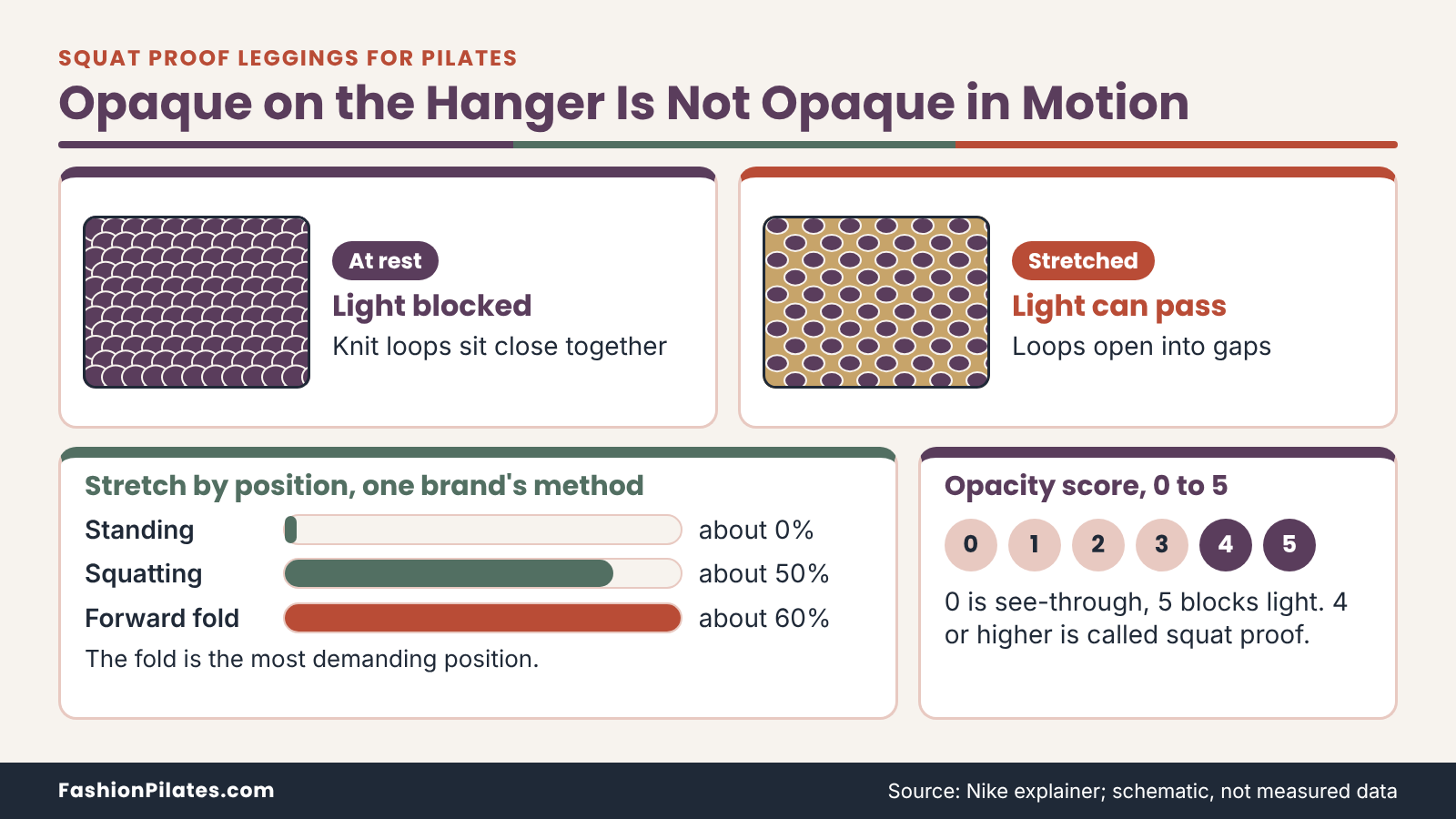
A squat proof legging holds its coverage when it is stretched across the seat, thighs and hips. In a knit fabric, stretching pulls the loops of yarn apart, which opens tiny gaps that let light through. Skin tone and underwear can then show as a shadow or a lighter patch, even though the same fabric looked solid a moment earlier. For Pilates, the useful version of the definition is simple: the leggings stay visibly the same color in every position you will hold, including the ones where your back is to the room.
Why thickness alone misleads
Many shoppers assume a heavier, thicker-feeling fabric is automatically opaque. Thickness helps, yet knit construction, yarn fineness, color and how far the fabric stretches on your particular body all matter too. A dense interlock knit can stay solid at high stretch, while a thick-feeling but loosely knit fabric can thin out the moment it is pulled. Brand explanations of opacity, including the one discussed next, keep returning to construction and tightness of the knit rather than weight on the scale.
How One Major Brand Measures It
The most useful public description of an opacity test comes from Nike’s explainer on squat proof leggings. It is a manufacturer describing its own process, so treat it as informative rather than independent, but it shows what a rigorous version of the claim looks like.
The three measurement positions
According to that page, Nike uses a spectrophotometer, an instrument that measures how much light passes through a material, at three points: standing, squatting and folding forward. The fabric is held at roughly 0 percent, 50 percent and 60 percent stretch to represent those positions, and each result is scored from 0 to 5, where 0 is see-through and 5 lets no light through. The brand says it calls anything scoring 4 or higher squat proof, with the ratings based on data for both black and colored leggings.
| Position measured | Stretch level described | Pilates movements with similar demand |
|---|---|---|
| Standing | About 0 percent | Standing arm work, footwork setup, walking into the studio |
| Squatting | About 50 percent | Chair-style holds, deep reformer lunges, kneeling transitions, sitting back before a stand |
| Forward fold | About 60 percent | Roll-ups, spine stretch forward, rolling movements, leaning over the footbar |
What the numbers do and do not tell you
The scale tells you that a serious test exists and that the forward fold, not the squat, is the most demanding position it measures. That is good news for Pilates, because folding is a Pilates staple. What the page does not give is any list of scores by product, so you cannot look up a pair and read its rating, and other brands may use different instruments and thresholds. Treat the framework as a model for your own checks rather than a certificate you can rely on in a store.
Why Pilates Puts Leggings Through a Different Test
Most squat proof advice is written for weightlifting. Pilates asks different things of fabric: more rolling, more folding, more time on the floor and more positions where a seat seam is in contact with a mat or a carriage. A pair that is perfect for the barbell rack can still fall short here.
The Positions That Stress Fabric Most
Think of your class as a series of fabric stress tests, some obvious and some surprising. Knowing which ones apply to your routine tells you which opacity checks matter most.
Floor work: rolling, folding and lifting the hips
On the mat, movements such as the roll-up, spine stretch forward and rolling like a ball bring your torso over your legs and tilt your pelvis. Bridges and leg circles lift and rotate the hips. Each one stretches the seat and back-of-thigh fabric in a slightly different way, so leggings that survive a single squat in a fitting room can still reveal a pale patch during a long, slow roll-up. Plan to check the seat seam and the upper back thigh, not only the front.
Reformer work: lunges, footbar work and long reaches
Reformer classes add deep lunges, kneeling work, wide-leg positions and time spent facing away from the room while standing on the carriage or platform. These positions pull the fabric across the inner thigh and the seat, and the lighting in a studio is often brighter and more direct than a fitting room. Springs, straps and a moving carriage also mean snags and friction on the fabric surface, which is one more reason a smooth, tightly knit surface is worth looking for.
Comfort Needs That Sit Beside Opacity
Opacity is only one of the jobs your leggings have. If a pair is perfectly solid but slides to your hips every time you lie back, you will spend the class tugging at the waistband, and the quiet focus a Pilates session rewards is gone.
Waistband and rise
Pilates is full of transitions between lying, sitting, kneeling and standing, which makes waistband behavior a big deal. An outfit guide from the performance brand On recommends form-fitting bottoms that stay in place rather than loose styles that shift mid-practice, and it features high-waisted designs. A wide, flat waistband that does not dig in or flip over is worth more than any extra pocket. A high rise also means the midsection and hips remain covered when you fold, which adds coverage that has nothing to do with fabric density.
Seams, texture and surfaces
The same On guide notes that bulky seams tend to get in the way during floor work and time on the reformer. Think about what your legs and seat touch: a carriage pad, a mat, a wall. A thick back-rise seam can press into your tailbone when you lie supine, and a rough seam can catch on a mat surface. Flat or bonded seams, a smooth hand feel and as few seams as possible across the seat are practical features that also happen to support a cleaner, more even look when the fabric stretches.
Fabric and Construction: What a Label Can Tell You
The tag sewn inside a legging is the most overlooked piece of evidence in the whole shopping process. It will not state an opacity score, but it narrows the field faster than any product photo, and the construction notes on the product page fill in the rest.
Reading the Fiber Content Label
In the United States, clothing sold at retail carries a fiber content label, and the rules behind it are published by the Federal Trade Commission. Knowing how to read that tag keeps you from paying for a name rather than a fabric.
What the tag must show
The FTC’s guidance on textile labeling says clothing labels must list the generic fiber names with percentages by weight, in descending order of predominance, along with the country of origin and the identity of the manufacturer or dealer. Fibers that make up less than 5 percent are grouped as “other fiber.” Practically, that means the first fiber on the list is the one there is most of, and a small amount of elastic fiber can sit in the mix without being named individually if it falls under that threshold.
Making sense of common blends
Most Pilates leggings combine a base fiber, usually nylon or polyester, with an elastic fiber such as spandex or elastane. The base fiber affects feel and moisture handling, while the elastic fiber affects recovery, meaning how well the fabric snaps back after stretching. A tag cannot tell you whether the knit is tight or loose, so use it as a first filter: a blend with a meaningful share of elastic fiber is more likely to hold shape through a long class, yet two leggings with identical percentages can behave very differently once the knit structure comes into play.
Knit Structure: The Part That Drives Opacity
If fiber content is the ingredient list, knit structure is the recipe. This is where opacity is largely won or lost, and it is also where marketing language gets vague.
Interlock and spacer constructions
In the Nike explainer cited earlier, the brand’s product line manager says the best squat proof leggings typically use an interlock, which is two fabrics knitted together, or a spacer construction, which has two outer layers connected by threading. The same source adds, in a short quote, that “an interlock is usually safest.” The logic is straightforward: two layers of knit loops overlap, so when one layer stretches open, the other still blocks much of the light. Interlock can also feel smooth and substantial against the skin, which many Pilates students prefer for floor work.
Denier, gauge and knit tightness
The same page lists yarn denier, gauge and knit tightness as the factors that shape the result. Denier is a measure of yarn thickness, gauge describes how many stitches are packed into the knit, and tightness describes how closely those stitches sit. You will rarely see these numbers on a product page, so do not hold out for them. Treat any listing that does mention double-layer, interlock or a dense knit as giving you a useful clue, and treat a listing with only the words “buttery soft” as giving you none.
| Construction | What it is | Opacity expectation | Watch for |
|---|---|---|---|
| Interlock knit | Two knit fabrics joined, giving a smooth, even surface on both sides | Often strong under stretch, according to one brand’s guidance | May feel warmer in heated rooms |
| Spacer knit | Two outer layers connected by threading | Often strong, with a structured feel | May feel more compressive or bulky at the seams |
| Single-jersey or lighter knit | One layer of loops, usually thin and soft | Varies widely; more likely to thin when stretched | Check in bright light at the seat and thighs |
| Seamless or engineered knit | Knit in one piece with zones of different density | Depends on the zone; dense areas may be solid while mesh zones are not | Ventilation panels at the back of the knee or seat |
| Ribbed or textured knit | Raised lines or patterns in the fabric | Texture can disguise some show-through, yet ridges thin when stretched | Pattern distortion at the fold |
Color, Pattern and Light
Even the best construction can be undone by a shade that shows every shadow. Color is a practical opacity variable, and it is the one shoppers forget until they are standing under studio lighting.
How Color Changes What Shows
The same fabric can behave differently in different colorways, because dye and the background behind the fabric interact with light. The Nike page mentions that its ratings are based on data for both black and colored leggings, which hints that the thresholds are not identical across shades.
Dark neutrals
Black, charcoal, deep navy and espresso tend to hide shadows and underwear lines better than lighter shades, which is why they dominate the squat proof lists. The trade-off is practical: dark leggings show lint, pet hair and chalky mat residue, and a black legging that has faded to gray at the seat can quietly lose coverage. Dark does not equal opaque, but it gives you more margin when the fabric thins at the fold.
Light and bright shades
Cream, pale gray, light pink and bright whites are the hardest to get right because the skin or underwear behind the fabric contrasts more strongly with it. If you love a light color, treat it as a separate purchase from your black pair and test it separately, in the exact lighting where you will wear it. Choosing underwear close to your skin tone, without seams or bold patterns, helps with the light shades far more than any promise printed on the product page.
Prints, Panels and Visible Underwear Lines
Design details are part of the opacity story, because every panel, print or cutout either supports or interrupts coverage.
Mesh, cutouts and ventilation
Mesh panels at the calf, ankle or back of the knee are popular for heat management and are usually meant to be see-through, so they are fine where nothing is behind them. The risk is panels placed near the seat or upper thigh, where a design that looks sleek when you stand can reveal more than you planned when you roll or fold. Check where the mesh sits and whether it is lined before you assume it is a purely decorative choice.
Seam lines, prints and contrast panels
Bold prints and contrast panels can mask minor show-through, but they also draw the eye to seams and to where a pattern stretches out of shape. A busy print can look distorted at the fold when the fabric is pulled to its limit. Lines from underwear, whether seams, elastic or thongs, are a separate issue from true transparency, and they are mainly a fit and fabric thickness question. Seamless underwear or a thin, bonded edge reduces them on any legging.
Fit and Sizing: The Cheapest Opacity Upgrade
Fit rarely makes it into a “best leggings” list, yet it may be the most powerful opacity variable you control. Sizing changes how far the fabric stretches on your body, and stretch is what opens the knit.
Why the Wrong Size Fails
The Nike source stresses buying the correct size before testing, and the reason is mechanical. The same fabric at 50 percent stretch is more transparent than it is at 20 percent, and a pair that is one size too small asks the knit to stretch further everywhere.
When you are between sizes
If you fall between two sizes, the instinct to size down for a “snug, supportive” feel can backfire. A legging that is too tight pulls the fabric thin across the seat and thighs and may roll at the waist during movement. Sizing up one step often gives a fabric that sits close to the skin while keeping the knit closer to its resting state. Check the brand’s size chart, read the fit notes on the product page, and consider ordering both sizes if the return policy allows it.
Rise and length
Rise is the distance from crotch seam to waistband, and it determines how much of your hips and midsection stay covered when you bend. A high rise supports modest coverage in folds and is the style most often recommended for Pilates. Length matters too: full-length leggings that bunch at the ankle can bunch under a reformer strap or a grip sock, while cropped styles leave the calf free. A pair that fits your torso length and inseam without tension at the knees stays opaque and comfortable for longer.
Compression and Second-Skin Feel
Leggings are often described as compressive, light or buttery. Those words describe how the fabric feels on your body, and they interact with opacity in ways that are not obvious.
Lighter, softer-feeling fabrics
Soft, light fabrics feel wonderful and are popular for slow floor work, but a lighter weight often means less margin when stretched. If you choose a soft, light knit, make a point of running the full stretch and squat checks described later, and use a size that does not push the fabric near its limit. These can be the best choice for low-intensity sessions where you hold fewer deep folds, provided the test confirms the coverage.
Firmer compression and skin comfort
The On guide notes that one athlete values the compression of Pilates tights because it helps them feel where movements are being cued from. Firmer fabrics can offer that body-awareness benefit and typically resist show-through. They also press on the skin for a long time, so check the waistband and thigh seams for chafing. The American Academy of Dermatology explains on its folliculitis page that tight clothing can rub the skin and irritate hair follicles when it is hot and humid, so a firm fit should still feel comfortable once you warm up.
A Decision Framework for Choosing Leggings
With the building blocks in place, you can turn them into a decision. The aim is to match leggings to the kind of Pilates you actually do, then score a short list against the same criteria so a nice product photo does not do the deciding for you.
Choosing the Best Squat Proof Leggings Pilates Formats Call For
The right pair is not the same for every format, because a heated mat class, a classical reformer session and a quiet lunchtime stretch place different demands on fabric.
Mat classes and classical floor work
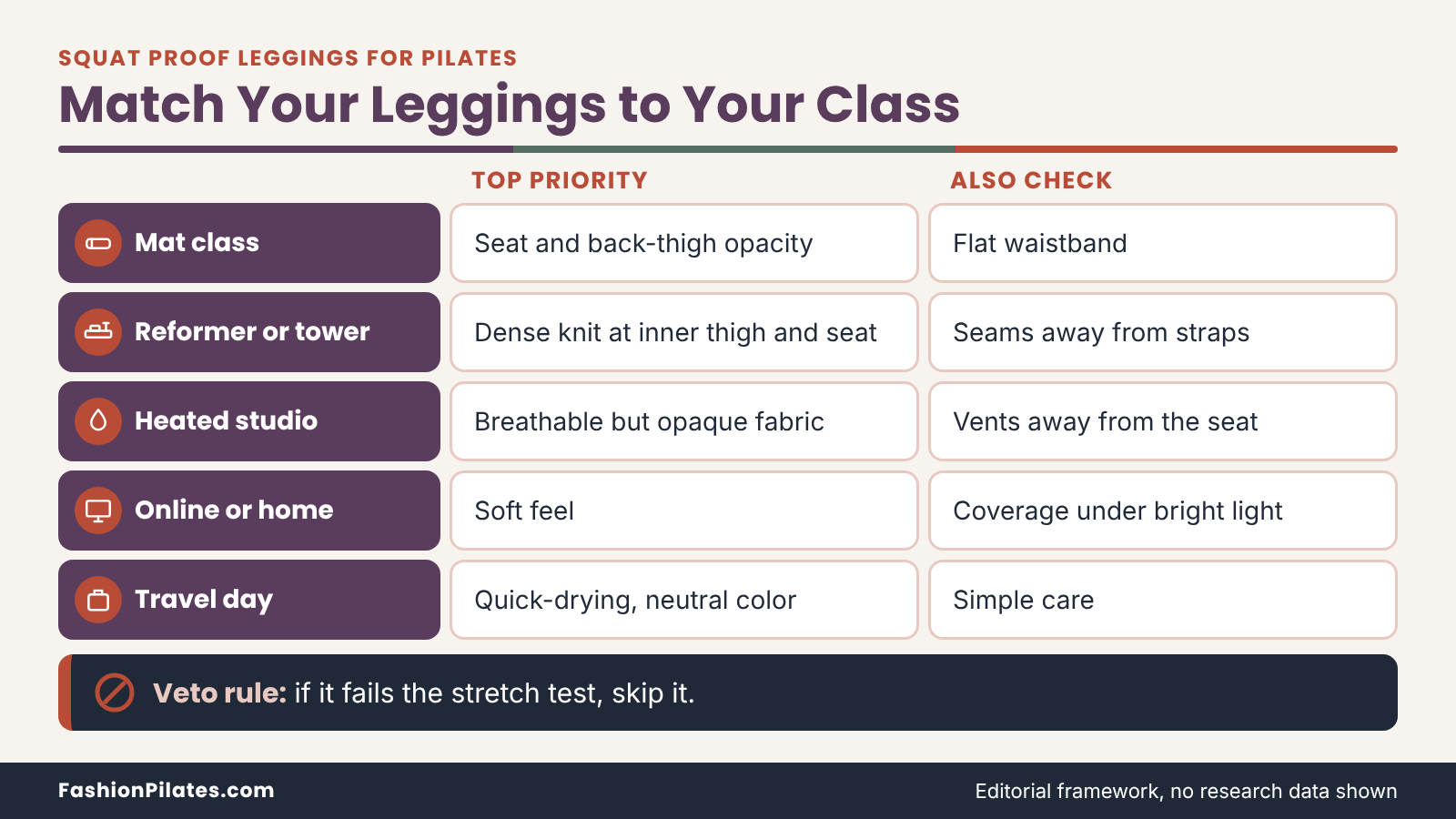
Floor-based classes involve a lot of rolling, folding and time lying on your back, so the seat and back-thigh opacity matter most, along with a smooth surface that glides on a mat rather than catching. A flat waistband that stays down when you lie supine is more valuable than compression. Because you are often facing the ceiling or the wall, check the sides and back of the legging, not only the front, under a bright light before you decide it passes.
Reformer, tower and heated studio classes
On a reformer, the stretch is concentrated in lunges and wide-leg positions, and you may be standing on a moving carriage in full view of the room. A dense knit with an anti-slip waistband makes sense, along with fabric that handles heat if the studio is warm. Grip socks matter here too: Club Pilates says every class participant needs them, which is worth remembering when you plan the lower half of the outfit. Check your studio’s own dress notes for anything specific.
| Class format | Top priority | Also look for | Think twice if |
|---|---|---|---|
| Mat class | Seat and back-thigh opacity in forward folds | Flat waistband, smooth surface, few seams | The fabric is textured enough to catch on the mat |
| Reformer or tower class | Dense knit across the inner thigh and seat | Waistband that stays put, flat seams, easy pairing with grip socks | Seams sit where straps and springs rub |
| Heated studio | Breathable, moisture-handling fabric that stays opaque | Lightweight but dense knit, ventilation away from the seat | The fabric traps heat and clings when damp |
| Online or home session | Comfort and consistent coverage on camera | High rise, soft hand feel | The fabric is thin enough to show under a bright ring light |
| Travel and multi-use days | Wrinkle-resistant, quick-drying fabric | A neutral color and a waistband that works under layers | The piece needs special laundering |
Scoring Your Shortlist
Once you have two or three candidates, a simple scorecard keeps the decision honest. Shopping lists can feel endless, and a scorecard turns a hazy feeling into a comparison you can repeat.
A weighted scorecard you can copy
Give each candidate a score from 1 to 5 on the criteria below, multiply by the weight, and add them up. The weights are an editorial starting point, not research data, so change them to fit your priorities. Someone who mostly attends brightly lit reformer classes may weight opacity higher than someone doing quiet, carpeted home sessions. If a pair fails the stretch test outright, treat that as a veto rather than a score.
| Criterion | Suggested weight | What a 5 looks like |
|---|---|---|
| Opacity under stretch | x3 | No visible change in color at the seat, thigh or fold in bright light |
| Waistband behavior | x2 | Stays flat and in place through rolling, lying back and standing |
| Fit without strain | x2 | Snug without pulling the fabric near its limit; no digging or pinching |
| Comfort and seams | x2 | Flat seams, smooth surface, no rubbing during long holds |
| Care and durability | x1 | Clear care label, simple laundering and fabric that holds shape |
| Style and color range | x1 | A shade you will genuinely wear and have checked in good light |
Price and value without the guesswork
Price is not a reliable indicator of opacity, so a high price tag does not exempt a pair from the test and a low one does not condemn it. A more useful way to think about value is cost per wear. If a pair holds its opacity, shape and color through many washes, it can cost less over time than a cheaper pair you retire early. Prices change often, so check the current listing and the return terms rather than trusting any figure printed in an article.
Building the Rest of the Outfit Around Your Leggings
Leggings rarely work alone. The top you wear over them can add coverage, and the layers you carry to and from class decide how much that coverage matters on the way in.
Tops, length and layers
A longer top or a cropped jacket worn over high-waisted leggings can give extra confidence if you are testing a lighter color, though it should never be a substitute for opacity that holds up in the positions you do most. Choose a top that stays put when you roll, since a hem that rides up exposes the waistband you worked to select. For ideas on pairing pieces from head to toe, see our back to studio Pilates outfits and fall Pilates outfits 2026 roundups.
The commute and the studio floor
Much of a legging’s life is spent walking to the studio, sitting in a car and waiting in a lobby, and those moments are rarely as bright as a class. Still, a long cardigan or a warm-up layer tied around the waist is a simple fallback if you are testing a new pair in public for the first time. If the studio asks for grip socks, as Club Pilates does, put them on after you arrive so the hems of your leggings do not bunch under your shoes on the way in.
The At-Home Test Routine and Return Strategy
Product pages cannot tell you how a pair behaves on your body in your lighting. A short, repeatable routine can, and it works best when you do it before you remove tags or wash anything.
A Step-by-Step Opacity Check
This is a fabric check, not a workout, so keep the movements gentle and well within your normal range. Skip any position that causes discomfort, and treat this as general fitness education rather than individualized medical advice.
Set up the room and the hand test
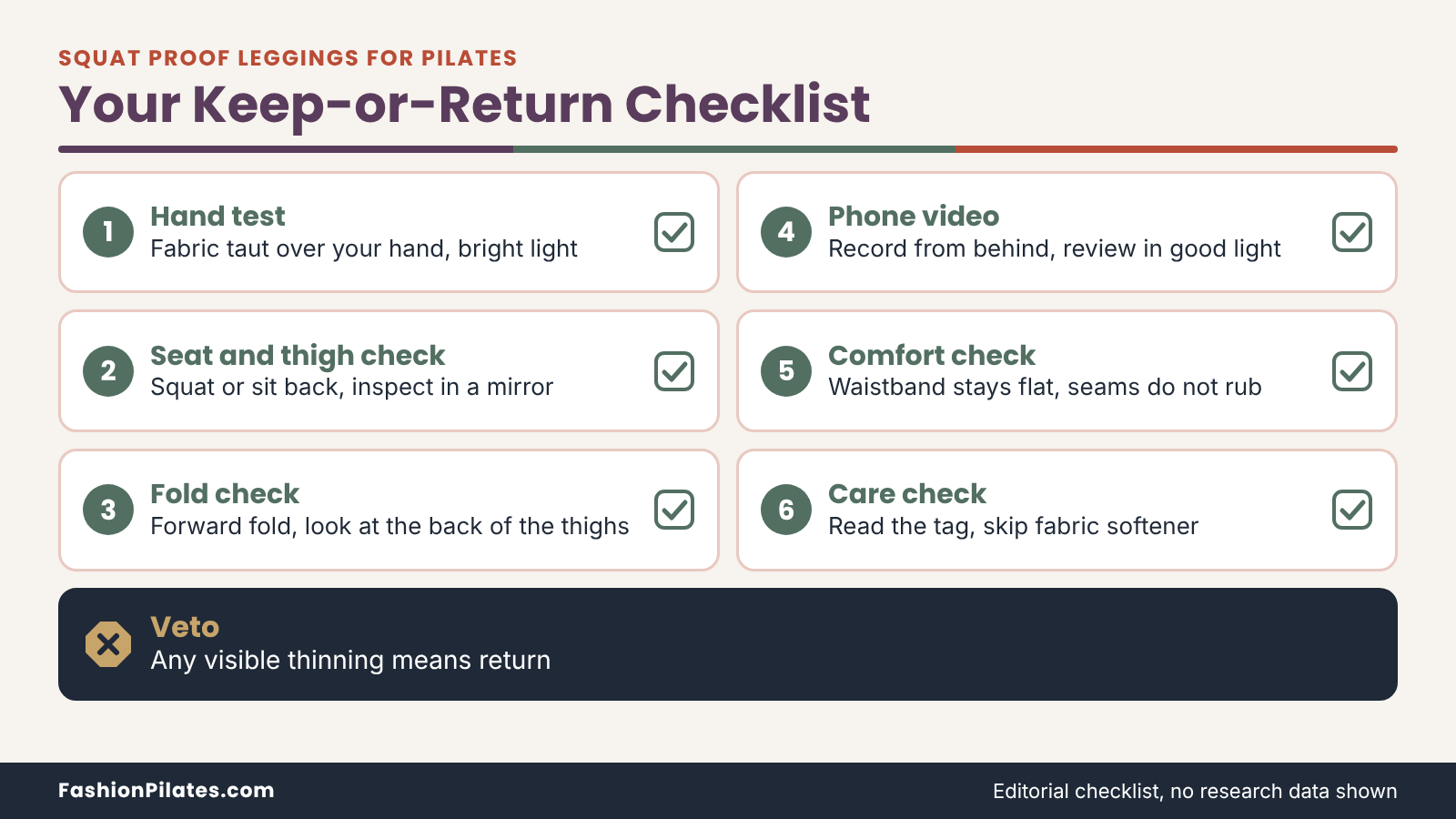
Start with a bright room, ideally daylight near a window, plus a full-length mirror. First, hold a section of the fabric taut over your hand or knee in front of the light. If you can clearly see the shape of your hand through it, that is a warning sign, because the same stretching will happen on your seat and thighs. Squatwolf, a brand that sells leggings, describes a similar pull-it-taut check and a squat-in-front-of-a-mirror check on its buying guide, which matches Nike’s advice to test at home.
Move through the Pilates positions
Put the leggings on over your usual underwear and move through a short sequence in front of the mirror: a comfortable squat or sit-back, a forward fold, a bridge-style lift if you do those, a side-lying leg lift, and a deep lunge as far as is comfortable. After each position, check the seat, the back of the thighs and the inner thigh for lighter patches. Use your phone to record a short video from behind, then review it in bright light, because the camera often catches what a mirror hides.
Returns and Record-Keeping
A good test only helps if you can act on it. The best time to learn about a return policy is before you buy, not after you find a problem.
Read the policy before you try
Policies for activewear vary a lot. Some retailers accept returns of items that have been tried on at home but not washed, and others restrict worn or washed items, so check the retailer’s current policy page for time limits, condition requirements and who pays for return shipping. Keep tags on until you have finished testing, and wear the pair only indoors on a clean surface. If you are ordering two sizes to compare, confirm that the policy covers both before you start.
Document what you see
If a pair fails, a quick photo or video from the test gives you a clear record and a precise way to describe the problem, such as “visible thinning at the seat when folding forward” rather than “see-through.” That wording helps customer service and helps you remember which pair performed better when you compare two options a week later. Note the size, color and fabric details from the product page and tag at the same time, because sizes and colors vary between production runs.
Re-Testing After the First Wash
Many shoppers run the opacity check once and never again. A second look after the first wash costs five minutes and tells you how the pair will behave for the long haul.
What to look for after laundering
Wash the pair according to the care label, let it dry as directed, and repeat the hand test, squat and forward fold in the same bright light. Compare the results with your first set of notes or video. A small change in the hand feel or sheen is normal, but a noticeable lightening at the seat or a looser, thinner knit suggests the fabric may not hold up to regular classes. Check this inside the return window whenever the policy permits washing, and ask the retailer before you do so.
Building a simple rotation
Rotating two or three pairs means each one is worn less often between washes, which gives the fabric more time to recover and may extend its life. Keep your most reliable, most opaque pair for the brightest studios and the longest classes, and use the others for home sessions, travel and lighter days. A rotation also means a failed pair never ruins your plans, because you already own a tested backup.
Common Mistakes and How to Fix Them
Most disappointing legging purchases come down to a handful of repeat errors. Some happen at the checkout and some happen in the laundry room months later, so it helps to treat both halves of the lifecycle.
Mistakes Made Before the Pair Arrives
The online shopping experience is built to move you from photo to cart in seconds, which leaves little room for a skeptical eye. A few habits slow that process down in a useful way.
Trusting the label and the photos
A “squat proof” badge is a claim, not a certificate, and the model in the product photo is standing in controlled lighting. The fix is to read the fabric details, look for construction hints such as interlock or double-layer knit, scan customer questions for comments about sheerness in your color, and then run the stretch and mirror checks yourself. If a listing is silent about construction and fabric weight, assume you will need to test it carefully rather than hoping for the best.
Testing in the wrong light or the wrong underwear
A dim bedroom flatters almost every fabric, and so does a pale, patterned pair of underwear. Test in the same kind of light you will be exposed to in class, and test with the underwear you plan to wear. If you plan to wear seamless briefs in class, test with those, and if a light color is the goal, test with a nude-toned pair. A pass in the wrong conditions only postpones the problem until you are in the middle of a roll-up.
Mistakes Made After You Own Them
Even a pair that passes every test can slowly change if you treat it carelessly. The good news is that proper care is simple, and the instructions are already sewn in.
Laundry habits that undo opacity
The FTC’s care labeling guidance says garment labels must give care instructions that stay legible for the useful life of the product, so the tag is your best source for your specific pair. Lululemon’s care page, from its New Zealand site, advises avoiding fabric softener because it coats technical fabric and limits its wicking, and recommends cold washing with other synthetics and air or low-heat drying. High heat and abrasive items such as zippers and hook-and-loop closures are the typical enemies of a smooth, even knit, so wash leggings with similar fabrics and follow the tag.
Sweat, skin and when to retire a pair
The American Academy of Dermatology recommends, in the folliculitis guidance linked earlier, changing out of your clothes right after working out and showering. That is useful general advice for sweat-dampened leggings, which can rub the skin and stay damp in a gym bag. As a pair ages, watch for pilling, a shiny or faded seat and thinner patches that were not there before. Once the fabric stops passing your stretch test, move it into the lounge rotation, even if it still looks fine on the hanger.
Special Situations, Limits and Next Steps
General advice has edges. Bodies, budgets and routines vary, and some shoppers need to adapt the standard checks rather than follow them to the letter.
Fit Differences and Coverage Needs
Sizing systems are built around averages, so your own proportions can change how a pair stretches and where it sits. The goal is not to make the pair fit a template, but to find the one that holds up on you.
Extended sizes and proportions
Check the size range and the fit notes for the specific style, because some brands design fabric weight and seam placement differently across sizes, and a style may be offered in fewer sizes than the brand’s main line. Larger sizes often have more fabric to work with, and the checks still apply: stretch test, mirror, bright light. Look for a wide waistband, flat seams and a knit that does not become noticeably thinner at the thighs when you move.
Tall, petite and long-torso fits
Inseam and rise vary between brands, and a legging that is too long in the rise can bunch at the waist while one that is too short can pull down when you fold. If the brand offers inseam options, use them, and check customer notes from shoppers with similar proportions. For a pair that fits well except for length, a tailor can often shorten the hem without changing how the knit behaves where it matters most.
Sales, Lookalikes and Smart Budgeting
Not everyone wants to spend freely on leggings, and nobody needs to. The same test that screens expensive pairs also protects you when you shop for a deal.
Sale shopping and last-season colors
End-of-season sales can be a good time to buy a pair you have already tested or have read detailed fit notes about. Be careful with final-sale items, because they often cannot be returned, and the opacity check is useless if you cannot act on it. If a pair is discounted because the color is being phased out, remember that light shades are the riskiest, so choose a dark neutral if you cannot test before you commit.
Lookalikes and unbranded options
Lower-priced alternatives to popular styles can work well, yet their fabric details are often thin or inconsistent between listings. Treat them with the same checks as any other pair, and lean on the FTC-required fiber label and customer photos in your color. Price does not tell you whether a knit is dense, and a pair with a sound construction at a modest price is a fine find. If a listing makes strong opacity promises without describing the fabric at all, the claim is doing more work than the evidence.
What This Guide Cannot Do
This guide is built from published brand descriptions, federal labeling guidance and category criteria, not from hands-on wear-testing, so it cannot tell you how a given pair will perform on your body. That is why the home test sits at the heart of the advice.
Health and comfort notes
This is general fitness and apparel education, not individualized medical advice. If you are pregnant or postpartum, recovering from surgery or managing a health condition, ask a qualified clinician or Pilates professional which exercises suit you, and look for maternity or support-specific designs rather than adapting standard leggings. If you notice repeated skin irritation, bumps or rashes after wearing a certain fabric, stop wearing it and talk with a dermatologist or other clinician.
A practical next step
Pick two or three candidates, score them with the scorecard and run the home test on each before the return window closes. In practice, the best squat proof leggings Pilates shoppers can own are the ones that pass with margin, not the ones that barely squeak by. When you are ready to build the rest of your wardrobe, see our Pilates Leggings & Bottoms hub for more bottoms guidance, and Pilates bra fit guide for the top half.
Frequently Asked Questions
What does “squat proof” mean for Pilates leggings?
It means the leggings stay opaque when the fabric is stretched, rather than only looking solid when they are relaxed. The term is not tied to one official standard, so each brand decides how it tests and what score or check earns the label. For Pilates, the useful meaning is broader than squats alone, because forward folds, bridges and lunges can stretch the fabric as much or more. Treat the label as a starting point and confirm it with a mirror check in bright light.
Are black leggings automatically squat proof?
No, although dark colors give you more margin than light ones. A thin, loosely knit black legging can still turn gray and show skin or underwear lines where it stretches across the seat. Fading from repeated washing can also reduce coverage over time. Run the same stretch and mirror checks on black as you would on any color, and recheck as the pair ages.
How can I check leggings for sheerness at home?
Start with a bright room and hold a section of the fabric taut over your hand or knee to see whether the shape shows through. Then put the leggings on and move through a squat, a forward fold, a lunge and a bridge-style lift in front of a full-length mirror. Record a short video from behind and watch it in good light, because the camera often reveals patches a mirror misses. Keep the tags on and wear the pair only indoors on a clean surface until you have decided.
Should I size up to make leggings more opaque?
Sometimes, because a size that stretches the fabric less usually shows less through the knit. A pair that is too small pulls the fabric thin across the seat and thighs and may roll at the waistband. If you fall between sizes, compare both when the return policy allows it and choose the one that feels snug without pulling. A legging that is too loose can shift and bunch during movement, so aim for supportive rather than baggy.
Does thicker fabric always mean more opaque leggings?
Not always, because construction and knit tightness matter as much as weight. A dense interlock knit can stay solid under stretch, while a heavier-feeling but looser knit may thin out when pulled. Thick fabrics can also run warm, which matters in a heated studio. Use fabric weight as one clue and rely on the stretch test for the final answer.
Do I need different leggings for reformer and Mat Pilates?
You do not need separate pairs, but the two formats stress leggings differently. Mat classes put more emphasis on seat and back-thigh opacity during rolling and folding, while reformer classes add deep lunges and positions with your back to the room. A dense, smooth knit with a flat, secure waistband and flat seams suits both. If you take both types of class, test your pair in the positions from each.
How should I wash leggings to keep their coverage?
Follow the care label first, since federal rules require garment labels to carry usable care instructions. Lululemon advises avoiding fabric softener because it coats technical fabric and limits wicking, and suggests cold washing with similar fabrics and air or low-heat drying. High heat and rough items in the same load can wear the knit faster. Retest the pair after the first wash, then every so often as it ages.
How long do squat proof leggings stay opaque?
There is no reliable timeline, because it depends on the fabric, how often you wear the pair and how you wash it. Opacity can decline gradually as the knit relaxes, pills or fades, and the seat is usually where you notice it first. Rotating several pairs and caring for them as directed can slow that change. When a pair no longer passes your stretch test in bright light, move it to casual use and replace it for class.