
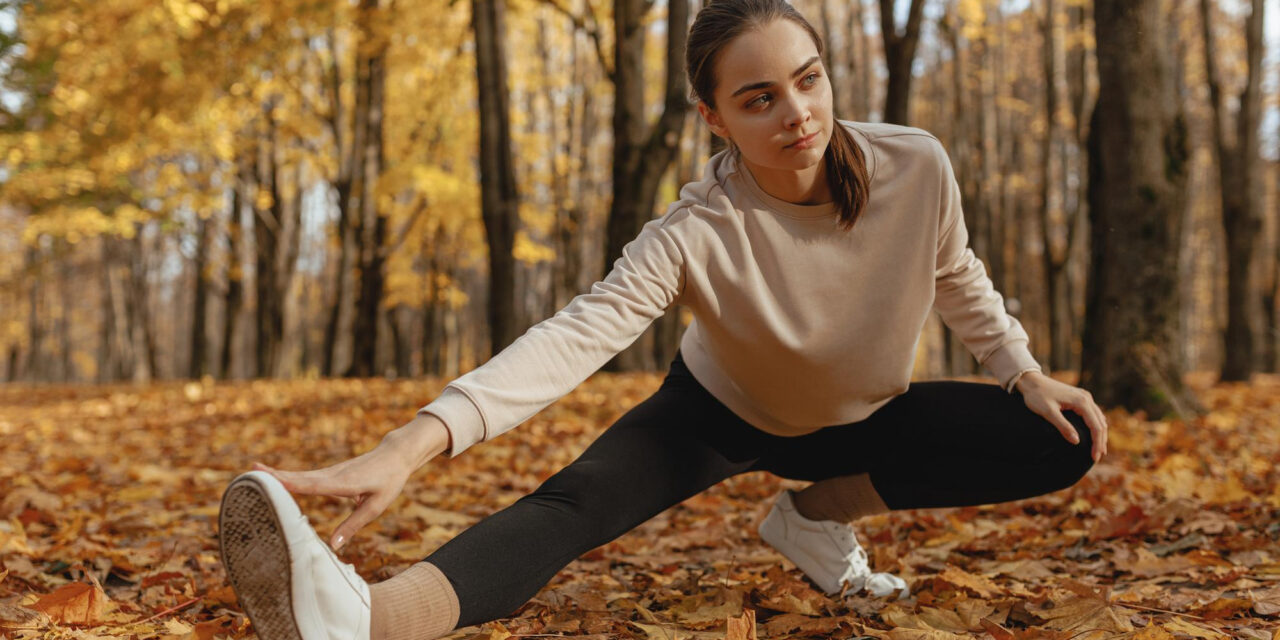
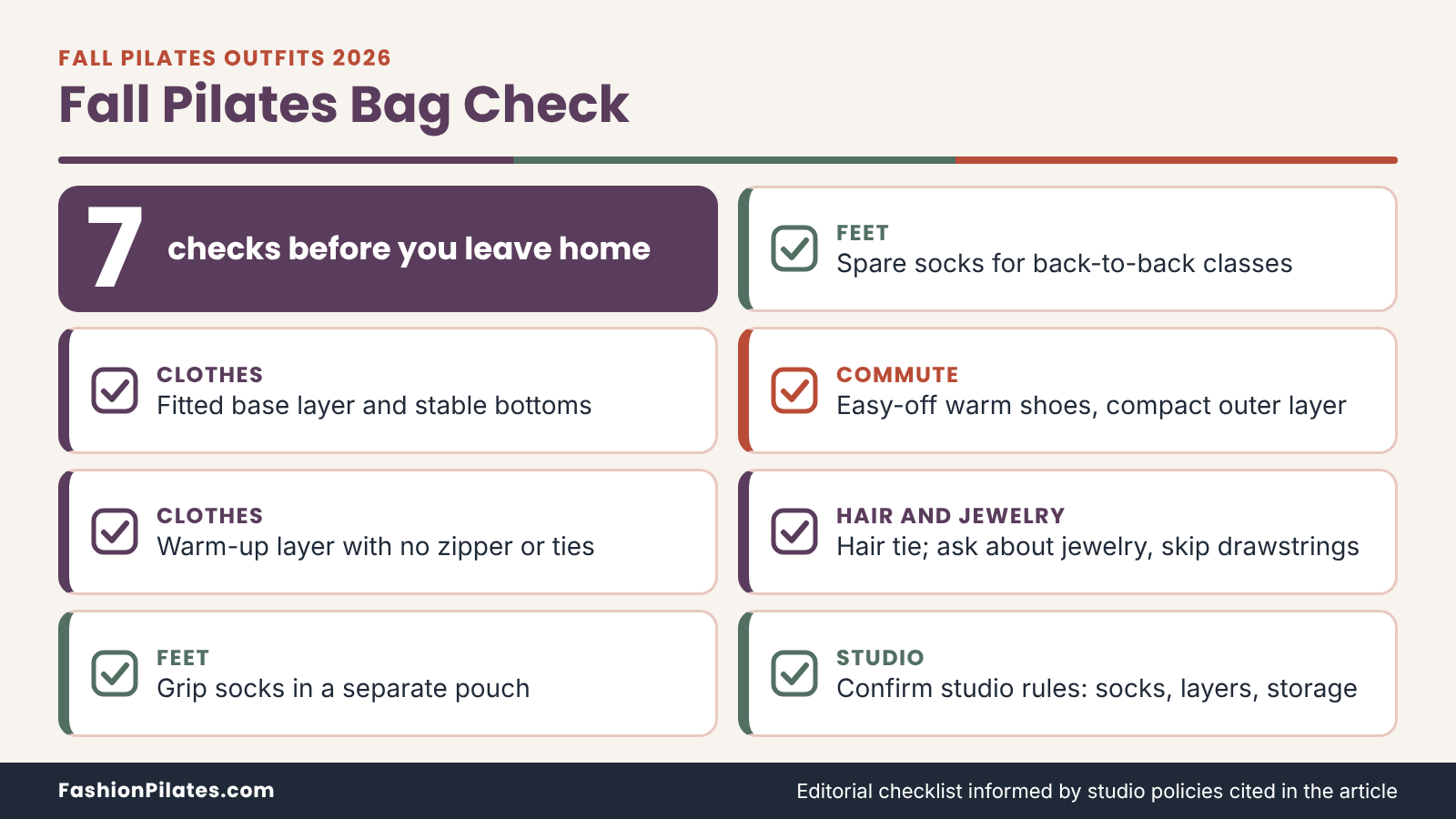
Direct answer: The best fall pilates outfits 2026 are not a trend report, they are a small system you can repeat every week. Start with a fitted, stretchy base layer and bottoms that stay put when you roll, reach, and lie back. Add a warm-up layer that comes off in seconds, keep a separate outer layer for the walk in, and choose neutrals so every piece works with every other piece. Treat grip socks as required unless your studio tells you otherwise.
This guide is for people who take reformer, tower, chair, or Mat Pilates classes and want a cooler-weather wardrobe that does not turn into a pile of single-use purchases. It is a research-based decision guide built on published studio policies, government and clinic health pages, consumer-labeling rules, and published fabric studies; we did not conduct hands-on testing. It names no prices and makes no claims about this season’s colors, because those could not be verified from primary sources. If you are coming back to class after a long break, back-to-studio Pilates outfits for returning to class covers that situation on its own, and the wider Pilates Sets & Outfit Ideas hub collects related guides.
How Pilates Clothing Differs From Running, Yoga, and Lifting Gear
Pilates is low-impact, so you do not need the bounce control of running gear. What you do need is clothing that behaves around equipment, the floor, and an instructor who wants to see how you move. That combination is unusual enough that a closet built for other workouts often fails in small, specific ways.
What the studio floor asks of your clothes
Two things shape every Pilates outfit decision: what the equipment can grab, and what your body spends its time pressing against.
Contact with springs, straps, and moving parts
A reformer has a sliding carriage, springs, ropes or straps, a footbar, and shoulder blocks. Loose fabric, dangling cords, and hardware can catch on any of them. A Colorado recreation district publishes a reformer policy that asks for form-fitting clothing that allows full range of motion without being loose enough to get caught in the machine, and it specifically rules out zippers and rough fabrics that could harm the carriage. That is a useful template for any studio: snug enough not to snag, smooth enough not to scratch.
Rolling, lying down, and long stretches on your back
Much of a reformer class happens flat on your back, and Mat Pilates adds rolling and sitting work on the floor. A Club Pilates instructor, quoted in the studio’s own article on first-class outfits, points out that a zipper pressing into your lower back for the length of a class is genuinely miserable. The same logic applies to thick seams, bra clasps, and stiff waistbands. A beginner guide on Healthline notes that thin padding makes rolling movements uncomfortable, which is a reminder that the spine takes pressure in this style of exercise and your clothes should not add to it.
How Pilates differs from the workouts you already dress for
Most people arrive with a wardrobe built for another sport. Knowing what that wardrobe was designed to solve helps you decide what carries over.
Against running and cycling
Running and cycling clothes are designed around wind, bounce, and moving air. They tend to include pockets, reflective details, zippers, and loose-fitting jackets that flap pleasantly at speed. Pilates rooms are different. ClassPass describes reformer studios as small spaces where the air gets hot and humid quickly, so breathability matters more than wind protection. Pockets and zips that were handy on the trail become hardware you lie on, and a jacket you would never take off outdoors becomes a layer you must shed within minutes.
Against yoga and lifting
Yoga clothing can be generous because teachers see your shape through a cue rather than through your outline. Pilates teachers often want to watch pelvis, ribs, and shoulder placement, which is why both ClassPass and Club Pilates instructors favor fitted pieces that make alignment easier to see and control. Lifting clothes lean toward durable, thick fabric and structured footwear, while Pilates swaps shoes for grip socks. A boxy tee that hid everything at the squat rack will ride toward your chin the first time you curl up from lying down, and that is a design mismatch, not a personal failing.
The Cold-Weather Layering System
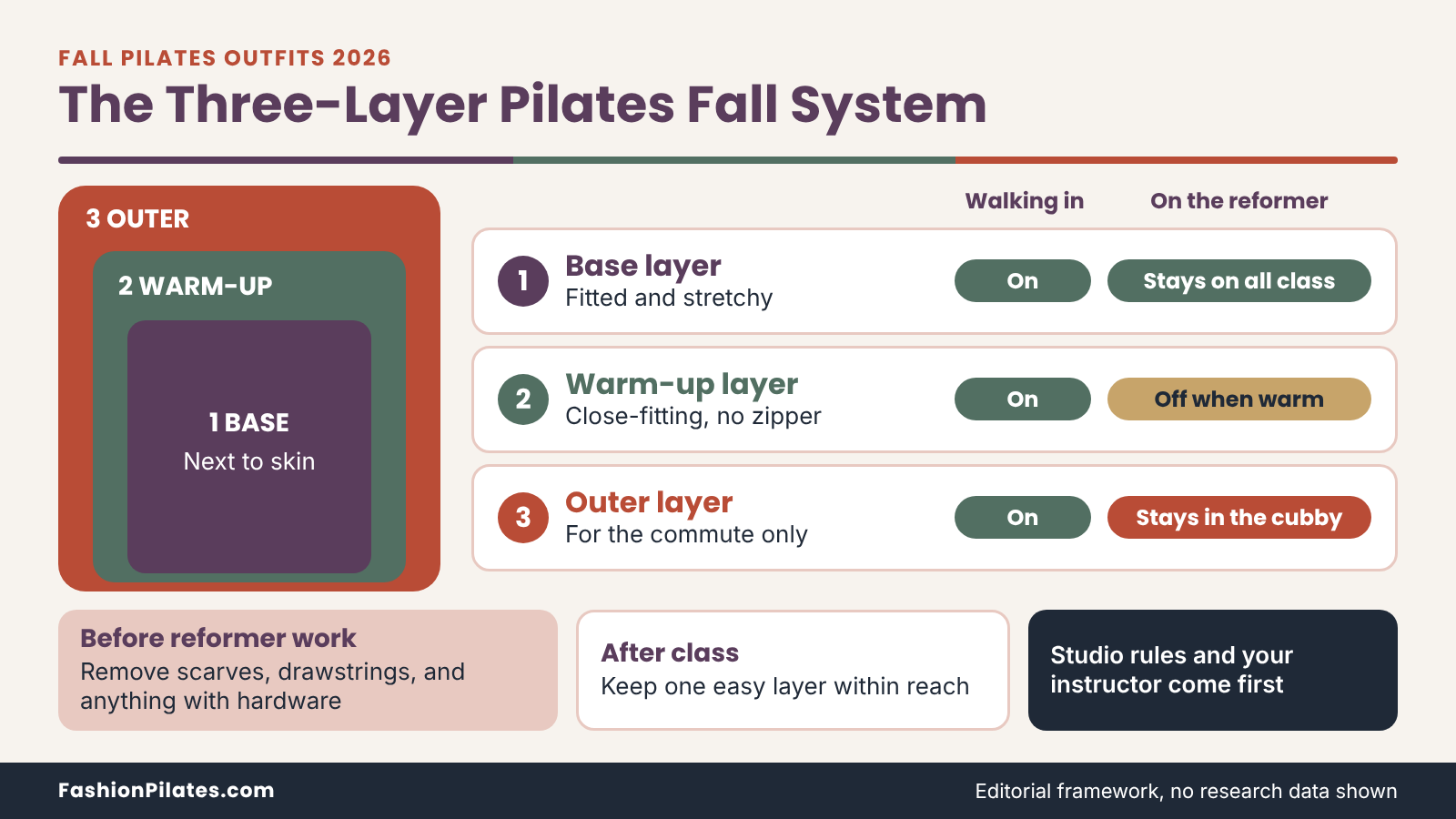
Fall weather changes the walk to the studio far more than it changes the class itself. The layering system below separates those two problems so you are never wearing a coat-weight piece in a warm, humid room.
Three layers, three jobs
Each layer should earn its place by doing one job well. If a piece tries to do two, it usually does both badly.
Base layer: the piece that touches your skin
Your base layer is the fitted top and bottoms you will actually exercise in, so everything else on this list is built around it. It should stretch with you, stay in place when you lie back, and manage sweat. Mayo Clinic, writing about outdoor winter exercise, advises against cotton next to the skin because it holds moisture and stays cold. Pilates is indoors and usually warmer, and the fabric research is more mixed than that advice suggests, as the evidence section later explains. Still, a base layer that dries reasonably fast is the safer default for fall.
Warm-up layer: the piece that stays on early and comes off fast
The warm-up layer keeps you comfortable while you arrive, set up, and ease in. Mayo Clinic describes a warm-up of roughly five to ten minutes that gradually raises body temperature and blood flow, and a light, fitted layer can support that comfort at the start of class. Think a cropped cardigan, a fitted pullover without a zipper, or a wrap that stays close to the body. Skip anything with long ties or a hood, because the whole point of this layer is that it can disappear quickly.
Outer layer: the piece that never enters the room
The outer layer belongs to the commute. It handles wind, drizzle, and the chill between the car and the front desk, and it should stay out of the studio itself. Mayo Clinic’s cold-weather advice also stresses protecting hands, feet, and head, since those are the first places to get cold. In practice that means gloves and a hat you can tuck into a pocket, and a coat that stuffs into a cubby without taking up the whole shelf.
What comes off before reformer work
Studios set their own rules, and your instructor has the final say. The checklist below is a sensible default when you have not been told otherwise.
Before you lie down: the removal checklist
Take off the outer layer, scarf, and anything with drawstrings, loops, or zippers before you reach the reformer. Check your sleeves: bulky cuffs can bunch under your hands on the footbar or catch on a strap. Decide about the warm-up layer based on fit rather than hope. If it stays close to the body and has no hardware, many people keep it on for the first few minutes, but the moment it rides up, bunches, or makes you hot, it goes into the cubby. Ask the instructor if you are unsure.
Where the layers wait while you work
Plan the layer handoff before class begins, because a pile of coats on a reformer is a safety problem and a studio-etiquette problem at once. Find the cubby or hook, put the outer layer there, and keep the warm-up layer within reach rather than at the bottom of your gym bag, where it will become a mystery fabric by the end of class. Many people feel a chill once sweat cools after class, so being able to pull a layer back on quickly is part of the plan, not an afterthought.
Fabric Categories and What They Do
Fabric language in activewear is full of promises, so this section sticks to categories and trade-offs instead of brand claims. The goal is to help you read a label and know what you are likely to get, not to crown a winner.
Fibers and what each one brings
The fiber content tag tells you what the yarn is made of. In the United States, the Federal Trade Commission requires that tag to list fibers by their generic names in order of weight, which is why it is the first place to look before you trust a product page.
Nylon and polyester
These two synthetic fibers dominate stretch activewear. Both are strong, resist abrasion, and generally dry faster than cotton because they absorb little water themselves; the way the yarn is knit does much of the work of moving sweat along. Nylon-based knits often feel smoother and denser, while polyester-based knits are common in lighter, more open constructions. Neither is automatically better. What matters for Pilates is whether the knit is smooth enough not to snag on equipment and stretchy enough to recover after a deep reach.
Elastane (spandex)
Elastane is the stretch ingredient, sold in the United States under the generic name spandex. It rarely appears alone; it is blended into nylon, polyester, or cotton at a modest percentage so the fabric stretches and snaps back. The FTC allows a labeler to list spandex even when it makes up a small share of the fabric, because it is functionally significant. For Pilates, look for enough stretch that a fitted piece moves with your hips and shoulders without your noticing it. Many care labels warn against high heat for stretch garments, so follow yours.
Cotton and cotton blends
Cotton is soft, familiar, and absorbent, but it holds moisture and dries slowly. Mayo Clinic’s cold-weather guidance warns against it next to the skin outdoors for that reason. Indoors the picture is less clear: a small laboratory study of cyclists found synthetic shirts felt cooler than cotton, while a separate heat-exercise comparison found the two comparable on health and thermoregulation measures. Cotton blended with elastane can make a perfectly good low-key warm-up layer; it is simply a slower-drying choice for the layer closest to your skin.
Merino and other wool
Merino is a fine wool that many brands use for next-to-skin layers. It absorbs moisture vapor and does not feel as clammy as other fibers when you cool down, according to research summaries published by Woolmark, a wool-industry organization, so treat those figures as industry-reported rather than independent. The trade-offs are practical: wool and wool blends can need gentler washing, and some people find certain wool knits scratchy. Under US labeling rules, wool must be named on the tag no matter how small its share, which makes it easy to check.
Constructions that change how the same fiber feels
Two garments with the same fiber content can behave very differently, because knitting and finishing change thickness, texture, and warmth.
Brushed and fleece-backed knits
Brushing is a finishing step that raises the fibers on one side of the fabric, creating a soft, slightly fuzzy surface that traps warm air. That makes brushed or fleece-backed pieces natural candidates for the warm-up layer or for the commute. The catches are bulk and lint: a thick brushed interior can feel too warm once class begins, and it tends to collect fuzz over time. Keep brushed fabrics out of the layer you will lie on for fifty minutes unless the studio is genuinely cold.
Ribbed, waffle, and open knits
Textured knits look good in a capsule because they add visual interest without adding color. Ribbed knits stretch well across the body, while waffle and open knits add airflow and a little warmth. The risk is snagging: open constructions can catch on rough edges, hook-and-loop fasteners, and jewelry. Hold the fabric up to a light before buying. If you can see through it when it is not stretched, it will probably be more sheer when you bend or reach.
Seams, finishes, and labels
On a reformer, seams matter as much as fabric. Flat, smooth seams along the spine and under the arms reduce pressure and rubbing, while thick stitching and external tags can dig in when you are lying down. Check for rough hooks, clasps, or metal on a bra back and look at where waistband elastic sits. A tag you can feel through the garment is a free preview of how it will feel by minute thirty, so a few quick checks in the fitting room save a lot of adjusting later.
The table below puts these categories side by side, drawing on the label rules, studio guidance, and research cited in this guide. It is a decision aid, not a ranking.
| Fabric or construction | What it does well | Watch for | Best role |
|---|---|---|---|
| Nylon or polyester stretch knit | Dries relatively fast, resists abrasion, smooth surface | Can hold odor; may shed fibers in the wash | Base layer, bottoms |
| Cotton or cotton-elastane blend | Soft, familiar, absorbent | Slow to dry, can feel damp and cool after class | Warm-up layer, casual commute pieces |
| Merino or wool blend | Handles stop-and-start temperature changes, named clearly on labels | Gentler care, possible itch, industry-reported research | Base layer if you run cold |
| Brushed or fleece-backed knit | Warm and soft | Bulk, lint, too warm once you move | Warm-up layer |
| Ribbed or open knit | Stretch and airflow | Snags and sheerness when stretched | Warm-up layer, tops |
Neutrals and Color Capsule Logic
A capsule is a small set of pieces that all work together. Neutral colors are the easiest way to make that happen, and Pilates, with its lack of fanfare, suits the idea well.
Why a neutral palette works as a system
The case for neutrals is mostly arithmetic and logistics, not taste.
The mix-and-match arithmetic
Imagine three bottoms and four tops in colors that all coordinate. That is twelve outfits from seven pieces, before you add a warm-up layer. Now imagine seven pieces in seven unrelated colors: you may still own seven items, but far fewer combinations will look intentional. This is the quiet advantage of a neutral base. Because every piece plays with every other, you can wash on a schedule without worrying that the one pair that matches is in the hamper, and you can stop buying outfits and start buying components.
Opacity, sweat, and light
Color affects more than looks. Pale shades can show sweat and can become see-through when stretched, while very dark shades tend to show lint and dust, which is a quiet tax on any black leggings owner. Mid-tone neutrals like taupe, olive, and heather gray hide both issues better than the extremes. Whatever you choose, bend forward and reach overhead in front of a mirror, in good light, before you commit. Opacity changes with stretch, so a quick test is worth more than a product description.
Fall pilates outfits 2026: decisions before trends
Seasonal guides often lean on predictions about what will be popular. This one stays with decisions you can defend.
What this guide deliberately does not claim
We did not find an official or primary source that confirms specific fall 2026 colors or silhouettes for Pilates, so this guide does not announce any. Trend reports tend to come from retailers, publications, and brands with something to sell, which makes them poor evidence for what will hold up in your closet. What does hold up is evergreen: fitted pieces, smooth seams, stretch with recovery, and colors that coordinate. The year in the title is a date stamp for the season, not a promise about fashion.
How to add a trend color without breaking the capsule
If a seasonal color tempts you, put it where the stakes are lowest. Grip socks, a hair accessory, or one warm-up layer are inexpensive ways to try an accent, and they are easy to retire if you tire of them. Keep your base layer and bottoms in the neutral family, since those are the pieces you wear every class and the ones that must match everything else. One accent, three or four neutrals, and an honest look at what you already own is a better formula than a full palette swap.
Grip Socks, Footwear, and Studio Dress Code
Socks and shoes are where fall changes the most, since cold feet and wet pavement meet a studio floor that may or may not allow bare skin. The rules also vary more here than anywhere else in the outfit.
Grip socks: the item with the clearest rules
If one accessory is non-negotiable at many reformer studios, it is the grip sock. The specifics still depend on where you take class.
Why studios require them
Club Pilates states that grip socks are mandatory for every class and says they are needed to help prevent injury and keep you stable on the reformer; the studio also sells them on site. That is a studio policy and a stated reason, not a research finding, so treat it as a rule of the house. Policies are not universal. The Colorado recreation district mentioned earlier recommends grip socks but also allows bare feet. Check the policy before your first visit, because buying socks at the front desk is convenient and also a small tax on forgetting.
Fit and design: full-toe, toe-free, and heel fit
According to Club Pilates instructors, both full-toe and toe-free grip socks work, as long as they fit securely at the heel. In cooler months, full-toe styles keep your toes warmer, while toe-free versions leave your toes bare, which some people prefer for control. Because grip socks sit between you and the footbar, a sock that slides, bunches, or twists is a bigger nuisance than a sock that looks plain. If a pair bunches under your arch while you stand, it will bunch during footwork too. Pilates grip socks guide compares styles in more detail.
Getting to and from class in cooler weather
The studio floor is only part of the footwear story. The rest is what happens between your front door and the reformer.
Walking-in shoes and the studio floor
Most studios want you to wear grip socks in the exercise room and leave outdoor shoes elsewhere, so pack a pair of easy slip-on shoes or boots you can remove quickly. The American Academy of Dermatology advises wearing shower shoes, flip-flops, or sandals around pools, gyms, and locker or shower areas to avoid fungal exposure, which is worth remembering if your studio has a changing room. A simple rule is that if you would not stand barefoot there, keep something on your feet.
Keeping feet warm without bulk
Mayo Clinic flags hands, feet, and head as the areas most at risk in cold weather, so wear warm socks and boots on the way in and change into grip socks at the studio. Carry the grip socks in a small pouch so they stay separate from damp gloves and wet umbrellas. The dermatology guidance also advises changing socks daily and right away when they get wet, so a spare pair is useful if your commute includes puddles. Do not wear a thick sock under a grip sock unless your studio and the fit allow it.
Dress-code questions to ask before your first class
Dress codes at Pilates studios are usually short, but they are specific. A two-minute email or phone call saves a mid-class wardrobe correction.
Questions about equipment and class type
Start with what you will be using. Reformer, tower, chair, and Mat Pilates each put different things in contact with your body, and the equipment names alone can sound like a used-car lot. Ask whether the class is mat, reformer, or mixed, whether grip socks are required or merely recommended, and whether there are rules about zippers, jewelry, or long hair. Mat Pilates leaves out the moving carriage, which usually makes a wider range of pieces workable; reformer and tower classes call for the closest fit.
Questions about temperature, storage, and policy
Ask how warm the room tends to be, since ClassPass describes reformer rooms as heating up fast, and where coats, bags, and shoes go during class. Ask whether you can keep a warm-up layer on for the first few minutes and whether the studio rents or sells grip socks if you forget. Finally, ask whether there is a towel policy and a laundry expectation for rented items. The answers decide how much you can carry, how many layers you need, and how fast you can shed them.
The table below turns those questions into a quick checklist you can adapt to any studio.
| Question to ask | Why it matters | What changes if the answer is yes or no |
|---|---|---|
| Are grip socks required? | Some studios mandate them, others only recommend them | Buy or borrow a pair before the first visit |
| Is the class mat, reformer, or mixed? | Equipment contact differs by class type | Reformer and tower classes call for the closest fit and no hardware |
| Are zippers, jewelry, or long ties restricted? | Hardware can catch or scratch equipment | Choose zipperless layers and remove accessories |
| How warm does the room get? | Heat level decides base layer weight | Lighter base layer if the room runs warm, more reliance on the warm-up layer if cool |
| Where do coats and bags go? | Layers need a place that is not the equipment | Pack a compact outer layer if storage is limited |
| Can I keep a layer on at the start? | Instructors may want to see your alignment | Pick a fitted warm-up layer, or plan to remove it |
Pieces to Skip and Common Mistakes
Most outfit trouble in a Pilates class traces back to a handful of repeat offenders. Knowing them in advance is cheaper than discovering them at minute twenty.
Pieces that fight the equipment
Some items are not just uncomfortable, they interact badly with the machine itself.
Zippers, hardware, and exposed metal
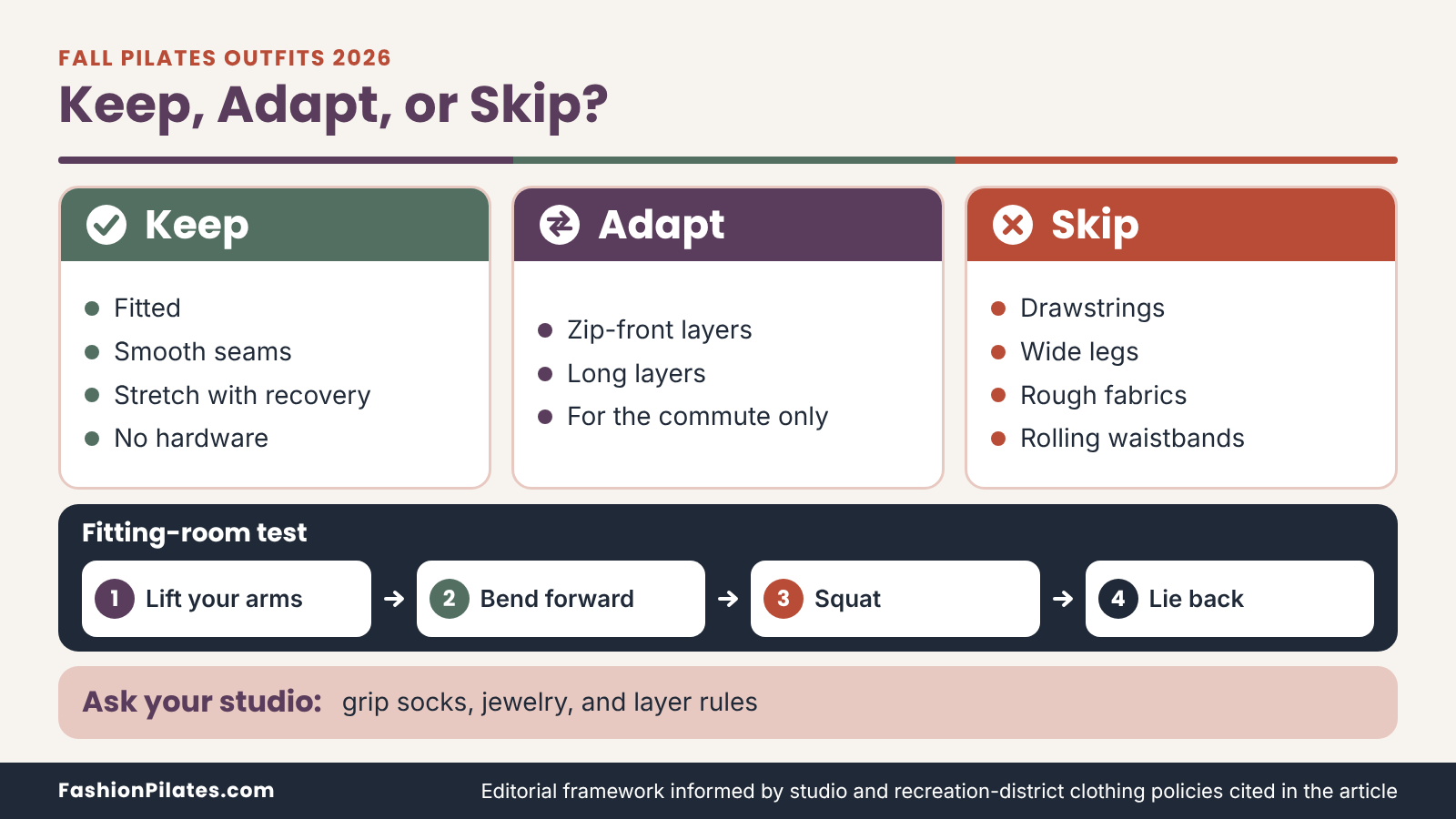
Zippers appear in two of the studio and recreation-district sources reviewed for this guide as pieces to avoid. A zipper can scratch a reformer carriage, press into your back when you are lying down, and snag a strap. The same goes for snaps, grommets, studs, and sequins. If you love a zip-front warm-up layer, wear it for the commute and take it off before you reach the machine. Better still, shop for layers with a pullover or wrap design that avoids the problem entirely.
Loose, long, and dangling
Loose clothing gets caught in moving parts, which is why a reformer etiquette page from a municipal facility in Western Australia tells participants to keep clothing and hair away from springs and moving parts, echoing the Colorado policy. That covers drawstrings, wide-leg bottoms, long open cardigans, scarves, and dangling jewelry. It also covers long hair, so bring a hair tie. When a piece is loose enough to move independently of you, it is loose enough to catch on something.
Pieces that fight your comfort
Other items are fine for the equipment but wrong for the way you actually move.
Heavy, bulky, and slippery fabrics
Thick sweater knits and chunky fleece are cozy at the front desk and punishing at minute twenty. Very slick fabrics can slide against equipment surfaces or against your own skin during rolling work. Choose a fabric you can stretch freely and that lies flat in a supine position. If you cannot imagine lying on your back in it for several minutes without adjusting, leave it in the cubby.
Fit mistakes: rolling waistbands and shifting tops
Club Pilates instructors favor high waistbands that stay put and fitted tops that are not overly tight, and ClassPass warns against very tight garments with no elastane because they restrict movement. In practice, the common failures are waistbands that roll down, tops that ride up when you lift your arms, and bottoms that bunch at the ankle under grip socks. Check each in the fitting room by lifting your arms overhead, bending forward, and squatting before you buy.
This table pairs each frequent problem with a more workable swap.
| Skip | Why it causes trouble | Swap for |
|---|---|---|
| Zip-front jackets | Zippers can scratch equipment and dig into your back | Pullover or wrap layer without hardware |
| Drawstring or tie waists | Cords can catch on straps and springs | Smooth elastic waistband |
| Wide-leg or long-hem bottoms | Loose fabric can snag in moving parts | Fitted leg that ends at or above the ankle |
| Thick sweater knits | Bulky, hot, and uncomfortable when lying down | Thin brushed or ribbed knit |
| Rough or sequined fabrics | Can scratch the carriage and your skin | Smooth stretch knit |
| Waistbands that roll | Shift during curls and reaches | High, flat, stable waistband |
Budget Tiers by Decision
Price tags change constantly, so this section organizes spending by decision instead of by dollar amount. The question to ask of any piece is how often you will wear it and how much it affects your comfort during class.
Where spending earns its keep
Spend first where the garment touches your body most and where a failure interrupts class.
Pieces you wear every class
Bottoms, a supportive bra, and grip socks are worn at every session, so small flaws multiply quickly. A waistband that rolls once is an annoyance; one that rolls twelve times a month is a reason to stop wearing the leggings. Prioritize stable waistbands (see Pilates leggings buying guide for that comparison), smooth seams, opaque fabric at full stretch, and reliable grips on your socks. If you have to choose between upgrading one piece, upgrade the one that is on your body in every position, and let the rest follow later.
Layers worth buying once
A warm-up layer you reach for every cool morning is worth a bit more thought, because it covers the part of class when you are most likely to run cold. The same goes for a base layer if you tend to feel chilly. Check fiber content, care instructions, and how the piece fits when you lift your arms, then buy the version that you will actually wear. A thoughtful pick that you use twice a week all season beats three trend pieces you wear once.
Where to save, and how to think about cost
Saving money on activewear works best when you know what you are trading away.
Pieces where simpler is fine
The outer layer is the easiest place to save, because you probably own a coat already and it never enters the studio room. Hair ties, a spare pair of socks, and a simple bag also do not need to be fancy. Seasonal accent colors are a smart place to buy cheap and see if you like them. If the label is clear and the piece passes the movement test later in this guide, it can do the job.
Cost per wear, in plain arithmetic
A piece worn twice a week through a ten-week season is worn twenty times, so divide whatever it cost by twenty. That figure makes quality comparisons easier, because a more expensive piece used heavily can cost less per class than a cheaper piece left in a drawer. Price alone does not guarantee better fabric or fit, and marketing copy loves words like “buttery” that no label can verify. Read the fiber and care tags, and judge the garment on how it moves.
The table below organizes the main purchases by decision so you can see where to start, where to step up, and what should trigger an upgrade.
| Decision | Start here | Step up when | Upgrade trigger |
|---|---|---|---|
| Bottoms | One pair with a stable waistband and opaque stretch fabric | You attend weekly or more | The waistband rolls or the fabric thins or pills |
| Base top | One fitted top in a dry-feeling stretch knit | You find yourself wearing it twice between washes | It rides up or holds odor |
| Warm-up layer | A simple fitted pullover or cardigan you already own | Your studio runs cool | It is too bulky or has hardware |
| Grip socks | Two pairs that fit at the heel | Classes are back-to-back or the pairs wear out | The grips peel or the fit slips |
| Outer layer | The coat you already own | Your commute is long or wet | It will not fit in the cubby |
Care of Technical Fabrics
Stretch and moisture-managing fabrics can last for years or fade within a season, and the difference is often care. The most reliable guide is the label sewn into the garment.
Reading the label before you wash
Two labels matter: the fiber content tag, covered in the fabric section, and the care label, which is the focus here.
What a care label must tell you
The FTC’s Care Labeling Rule requires that garments carry instructions for regular care, or a warning if the product cannot be cleaned without damage. A complete washing instruction covers method, temperature where hot water would harm the garment, bleach, drying, and ironing where relevant, plus warnings about procedures a consumer might assume are safe. If a label says to dryclean only, the manufacturer is saying washing would harm the product, and it needs evidence for that claim.
Labels versus product-page promises
A product page may describe a fabric as easy care, but the label in the garment is the legally required instruction set. When the two disagree, follow the label and treat the page as marketing. This matters most for wool blends, brushed fabrics, and anything with a heat-sensitive print or trim. Photograph the label when you buy the piece so you still have the instructions after the tag is cut out, which many people do the first time it itches.
Washing and drying habits for stretch fabrics
Most of the damage to activewear comes from heat, friction, and neglect.
Heat, softeners, and elastic
Many care labels for stretch garments advise cooler washing and low heat or air drying, because high heat is hard on elastane and can weaken its recovery over time. Some manufacturers also advise against fabric softener on moisture-wicking pieces, since residue may interfere with how the fabric handles sweat, so check the label before adding it. When in doubt, wash on a gentle cycle, close fasteners, and avoid washing delicate knits with items that can snag them, such as hook-and-loop closures.
Pilling, odor, and shed fibers
Friction causes pilling, so turning garments inside out and washing them away from rough items helps. Synthetics can hold odor, which is a good reason to air them out between wears when the fabric allows. They also shed tiny fibers in the wash: a 2019 study in Scientific Reports, which washed commercial synthetic garments in household machines, measured hundreds of thousands to over a million microfibers released per wash and found tighter, high-twist yarns shed less. The study used only two replicates per test, so treat it as an indication rather than a precise rate.
Build-Your-Own Capsule
This is where the earlier decisions turn into a shopping list. The quantities below are an editorial starting point, not a research-backed prescription, so adjust them to how often you take class and how often you do laundry.
Counting the pieces
The right number of pieces depends less on style than on laundry rhythm. Count your classes between washes, then add a spare.
A starter capsule for one or two classes a week
For a light schedule, aim for two bottoms, three tops that can serve as base layers, one warm-up layer, two pairs of grip socks, and one commute-only outer layer. That is eight clothing pieces plus socks, and with coordinating neutrals it produces a surprising number of combinations. If you own black leggings and a few tees already, the list may shrink to what you genuinely lack. Resist buying duplicates of what works; the goal is coverage, not abundance.
Scaling up for three or more classes
If you take three or more classes a week, build the capsule around your wash cycle instead. Count how many classes happen between laundry days and make sure you own that many bottoms and base tops, plus one spare. Warm-up layers can usually be shared across several classes, since they spend less time against sweat, while socks need more frequent replacement. Back-to-back class days may justify an extra pair of grip socks, as the dermatology guidance on changing damp socks makes clear.
Fitting-room and at-home checks
A garment that looks right on a hanger can fail in motion. These two checks catch most problems before you cut the tags.
The movement test
Wear the piece with the items it will be worn with, then lift both arms overhead, bend forward at the hips, squat, and sit on the floor if the store allows. Watch the waistband, the hem of the top, and the leg openings. Then lie back and notice whether any seam, label, or clasp presses into you. Pilates movements involve curling, rolling, and reaching, so a garment that stays put through these shapes is more likely to behave in class. Stop any test that hurts, and treat this as clothing fit, not exercise instruction.
The material check
Hold the fabric up to a light, stretch it, and see how quickly it springs back. Run your fingers along the seams and inside edges for rough spots, check any hardware, and read the fiber and care labels before you decide. If a garment fails the light test while unstretched, expect more transparency in motion. Look at what the label says about washing, because a piece that needs special care will cost more in time even if it costs less at the register.
Use the table below as a template for your own list, filling in quantities for your schedule.
| Piece | Job | Starter quantity | What to look for | Check before buying |
|---|---|---|---|---|
| Bottoms | Stay put through rolling, reaching, and lying down | 2 | Stretch knit with elastane, flat waistband | Squat and bend test, light test |
| Base tops | Fitted layer next to skin | 3 | Dry-feeling stretch knit, flat seams | Lift arms overhead, check tag and seams |
| Warm-up layer | Warmth at arrival, easy to remove | 1 | Fitted, brushed or ribbed, no zipper | Check sleeve cuffs and snag risk |
| Grip socks | Traction and warmth on the reformer | 2 pairs | Secure heel fit, working grips | Studio policy, fit when standing |
| Outer layer | Commute protection | 1 | Wind and rain resistance, stuffable | Fits in the cubby or bag |
| Commute shoes | Warm, easy to remove at the door | 1 pair | Slip-on or quick-lace | Studio shoe rule |
What the Research Does and Does Not Tell Us
Most of what is written about fall pilates outfits 2026, or about any other season, is opinion from brands, studios, and retailers. That is not worthless, but it deserves labeling. This section separates what comes from studies, what comes from policies, and what is simply convention.
What the fabric studies actually show
Several studies compare cotton, synthetic fabrics, and wool, but none were conducted in Pilates studios, and that gap matters.
Cotton versus synthetic shirts
A McGill University crossover study had 15 competitive cyclists ride 20 kilometers in a laboratory wearing either a 60 percent polyester and 40 percent nylon shirt or a 100 percent cotton one. The synthetic shirt produced lower skin temperature and cooler comfort ratings, with similar sweat rates, though participants could tell the fabrics apart. A 2023 study of 32 people exercising in heat found synthetic and cotton shirts comparable on health and thermoregulation outcomes. Both involved intense cycling, not low-impact Pilates, so they are suggestive rather than decisive.
Merino research and who reports it
Woolmark reports that a North Carolina State University research program found merino wool buffered moisture better than polyester, cotton, and viscose during stop-and-start activity, with the largest gap against polyester. The summaries we reviewed did not state the funding or sample details, and Woolmark is itself a wool-industry organization, so the findings are best treated as industry-reported until independent trials appear. Pilates is a stop-and-start activity of sorts, but the studies tested cycling, climbing, hiking, and golf, not studio exercise.
Policy, evidence, and what we could not verify
A good guide labels what it knows and what it assumes, and this one comes with some honest gaps.
Studio rules are policy, not proof
Grip sock requirements, zipper bans, and fitted-clothing advice come from studios and recreation districts. They are credible as statements of house rules, and the reasons given, such as stability and equipment protection, are sensible. They are not outcomes from controlled studies. This guide uses them to describe what you are likely to encounter, not to claim that any garment prevents or causes any particular outcome. When your studio says something different, its rule wins.
What we did not verify
We did not verify specific fall 2026 color or silhouette trends, any product prices, or any brand claims, and we did not conduct hands-on testing of garments. General statements about fabric behavior, such as how quickly synthetic knits dry and how heat affects elastane, reflect common textile knowledge and label conventions, not a study cited here. If your needs include medical, circulatory, or skin concerns, ask a clinician, and for questions about returning after a break, see back-to-studio Pilates outfits for returning to class and the Pilates Fashion category hub.
Frequently Asked Questions
What should I wear to Pilates in cold weather?
Wear a fitted, stretchy base layer and bottoms that stay put, then add a warm-up layer you can remove quickly. Keep your outer layer for the commute only and plan to leave it in the cubby. Choose grip socks that fit at the heel and bring warm shoes for the walk to class. Your studio may have its own rules, so ask before your first class.
Can I wear leggings with a pocket or a zipper to reformer class?
You can, but check the studio policy first. One recreation district rules out zippers because they can harm the reformer carriage, and Club Pilates instructors note that zippers dig into your back when you lie down. Pockets add bulk but carry no metal, so ask whether your studio has a view on them. A smooth waistband without a zipper is the safer choice.
Are grip socks always required?
No, policies differ by studio. Club Pilates requires them for every class, while a Colorado recreation district recommends them but allows bare feet. Ask before you go so you know whether to buy a pair in advance. If you forget, many studios sell them at the front desk.
Is cotton a bad choice for Pilates?
Not necessarily, but it dries more slowly than synthetic fabrics. Mayo Clinic advises against cotton next to the skin for outdoor cold-weather exercise, and one laboratory study found cotton shirts felt warmer than synthetic ones. Another heat study found the two comparable, so the evidence is mixed. A cotton and elastane blend works well as a warm-up layer, while a faster-drying fabric is the safer base layer.
Do I need merino wool for fall Pilates?
No, merino is an option rather than a requirement. Industry-reported research suggests it handles moisture well during stop-and-start activity, but the studies were not done in Pilates settings. Wool can also need gentler washing and may feel scratchy to some people. If you run cold, a merino base layer is worth considering, and otherwise a good synthetic knit is enough.
What colors are best for a Pilates capsule?
Neutrals that coordinate, such as black, charcoal, navy, cream, and taupe, give the most combinations from the fewest pieces. Mid-tone shades hide both lint and sweat better than very pale or very dark ones. Check any light color for sheerness when stretched. Add an accent in socks or a hair accessory if you want some seasonal color.
How should I wash technical Pilates clothes?
Follow the care label first, because it is the manufacturer’s required instruction. Many stretch garments do best with gentle washing and low heat or air drying. Turn pieces inside out to reduce friction and avoid washing them with items that can snag. Synthetic garments also shed tiny fibers in the wash, so washing only when needed helps.
How many Pilates outfits do I actually need?
Count the classes you take between laundry days and own that many bottoms and base tops, plus one spare. For one or two classes a week, two bottoms and three tops usually cover it. Warm-up layers and outer layers can be shared across many classes. Add grip socks to match how often you run back-to-back sessions.


Trackbacks/Pingbacks