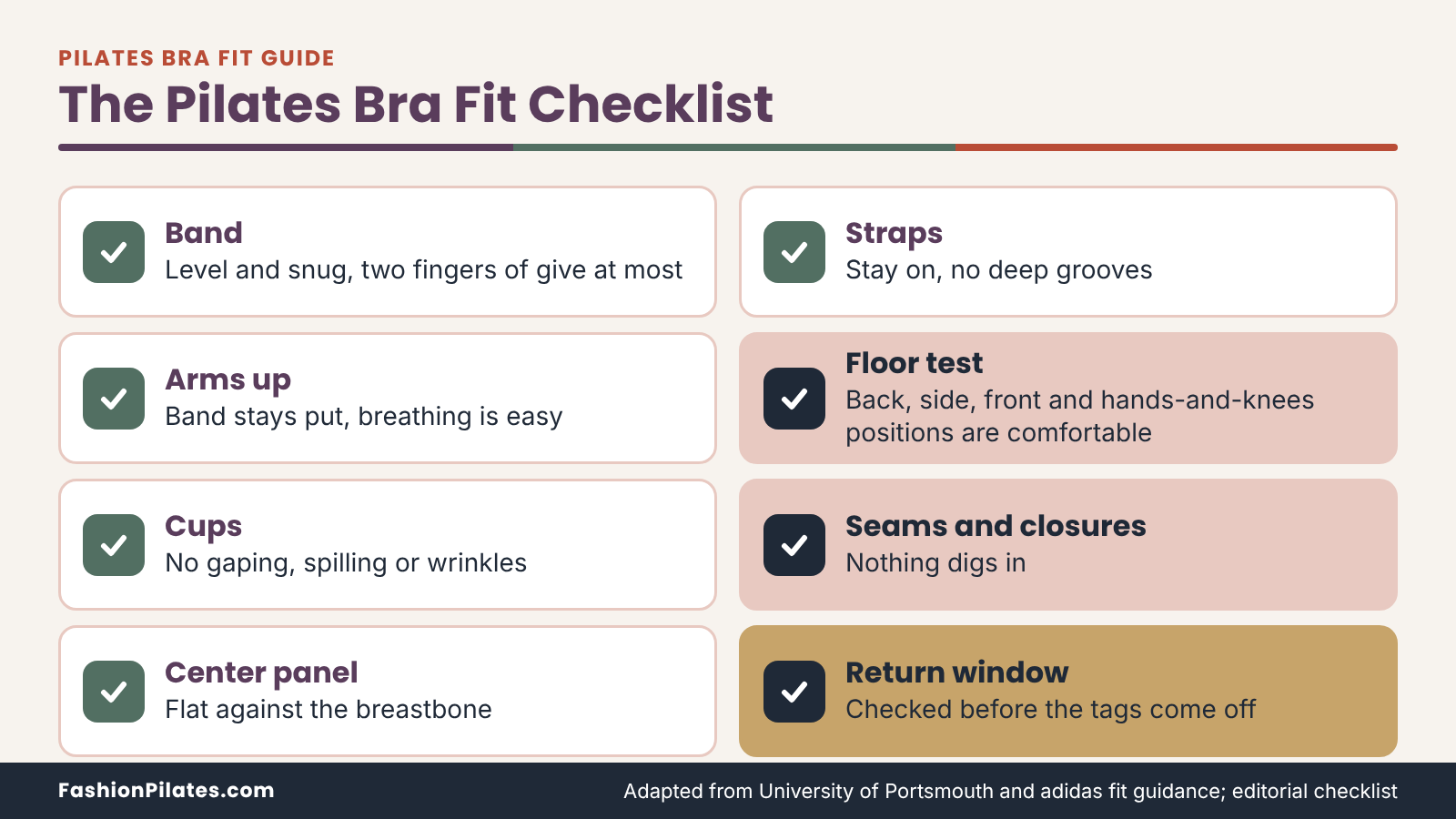
Direct answer: A reliable pilates bra fit guide boils down to five checks: a band that sits level and stays put, cups that hold everything without gaping or spilling, straps that stay on your shoulders without digging, a center panel that rests flat, and a floor test that proves it all still works when you roll, reach and lie face down. Low-impact movement usually calls for light to medium support, but comfort in Pilates positions matters as much as any support label.
This guide is for anyone shopping for, or second-guessing, the sports bra they wear to Mat Pilates (if you’re new, start with a beginner Mat Pilates workout), reformer classes and other low-impact sessions. It covers how to read a bra’s anatomy, how to run a fitting-room check that mimics real Pilates positions, how to choose support level and style, how to solve the most common fit problems, and how to make a bra last. Because the right bra depends on your body, your class format and your sensitivity to fabric and seams, the advice is built around decision criteria rather than a ranked list.
How this guide was built: it is a research-based comparison drawing on published breast-health research, health-agency pages and manufacturer fit guidance. It is not the result of hands-on testing, it names no specific products, and it is general fitness and apparel education rather than individualized medical advice.
What a Pilates Bra Actually Has to Do
Most sports bra advice is written for runners, and Pilates is a different job. Before you compare straps and cups, it helps to be clear about what a bra for slow, controlled, mostly floor-based movement has to accomplish. If you’re brand new to the practice, the Pilates for beginners guide explains what a first class involves. That clarity keeps you from overspending on high-impact engineering you don’t need, or underbuying and spending class time tugging at your neckline.
Low-Impact Is Not the Same as No-Impact
Calling Pilates low-impact is accurate for your joints, but it says little about how a bra behaves. Your torso curls, extends, rotates, inverts and spends long stretches face up, face down and on its side.
What the Research Does and Does Not Cover
Nearly everything we know about breast movement and bra performance comes from studies of running, jumping and agility tasks. A conference abstract from the University of Portsmouth’s breast-health researchers, for example, notes that most of the literature centers on treadmill activity and argues that other kinds of movement need study so support can be designed for them. We found no study that measured bras during a Pilates class, so anything specific to Pilates in this guide is reasoned from fit principles, not proven by Pilates data. Treat it as informed guidance and let your own comfort be the tiebreaker.
Why Pilates Movements Load a Bra Differently
In a running bra, the main enemy is vertical bounce. In Pilates, the challenges are different: a roll-up or rolling movement presses the back band into the floor, a prone extension compresses the front of the chest, side-lying work asks the band to stay level on an angle, and overhead reaches test whether straps and bands creep. Reformer classes (reformer Pilates explained) add more of the same, plus the occasional jump-board section that moves a class toward medium impact. A bra that feels fine standing at a mirror can fail the first time you lie back on a hard surface, which is why the fit check later in this guide happens on the floor.
The Four Jobs of a Pilates Bra
It’s useful to think of a Pilates bra as doing four jobs at once. If a bra does three of them well and one badly, you’ll usually notice the weak one by the second exercise.
Support That Stays Put
Support in a low-impact setting is less about stopping bounce and more about stability: the bra should hold its position through transitions so you aren’t adjusting between exercises. Researchers at the University of Portsmouth link inadequate breast support in running to greater perceived effort and altered muscle activity, according to the group’s overview of its findings. That evidence is from running, but the underlying idea carries over in a modest way: a bra that moves around is a distraction you’d rather not have while you’re trying to feel your deep abdominal muscles work.
Comfort in Every Position
Comfort is the job people underrate. A bra has to feel acceptable lying on your back, on your stomach, curled over your knees and reaching overhead, and those positions expose seams, clasps, wire ends and tags that never bother you standing up. Because Pilates is quiet and focused, small irritations get loud quickly. When you evaluate a bra, judge the least comfortable position, not the most flattering one.
Freedom to Breathe and Rotate
Pilates cueing leans heavily on breath and rib-cage movement, so a band that restricts expansion works against the method. Compression that feels reassuring when you try it on can feel oppressive by minute thirty of a class, especially in a warm room. The goal is snug, not constricting: you should be able to take a full breath into the sides and back of your ribs, twist through the spine and reach overhead without the band riding up.
Coverage and Confidence Under Your Outfit
The fourth job is how the bra works under what you wear: tank straps, a cropped top, a wrap, a fitted long-sleeve. Visible lines, strap collisions and see-through fabric are fashion problems, but they’re also comfort problems if you spend a class managing them. Choosing a bra with your usual tops in mind, and pairing it with squat-proof Pilates leggings and the looks in our fall Pilates outfits guide, saves a surprising amount of fiddling. The wardrobe section below returns to this idea.
Bra Anatomy and Sizing Basics
You can’t evaluate fit if you don’t know which part of the bra is responsible for which job. The anatomy is simpler than the marketing makes it sound, and sizing is messier than the numbers on the tag suggest.
Reading the Parts of a Sports Bra
Every sports bra, from a pullover crop to a hook-and-eye style, has the same basic components. Learning what each one is supposed to do turns vague discomfort into a specific diagnosis.
The Band Does Most of the Work
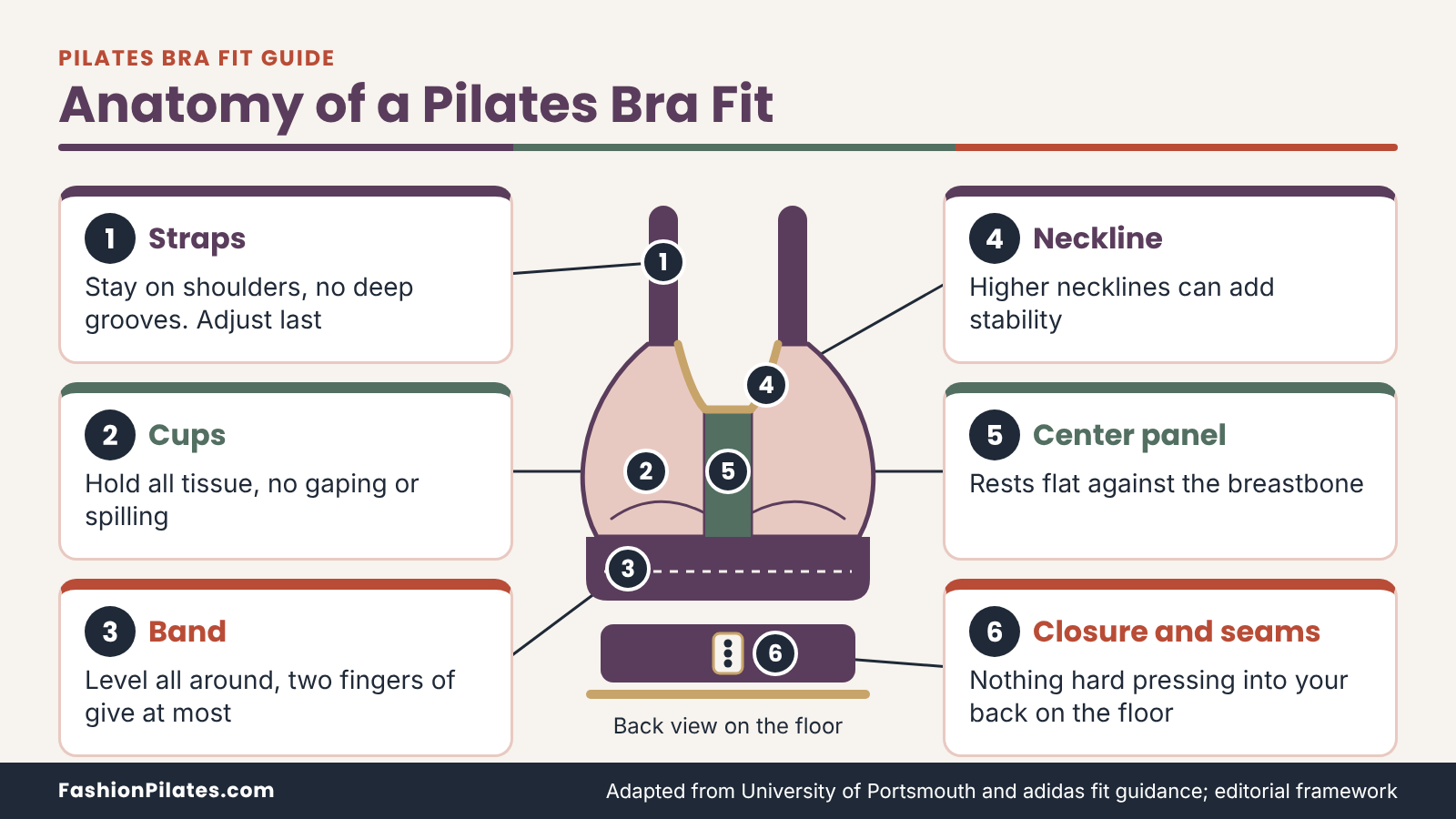
The band, sometimes called the underband, is the elastic section that circles your ribs below the cups. It should carry most of the support, lie level all the way around, and stay in place when you raise your arms. The Portsmouth research group’s “best fit” criteria, as described by one of its researchers, say that if you can pull the band away from your body by more than about 2 inches (5 centimeters) at the side, it’s too loose. A manufacturer fit guide from adidas offers a friendlier rule of thumb: you should fit about two fingers between your body and the band, but not more.
Cups, Center Panel and Straps
The cups should hold all of your breast tissue with no bulging at the top or sides and no empty, wrinkled fabric. The center panel, the section between the cups, should rest flat against your breastbone; if it lifts away, the cups may be too small. Straps are the supporting actors: they stabilize and fine-tune, but they shouldn’t be doing the heavy lifting, and if they leave deep grooves the band is probably too loose and the straps are compensating.
Why the Numbers on the Tag Disagree
If you’ve ever worn a 34B in one brand and a 36A in another, you’ve met the real problem with bra sizing. Understanding why will save you from treating any one size as gospel.
Sizing Is Not Standardized
Researchers at the University of Wollongong note in a university news feature on bra design that sizes are not standardized across manufacturers and that many designs scale up from a single base size even though breast and torso shapes do not scale in the same way. The practical meaning is that your size is a starting point, not an identity. Sports bras add another layer, because many are sold in small, medium and large instead of band and cup, and each brand maps those letters to a different range of measurements.
Sister Sizes and Why a Tape Measure Is Only a Start
Sister sizes sound like a sitcom, but they’re a real fitting tool: when you go up a band size, you go down a cup size to keep roughly the same cup volume, so a 34C and a 36B are related. That helps when a bra’s band feels right but the cups don’t, or the reverse. The Portsmouth group argues for fitting by a best-fit check rather than relying on a tape measure alone, and its published figure is that a large majority of women, 70 to 80 percent by its estimate, wear the wrong bra size. Take that statistic as the group’s own estimate rather than an independent audit, but the lesson is clear: measure, then try on, then trust the try-on.
A Pilates Bra Fit Guide for the Fitting Room
This is the practical center of the article: a two-stage check you can run in a fitting room or at home with the tags still on. Stage one is a standing inspection. Stage two is a floor test built around the positions Pilates actually uses. Do both before you decide, and check the retailer’s return policy first so a failed floor test is an easy exchange, not a sunk cost.
Stage One: The Standing Inspection
Stand in front of a mirror with good light, adjust the bra the way you would for class, and work from the band outward. Fastening or pulling on the bra to its loosest or tightest setting is a common shortcut that hides problems, so start with the setting you’d actually wear.
Band and Strap Checks
Begin with the band. It should sit level front to back, feel snug but not squeezing, and show no more than about two fingers of give when you tug at the side. Raise both arms overhead and lower them: a band that creeps up your back is too loose or the wrong shape for your torso. Then adjust the straps last, so they hold the cups in position without lifting the band. Two fingers should slide under a strap with a little resistance, and the straps should neither slide off nor leave deep grooves. If you only fix the band by tightening the straps, you’ve hidden the problem rather than solved it.
Cup, Center Panel and Neckline Checks
Next, look at the cups. Your tissue should be fully contained, with a smooth line at the top and sides, and no wrinkling or empty space at the front. The center panel should rest flat against your breastbone; if it floats away from your chest, try a size up in the cup, which is consistent with the Portsmouth group’s fit criteria. Finally, check the neckline. For larger busts, a Portsmouth researcher said that each centimeter of raised neckline may reduce breast movement by around 1 percent, which is a useful reminder that coverage up high contributes to stability, not only modesty.
Stage Two: The Floor Test
The floor test is what separates a Pilates bra fit from a generic one. It takes about five minutes, and it works best in a changing room with enough floor space, or at home on a mat or carpet. You’re not performing a workout, so keep every movement small and easy. This is general fitness education and not individualized medical advice: if you have a current injury, are pregnant or postpartum, have had recent surgery or have a chronic condition, check with a qualified clinician or Pilates professional about which positions are appropriate for you.
The Five-Position Sequence
Move through five positions slowly, pausing in each for two or three easy breaths. First, lie on your back with knees bent and feet flat, and notice whether the back closure or seams press into your spine. Second, hug your knees to your chest and rock very gently forward and back an inch or two, as you would in a rolling movement, and see whether the band shifts. Third, roll to your side with your head on your arm and check that the band stays level. Fourth, if comfortable for you, lie face down and notice pressure at the front of the chest. Fifth, come to hands and knees, then sit tall and reach both arms overhead. Stop any position that causes sharp pain, dizziness, numbness or tingling.
Reading the Results and Making Quick Fixes
After the sequence, stand and look in the mirror again. A bra that passes is one where nothing moved far, nothing dug in, and you stopped noticing it by the third position. If the band rode up, try one band size smaller or the next sister size, then repeat the test. If straps slid, shorten them or consider a different strap shape, such as a racerback. If a seam or clasp pressed into your back or chest, no adjustment will help, so move on to a different construction. Return policies exist for exactly this moment, so if you can’t test on the floor in the store, test at home before removing tags.
Choosing Support Level and Style
With fit established, the next decision is how much support and what silhouette. This is where marketing language gets loud, so it helps to understand what support labels do and don’t tell you.
Light, Medium and High: What the Labels Mean
Most brands sort sports bras into light, medium and high support. These categories are helpful shorthand, but they aren’t regulated, so one brand’s medium can be another’s light.
There Is No Universal Support Standard
Support categories are brand-defined. The adidas fit guide mentioned earlier, for example, places yoga and Pilates in its light-support category, suggests medium support for cycling and dance, and reserves high support for running and similar activities. Treat those pairings as one manufacturer’s recommendation, not a rule. A more reliable approach is to look at the construction features that research associates with better support in running bras, which the Portsmouth group lists as encapsulation style, padded cups, an adjustable underband, nylon fiber content and a high neckline. Those are running findings, so use them as a checklist of features to notice, not a guarantee.
When Light Support Is Not Enough
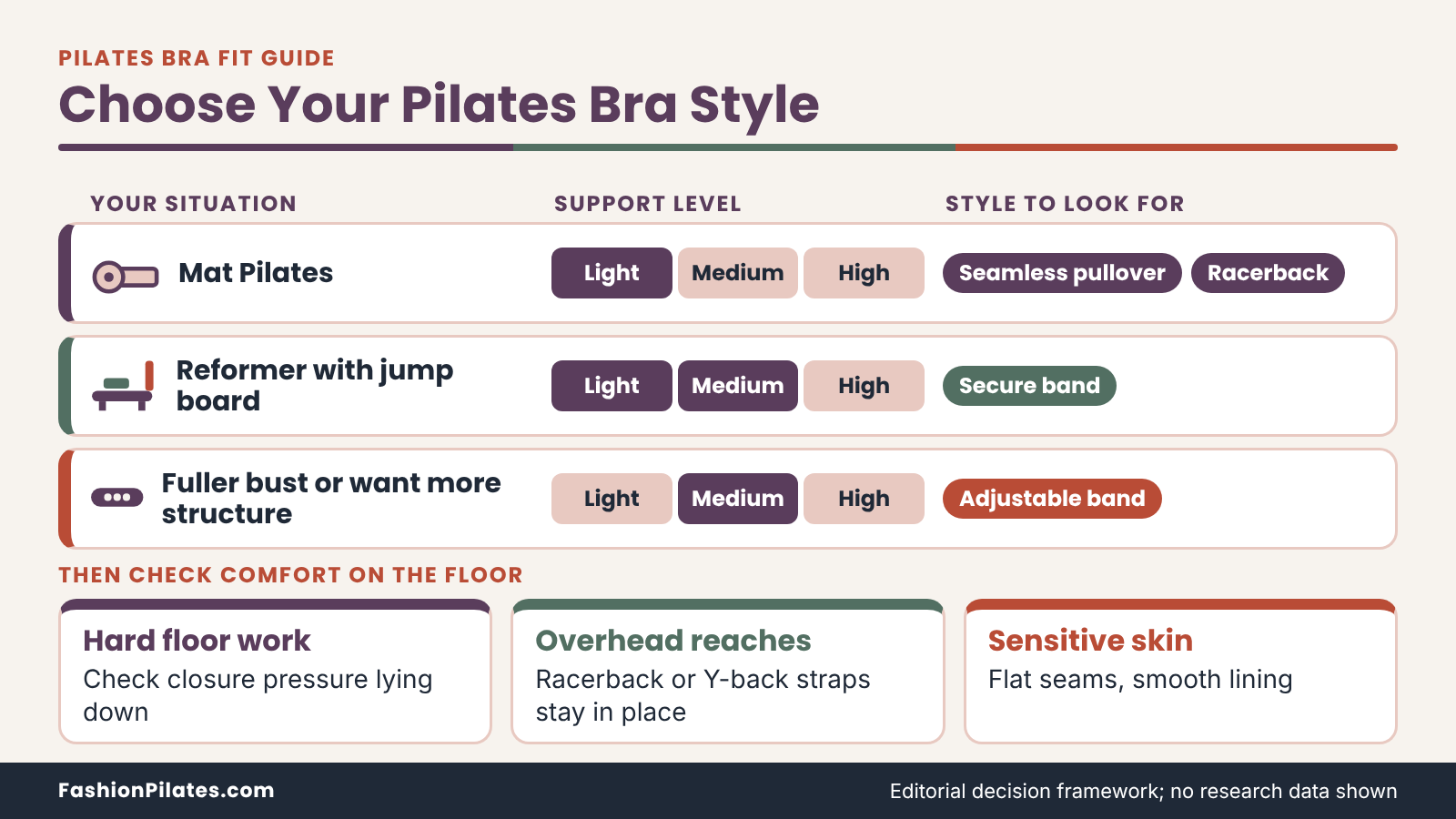
Light support suits a lot of Pilates, but there are good reasons to step up to medium. You may carry more tissue and find that a stretchy, pullover crop doesn’t feel stable. You may take classes with jump-board sections or cardio intervals, or you may use the same bra for a walk to class. You might simply feel more comfortable with more structure. If you find yourself holding your chest during transitions or avoiding certain exercises because of how the bra feels, that’s information worth acting on, and a different bra is a cheaper fix than a lower-quality class.
Silhouettes and Construction Compared
Once you know your support level, the silhouette determines how the bra behaves in Pilates positions. The table below compares the most common styles on the criteria that matter for floor work.
| Style | Best for | Watch out for | Floor-work comfort |
|---|---|---|---|
| Pullover compression crop | Smaller to moderate busts; simple, seamless wardrobe basics | Hard to adjust; can flatten or ride up with arm reaches | Usually good, since there is no clasp |
| Racerback or Y-back | Keeping straps in place during overhead reaches | Pulling on the neck if straps are too tight; fiddly to put on | Good; straps stay clear of the floor |
| Crossover or strappy back | Visible-back tops and personalization | Strap collisions; pressure points where straps cross | Mixed; check straps on your back when lying down |
| Front zip or front closure | Easier to take on and off; some added adjustability | Zipper pulls pressing on the chest face down | Good on the back, check face-down comfort |
| Hook-and-eye back closure | Adjustable band; more structure for fuller busts | Hooks pressing into the spine on a hard floor | Varies with padding behind the hooks |
| Encapsulation (separate cups) | Fuller busts, extra stability, medium-support days | More seams; usually a longer fitting process | Depends on seam placement |
| Wireless vs underwire | Wireless: typical for low-impact comfort. Underwire: some prefer for shape | Underwire ends digging in when lying on side or front | Wireless is usually more comfortable on the floor |
Compression Versus Encapsulation
Compression bras press the chest against the body to reduce movement, while encapsulation bras give each breast its own cup. Published running research suggests encapsulation can be a feature of better support, but Pilates positions change the calculus. Compression is simple and often seamless, which many people prefer for floor work. Encapsulation tends to suit fuller busts or anyone who wants more structure. Some bras blend the two, which is why the style names on a product page matter less than how it feels on the floor.
Back Styles, Closures and Floor Contact
A style that looks great from behind can be miserable under a back-lying hold. Racerbacks keep straps off the floor, which helps in supine and rolling work. Hook-and-eye closures offer adjustability but can press into the spine when you lie back, especially on a firm surface. Wide, flat bands behind the clasp, or a clasp set within a padded panel, can reduce that pressure. If you attend reformer classes, remember that you’ll be lying against a padded carriage, which is more forgiving than a hard floor, so a style that fails on a bare studio floor may still work there.
Fabric, Seams, Padding and Skin Comfort
Two bras with the same size tag and the same support label can feel completely different once you start moving, and the difference is usually in the materials and construction. Pilates rewards a bra that disappears, so the details your skin notices matter more than the details a product photo shows.
Fabric and Construction
Fabric affects stretch, recovery, moisture handling and how long a bra keeps its shape. You can’t test fabric longevity in a fitting room, but you can read labels and feel the material for what you can control.
Fibers, Stretch and Moisture
Most sports bras are blends of nylon or polyester with elastane for stretch. The Portsmouth group lists nylon fiber content among the features associated with better running-bra support, though that finding comes from running and shouldn’t be read as proof that nylon is better for Pilates. For skin comfort, the Cleveland Clinic’s guidance on chafing recommends choosing moisture-wicking fabrics over cotton, which holds moisture and dries slowly, and notes that moisture makes skin easier to damage. A warm studio or a heated-room class raises the stakes, so look for breathable panels and a soft, smooth inner surface. Check the stretch, too: a fabric that stretches easily and never recovers will fail within months.
Seams, Closures, Labels and Hardware
Friction is the root cause of chafing according to the same Cleveland Clinic page, which also points to tags and seams as common culprits. In Pilates, seams matter most where your body presses against the floor or the carriage: along the band, behind the clasp, under the arms and at the front of the chest in prone work. Run a finger along the inside before you buy. Flat-bonded or laser-cut seams, tag-free labeling, a covered clasp and smooth elastic edges tend to be gentler than raised stitching, but trust your own skin over any product description.
Padding, Cups and Coverage
Cups come in several constructions, and each has trade-offs for shape, coverage and how a bra behaves under thin fabric. Pilates tops are often fitted and sometimes light-colored, so cup design affects your outfit as well as your comfort.
Removable Pads, Molded Cups and Shelf Styles
Removable pads give you control, since you can take them out if they bunch or slip, but they can shift in the wash and migrate during floor work. Molded cups hold their shape and offer smooth coverage, and they tend to be a better fit if you want a consistent silhouette, though they can feel stiff on your stomach. A shelf or built-in bra, common in tank tops, is the lightest option and suits some people for gentle classes. It rarely provides the stability of a standalone bra, so it’s worth asking whether you trust it for every exercise in your routine.
What Surveyed Exercisers Say They Want
A survey of 3,147 active women in the United States, the United Kingdom and China found that many US and UK respondents preferred compression-style bras with racerback designs, wide adjustable straps and underbands, no underwire, and padded or molded cups. About a third of all respondents said shoulder straps dug into their skin, and 25.4 percent named difficulty finding suitable bras as a barrier to exercising. The study was sponsored by a sportswear manufacturer and is self-reported, so read it as a snapshot of preferences, not proof of what works. It does suggest that strap comfort and adjustability are common pain points worth checking.
Common Fit Problems and Fixes
Even a bra that passed the fitting-room check can develop problems by the third or fourth class, because bodies change through the day and fabrics relax with wear. The key is to match the symptom to the likely cause before you spend money on a replacement.
Problems at the Band and Straps
Band and strap complaints account for many returns, and they often share a root cause. If you fix the band first, straps usually follow.
The Band Rides Up or Digs In
A band that creeps up your back during overhead reaches is usually too loose, or its elastic has lost recovery. Try the tighter hook if there is one, or go down a band size and up a cup size to keep the cup volume similar. A band that digs in, leaves deep marks or limits your breathing is too tight, and tightening it further does not add support so much as it adds discomfort. If the band is right but the elastic edge presses into skin, look for a wider, softer band or a different construction rather than trying to live with it.
Slipping Straps and Shoulder Grooves
Straps slide when the band is loose, the cups are too large, or the strap shape doesn’t suit your shoulders. Shorten straps only after fixing the band, and consider a racerback or Y-back if straps keep drifting. Deep grooves mean the straps are carrying too much load, which is again a sign the band isn’t doing its share. Wider, padded straps spread pressure better, which matches what survey respondents said they prefer, but a wide strap on a loose band just moves the problem somewhere else.
Problems at the Cups and Chest
Cup issues are visible in the mirror and often easier to diagnose than band issues, but the fixes are less obvious because a different cup size changes the band, too.
Gaping, Spilling and Flattening
Gaping at the top of the cup means the cup is too big or the bra isn’t centered, while spilling over the top or sides means it’s too small. Flattening or a single-shape silhouette can happen with some compression designs, and it isn’t necessarily wrong if you’re comfortable, but if you feel pinned in, try an encapsulated design. If the center panel lifts away from your breastbone, the Portsmouth criteria suggest going up a cup size. Move one variable at a time so you know which change helped.
Soreness, Red Marks and Chafing
Red lines that fade within an hour are common and not necessarily a problem, but marks that persist, broken skin or burning are signs of a poor fit or a fabric issue. The Cleveland Clinic notes that chafing generally improves within days with self-care and advises contacting a provider if it worsens or you suspect infection. Breast pain is a different matter: the NHS says that wearing a properly fitted bra may help ease breast pain, and also lists signs that warrant medical attention, such as a hard lump, nipple discharge, redness or swelling. Persistent or unusual symptoms are a reason to see a clinician, not to buy another bra.
The table below turns the most common complaints into a quick troubleshooting guide you can use in a fitting room or after a class.
| What you notice | Likely cause | What to try first | When to move on |
|---|---|---|---|
| Band creeps up your back | Band too loose or stretched out | Tighter hook, or one band size down and one cup size up | If it rides up again within a few washes |
| Band digs in or limits breathing | Band too tight or too narrow | Loosen one hook or go up a band size | If the edge still cuts in at the right size |
| Straps slip or leave grooves | Loose band, oversized cups or wrong strap shape | Fix the band, then shorten the straps | If straps still slide with a snug band |
| Gaping at top of cups | Cups too large or bra off-center | Re-seat the bra; try one cup size smaller | If the gap remains in every size |
| Spilling at top or sides | Cups too small | Go up one cup size and check the band | If the next size is loose at the band |
| Center panel floats off the chest | Cups too small for your shape | Try a larger cup size | If it persists in a different style |
| Rubbing or red marks after class | Seams, moisture or friction | Check the inner seams and fabric; try a smoother, moisture-wicking option | If skin breaks or the area looks infected |
| Persistent breast pain or new lump | Not a fit problem to solve at home | Book an appointment with a clinician | Do not wait to try another bra first |
Fit Across Body Types and Life Stages
There’s no single correct sports bra, and the advice that works for one body can mislead another. This section covers how fit priorities shift with bust size, and what to consider when your body changes, without prescribing anything medical.
Smaller Busts to Fuller Busts
Bust size changes which trade-offs matter most. A smaller bust usually has more freedom of choice, while a fuller bust has more to gain from structure and fewer styles to pick from.
Smaller Cup Sizes
If you wear a smaller cup, light support is often plenty for Pilates, and many people are happiest in seamless pullovers, bralettes or shelf styles. The risks are different: bras that are too large can gape and slip, and thin fabrics can show more through fitted tops. Look for a band that holds firmly, cups that fill without wrinkling and straps that stay put. Don’t assume a small cup means you can skip the fit check, since the same band and strap problems appear at every size, and poorly designed bras are not exclusive to fuller busts.
Fuller Busts and More Structure
If you have a fuller bust, adjustability and structure usually deserve more of your attention, and many brands offer extended sizing in separate lines. Look for an adjustable band with multiple hooks, wide and cushioned straps, a high neckline and separate cups if compression alone feels insufficient. The Portsmouth researchers’ neckline finding was framed around larger busts, and the adidas guide associates light support with smaller cup sizes and recommends more support for larger ones. If you have a fuller bust and find light-support bras uncomfortable in Pilates, that isn’t a personal failing but a reasonable reason to choose medium support for class.
When Your Body Changes
Your size isn’t fixed for life, and sometimes it isn’t fixed for the week. Knowing what can change your fit helps you decide when to refit, not just when to buy.
Everyday, Monthly and Gradual Changes
Many people notice that breast fullness or tenderness shifts across a month, and weight changes, strength training and aging can all alter band and cup fit gradually. If a bra that fit last season suddenly feels wrong, re-run the five-point check before blaming the bra. Having one bra with a more forgiving, adjustable fit in your rotation can help on days when your usual choice feels snug. Sizing up or down a band or cup is not a verdict on your body, it’s just a better description of your current measurements.
Pregnancy, Postpartum, Nursing and After Surgery
Pregnancy, postpartum recovery, nursing and breast or chest surgery can change fit needs substantially, and these are situations where individual guidance matters. Check with your obstetric provider, surgeon or care team about what’s appropriate to wear and when, and about which Pilates positions to include or avoid. Some people benefit from a specialist fitter, particularly after breast surgery, where a clinical team or a qualified fitter can advise on styles and timing. This guide doesn’t give medical direction for those situations, and the fit checks above are a starting point for a conversation, not a substitute for one.
Care, Lifespan and Smart Spending
A bra that fits well on day one can fail by month three if you treat it like an ordinary garment. A bit of care, plus a realistic idea of when to retire a bra, keeps both comfort and budget on track.
Making a Bra Last
Sports bras are working garments, and elastic is the first thing to go. A few habits slow that down, and none of them require special products.
Washing and Drying
Start with the care label, because manufacturers know their fabrics and constructions. Heat is a general enemy of elastic, so many people choose cooler washes and air drying over a hot dryer, and fastening hooks before washing helps protect other garments and the bra itself. Skip fabric softener unless the label allows it, since softeners can coat technical fabrics and reduce moisture handling. Rinse and dry the bra soon after class instead of leaving it in a gym bag, because lingering sweat and bacteria are not kind to skin or fabric, and gym-bag chaos has ruined more bras than any washing machine.
When to Replace a Bra
There’s no universal expiry date, and the available guidance varies. A Portsmouth researcher quoted in a Coach magazine feature said sports bras can lose support after around 25 washes, while the adidas guide suggests replacing every six to twelve months or after roughly 100 washes. Both are rules of thumb from interested parties, and the gap shows how soft the numbers are. A better test is practical: if the band has stretched so you’re on the tightest hook, the fabric is thin or pilled, the cups have lost shape or you feel less stable than before, it’s time to replace it.
Building a Small Rotation
You don’t need a drawer full of bras, but one is rarely enough. Rotating between a few bras extends each one’s life and gives you options for different outfits and different days.
A Three-Bra Rotation
A simple rotation covers most Pilates weeks: a light-support everyday bra for Mat Pilates, a more structured medium-support option for reformer or longer classes, and a back-up for days when the first two are in the wash. The table below outlines how to assign roles and what to look for in each, so every bra has a clear job instead of piling up as a near-duplicate.
| Role | Support level | What to prioritize | Skip if |
|---|---|---|---|
| Everyday Mat Pilates bra | Light | Seamless feel, flat closure or no closure, stretch that recovers | You often feel unstable during transitions |
| Longer class or reformer bra | Light to medium | Secure band, adjustable straps, smooth seams for carriage contact | You always wear a high-support bra anyway |
| Back-up or travel bra | Light to medium | Quick-drying fabric, simple construction, similar fit to your usual | You already own two bras that fit well and rotate easily |
Spending Wisely and Shopping Smart
Price is a poor stand-in for fit, and you can find well-fitting bras across a wide range of budgets. Spend your money where it counts: adjustability, band quality, comfortable seams and a return policy you’ve read. Be wary of pricey accessories or novelty features that don’t address your actual complaint. We don’t quote prices in this guide because they change, so check current listings and return terms on the retailer’s page. If you’re building a wardrobe from scratch, buy one bra that passes every check before you buy two, and keep tags on until you’ve done the floor test at home.
Frequently Asked Questions
How should a sports bra fit for Pilates?
A sports bra for Pilates should feel snug without restricting your breathing, with a band that sits level and stays in place when you raise your arms. The cups should hold all of your breast tissue without gaping or spilling over the top or sides. Straps should stay on your shoulders without digging, and the center panel should rest flat against your breastbone. Manufacturer guidance suggests that about two fingers of space between the band and your body is a reasonable check. After you pass the standing checks, confirm comfort in floor positions such as lying on your back, side and front.
Do I need a sports bra for Pilates at all?
Many people choose to wear one, and there is no rule that says you must. Pilates is low-impact, so the main reasons are comfort, stability during rolling and transitions, and confidence in fitted clothing. Some people are comfortable in a supportive tank with a built-in shelf for gentle classes, while others prefer a standalone bra for the added stability. If you notice discomfort or find yourself adjusting your chest during class, try a bra with a firmer band. Persistent breast pain is worth discussing with a clinician.
What support level is best for low-impact Pilates?
Light to medium support is the most common choice for Mat Pilates and reformer classes. One manufacturer’s fit guide places yoga and Pilates in its light-support category, but support labels are not standardized across brands. A fuller bust, a class with jump-board sections or a preference for more structure may point you toward medium support. Try the bra through a short floor test, since comfort in lying positions matters as much as the label. Choose the lightest option that keeps you stable and comfortable, not the one with the biggest claims on the tag.
Is a wireless or underwire bra better for Pilates?
Wireless bras are generally more comfortable for Pilates because you spend time lying on your back, side and front. Underwire ends can press against your ribs or chest in those positions, and a wire that does not sit correctly can cause soreness. Some people with fuller busts prefer the shape and separation an underwire gives, so it is a personal decision. In a survey of exercising women in the United States and United Kingdom, many respondents said they preferred bras without underwire. If you try an underwire style, run the floor test carefully and check that the wire does not rest on breast tissue.
Why do my sports bra straps keep digging in?
Strap digging usually points to a band that is too loose, so the straps are carrying more of the load than they should. Fix the band first by tightening to a snugger hook or trying a smaller band size, then adjust the straps. Wider, cushioned straps spread pressure more evenly than thin ones. In one large survey, about one third of exercising women reported that straps dug into their skin, so you are far from alone. If the problem persists across several bras, a different strap shape such as a racerback may suit your shoulders better.
How often should I replace a Pilates sports bra?
Replace it when it stops doing its job, rather than on a fixed date. Published advice varies, with one researcher suggesting support can fade after roughly 25 washes and a manufacturer guide suggesting six to twelve months or about 100 washes. Signs to watch for include a stretched band that only fits on the tightest hook, thinning or pilling fabric, cups that have lost their shape, and a bra that no longer feels stable. Washing according to the care label and avoiding high heat can extend its life. Rotating several bras also reduces wear on each one.
Can I wear a regular bra to Pilates?
You can, and many people do for gentle sessions, but a sports bra is designed for movement. Regular bras often have wires, hooks and seams that press into your body when you lie down, and they may shift during rolling and reaching. A well-fitting wireless bralette can work for some classes. If you notice rubbing, digging or constant adjusting, that is a sign to try a bra made for activity. Comfort in floor positions is the best test of whether any bra works for you.
Should I get professionally fitted for a sports bra?
A professional fitting can be helpful, especially if you have struggled to find a comfortable bra, but it is not required. Sizing varies between brands, so even a good fitter’s recommendation is a starting point to try on, not a guarantee. Look for a fitter who evaluates band, cups, straps and center panel and who lets you try several sizes and styles. If you are pregnant, postpartum, nursing or recovering from surgery, ask your care team whether a specialist fitter is appropriate. You can also do a careful self-check at home using the steps in this guide.