Direct answer: A pilates instructor certification tells you that a teacher finished a defined course of training and, in the strongest version, also passed an independent exam that measures entry-level competence. It is not a government license. The National Pilates Certification Program describes Pilates as an unregulated industry rather than a licensed profession, so the value of any credential depends on who issued it, what it covered, and how much supervised teaching sat behind it.
This guide is for three kinds of readers: people curious about teacher training, students who want to know what the letters after an instructor’s name mean, and anyone comparing programs before they spend real money. It is a research-based explanation built on the published pages of credentialing bodies and training schools; we did not take any course, sit any exam, or visit any school. Hours, requirements, and fees change, so treat every number below as a snapshot and confirm it on the official page before you act. This is general education, not career, legal, or medical advice.
What a Pilates Instructor Certification Actually Is
The word “certified” gets used loosely in the fitness world, and Pilates is no exception. Before comparing programs, it helps to separate three ideas that often get blended together: a certificate, a certification, and a license. They sound like cousins, but they answer different questions.
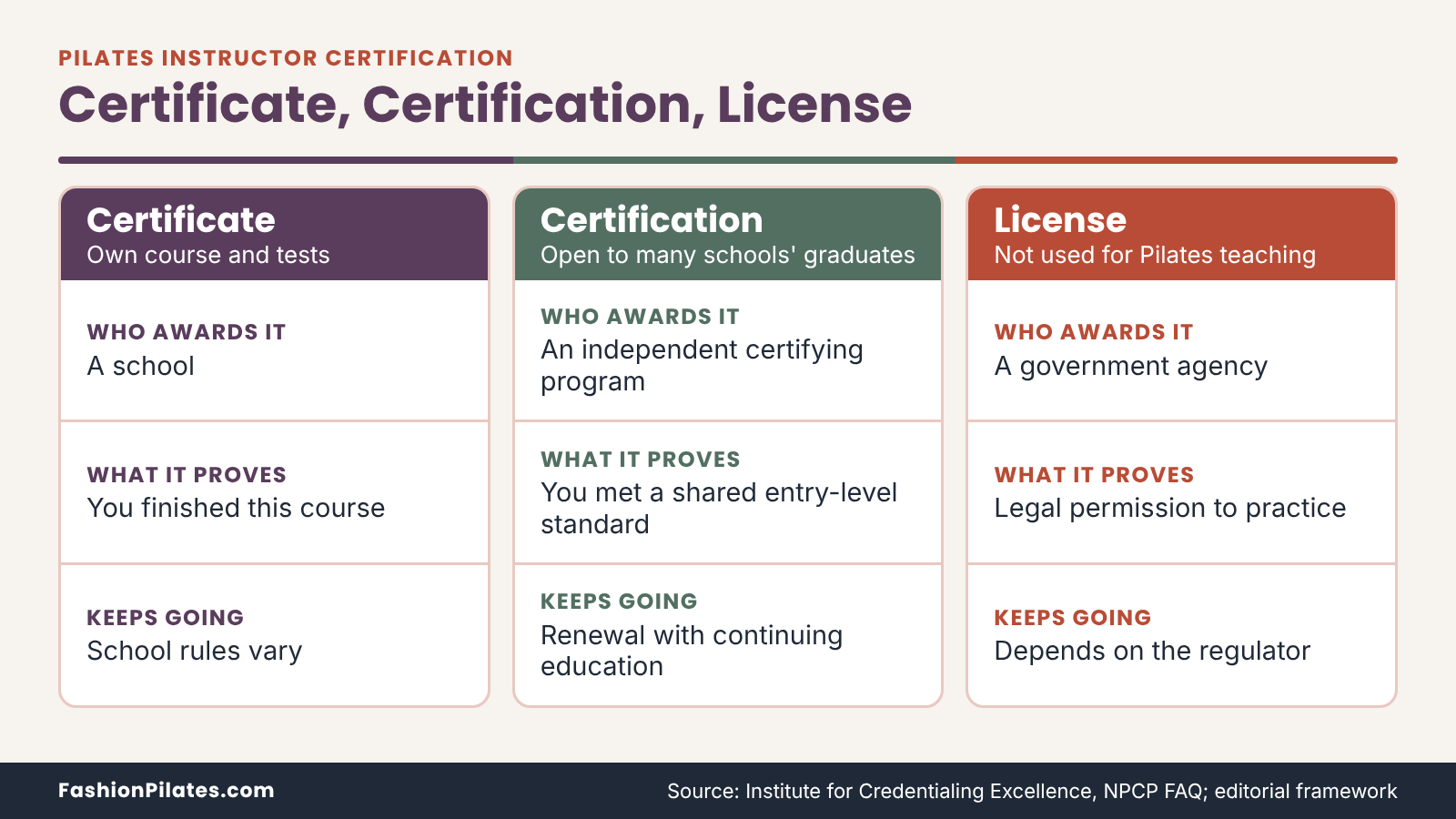
Certificate, certification, and license are three different things
Credentialing professionals draw a sharp line between what a school hands you and what an independent body awards you. Understanding that line is the single most useful move you can make when reading any instructor bio.
A certificate shows you finished a course
The Institute for Credentialing Excellence describes a certificate program as instruction that does not grant a degree, with an assessment tied directly to what was taught. In Pilates terms, that is the diploma a school gives after you finish its coursework, practice hours, and its own written and practical tests. It tells you the student met that school’s standard. It does not, by itself, tell you how that standard compares with any other school’s.
A certification tests competence independent of the course
Per the same organization, a professional certification assesses whether people already have baseline knowledge, skills, or competencies, and it is not tied to any single learning event. Think of a driving test versus a driving school’s attendance record. In Pilates, the clearest example is the exam run by the National Pilates Certification Program, where graduates of many different schools sit the same test. That shared yardstick is what makes certification more comparable than certificates.
Why Pilates has no government license
If you came here expecting a state-issued license like those for physical therapists or massage therapists, the reality is quieter. Pilates teaching sits in the same loosely governed space as most fitness instruction, and that shapes how the whole credential market works.
An unregulated field, in the credentialing body’s own words
The National Pilates Certification Program’s FAQ calls Pilates an unregulated industry that is not a licensed profession, and presents third-party certification as the next best way to reassure the public that a teacher is competent and safe. That does not mean rules never apply to you. A studio, a gym, or an insurer can set its own hiring and coverage requirements, and local business rules can vary. It does mean nobody can point to a single legal definition of “qualified Pilates instructor.”
How employers fill the gap
The US Bureau of Labor Statistics notes that group fitness instructors may start without certification, but employers often encourage or require it, and that requirements vary by facility. The same page says most fitness instructors need CPR and first aid certification plus AED (automated external defibrillator) training. Translation: a studio manager is acting as the licensing board, which is why two studios in the same city can hire on very different standards.
Who Awards What: Schools, Exams, and Accreditation
The credential landscape has layers, and the alphabet soup is half the confusion. Roughly, there are teacher-training schools that educate, an independent certifying program that tests, and an accreditation layer that reviews the testing program itself.
The school layer: where your training actually happens
Almost every working instructor learned inside a school, studio-based program, or equipment company’s education arm. These programs differ in philosophy, structure, and depth, so the school’s name tells you something real about the training even though it does not tell you everything.
Brand and lineage programs have their own standards
Equipment-company and method-based schools publish their own curricula. Balanced Body’s mat program, for example, lists three 16-hour mat courses plus supervised practice and a final written and practical test, and its page says students become a fully qualified Balanced Body Mat Instructor once everything is complete. Merrithew’s STOTT PILATES training page lists its own mat, reformer, and comprehensive tracks with set hours. Each school defines success on its own terms, which is fine, as long as you know that is what you are looking at. For background on the method itself, our explainer on Contrology, the original name for Pilates shows why lineage matters to some teachers.
A school name is not a national credential
Finishing a respected school’s program and holding an independent certification are separate achievements. Some teachers do both: they graduate from a school, then sit the national exam. Others hold only the school’s certificate, which can be perfectly good training. When you read “STOTT certified” or “Balanced Body trained” on a bio, you are reading about the school. When you read “NCPT,” you are reading about the exam body. Neither label is automatically better; they tell you different things.
The independent exam: NPCP and the NCPT
The National Pilates Certification Program, or NPCP, is the independent certifying body most often cited in the United States. Its exam is separate from any one school’s curriculum, which is the whole point.
What the NCPT credential covers
According to the NPCP’s 2026 exam handbook, the NCPT (Nationally Certified Pilates Teacher) credential goes to teachers who show they are qualified to teach Pilates Comprehensive to people who are apparently healthy or have medical clearance to exercise. The comprehensive exam is multiple choice with 125 items, 100 of which are scored, over three hours, and a passing score of 80 of those 100. It spans four domains: critical observation, teaching, technical expertise, and professionalism. That wording about “apparently healthy” people matters, and we return to it in the client section.
What NCCA accreditation does and does not tell you
The NPCP states that it is accredited by the National Commission for Certifying Agencies, or NCCA. The Institute for Credentialing Excellence explains that accreditation is an independent review of a credentialing program against professional standards, and that it applies to programs rather than individual people. So NCCA accreditation is a statement about the exam’s quality and fairness. It does not rate any individual teacher’s cueing, warmth, or taste in playlists.
Mat, Reformer, or Comprehensive: What the Scope Means
Two instructors can both say they are certified and be trained for very different jobs. Scope is the part of a credential most readers skip, and it is often the part that matters most. A teacher trained for the floor may never have been taught to handle spring tension, and a comprehensive graduate has usually been trained across a long list of apparatus.
Reading the published hours honestly
Hour counts are the easiest number to compare and the easiest to misread. Schools count different activities toward their totals, so a bigger number is not automatically a deeper program.
Mat-focused programs: what the hours include
Balanced Body’s mat page (linked above) states a total of 134 hours for completion. Add up its pieces and the math works: 48 hours across three 16-hour mat courses, 16 hours of movement principles, 20 personal mat sessions, 15 observation hours, and 35 student-teaching hours. STOTT PILATES lists its Intensive Mat-Plus at 95 hours, built from instruction, observation, physical review, and practice teaching. The NPCP’s mat certification sets a floor of at least 100 hours of mat teacher education based on Return to Life, Joseph Pilates’ mat book. So a mat route generally means somewhere near 95 to 135 published hours, with a lot of that being your own practice and observation rather than lecture time.
Reformer and comprehensive: the apparatus jump
Adding equipment changes the scale. STOTT PILATES lists its Intensive Reformer at 125 hours and its Comprehensive Matwork and Reformer program at 310 hours, with a 60-hour apprenticeship included in that figure. Balanced Body’s comprehensive page lists about 166 hours of courses, and separately requires 65 reformer sessions, 65 observation sessions, and 220 student-teaching hours. For the NPCP’s comprehensive exam, the published requirement is at least 450 hours of education covering mat, reformer, trapeze table (often called the Cadillac), Wunda chair, ladder barrel, spine corrector, and magic circle. If you want to understand what that apparatus even is, start with our beginner-friendly guide to Reformer Pilates.
The table below puts the published figures side by side. They come from each school’s or credentialing body’s own pages as of October 2026, and the structure of each column differs, so use it for orientation rather than a ranking.
| Pathway | Published hours and structure | Equipment scope | Best fit |
|---|---|---|---|
| Balanced Body Mat | 134 hours total: three 16-hour mat courses, movement principles, 20 personal sessions, 15 observation, 35 student teaching, final tests | Mat, with props | Teaching group mat classes |
| STOTT PILATES Intensive Mat-Plus | 95 hours: instruction, observation, physical review, practice teaching | Mat (63 exercises listed) | A shorter path into mat teaching |
| STOTT PILATES Intensive Reformer | 125 hours with observation and practice teaching | Reformer (139 exercises listed) | Reformer-focused studio work |
| STOTT PILATES Comprehensive Matwork and Reformer | 310 hours including a 60-hour apprenticeship | Mat and reformer (185 exercises listed) | Broad teaching base in one brand |
| Balanced Body Comprehensive | About 166 course hours plus 20 mat and 65 reformer personal sessions, 65 observation, 220 student teaching | Mat, reformer, apparatus, chairs, barrels | Full-studio teaching |
| NPCP Mat exam route | At least 100 hours of mat teacher education before the exam | Mat, based on Return to Life | Adding an independent credential to mat training |
| NPCP Comprehensive exam route | At least 450 hours of education before the exam | Mat plus the full list of classical apparatus | Adding an independent credential to full training |
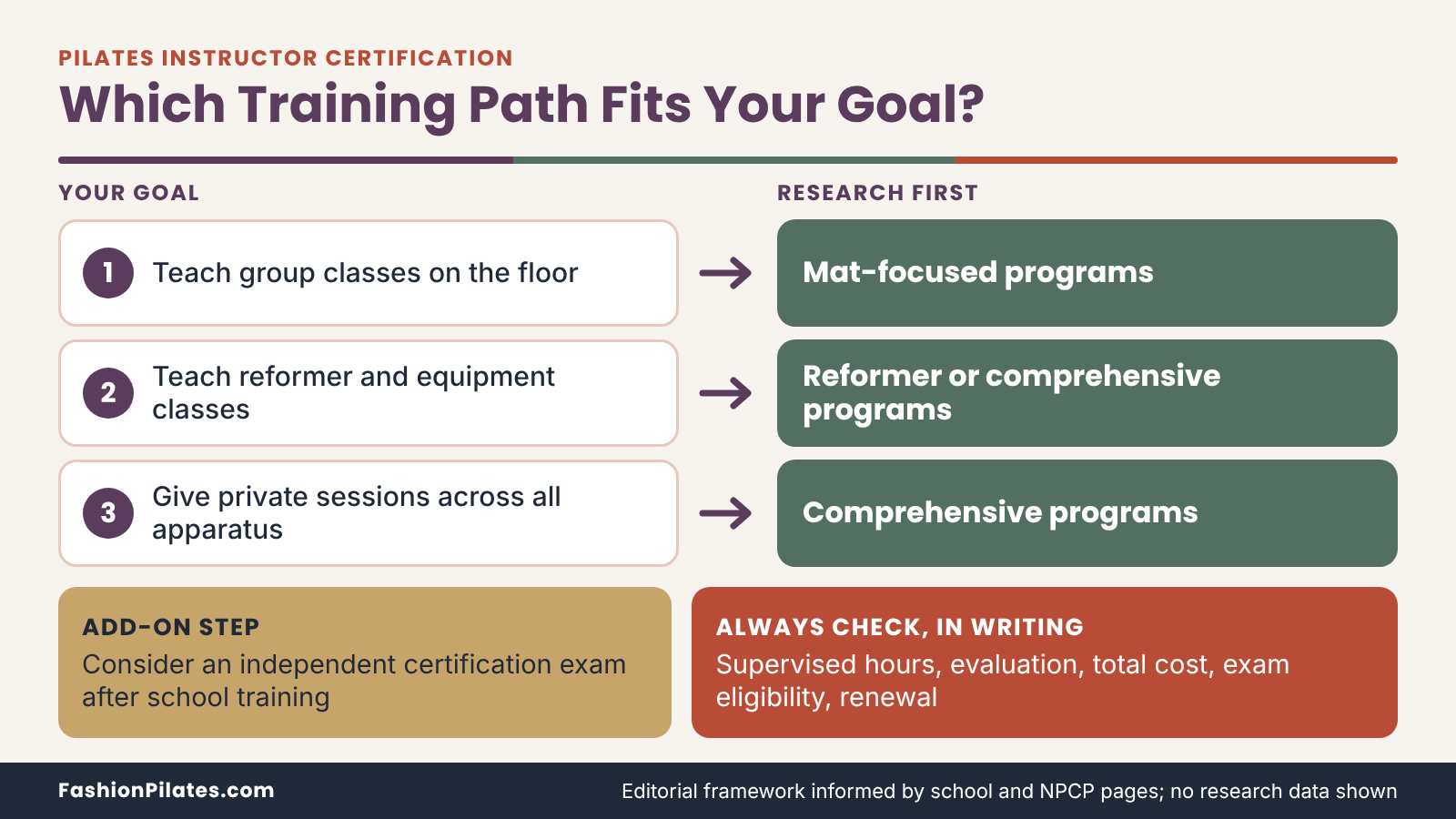
Choosing a scope that matches your goal
Before you shop for a school, decide what you picture yourself doing on a normal Tuesday. The answer narrows the field faster than any brochure can.
If you want to teach group mat classes
A mat-focused certification is the more proportionate choice when your goal is group classes on the floor, community programs, or adding Pilates to an existing fitness teaching practice. Mat teaching is a legitimate career on its own, and the method deserves respect as more than a stepping stone; our guide to what Mat Pilates is explains why. The trade-off is scope: a mat-only credential should not be read as permission to teach reformer or chair classes. If you think you might want apparatus work later, ask each school how mat hours can count toward a larger program.
If you want private sessions or a full apparatus studio
Studios built around reformers, towers, and chairs usually want teachers trained across that equipment, and clients booking private sessions often arrive with specific goals or health histories. In those settings, a comprehensive path and a higher hour count generally make more sense, because you will be adjusting springs, setups, and progressions for individual bodies. The cost is time and money, plus a longer apprenticeship period before you feel fluent. It is also the route where an independent comprehensive credential is most likely to be asked about.
What Good Pilates Teacher Training Should Include
Hours are only a container. What fills them is what shapes the teacher you become. The NPCP’s published eligibility rules, which take effect January 1, 2027 for its comprehensive exam, give a useful outline of what a serious program should cover, and the school-comparison questions in its guide to choosing a training school point the same way.
The classroom side: knowledge you cannot skip
Good training teaches you why as well as what. A teacher who can recite a sequence but cannot explain its purpose will struggle the first time a client asks for a modification.
Anatomy and movement principles
Functional anatomy and the principles of movement are the vocabulary behind every cue. The NPCP’s eligibility page says history and anatomy education may be pre-recorded but must include a supporting quiz. Schools build this in differently: STOTT’s comprehensive track lists 30 hours of functional anatomy, while Balanced Body requires a 16-hour movement principles course and recommends a separate anatomy course for its mat track. Ask where anatomy sits in the sequence, and whether you will be assessed on it or simply sit through it.
Repertoire, cueing, modifications, and special populations
This is the heart of the craft. Per the NPCP’s published requirements, repertoire training should cover teaching technique, modifications, contraindications, progressions, and cueing, along with special populations, and those parts need an in-person or live virtual component. In plain English: learning to cue a movement is not the same as being able to watch a real body do it and adjust the instruction. A program that is mostly videos you watch alone would leave that gap wide open.
The practice side: where teaching skill is built
Reading about teaching and teaching are different skills, and the practice hours are where a person becomes an instructor instead of a well-informed student. This is the part that cannot be rushed.
Your own practice and observation hours
Strong programs expect you to feel the work in your own body and to watch experienced teachers handle real classes. The NPCP says observation and practice teaching must include a portion supervised by a school-approved teacher, in person or live virtual, with the school setting the exact share. STOTT lists 10 to 20-plus observation hours depending on the track, and requires at least 30 hours of Pilates class participation before its intensive mat and reformer courses. Observation teaches you what you cannot get from a manual: pacing, room management, and how a veteran fixes a problem without making it a lecture.
Practice teaching and apprenticeship
Practice teaching is where your cueing meets reality, and apprenticeship is the longer version, working with a supervising teacher over weeks or months. STOTT’s comprehensive track lists a 60-hour apprenticeship at an Academy Partner after the course, with practice logs, written and practical exams, and an apprenticeship log. Balanced Body’s comprehensive path lists 220 student-teaching hours. Ask any school how many hours are supervised, who evaluates you, and what happens if you are not ready at the end. Honest answers to that last question tell you whether the final exam is a real checkpoint or a formality.
How to Vet a Pilates Teacher Training Program Before You Pay
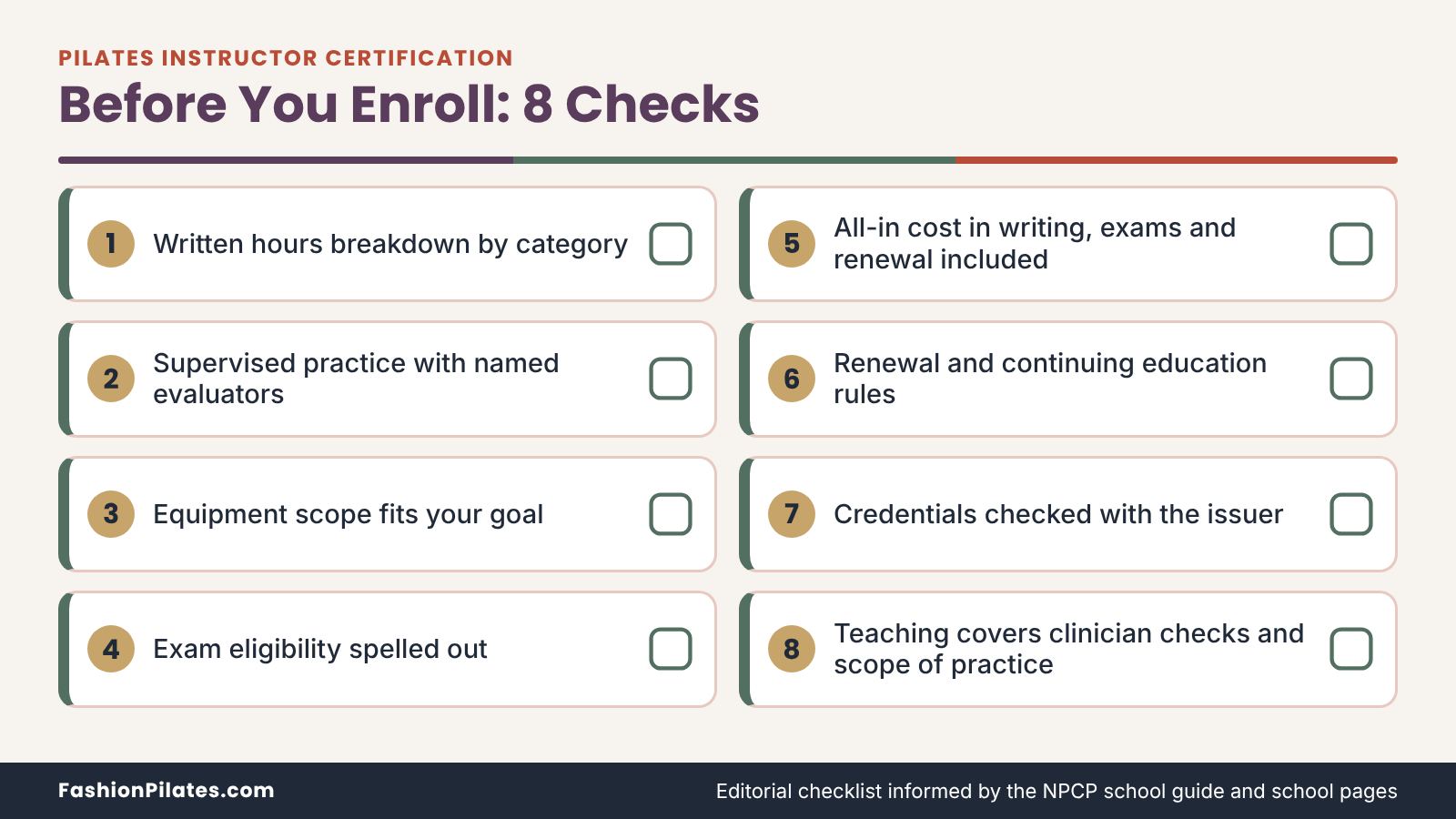
Enrolling is a large commitment of money and months, and the marketing pages for training programs are written to sell, not to compare. The better approach is to bring your own checklist. The questions below follow the themes in the NPCP’s published guide to choosing a training school, supplemented with common-sense editorial criteria.
Questions to ask a school before enrolling
You are not being difficult by asking for specifics. A program that is proud of its structure will answer plainly, and a vague answer is information too.
Hours, supervision, and who signs off
Start by asking for a written breakdown of the total hours: how many are instruction, self-practice, observation, practice teaching, and apprenticeship, and how many of those are supervised by an approved teacher. Then ask who makes the final call that you are ready, since the NPCP’s eligibility rules say a school, mentor, or authorized individual must verify the complete education when a candidate trained in more than one place. If you plan to sit an independent exam later, ask the school directly whether its graduates are eligible, and in which pathway. The NPCP guide itself notes that its list of schools is informational and that students are responsible for confirming a school meets the standards.
Exam eligibility, renewal, and the full cost
Ask what the total price will be from first day to certified, in writing, including manuals, required personal sessions, exam fees, and anything the school charges for materials. Then ask about what comes after: do you need continuing education to keep any credential, and what do those requirements typically cost in time and money? The NPCP’s guide encourages students to ask schools about tuition, registration, exam, and certification costs, and about ongoing maintenance. A school that cannot estimate those numbers has probably not thought about what happens to its graduates after graduation.
This table turns those questions into a quick scorecard you can take to a school call or open house. The “good answer” column is editorial judgment based on the published criteria above, not a rating of any real school.
| Question | What a strong answer sounds like | Warning sign |
|---|---|---|
| How many hours are supervised? | A written breakdown of instruction, observation, practice teaching, and apprenticeship | One big hour total with no categories |
| Who evaluates my teaching? | Named, approved teachers with a clear evaluation method | Self-reporting only |
| Which exams can graduates sit? | Specific pathways named, with the eligibility rules to read yourself | “Everyone qualifies” with no details |
| What is the all-in cost? | An itemized estimate including exam and renewal costs | Tuition only, extras revealed later |
| What happens if I am not ready? | A defined remediation or extra-practice process | Everyone passes by default |
| What equipment will I learn? | A clear list matching the scope of the credential | Broad claims, narrow curriculum |
Red flags and green flags
Beyond the questions, there is a pattern-spotting skill. Most weak programs share a handful of habits, and most strong ones share the opposite handful.
Promises of speed, guarantees, and shortcuts
Be cautious about any program that promises you will be fully qualified in a surprisingly short window or that guarantees a job or a pass. Teaching skill takes repetition with real people, and the published programs above spread their hours across months for a reason. STOTT’s comprehensive track, for example, lists 12 to 15 weeks of course time followed by a six-month apprenticeship. A short, intense course is not automatically bad, but it should be honest about what it does and does not prepare you to do on day one.
Credentials you cannot check
If a school, or an instructor, cites a credential, you should be able to find out who issues it and what it required. Vague phrases such as “internationally certified” or “master teacher” with no issuing body deserve a polite follow-up question. On the NPCP site we reviewed, we did not see a public lookup tool, but it offers a contact page, so asking the credentialing body directly is a reasonable route when you need to confirm a claim. Treat unverifiable credentials the way you would treat an unverifiable review: as marketing until proven otherwise.
How to Read an Instructor’s Credentials as a Client
Not everyone reading about certification wants to teach. Many people just want to book a class or a private session with someone who knows what they are doing. The good news is you do not need a decoder ring; you need a handful of sensible questions.
What a credential can and cannot tell you
A credential is a starting point for trust, not a verdict. Holding it means something; not holding it does not necessarily mean the opposite.
What it can signal
A certification from an independent, accredited program suggests that the teacher met a shared standard for entry-level knowledge, including anatomy, technique, observation, and professionalism. A school certificate suggests the teacher completed a defined curriculum with supervised practice. Either one can signal that a teacher has a shared vocabulary for technique and some training in how to adapt exercises. If you are just starting out, our start-here guide to Pilates for beginners will help you set realistic expectations for your first few classes.
What it cannot tell you
A credential cannot tell you whether a teacher’s pacing suits you, whether their cueing makes sense to your brain, or whether they have experience with your particular situation. Scope matters too: the NPCP describes the NCPT as qualifying a teacher to work with people who are apparently healthy or have medical clearance to exercise. That is not a credential in medicine or rehabilitation. If your health picture is complicated, a certificate on the wall is not a substitute for guidance from your own clinician.
Practical checks before you book
You can learn a lot in a two-minute conversation or a quick look at a studio’s teacher page. The aim is not to interrogate anyone, just to know what you are walking into.
Ask about training and equipment scope
Look for the school, the type of program, and whether the teacher trained on the equipment you will be using. A friendly question such as “which program did you train in, and does it cover the reformer?” is perfectly normal and most teachers enjoy answering it. If you are weighing studios in your city, read each teacher’s bio the same way before you book. If nerves are the real issue, our first-class confidence guide covers what to expect.
Know when to bring your clinician in
If you are pregnant or postpartum, recovering from surgery, living with osteoporosis, managing an injury, or dealing with a chronic condition, check with a qualified clinician before starting or changing a Pilates routine, and tell your teacher about it. A good teacher will welcome that conversation and will adapt, or tell you plainly when something is outside their scope. Stop and seek advice if you feel sharp pain, dizziness, numbness, or anything that feels wrong. Whether you are booking in person or online, our comparison of online Pilates and studio classes weighs cost, coaching, and convenience, which is where teacher qualifications show up most.
Time, Cost, and Staying Certified
Training is a budget decision as much as an educational one, and the second budget, the one that keeps your credential alive after you graduate, is the one people forget. Thinking through both before you enroll prevents unpleasant surprises.
Budgeting your time and money
Published hour counts are easy to quote and hard to picture. Turning them into weeks on a calendar, and categories on a spreadsheet, makes the commitment concrete.
A worked time example
Suppose you can protect 10 hours a week for training, counting classes, personal practice, observation, and teaching practice. A 95-hour mat program then takes about 10 weeks, a 134-hour mat program about 13 weeks, a 310-hour comprehensive program about 31 weeks, and a 450-hour path about 45 weeks. At 5 hours a week, double every one of those figures. These are illustrations of the arithmetic, not predictions; real schedules include fixed course dates, apprenticeship windows, and exam scheduling that do not bend to your calendar.
The table lays out the same arithmetic so you can compare how a pathway might look at two different weekly time commitments. The hour totals are the published figures from the pages cited earlier.
| Published total | At 10 hours a week | At 5 hours a week |
|---|---|---|
| 95 hours (STOTT Intensive Mat-Plus) | About 10 weeks | About 19 weeks |
| 134 hours (Balanced Body Mat) | About 13 weeks | About 27 weeks |
| 310 hours (STOTT Comprehensive Matwork and Reformer) | About 31 weeks | About 62 weeks |
| 450 hours (NPCP Comprehensive minimum) | About 45 weeks | About 90 weeks |
The cost categories to price out
We are deliberately not quoting prices, because they change and vary by school and location. What you can do is list the categories and ask every school to fill them in: tuition, manuals and materials, the personal sessions many programs require, observation or apprenticeship fees, final exam fees, any independent exam fee, CPR and first aid certification, liability insurance if a studio requires it, and renewal or continuing education costs. Add travel and lost work time if the course is in person. Seeing the whole list on one page often changes which program feels reasonable, which is the whole point of doing the math.
What happens after you pass
Graduating is a beginning. The working life of a teacher includes finding classes, building confidence, and keeping your knowledge current.
What studios and gyms look for
The US Bureau of Labor Statistics says employers vary in what they require, and that group fitness instructors can sometimes start without certification, though certified candidates are generally preferred. In Pilates, that means a studio might ask for a specific school’s credential, an independent certification, an audition class, or all three. Reading job postings in your area is the fastest way to learn what local employers value. Every studio has its own culture, and a program’s reputation in your city can matter as much as its curriculum.
It also helps to separate what the credential opens from what the studio will teach you on the job. Many studios run their own mentoring, cover-class, or audition processes, because a certificate cannot fully predict how a new teacher will handle a full room. If you are choosing between two programs, ask local studio managers which ones they recognize and why. Their answer is market research you cannot get from a brochure, and it costs you one polite email.
Renewal and continuing education
Independent certifications generally expect you to keep learning. The NPCP’s mat certification FAQ lists 8 approved continuing education credits within each two-year renewal period, and its 2026 handbook says certified comprehensive teachers must earn 16 credits in each renewal period and pay a renewal fee. Credits do not roll over on the mat side. Schools have their own rules about whether certificate holders must keep any status current, so ask. Continuing education is not a nuisance to be endured; it is how a teacher keeps pace with new research and new client needs.
Common Myths and Costly Mistakes
A few misunderstandings come up again and again, and most of them cost people either money or confidence. Keep in mind the limits of this guide: it summarizes published pages, rules change, and no article can tell you which program is right for your situation. For definitions of terms you meet along the way, our Pilates glossary and the wider Pilates FAQs and glossary hub are useful companions.
Myths worth retiring
Credential talk is full of tidy slogans. Most of them hold a grain of truth wrapped in a bigger oversimplification.
“A certificate is the same as a certification”
It is not, and the difference is not pedantic. A certificate shows completion of a particular course; a certification, in the Institute for Credentialing Excellence’s framing, tests baseline competence independent of any specific course. A teacher can have a great certificate and no independent certification, or both, or an independent certification earned after a very different kind of training. Reading a bio carefully means noticing which one is being claimed. Marketing copy that says “certified” without naming the body is leaving that question for you to answer.
“Certified means medically qualified”
Pilates teacher credentials are about teaching movement, not diagnosing or treating anything. The NPCP’s NCPT is framed around teaching people who are apparently healthy or have medical clearance to exercise. A certified teacher can modify exercises thoughtfully and recognize when to refer you to a professional, but they are not a substitute for a physician or physical therapist. If you have a medical condition, the safest approach is to involve your own clinician and share their guidance with your teacher.
Mistakes that cost time and money
None of these mistakes is catastrophic, but each is common enough that avoiding it counts as an advantage.
Buying scope you do not need, or too little
Enrolling in the longest comprehensive program because it sounds most impressive can burn months on apparatus you will never teach. Choosing the shortest mat course and then discovering your local studios only hire equipment-trained teachers is the opposite mistake. The fix is to research real job postings and talk to working teachers in your area before you pick a scope, and to ask schools how hours transfer if you decide to expand later. Neither path is superior in the abstract; fit is everything.
Skipping your own practice time
Some programs require prior class experience, and for good reason: STOTT lists at least 30 hours of Pilates participation before its intensive mat and reformer courses. Showing up with little personal experience means you are learning the movement and the teaching at the same time, which is a hard way to do both. Even where it is not required, a few months of regular classes first lets you meet different teaching styles and find out what you actually love about this work. It is also much cheaper than discovering that after tuition.
Frequently Asked Questions
Do you need a certification to teach Pilates in the United States?
No law requires a Pilates teacher to hold a particular credential, because the National Pilates Certification Program describes Pilates as an unregulated industry rather than a licensed profession. In practice, though, many studios and gyms set their own hiring rules. Those rules often ask for a school credential, an independent certification, or both. Insurers and facility owners can add requirements of their own, so the real answer depends on where you want to work. Checking local job postings is the quickest way to learn what employers in your area expect.
How long does it take to get a Pilates instructor certification?
It depends on the scope, because published programs range from roughly 95 hours for a mat course to 310 hours or more for a comprehensive program with an apprenticeship. The National Pilates Certification Program lists at least 450 hours of education before its comprehensive exam. At 10 hours a week, those totals translate to somewhere between about 10 and 45 weeks of steady work. Fixed course dates, apprenticeship periods, and exam scheduling can stretch that further. Ask each school for a realistic calendar rather than a best-case estimate.
What is the difference between a Pilates certificate and a Pilates certification?
A certificate is awarded by a school after you complete its course and pass its own assessments. A certification is awarded by an independent body after you pass an exam that measures baseline competence and is not tied to any single course. The Institute for Credentialing Excellence draws this same distinction in general terms for all professions. Many teachers hold both, which is common and perfectly reasonable. When you read a bio, look for which one is being claimed and who issued it.
Is a mat certification enough to teach reformer classes?
Generally no, because a mat-focused credential covers floor work and not the spring-loaded equipment. Reformer teaching involves setups, spring choices, and progressions that a mat course does not usually address. Schools such as STOTT PILATES publish separate reformer and comprehensive tracks for exactly this reason. Some programs let you build from mat to apparatus over time, so ask how earlier hours count. Check any studio’s own policy as well, since employers decide who teaches on their equipment.
What does the NCPT credential mean?
NCPT stands for Nationally Certified Pilates Teacher, and it is awarded by the National Pilates Certification Program to teachers who pass its comprehensive exam. According to the program’s 2026 handbook, it signals qualification to teach Pilates Comprehensive to people who are apparently healthy or have medical clearance to exercise. The program is accredited by the National Commission for Certifying Agencies, which reviews the exam program rather than any individual teacher. Holders must renew by earning continuing education credits and paying a renewal fee. It is a mark of entry-level competence, not a guarantee of teaching style or specialty.
Can I earn a Pilates instructor certification entirely online?
Not under the National Pilates Certification Program’s published eligibility rules for its comprehensive exam, which take effect January 1, 2027. Those rules say history and anatomy may be pre-recorded with a quiz, but repertoire and special populations need an in-person or live virtual component. Observation and practice teaching must also include supervision by a school-approved teacher. Other schools and credentials set their own formats, so read each program’s description closely. A program that offers only self-paced videos with no live feedback would be a reason to ask more questions.
How can I check whether an instructor is really certified?
Start by asking which school they trained with, which program they completed, and whether they hold an independent certification. Then confirm any named credential with the organization that issues it, since a credential you cannot trace to an issuer is only a claim. The National Pilates Certification Program site offers a contact page for questions. Many studios also list teacher training on staff pages, which gives you something specific to verify. Most teachers are happy to answer these questions, because clear credentials help them too.
Do I need to take Pilates classes before enrolling in teacher training?
Often yes, or at least it is strongly advised. STOTT PILATES, for example, lists at least 30 hours of Pilates class or workout participation for its intensive mat and reformer courses. Even when a program does not require it, regular classes first give you a feel for different teaching styles and for the movement itself. That experience also helps you decide whether the work suits you before you commit tuition. Plan for several months of consistent practice if you are new.