
“Pilates” is not one thing. Ask five different studios what a “Pilates class” involves and you might get five different answers — a floor-based bodyweight session, an hour on a spring-loaded machine, a physical-therapy-adjacent rehab session, or a beat-driven fusion class that borrows from barre and dance. All of them are legitimately Pilates, and all of them trace back to the same source. This is a full comparison of the six types of Pilates you’re most likely to actually encounter, built to answer one practical question: which one is right for you, right now?
We go deep on each type — what a class looks like, what it costs, who it tends to suit, and where it genuinely falls short — before pulling everything into one head-to-head comparison and a set of concrete recommendations tied to specific goals. Along the way, we’ll also walk through the actual history of how one man’s single method split into six recognizable branches, and untangle the pair that gets confused more than any other. This is a long read by design. Choosing the wrong type of Pilates rarely means Pilates isn’t for you; it usually just means you tried the wrong door first.
The quick answer
If you want the short version before the full comparison: Mat Pilates is the cheapest and most accessible entry point, Reformer Pilates offers the most guided resistance and visual feedback, Classical Pilates suits people who like fixed structure, Contemporary Pilates suits people who need individual modification, Clinical Pilates is the right call for injury rehab, and Pilates Fusion suits people who get bored easily and want variety. None of these six types of Pilates is objectively “the best” — each one optimizes for a different priority, and the right choice depends on your goal, budget, and body.
| Type | Equipment | Best for | Typical cost |
|---|---|---|---|
| Mat Pilates | Just a mat | Budget-conscious beginners | $ |
| Reformer Pilates | Reformer machine | Guided resistance & feedback | $$$ |
| Classical Pilates | Mat + full apparatus | Structure-lovers | $$–$$$ |
| Contemporary Pilates | Mat + apparatus (varies) | Injuries & individual needs | $$–$$$ |
| Clinical Pilates | Mat, reformer, or trapeze table | Rehab & chronic pain | $$$$ |
| Pilates Fusion | Mat + varies | Variety-seekers | $$ |
How we compared these types of Pilates
Before the deep dives, here’s exactly what we’re comparing and how, since “best” means something different depending on what you’re actually optimizing for.
We evaluated each type across five consistent dimensions: the equipment required, the realistic intensity range a beginner through advanced student would encounter, typical cost relative to the other five (a rough $ to $$$$ scale, not an exact price quote, since real pricing varies enormously by city and studio), who the format tends to suit best, and the single trait that most distinguishes it from the rest of the field.
A few honest caveats before you read on. These are general patterns, not universal rules — an individual studio can run an unusually expensive Mat class or an unusually gentle Reformer class, and instructor quality matters more to your actual experience than which type you pick on paper. This is desk research and industry-pattern synthesis, not a first-person review of specific studios or a claim that we personally tested every format in every city. And several of these types overlap in practice: a single class can be both Contemporary and taught on a reformer, since format (mat vs. equipment) and lineage (classical vs. contemporary) are actually two different axes that happen to intersect, not a strict either-or choice.
One more note on evidence, since this is meant to read like a genuine comparison rather than marketing copy for any single type. Most published research on Pilates benefits — core strength, balance, mild pain reduction — studies Pilates broadly rather than comparing these six types directly against each other. That means claims like “Reformer builds strength faster than Mat” reflect instructor consensus and mechanical logic (adjustable external resistance versus body weight alone), not a head-to-head clinical trial. Where this guide makes a comparative claim, treat it as an informed, widely shared professional judgment rather than a settled scientific fact, and talk to a doctor or physiotherapist directly for anything touching an actual diagnosis or injury.
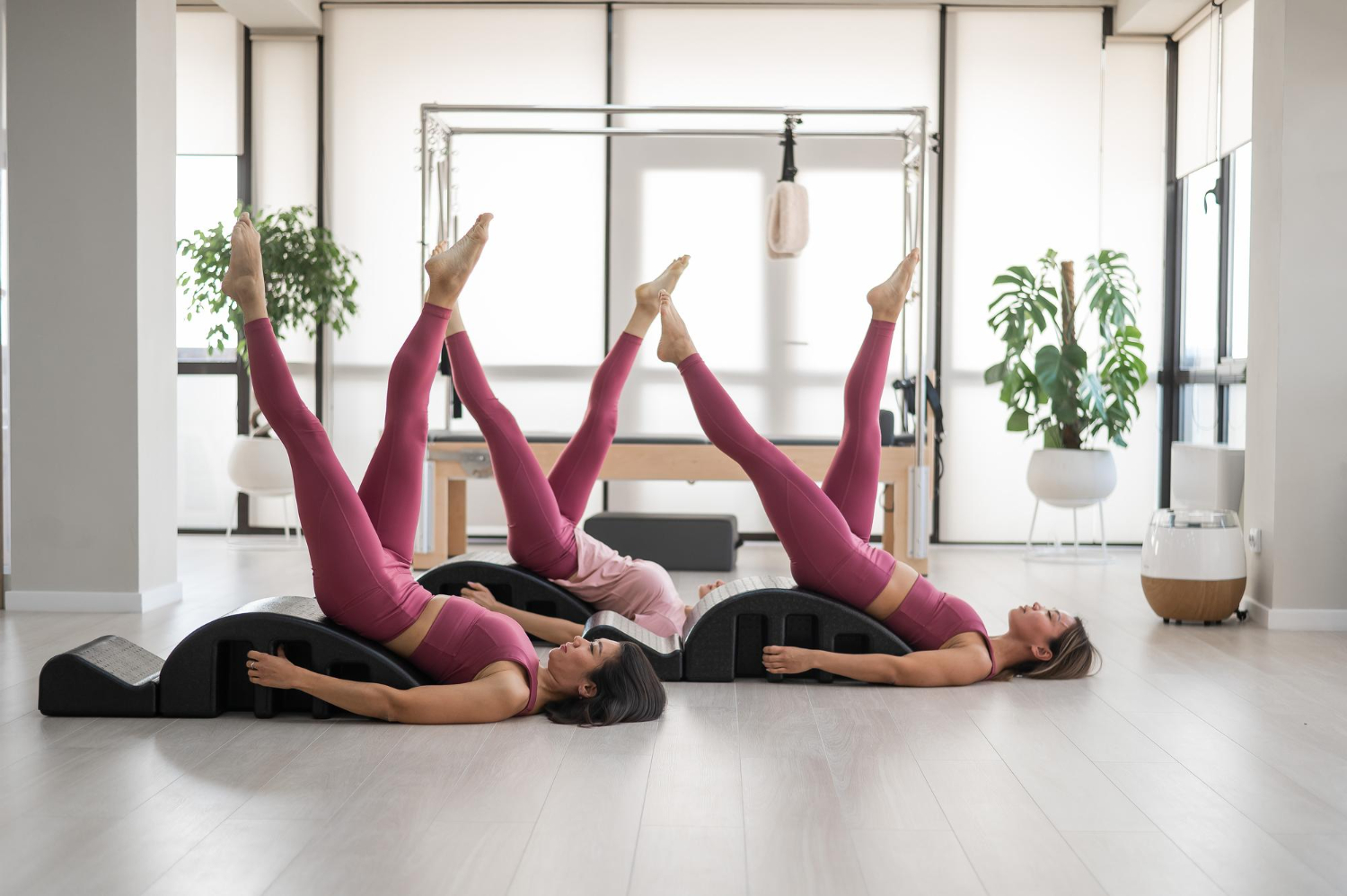
A short history of how one method became six types
None of this variety existed in Joseph Pilates’ own lifetime in the form you’ll encounter it today. He taught one integrated system — Contrology — combining mat work with a full lineup of apparatus he designed and built himself, all under one roof at his original studio. The six types compared in this guide are best understood as branches that grew outward from that single trunk over the following century, each shaped by a different set of people, needs, and eras.
The first split came from necessity rather than philosophy. Mat Pilates and Reformer (and Cadillac, Chair, and Barrel) work were never separate “types” to Joseph Pilates himself — they were simply different tools within one practice. They only became distinct, separately bookable offerings once studios needed to sell mat-only classes at lower price points to reach students who couldn’t afford or access the full apparatus lineup, a commercial reality more than a philosophical one.
The classical-versus-contemporary split came later, and from people, not equipment. After Joseph Pilates died in 1967, his direct students — the Elders — scattered to open their own studios and training programs. Some, like Romana Kryzanowska, prioritized preserving his exact sequence and teaching style as faithfully as possible; that lineage became what’s now called Classical Pilates. Others began blending what they were learning from emerging fields like sports medicine, physical therapy, and biomechanics research into their own teaching, gradually forming what’s now recognized as Contemporary Pilates, with organizations like STOTT PILATES (founded 1988) and BASI Pilates building structured, branded curricula around that evolving, research-informed approach.
Clinical Pilates emerged from a third direction entirely: healthcare rather than fitness or heritage. As physiotherapists observed Pilates-trained clients recovering well from injuries, the profession began formally adapting Pilates principles into its own rehabilitation toolkit, eventually developing the assessment-driven, one-on-one format now recognized as Clinical Pilates — a genuinely separate professional discipline with its own licensing requirements, not simply a gentler fitness class.
Pilates Fusion is the newest and least formalized branch, emerging alongside the broader 2000s and 2010s boutique fitness boom, as studios began blending Pilates with barre, yoga, and dance to compete for members who wanted variety and energy alongside a workout’s format. Unlike the other five types, Fusion has no founding figure, no certifying body, and no fixed curriculum — it’s a market category more than a method, which is exactly why its quality and content vary so much from studio to studio.
Mat Pilates
Mat Pilates is the original entry point into the method, and for a large share of practitioners, it’s the only kind of Pilates they ever need. It’s built entirely around body weight, gravity, and the six core principles, using little more than a padded surface and your own control.
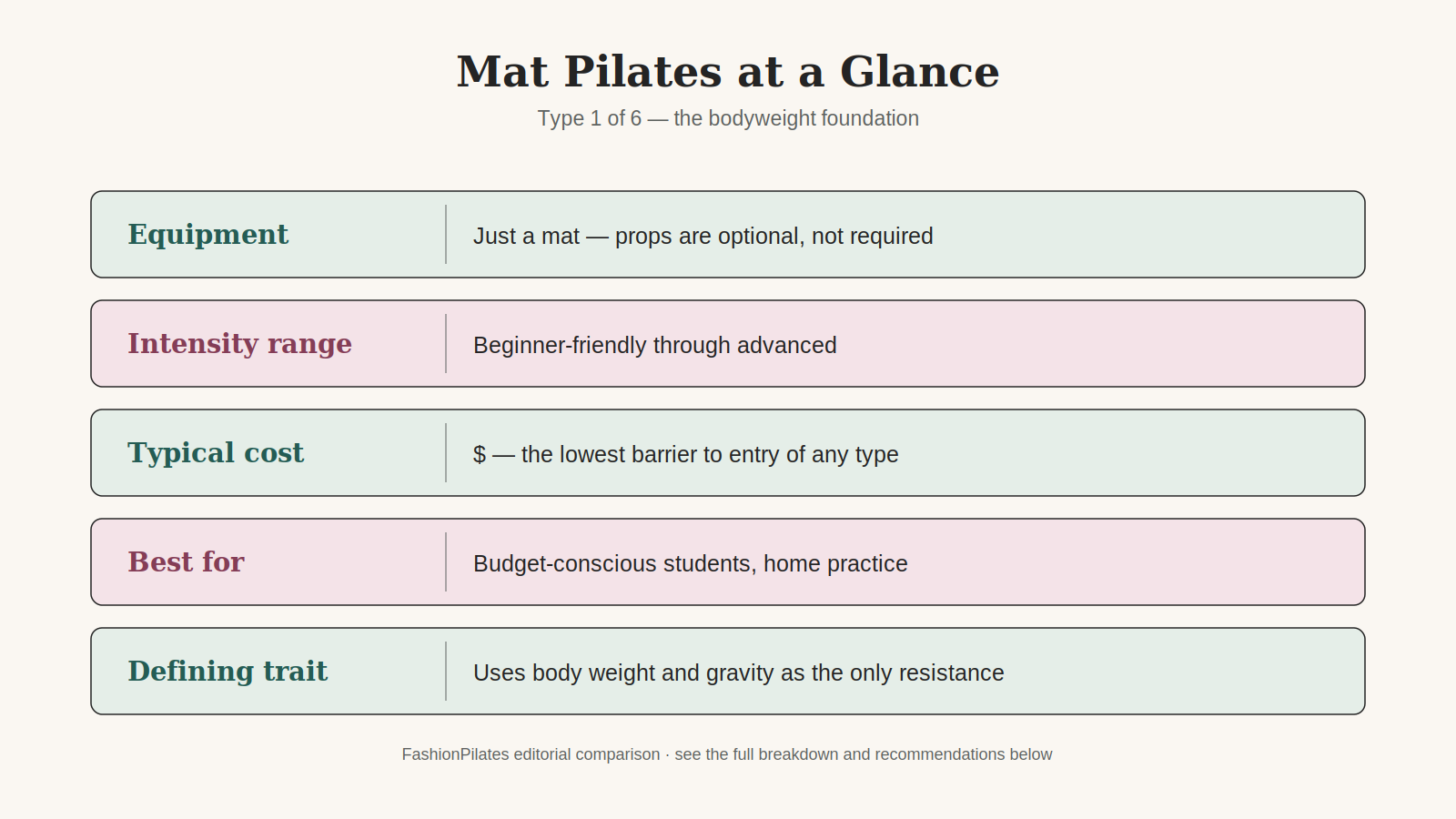
Mat Pilates at a glance.
Where it comes from
Mat work was part of Joseph Pilates’ teaching from the very beginning, but it gained a specific, documented identity when he published Return to Life Through Contrology in 1945, laying out a complete mat sequence in a fixed order for the first time in print. That book remains the closest thing the format has to an original source text, and classical mat classes today still draw directly on its sequence and photographs.
What a class actually looks like
Joseph Pilates documented a specific mat sequence in his 1945 book Return to Life Through Contrology, and most mat classes today still draw heavily on that same pool of exercises, whether or not they run the exact original order. A typical session opens with a brief warm-up, moves into foundational work like the Hundred and pelvic curls, builds through core and full-body exercises, and closes with stretching. Sessions usually run 45 to 55 minutes and can be taught to large groups just as easily as one-on-one, since no equipment needs sharing or setup between students.
Because it requires nothing but floor space, Mat Pilates is also the format most commonly bundled free into gym memberships, offered as a community class, or taught through videos and apps — which makes it the lowest-friction way to find out whether Pilates as a whole appeals to you before spending more.
Who it’s best for — and who might want something else
Mat Pilates suits budget-conscious students, people who travel often and want a format that works in a hotel room, and anyone who wants to test the method before committing to studio membership pricing. It also scales impressively: a beginner class stays gentle and supported, while advanced classical mat work (Boomerang, Control Balance, the full Teaser progression) is genuinely demanding, with nothing external to lean on.
That last point cuts both ways. Without a machine’s resistance and support, some people find it harder to feel where a muscle is supposed to engage, and progress can feel slower to notice without a reformer carriage’s visible distance as feedback. If you’re recovering from a specific injury, Mat alone may not offer enough individualized support — Contemporary or Clinical Pilates typically serve that need better. It’s also worth knowing that a large group Mat class, especially one bundled free into a gym membership, tends to get less individual correction per student than a smaller, dedicated Pilates studio class, simply because one instructor is watching more people at once.
Choose Mat Pilates if: you want the lowest-cost way to try the method, you’re comfortable motivating yourself without machine feedback, or you want something you can do literally anywhere with zero equipment.
Reformer Pilates
Reformer Pilates adds a sliding carriage, adjustable springs, and a set of straps and bars to the same underlying principles as Mat work. It’s the piece of equipment most people picture the moment someone says “Pilates,” and for many studios, it’s the format the whole business is built around.
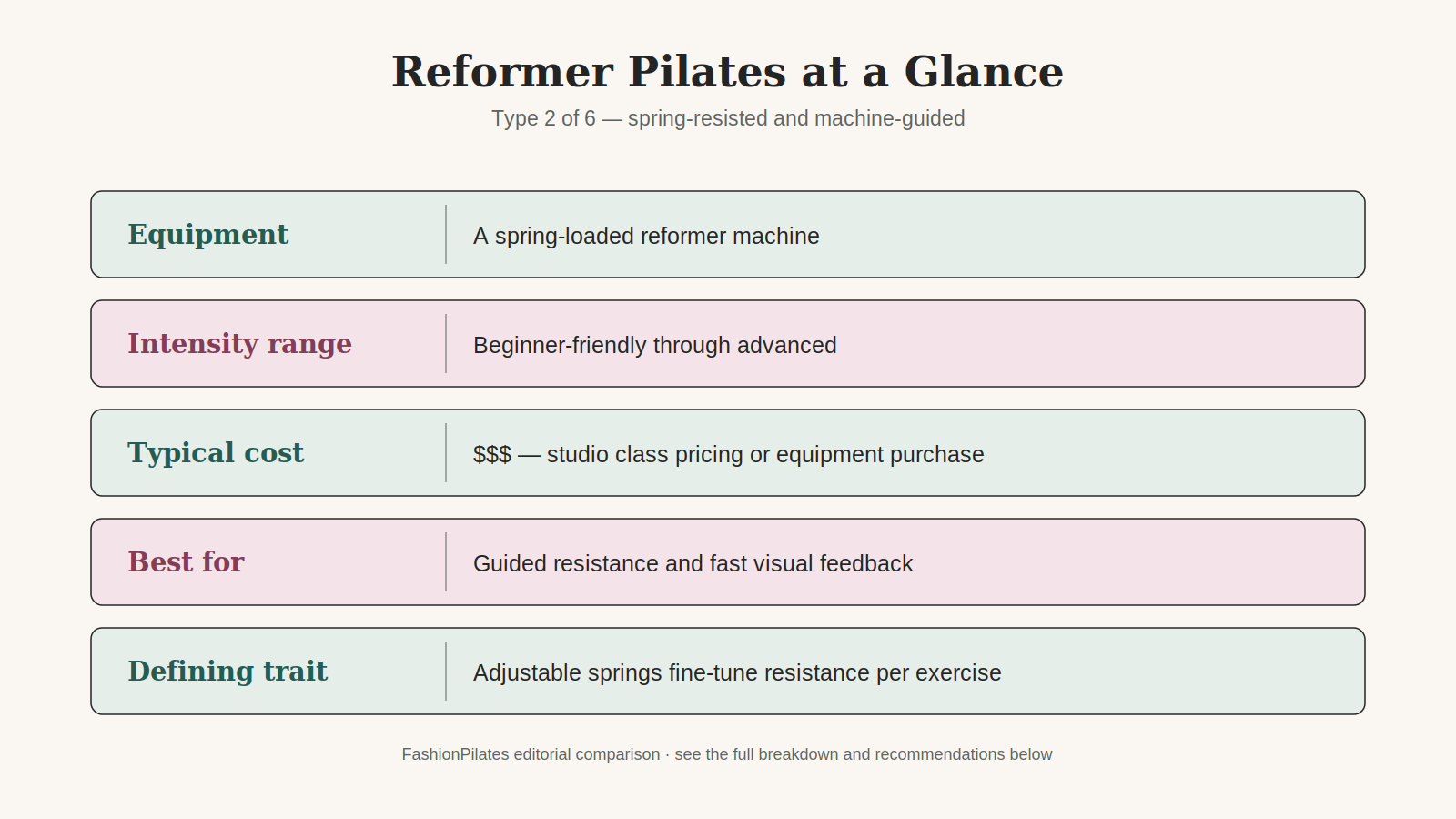
Reformer Pilates at a glance.
Where it comes from
The reformer’s origin story traces back to Joseph Pilates’ internment in England during World War I, where he reportedly rigged bed springs to create resistance for fellow internees, an early version of what became the modern carriage-and-spring design. He continued refining the apparatus for decades afterward, and today dozens of manufacturers — Balanced Body, Merrithew, Peak Pilates, and others — build their own reformer models on that same basic mechanical concept.
What a class actually looks like
A reformer session usually opens with footwork — pressing the carriage out and in using different foot positions on the footbar — before moving through sequences organized by body position: lying down, kneeling, standing, side-lying. Spring resistance is adjusted throughout, sometimes several times per class, to match each exercise’s demands. Sessions typically run 50 to 55 minutes, whether in a group reformer class with several machines in one room or a private, fully individualized session.
The carriage itself becomes a kind of built-in progress marker: you can watch and feel exactly how far you’re pressing it, which gives many students a more immediate sense of effort and improvement than mat work alone provides.
Who it’s best for — and who might want something else
Reformer Pilates suits people who want guided resistance rather than relying purely on self-control, people who like visible, mechanical feedback on their effort, and people targeting more noticeable strength gains in a shorter timeframe. Its adjustable springs also make it genuinely useful across a wide range of starting fitness levels within the same class.
The tradeoffs are access and cost. A reformer isn’t something you can do spontaneously at home without a real equipment investment, and studio pricing per session typically runs well above a mat class or general gym membership. First-timers can also find the machine’s straps, springs, and setup genuinely confusing for the first class or two — budget extra time to let an instructor walk you through it rather than expecting to move fast on day one. If cost is a genuine concern, group reformer classes are usually meaningfully cheaper per session than private ones, at the tradeoff of less individual correction.
Choose Reformer Pilates if: your budget supports regular studio classes, you like a machine doing some of the resistance work for you, or you want faster, more visible feedback on your effort than a mat alone provides.
Classical Pilates
Classical Pilates isn’t a piece of equipment — it’s a lineage. It refers to an approach that follows Joseph Pilates’ original exercise sequence in a fixed order, taught largely the way his first-generation students, sometimes called “the Elders,” learned it directly from him.
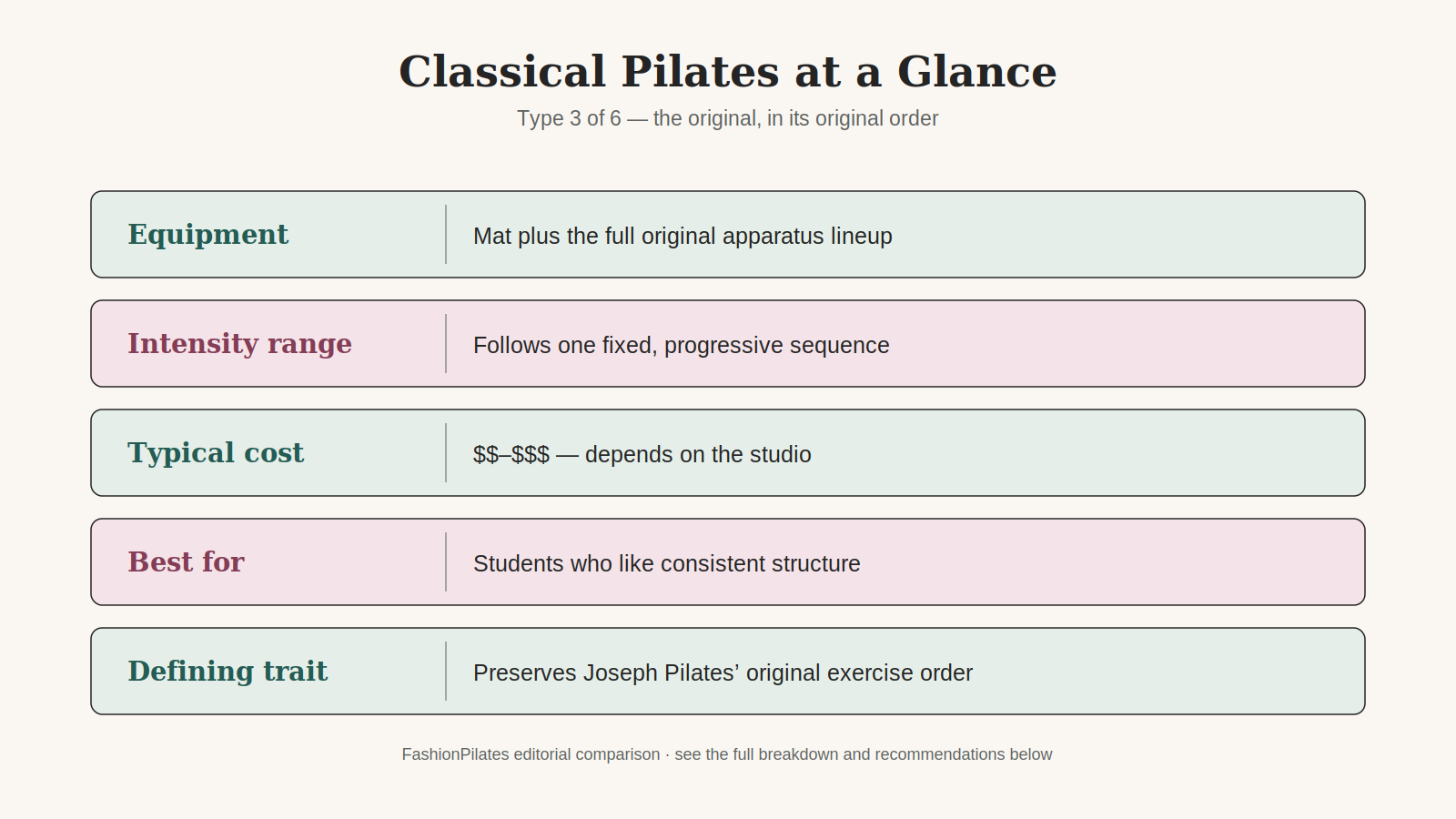
Classical Pilates at a glance
Where it comes from
Classical Pilates traces its authority directly to Joseph Pilates’ own studio and his handful of long-term students, several of whom continued teaching his exact method for decades after his 1967 death. Romana Kryzanowska, who studied with him personally and later ran his original studio, is probably the most widely cited figure in this lineage; “Romana’s Pilates” as a named certification exists specifically to trace instructor training back to her and, through her, to Joseph Pilates himself.
What a class actually looks like
A genuinely classical class runs through the same progression every time, whether on the mat or across the full original apparatus lineup (reformer, Cadillac, Wunda Chair, and the rest). Beginners work a modified subset of the full order; more advanced students gradually work up to running the entire sequence, which is part of the appeal for people who like measurable, ritual-like progress. Romana’s Pilates, named for Romana Kryzanowska, a direct student of Joseph Pilates, is one well-known lineage within this classical tradition.
Instructor training for classical lineages tends to be extensive and apparatus-comprehensive, often requiring several hundred hours before certification, which is part of why classical-focused studios sometimes run smaller class sizes and higher per-session pricing than a general gym Pilates class.
Who it’s best for — and who might want something else
Classical Pilates suits people who like consistent structure and the sense of mastery that comes from repeating and refining the same sequence over time, purists genuinely curious about the method’s original intent, and anyone planning to eventually pursue instructor training, since classical work is the foundation many certification programs build on regardless of specialization.
The fixed sequence is also its main limitation. It offers less built-in individualization for a specific injury or limitation than a Contemporary approach, and some students find the ritual repetitive rather than reassuring. A skilled classical instructor still modifies exercises when genuinely necessary, but the underlying philosophy favors preserving the order over rebuilding it around one student’s needs.
Choose Classical Pilates if: you like structure and repetition as a feature rather than a limitation, you’re drawn to the method’s original history, or you’re considering teacher training down the road.
Contemporary Pilates
Contemporary Pilates keeps the same underlying six principles as the classical tradition but folds in newer biomechanics and rehabilitation research, and instructors trained this way typically reorder or adapt exercises to fit the student in front of them rather than running a fixed sequence.
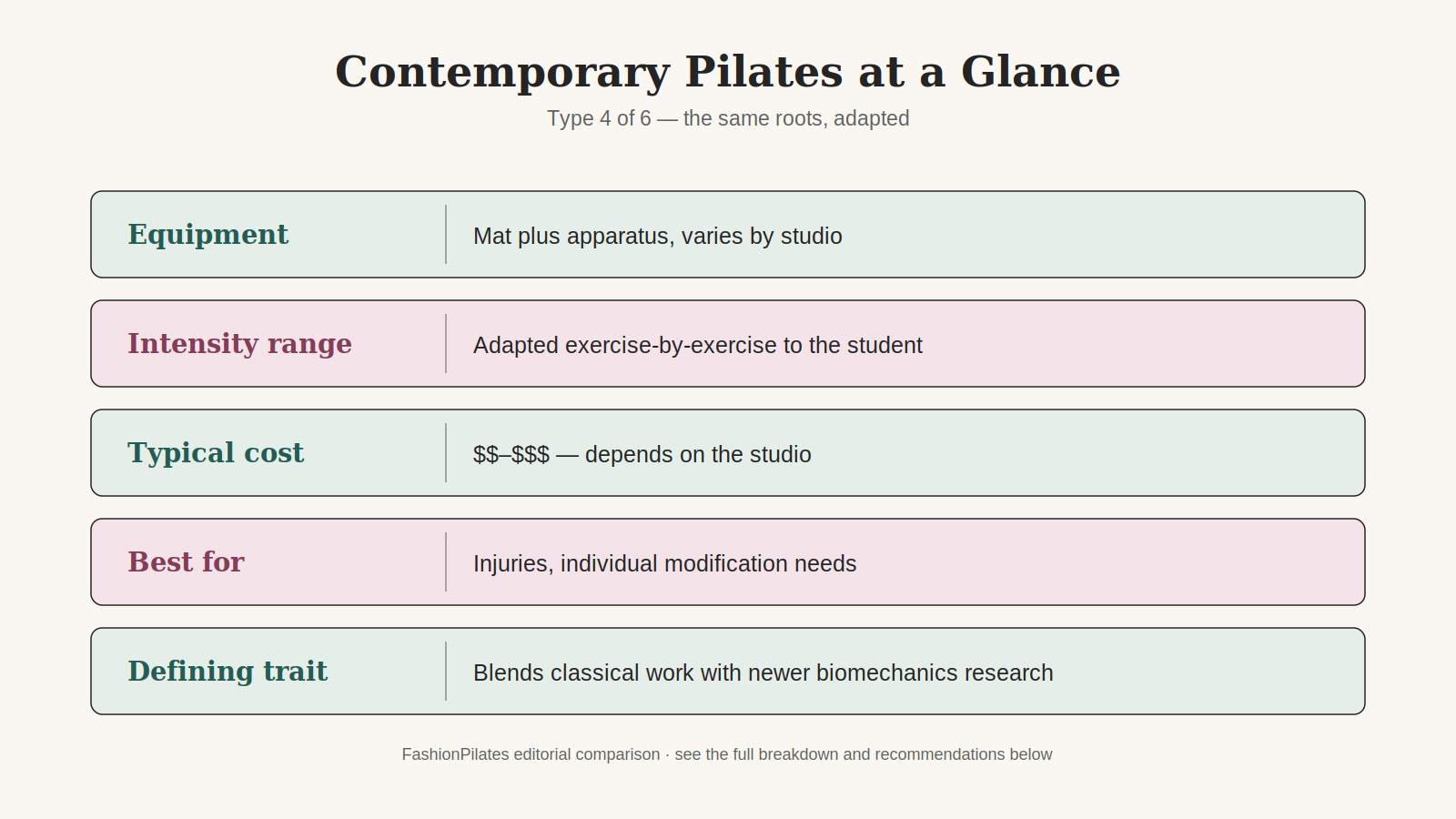
Contemporary Pilates at a glance.
Where it comes from
Contemporary Pilates grew out of other students of Joseph Pilates and their successors who, rather than preserving his sequence exactly, began incorporating emerging research on anatomy, rehabilitation, and injury prevention as those fields developed through the late twentieth century. STOTT PILATES is a well-documented example: founded in Toronto in 1988 by Moira and Lindsay Merrithew, after Moira trained under Romana Kryzanowska and then began adapting that classical foundation using newer biomechanics research, eventually growing into the global Merrithew Corporation’s education and equipment business.
What a class actually looks like
A contemporary class can look quite different studio to studio, since there’s no single fixed curriculum the way classical lineages share one. Named training organizations like STOTT PILATES, developed by Moira and Lindsay Merrithew through the Merrithew Corporation since 1988, and BASI Pilates (Body Arts and Science International) each represent a specific, branded contemporary approach, blending classical exercises with anatomy-based modifications and updated cueing.
Expect an instructor to actively adjust the plan in real time — swapping an exercise, changing spring tension, or adding a prop — based on what they observe about your alignment, history, or that day’s energy, rather than sticking to a predetermined order regardless of how you’re moving.
Who it’s best for — and who might want something else
Contemporary Pilates suits people managing an old injury or physical limitation who need an instructor willing to genuinely adapt around it, people who prefer variety over fixed ritual, and anyone drawn to cueing that reflects current movement science rather than century-old phrasing alone.
The flexibility that makes Contemporary appealing also makes quality harder to predict from the outside. Since there’s no single fixed curriculum binding every contemporary-certified instructor, your actual experience depends heavily on that specific instructor’s training, judgment, and experience — two “Contemporary Pilates” classes at different studios can feel meaningfully different from each other in a way two classical mat classes usually don’t.
Choose Contemporary Pilates if: you have an injury history or physical limitation you want actively accommodated, you prefer variety to fixed routine, or you’re comparing named methods like STOTT or BASI on an instructor’s certification list.
Clinical (Rehabilitative) Pilates
Clinical Pilates is a therapeutic adaptation of the method, developed and taught by physiotherapists specifically for injury rehabilitation, chronic pain management, and post-surgical recovery. It shares foundational principles and often the same equipment as general Pilates, but its underlying goal and process are meaningfully different from a fitness class.
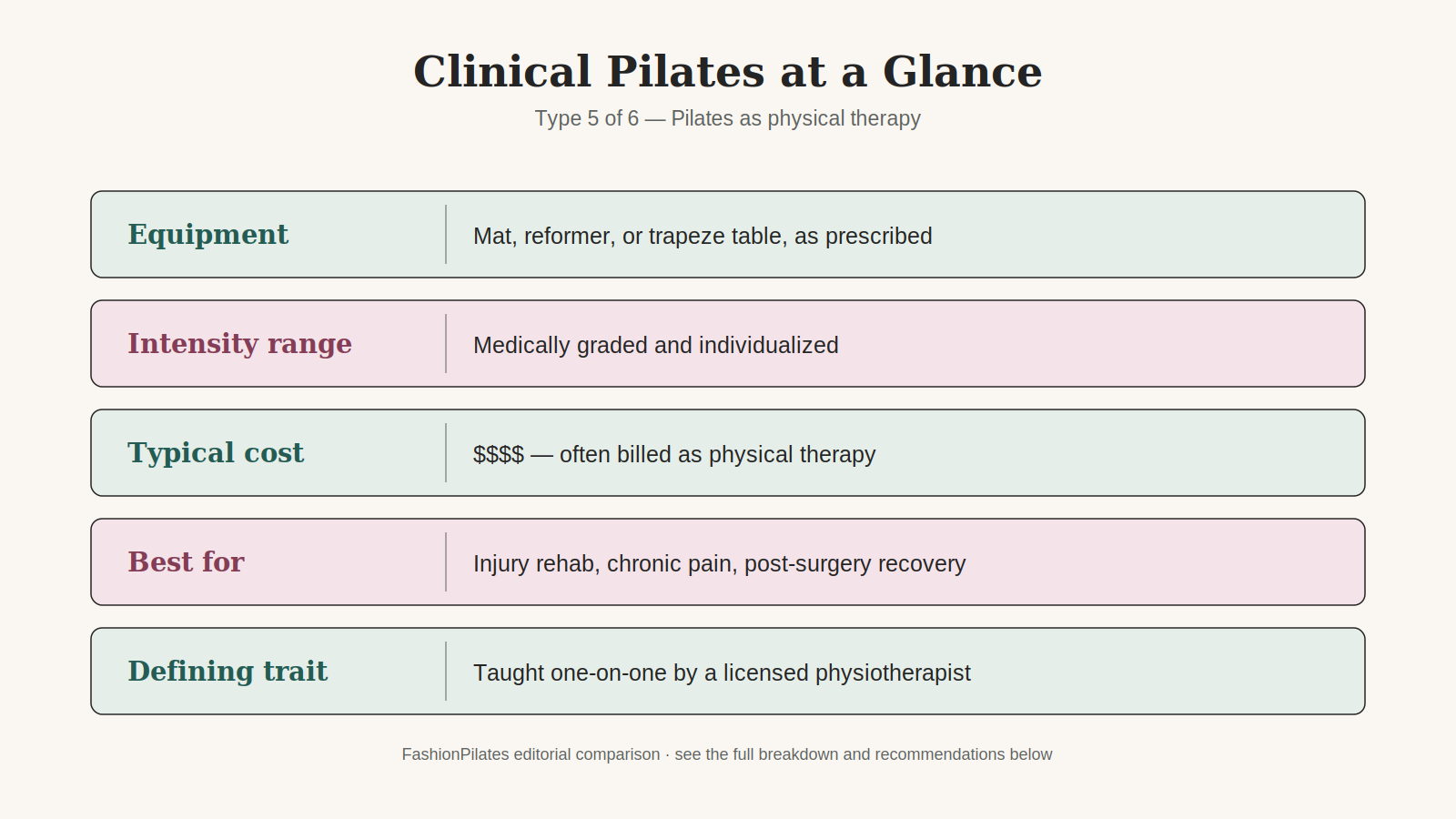
Clinical Pilates at a glance.
Where it comes from
Clinical Pilates developed as physiotherapists began noticing how well Pilates principles — controlled movement, core stability, precise breathing — mapped onto existing rehabilitation goals, and started formally adapting the method into their own treatment plans rather than simply recommending a general class. Unlike Classical or Contemporary Pilates, it didn’t emerge from Joseph Pilates’ own lineage of students at all; it developed independently within the physical therapy profession, which is part of why its format, pricing, and regulation look more like healthcare than fitness.
What a session actually looks like
Clinical Pilates typically begins with a thorough assessment — a physiotherapist screens your movement patterns, discusses your injury or condition history, and identifies specific goals before building an individualized program around them. Sessions are usually one-on-one or capped at a small group size, and a physiotherapist closely supervises technique throughout, grading exercises up or down based on how your body responds. Equipment can include a mat, a reformer, or a trapeze table, chosen based on what your specific condition requires rather than a fixed studio format.
Common applications include osteoarthritis, hypermobility conditions, back and neck pain, pre- and post-surgical conditioning, and general chronic pain management, though the specific fit for any of these depends entirely on an individual assessment, not this article.
Who it’s best for — and who might want something else
Clinical Pilates suits people actively recovering from an injury or surgery, managing a diagnosed chronic condition, or working with a healthcare provider who has specifically recommended it as part of a treatment plan. This is a medical or quasi-medical service, not a general fitness class, so it belongs in a conversation with a doctor or physiotherapist rather than a decision made from an article alone.
If you’re generally healthy and simply want a Pilates workout, Clinical Pilates is typically more expensive and more clinically paced than you need — Mat, Reformer, or Contemporary Pilates will usually serve general fitness goals more efficiently and at lower cost. Insurance coverage for Clinical Pilates also varies significantly by provider, plan, and country, so confirm coverage directly with your insurer rather than assuming it’s included as standard physical therapy.
Consider Clinical Pilates if: you’re recovering from an injury or surgery, managing a diagnosed chronic condition, or a doctor or physiotherapist has specifically recommended it — and talk to that provider before choosing a program.
Pilates Fusion
Pilates Fusion blends core Pilates exercises and principles with other workout formats — yoga (sometimes branded “Yogalates”), barre, dance, strength training, or cardio intervals — inside a single class. It’s less a lineage than a category of hybrid formats that studios and instructors assemble in their own way.
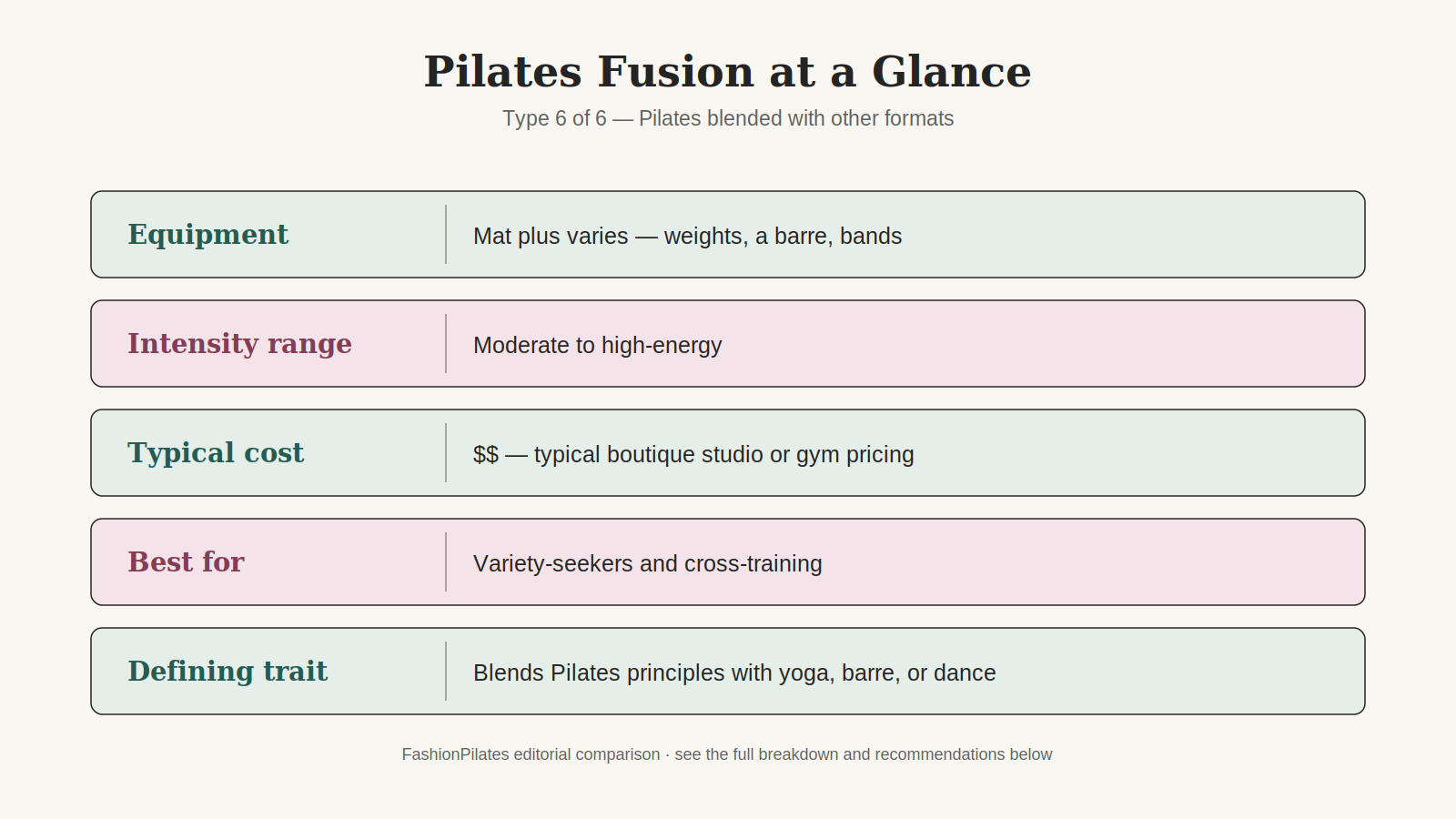
Pilates Fusion at a glance.
Where it comes from
Pilates Fusion doesn’t trace back to a single founder or studio the way the other five types do — it emerged gradually as boutique fitness studios, competing for members through the 2000s and 2010s, began blending Pilates with whatever else was popular at the time: barre borrowed from ballet conditioning, “Yogalates” blending yoga’s flow and mindfulness with Pilates’ precision, and dance- or interval-based formats for members who wanted more energy than a traditional class offered. It’s less a lineage than an ongoing commercial trend, still actively evolving as studios experiment with new combinations.
What a class actually looks like
Fusion classes vary more than any other type on this list, since there’s no shared curriculum binding them. A single session might combine a classical mat warm-up with weighted lunges and gliding-disc core work, or blend yoga flow sequences with a Pilates abdominal series and light kickboxing. Expect music-driven pacing, a faster overall tempo than a traditional Pilates class, and a genuine full-body, often heart-rate-raising workout rather than a purely low-impact session.
Because “fusion” describes a category rather than one defined method, reading a specific class description before booking matters more here than for any other type — two studios’ “Pilates Fusion” can differ as much as a Pilates class differs from a dance class.
Who it’s best for — and who might want something else
Pilates Fusion suits people who get bored with repetition and want built-in variety, people looking for one class that covers both strength and a cardio element, and anyone who enjoys a faster-paced, music-driven group fitness atmosphere more than a slow, principle-focused session.
The tradeoff is depth. Because attention splits across multiple modalities, Fusion classes generally build less precise core control and technical mastery than a dedicated Pilates practice, and the six core principles (concentration, control, centering, precision, breath, flow) tend to get less explicit emphasis than in a Mat, Reformer, Classical, or Contemporary class built entirely around them.
Choose Pilates Fusion if: you want variety and cross-training in one class, you’re motivated by music and pace, or a pure, principle-focused Pilates class has felt too slow or repetitive for your taste.
Head-to-head: comparing all six types
With each type covered individually, here’s the full comparison in one place, across the dimensions that matter most when you’re actually deciding.
| Type | Equipment | Cost | Individualization | Key limitation |
|---|---|---|---|---|
| Mat Pilates | Just a mat | $ | Low to moderate | No machine feedback or support |
| Reformer Pilates | Reformer machine | $$$ | Moderate | Cost and access to a machine |
| Classical Pilates | Mat + full apparatus | $$–$$$ | Lower — fixed sequence | Less built-in modification |
| Contemporary Pilates | Mat + apparatus (varies) | $$–$$$ | High | Quality varies by instructor |
| Clinical Pilates | Mat, reformer, or trapeze table | $$$$ | Highest — medically graded | Cost; needs a qualified provider |
| Pilates Fusion | Mat + varies | $$ | Low — group-paced | Less depth in core Pilates skill |
A few patterns worth naming explicitly. Cost roughly tracks how much individual attention and equipment a format requires — Mat costs the least because it needs the least, and Clinical costs the most because it delivers one-on-one, medically supervised attention. Portability runs the opposite direction: Mat travels anywhere, while Reformer and Clinical Pilates tie you to specific equipment or a specific provider. And individualization isn’t the same as quality — a well-taught Classical class with zero improvisation can still be excellent, while a poorly taught Contemporary class with lots of flexibility can still miss the mark. The format sets the frame; the instructor still does most of the actual work.
A second, more goal-specific way to compare the six types: which one actually serves a particular priority best, independent of cost or equipment.
| If your goal is… | The strongest fit is usually… |
|---|---|
| Building visible strength quickly | Reformer Pilates, thanks to adjustable, progressive spring resistance. |
| Recovering from injury or surgery | Clinical Pilates, supervised directly by a physiotherapist. |
| Practicing on a tight budget | Mat Pilates, which needs no ongoing equipment cost. |
| Traveling frequently and staying consistent | Mat Pilates, since it needs no fixed equipment or location. |
| Managing a specific old injury during general fitness | Contemporary Pilates, for its built-in individual modification. |
| Learning the method’s original, unaltered form | Classical Pilates, taught as close as possible to the source. |
| Raising your heart rate alongside core work | Pilates Fusion, for its blended, higher-energy format. |
| Staying motivated through variety | Pilates Fusion or rotating between several types. |
Our recommendations: which type fits your goals
Rather than one universal ranking across all six types of Pilates, here’s a direct recommendation for the specific situations readers actually show up with.
- If your top priority is cost: start with Mat Pilates. It’s the cheapest way to find out whether the method suits you before spending more on equipment or studio memberships.
- If you’re recovering from an injury, surgery, or a chronic condition: talk to your doctor or a physiotherapist about Clinical Pilates before choosing any other type — general fitness classes aren’t designed to safely manage an active medical issue.
- If you want fast, visible strength and control gains: Reformer Pilates typically delivers noticeable progress faster than mat work alone, thanks to adjustable resistance and immediate mechanical feedback.
- If you love routine, ritual, and measurable mastery over time: Classical Pilates rewards that temperament more than any other type on this list.
- If you have an old injury but otherwise want general fitness, not therapy: Contemporary Pilates usually strikes the best balance between real modification and a genuine workout.
- If you get bored easily or want one class that also raises your heart rate: Pilates Fusion delivers more variety and energy than a traditional, principle-focused class.
- If you’re genuinely unsure where to start: try a beginner Mat class first. It’s the lowest-cost, lowest-commitment way to test whether Pilates as a whole clicks for you before narrowing down a specific type.
A few common mistakes worth avoiding as you decide. Don’t judge the entire method by one bad-fit class — an intense advanced Reformer session and a gentle beginner Mat class can feel like completely different activities, even though both are “Pilates.” Don’t chase the hardest option for its own sake; intensity should match your actual goal, not your ego on day one. Don’t ignore cost sustainability — a format you can only afford for two months isn’t actually the right choice, however good it feels initially. Don’t assume every “Contemporary” or “Fusion” class is equally individualized or well-designed, since neither term is regulated or standardized the way a specific certification is; ask what the label actually means at that particular studio. And if you’re specifically considering Clinical Pilates, don’t skip verifying the provider’s credentials; confirm you’re working with a licensed physiotherapist, not simply a general instructor using the word “clinical” loosely.
Reformer Pilates vs. Clinical Pilates: how to tell them apart
These two get confused more than any other pair on this list, and it’s an easy mix-up to make: both can use the exact same machine, in a studio room that looks identical from the doorway. The difference isn’t the equipment — it’s the goal, the supervision, and who’s actually running the session.
Reformer Pilates is a general fitness class, open to essentially anyone, taught by a certified Pilates instructor, and built around developing strength, flexibility, and control for someone without an acute medical need driving the session. It’s energetic, often set to music, and designed to challenge a room full of students moving through a broadly similar sequence together.
Clinical Pilates uses the same or similar equipment but is taught one-on-one or in a very small group by a licensed physiotherapist, built around a specific injury, surgery, or diagnosed condition, and typically opens with a full movement assessment rather than jumping straight into exercise. The pacing is slower and more deliberate by design — the goal is careful, graded progress toward a functional outcome, not a challenging workout in the fitness-class sense.
The clearest tell, if a studio’s marketing doesn’t make the distinction obvious: ask directly who’s teaching the session. A general instructor with a Pilates certification teaches Reformer Pilates. A licensed physiotherapist with additional Pilates training teaches Clinical Pilates. If you’re not sure which you’ve actually booked, that one question resolves it before you even walk in the door — and it’s a completely normal thing to ask a studio before committing to a first session.
How to try a type before committing
Most studios offer a discounted intro package specifically so you can test a format before paying full membership pricing — ask about one before booking a single drop-in class at full price. A one-off trial class tells you more about whether a type fits than any amount of reading, this article included.
Before you book, it’s worth asking a few direct questions: which lineage or training program the instructor certified through, roughly how large the class will be, and whether modifications are genuinely available for your specific situation rather than assumed. For Reformer or Clinical Pilates specifically, ask what a first-timer’s setup process actually involves, so you’re not caught off guard by an unfamiliar machine on day one.
A short pre-booking checklist worth running through regardless of which of these types of Pilates you’re considering:
- Confirm the format matches what you actually want — a “Reformer Fundamentals” listing and a “Clinical Reformer Assessment” listing are not the same booking, even on the same studio’s calendar.
- Ask about class size, since a “small group” can mean anywhere from three students to fifteen depending on the studio, and that range changes how much individual attention you’ll actually get.
- Check the cancellation policy before your first booking, since intro packages sometimes carry stricter rules than standard drop-in classes.
- Ask what to wear and bring, since grip-sock and clothing requirements vary by studio and equipment type.
Resist buying home equipment — a reformer especially — before you’ve tested the studio version of a type first. It’s a significant investment, and what feels appealing in a class with an instructor guiding you can feel very different alone with an instruction manual and no one to correct your form.
Frequently asked questions
Which type of Pilates is best for beginners?
Mat Pilates is generally the best starting point for beginners, since it requires no equipment investment, is widely available through gyms and community classes, and lets you learn the foundational principles before adding a machine’s complexity. That said, a well-taught beginner Reformer class can also work well for a first-timer, especially if you prefer having equipment guide your resistance. The type matters less for beginners than finding a class specifically labeled “beginner” or “fundamentals,” regardless of which type you choose. Tell your instructor it’s your first time so they can pace and modify accordingly. Either way, a class explicitly labeled for newcomers will matter more to your first-day experience than which of the six types it happens to be.
Can I mix different types of Pilates, or should I pick just one?
Yes, you can absolutely mix different types of Pilates, and many long-term practitioners do exactly that rather than sticking to one exclusively. A common pattern is a weekly Reformer class for guided resistance work, supplemented with home Mat practice on other days for flexibility and convenience. There’s no rule requiring loyalty to one lineage or format, and cross-training between types can actually round out your practice more than repeating one format exclusively. The main reason to specialize in one type is usually cost or access, not a rule about Pilates itself. If anything, most instructors welcome students who’ve cross-trained, since it tends to translate into better body awareness across every format.
Is Reformer Pilates better than Mat Pilates?
No, Reformer Pilates isn’t objectively better than Mat Pilates — they’re different tools suited to different priorities, not a hierarchy with one at the top. Reformer offers more guided resistance and faster visual feedback, while Mat offers lower cost, higher portability, and a purer test of your own control without mechanical assistance. Advanced Mat work is also genuinely demanding in its own right, contrary to the assumption that Reformer is automatically the harder or more advanced option. Which one is “better” depends entirely on your budget, access, and what you’re trying to get out of your practice. If you can realistically afford and access both, trying each for a month before deciding is a more reliable test than any comparison article, this one included.
Do I need a doctor’s referral for Clinical Pilates?
It depends on the provider and your country’s healthcare system, so this isn’t a single universal answer. Some physiotherapy clinics accept Clinical Pilates clients directly without a formal referral, while others, especially where insurance coverage is involved, may require one. If you’re hoping insurance will cover some or all of the cost, confirm both the referral requirement and coverage details directly with your insurer and the clinic before booking. If you have an active injury or diagnosed condition, loop in your doctor regardless of the referral requirement, since they can help determine whether Clinical Pilates is actually the right fit for your specific situation. Bring any existing imaging, diagnosis paperwork, or surgical notes to your first assessment, since it typically speeds up how quickly the physiotherapist can build an appropriate program.
Which type of Pilates burns the most calories?
Pilates Fusion classes generally raise your heart rate more than a traditional Mat, Reformer, Classical, or Contemporary class, since they deliberately blend in cardio-oriented elements like dance or interval work. That said, Pilates as a whole, across every type, is generally a lower-calorie-burn activity compared to dedicated cardio training like running or cycling, since its core purpose is control and strength rather than sustained elevated heart rate. If calorie burn specifically is your primary goal, an advanced, fast-paced Reformer or Fusion class will typically get you closer than a gentle beginner Mat session. No figure here should be treated as a precise, verified number, since actual calorie burn depends heavily on individual factors and class intensity. If calorie burn is truly your primary goal rather than a secondary benefit, pairing any type of Pilates with dedicated cardio training elsewhere in your week will get you there faster than switching Pilates types alone.
Is Classical Pilates outdated compared to Contemporary?
No, Classical Pilates isn’t outdated — it’s a different, equally legitimate philosophy rather than an older, inferior version of Contemporary. Classical lineages deliberately preserve Joseph Pilates’ original sequence and reasoning, which plenty of students and instructors find valuable specifically because it hasn’t been altered. Contemporary approaches incorporate newer biomechanics and rehabilitation research, which offers real advantages for individualized modification, but that doesn’t make the classical approach wrong or obsolete. Many accomplished instructors train across both traditions over a career rather than treating one as a strict upgrade of the other. The honest way to think about it: Classical preserves a specific, well-documented approach on purpose, while Contemporary deliberately keeps evolving — neither goal is more correct than the other.
What type of Pilates is safest during pregnancy?
There’s no single type of Pilates that’s automatically safe for every pregnancy, since safety depends heavily on your specific health situation, trimester, and any complications, which only your doctor can properly assess. Many pregnant students do continue some form of modified Mat or Contemporary Pilates with an instructor specifically trained in prenatal modifications, since certain classical exercises aren’t appropriate during pregnancy and need substitution. Clinical Pilates, supervised directly by a physiotherapist, is worth discussing with your doctor if you have any pregnancy-related complications or concerns beyond routine fitness. Always get clearance from your OB-GYN or midwife before starting or continuing any Pilates practice during pregnancy, and tell any instructor about your pregnancy before class begins regardless of which type you choose. General guidance like this can’t replace an assessment of your specific pregnancy, so treat everything here as a starting point for that conversation, not a substitute for it.
Can Pilates Fusion replace a dedicated Pilates practice?
It depends on your goal — Pilates Fusion can absolutely serve as your primary workout if general fitness, variety, and enjoyment are your priorities, but it’s not a full substitute if you specifically want to master core Pilates technique and principles in depth. Because Fusion classes split attention across multiple modalities, they generally build less precise control than a dedicated Mat, Reformer, Classical, or Contemporary practice focused entirely on the six core principles. Plenty of people happily use Fusion as their only Pilates-adjacent workout, and that’s a perfectly reasonable choice if it’s the one you’ll actually stick with consistently. If you later want to go deeper into technique specifically, adding a dedicated Mat or Reformer class alongside Fusion is a natural next step rather than an either-or decision. Think of Fusion and a dedicated Pilates practice as different tools for different weeks, not competitors for the same slot on your calendar.
How do I know which type an instructor actually teaches?
Ask directly — most instructors list their certifications (classical lineage, STOTT, BASI, a clinical physiotherapy license) in a studio bio, and if it isn’t listed, asking in person or by email is completely normal and expected. A class description alone doesn’t always make the type obvious, since studios don’t universally standardize how they label classes across the industry. If a specific named method matters to you, such as confirming true Classical training versus a Contemporary approach that borrows classical exercises, ask specifically rather than assuming from the class title. Reputable instructors are generally happy to discuss their training background in detail, since it’s a genuine point of professional pride for most of them. A studio’s “about” page or instructor directory is usually the fastest place to check before you even book a first class.
Is it normal to dislike the first type of Pilates I try?
Yes, it’s completely normal, and it usually says more about that specific class or type than about Pilates as a whole. A common pattern is trying an intense Reformer class as a first exposure, finding it overwhelming, and concluding “Pilates isn’t for me,” when a gentle beginner Mat class might have felt completely different. Before writing off the method entirely, it’s worth trying at least one more type, ideally one that better matches your actual starting fitness level and stated goals. Instructor fit matters just as much as format — the same type of class with a different teacher can feel like a completely different experience. Give a second type, or at least a second instructor, a genuine try before deciding the whole method isn’t for you.
Sources and editorial notes
This guide is desk research and editorial synthesis — no products or specific studios are reviewed or recommended, and no claim here relies on hands-on testing or a first-person account. Cost comparisons are relative ($ to $$$$ scale) rather than specific price quotes, since real pricing varies by city, studio, and country. The sources below informed the article; each entry notes which part of the guide it supports.
- Encyclopaedia Britannica, “Pilates” — supports the general history of the method referenced throughout.
- Pilates Method Alliance, “History of Pilates” — supports the history of Joseph Pilates’ original students and studio, referenced in the Classical Pilates section.
- Pilates.com, “The Pilates Lawsuit” — supports background on “Pilates” as a generic term, relevant to how different types and studios can all legally use the name.
- Lifemark, “Know Your Pilates: Clinical Pilates versus Traditional Pilates” — supports the definition, equipment, and physiotherapist-led format described in the Clinical Pilates section.
- The Fitness Outlet, “Clinical Pilates vs. Reformer Pilates” — supports the direct comparison in “Reformer Pilates vs. Clinical Pilates: how to tell them apart.”
- Glo, “Pilates Fusion Classes” — supports the description of Pilates Fusion as a blend of Mat Pilates with barre, yoga, strength training, cardio, and dance.
- Merrithew, “What Is Pilates? Everything You Need to Know About Pilates” — supports the STOTT PILATES / Merrithew background in the Contemporary Pilates section.
- BASI Pilates, “The Classical Pilates Mat Exercises Listed” — supports the BASI Pilates background in the Contemporary Pilates section.
FashionPilates tip: pick based on your actual constraints this month — budget, access to a studio, any injury you’re managing — not on which type sounds most impressive. The “best” type of Pilates is the one you’ll actually keep showing up for.


Trackbacks/Pingbacks