
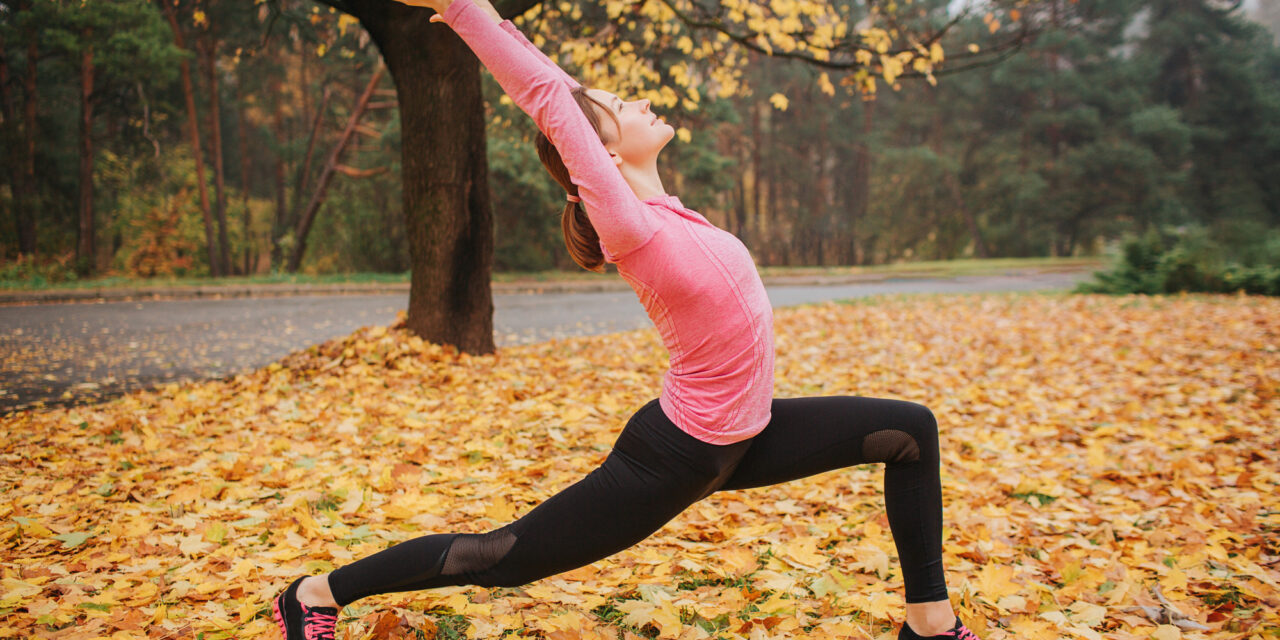
Direct answer: The smartest back to studio Pilates outfits are the ones you have already checked: leggings that stay put through a roll-down and a bridge, a fitted top with no loose hems, and grip socks with grip that still bites. Audit what you own first, confirm your studio’s rules on socks, jewelry and layers, and only then fill the gaps with a short list of replacements.
This guide is for anyone restarting studio Pilates after a summer break, a move, a busy season or a longer gap, and it owns the returning-to-class question: what to keep, repair, replace and pack. It does not try to build a whole seasonal wardrobe; that is a separate job, covered in fall Pilates capsule wardrobe. The advice here is a research-based comparison built from published studio policies, health agencies and manufacturer care guidance, and it is not based on hands-on testing.
Why a Returning Student Needs a Wardrobe Reset
Restarting class is not the same as starting. A first-timer shops from zero; a returning student shops from a drawer full of history, some of it excellent and some of it quietly past its prime. The reset is about sorting that drawer honestly before your first class back, so the only thing you have to think about on the carriage is your breathing.
What a Gap Does to Your Gear
Time away changes clothes in two ways: things you wore a lot have aged, and things you did not wear have sat folded in conditions you did not choose. Both deserve a look before anyone tells you to buy anything.
Fabric fatigue is real, even if it is boring
Stretch fabric gets its recovery from elastic fibers, and those fibers lose snap with repeated stretching, heat and washing. The outward signs are familiar: a waistband that rolls or creeps down, knees that stay bagged after standing up, and a fabric that looks shinier or thinner across the seat. None of this is dramatic. It simply adds up to leggings that need adjusting every few minutes, which is a poor way to spend a class built around concentration.
Stored gear ages too
Grip socks and leggings that spent the summer in a gym bag, a car or a damp laundry basket may smell, stiffen or look different than you remember. Grip dots may harden or peel, and any fabric that was packed away still damp deserves a good wash and a proper inspection. Treat the pile like a pantry after a long trip: open everything, sniff, and decide, rather than assuming it is all still fine.
What a Gap Does to Fit and Habits
The other half of the reset is you, and the point is not judgment. Bodies, schedules and preferences shift over months, and a wardrobe built for last spring’s routine may not match the one you are about to start.
Your fit and comfort needs may have moved
Weight, muscle, season and life circumstances all change how the same garment sits, and that is ordinary. A waistband that felt perfect in March can feel snug or loose now, and a sports bra that suited a twice-weekly routine may not suit an easing-back routine. Instead of arguing with your old size, let the movement checks later in this guide tell you what works today, and treat the label as a starting point only.
A bad first class back costs more than a new top
Returning is a motivation project as much as a clothing one. If your first class back involves tugging at slipping fabric, apologizing to a neighbor for a loose sock, or sitting out a movement because of a seam, the experience can quietly cancel the habit you are trying to rebuild. Sorting your outfit in advance removes the small frictions that make people say they will go next week.
The Wardrobe Audit: Keep, Repair, Replace
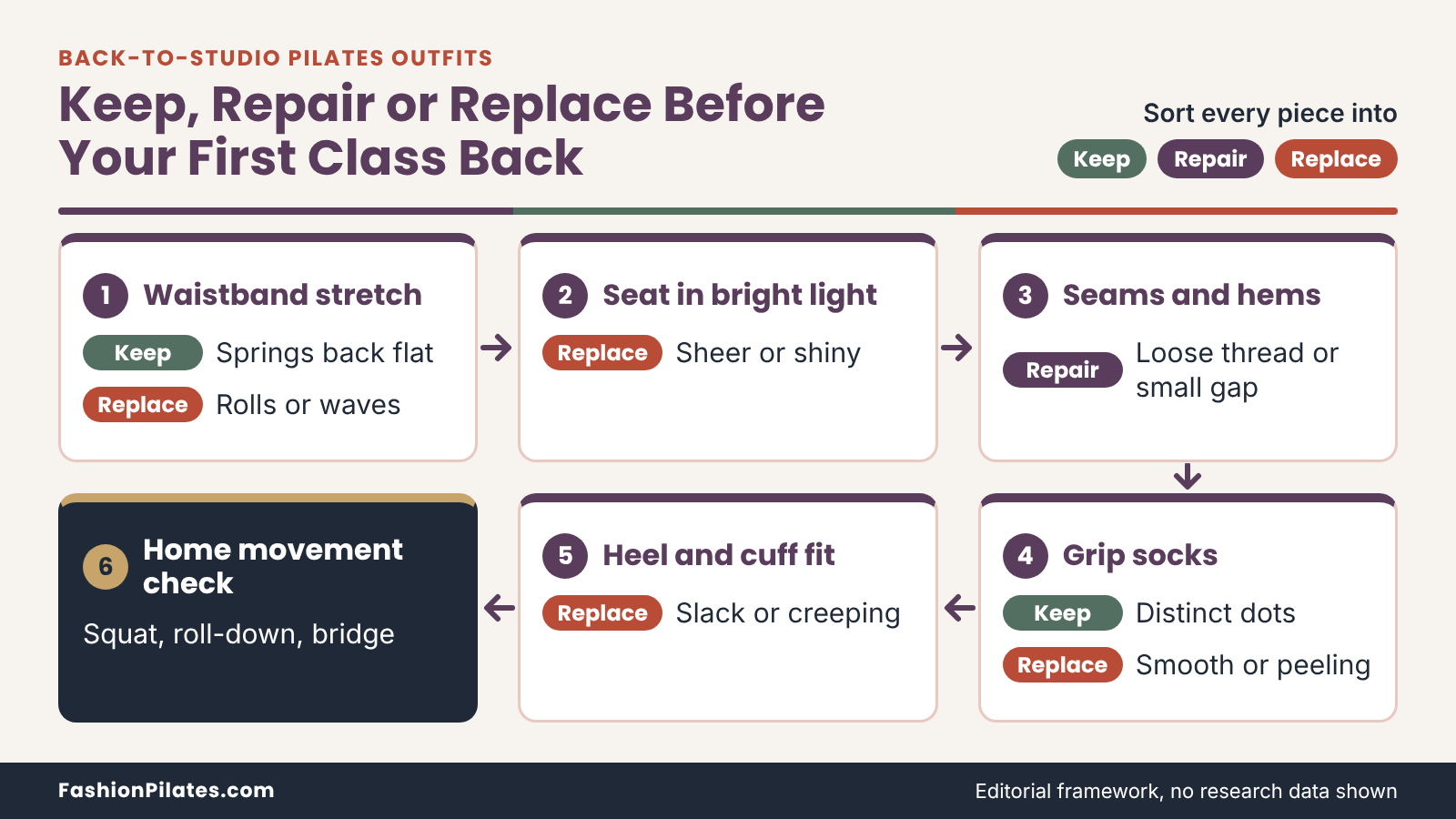
An audit takes about thirty minutes on a quiet evening and saves a surprising amount of money. Lay out everything you have ever worn to Pilates, add anything you plan to try, and sort it into three piles. The rules below keep the sorting fair and quick.
The Five-Minute Fabric Fatigue Check
Run each pair of leggings and each top through the same short routine so you are comparing like with like. You are looking for signs that the fabric still does its job, not for a flawless garment.
Waistbands and stretch recovery
Put the waistband on and stretch it a few inches with your thumbs, then let go and watch. It should spring back and lie flat, with no wavy edge, no permanent roll, and no crinkled elastic. Then wear the leggings for a few minutes of walking and sitting. If you have already adjusted the waistband twice, it will do it forty times in class. A waistband that fails this check goes to the replace pile, because it is the piece that matters most in rolling and bridging work.
Opacity, pilling and seams
Bend over in front of a bright window or under a phone flashlight and look at the seat and the backs of the thighs. Fabric that has gone sheer is a common complaint with worn leggings, and a Pilates education site specifically lists worn-out, see-through tights among the things to avoid in class, in its what-to-wear advice. Also check inner seams for pulled threads and look for pilling on the inner thighs, where fabric rubs against itself during movement. Small pills are cosmetic; thinning is a retirement sign.
Grip Socks: Wear Signs and Replacement Triggers
For a deeper look at choosing a pair, see best grip socks for Pilates. Grip socks are the one item many studios treat as non-negotiable, and they are also the one most likely to be worn out when you come back. A pair you loved last spring may be the weak point now.
Reading the grip pattern
Turn a sock over and look at the sole under good light. The grip dots or lines should be distinct, attached and evenly spread across the ball of the foot and the heel. Missing patches, flattened dots, or a sole that looks glassy mean the sock has lost its traction. Then do a quick tactile test: press your thumb and drag it across the grip on a clean, dry floor or a smooth surface. If it slides like an ordinary sock, it is decoration now.
Heels, toe seams and fit
Look at how the sock actually sits. A heel that has gone slack bunches under the arch, and a toe seam that rubs can become a pressure point once you are pressing against a footbar. If the cuff no longer holds the sock at the ankle, it will creep, which is exactly when feet slip. Replace socks on fit grounds as readily as on grip grounds, because a sock that shifts is not providing the stability it was bought for.
Sorting Into Keep, Repair, Replace
Once the checks are done, the decision is mostly mechanical. The table below turns the checks into a first-pass sort, and the two notes after it cover the gray areas.
A quick sorting table
Use the table as a first pass rather than a verdict; trust a failed movement check over a passed visual one. If a piece fails any one line twice, move it down a pile.
| What you see | Likely pile | Why |
|---|---|---|
| Waistband springs back and lies flat | Keep | Stretch recovery is the most important thing leggings do in class. |
| Waistband rolls, waves or creeps down | Replace | Elastic recovery is lost, and the fix is usually not repairable. |
| Loose hem, small seam gap, missing tag | Repair | Cheap to mend, and a loose thread tends to catch on equipment. |
| Fabric looks shiny or thin at the seat | Replace | Thinning usually leads to see-through fabric when you stretch. |
| Light pilling on thighs only | Keep | Usually cosmetic, and a fabric shaver can tidy it. |
| Grip dots intact and distinct | Keep | The sock can still deliver the traction the studio expects. |
| Grip worn smooth or peeling | Replace | Traction does not return after it is gone. |
| Sports bra band rides up or cups gape | Replace | Support and fit change with use, and a bra is cheap to swap compared with a bad class. |
What to do with the retired pile
Retired leggings and tops are not necessarily trash. Pieces that fail the studio test can still work for walking, errands or the laundry-day shift, and the ones with intact fabric but a tired waistband make fine lounge wear. Keep a firm rule, though: anything retired from class does not sneak back into the bag as a backup. A backup that fails mid-class is not a backup, it is a story you will tell later.
Back to Studio Pilates Outfits: What Studios Expect
Dress codes in Pilates studios are mostly about three things: grip underfoot, nothing hard or sharp near the equipment, and clothing that lets the instructor see how you move. The exact rules vary by studio, so the practical move is to read your own studio’s policy page, then fill the gaps with a two-line message to the front desk.
Dress Code Questions to Ask Before You Book
If you are returning after a long gap, assume nothing has stayed the same. Studios change owners, formats and policies, and the rule you remember may no longer apply. A short list of questions handles almost every surprise.
Socks and shoes
Ask whether grip socks are required for every class or only for reformer classes, and whether the studio sells them if you arrive without a pair. Published examples show the range: the Club Pilates help center states that all of its classes require grip socks and that they are available to buy at the studio, while a smaller studio, ABC Fit Studio, says its Pilates socks are required for reformer classes and asks members to leave shoes at reception. Also ask whether toeless grip styles are accepted, since some studios list preferences.
Jewelry, hair and scent
Jewelry is the most common surprise. One Pilates education site advises keeping metal off the machines and removing statement necklaces, bracelets and earrings because they can damage upholstery or get tangled, in its attire guide. ABC Fit Studio asks for long hair tied back and no heavy jewelry, and it discourages heavy perfume or body lotion because they can affect equipment and cause slipping. So ask: rings and watches okay, or off? Is there a place to leave valuables during class? Is hair up required?
Reading Published Policies Wisely
Policies on websites are written for broad audiences and sometimes updated slowly. Treat them as strong hints, then confirm with the people who will actually see you in class.
What the examples have in common
Across the policies and style guides reviewed for this guide, a few points repeat: socks with grips for equipment classes, fitted clothing instead of loose, no hard accessories, and nothing that could catch on springs or ropes. The Club Pilates style guide, published in 2021, recommends fitted, unrestricted tops and bottoms without zippers, since a zipper can dig into the lower back while you lie down, in its first-class clothing advice. Dates matter here; a 2021 article is a guide to the logic, not a current rulebook.
When your studio differs
Independent studios, boutique chains and gym-based Pilates rooms each write their own rules, and some are looser than the examples above. Rely on your studio’s own wording, and if it says nothing, ask. A written answer from the front desk beats a guess, and asking in advance beats negotiating at the door. If you are choosing a new studio altogether, how to choose a Pilates studio covers the questions beyond clothing.
Cold Rooms, Layers and Getting Warm
Air-conditioned studios can feel chilly for the first ten minutes of class, especially in the early morning or when you are lying still. Layers solve that, with a few rules so they do not become a hazard.
Choosing a layer that stays out of the way
A cold-room layer should be fitted, soft and easy to remove without a struggle. A cropped wrap, a snug zip-free jacket or a long-sleeve base layer works better than an oversized sweatshirt, because loose fabric can ride up around your face during supine work or bunch under your back. Zippers are worth avoiding for the same reason studios warn against them on leggings: hard hardware near your spine is uncomfortable and may mark upholstery.
Warming up without bulk
Many studios use the first part of class as the warm-up, which means you will probably not need the layer after about ten minutes. Plan for it to come off. Put it somewhere you can reach without leaving the equipment, ask your instructor where it should go, and keep it on the lighter side. If you tend to run cold, consider warm socks for the walk in and a long-sleeve base layer instead of a bulky jacket.
Fit Checks You Can Do at Home
The best fit test is the one that uses the same movements as class. These checks are a self-assessment you can do in your living room; they are not clinical measurements and they cannot replace a fitting from a professional, but they will catch most of what goes wrong in a real class.
Setting Up the Self-Check
A few minutes of preparation makes the results trustworthy. Decide on one outfit at a time, wear it the way you would to class, and use a mirror or a phone propped on a shelf for a quick video.
What to wear and what to use
Dress completely: bra, leggings, top, and the grip socks you plan to wear. Stand on a bare floor or a non-slip mat, not a plush rug that will hide whether the socks grip. A mirror helps you see waistbands and seams, and a short phone video shows what you cannot see from the front. Keep a small notebook or note on your phone so you can record which pieces passed.
What counts as a pass
A pass is simple: during every movement, nothing needs adjusting, nothing digs in, nothing slips, and nothing becomes sheer. If you pull, tug, hitch or hide, that is a fail for that movement. Keep the standard consistent, because it is tempting to let a favorite pair pass just because you like how it looks standing still.
The Movement Checklist
Move slowly and stay within a range that feels comfortable. This is a clothing check, not a workout, and you should stop at any sharp pain, dizziness or numbness. If you have a medical condition, are pregnant or postpartum, have had recent surgery, or have osteoporosis, check with a qualified clinician or Pilates professional before adding any movement to your routine, and note that this guide is general fitness education rather than individualized medical advice.
Squat and roll-down
For the squat, stand with feet about hip-width apart and lower into a comfortable half-squat, then return. Watch whether the waistband stays level, whether the seat fabric remains opaque, and whether the knees feel unrestricted. For the roll-down, stand tall, nod your chin, and slowly curl forward one segment at a time, then roll back up. A waistband that rolls over, a top that rides up past your ribs, or a seam that digs into your lower back will show itself immediately.
Leg circles and bridge
Lie on your back for small leg circles, one leg at a time, keeping movements modest. Notice whether the leg opening of your leggings pinches at the hip crease and whether the fabric bunches. Then do a bridge: feet planted, curl your pelvis up slowly, then lower. This is where the waistband and the grip socks earn their keep, since a sock that slides on a smooth floor is a poor sign. If the leggings slip toward your hips during the bridge, they will do it in class.
Overhead reach and seated twist
Reach both arms overhead while standing to see whether your top climbs. Then sit tall and rotate gently to each side, checking that a bra band stays put, that a neckline does not gape and that straps do not dig. If you want one more position, try a hands-and-knees stance, which tends to reveal neckline and waistband gaps. Anything that needs a tug is a fail.
When a Piece Fails the Check
A failed test is useful information. The question is what to do about it, and the answer depends on what failed.
Fix, adjust or retire
Some failures have easy fixes: a top that rides up may just need a longer cut, and a sock that slides may be the wrong size rather than worn out. Others have none. If the waistband is the issue and the elastic has lost recovery, replacement is the realistic route. Record failures in your notes so you can describe the problem exactly when you shop, for example a waistband that rolls during the roll-down, rather than a vague sense that the leggings are off.
Retest after changes
If you alter a piece, retest it rather than assuming the repair worked. A new thread line, a shortened hem or a different sock size can change how a garment moves. When a new item arrives, run the same movement list before you cut any tags, and keep the return window in mind. It costs ten minutes and tells you far more than looking in the mirror while standing still.
Building the Reset Capsule by Budget Logic
A reset capsule is the smallest set of pieces that lets you attend class comfortably without doing laundry every night. It is deliberately not a shopping list for a new aesthetic. Because prices vary by brand, retailer and season, this section uses spending logic rather than dollar figures, and anything you decide to buy should be checked against the current listing.
The Minimum Viable Pieces
Think in terms of what must work together on a single class day, and how many of each you need to get through a week of classes without a wash. For most returning students that comes down to a few categories.
Bottoms and the backup pair
Two pairs of leggings or fitted bottoms that pass every movement check is the practical floor for a routine of two or three classes a week, since one pair is always in the wash or drying. Prioritize a waistband that stays flat, opaque fabric, and a cut without back zippers or bulky pockets that press into your spine. Pockets are a nice bonus, and the Club Pilates attire guide lists them as one, but they are a bonus rather than a requirement.
Tops, bras and one layer
Two fitted tops and a medium-support sports bra you trust is enough to begin. Stay with tops that do not ride up, avoid back zippers or hardware, and remember that instructors generally need to see your alignment, which is one reason studios recommend fitted shapes. Add one light layer for cold rooms, as discussed earlier. If your routine includes a heated class, a second, lighter top is worth having.
Grip socks, in rotation
Socks are the item most worth buying in more than one pair, since they take the most wear and need the most frequent washing. Two pairs let one dry while you use the other, and three give you a spare if a pair is left in the locker room. Choose by fit first, since a sock that slides defeats its purpose, and by studio policy second, such as full-toe versus toeless.
Spending Logic Without Price Tags
You can make good decisions without comparing a dozen product pages. A few principles keep spending honest, and they hold whichever brands you prefer.
Cost per class, not cost per item
A useful way to compare is to estimate how many classes a piece will realistically see before it fatigues, then divide the price by that number. Leggings that you wear three times a week for a year tend to cost less per class than a trendy pair that fails after a few washes, even if the sticker price is higher. Do the math with your own numbers, using the retailer’s current price, and ignore sale-sign urgency.
Where to save and where to invest
Save on items that wear out quickly or that you do not use much, such as extra layers and a second tote. Invest in the items that touch the equipment and carry the most movement: waistband quality, opacity and grip. Do not buy matching sets for their own sake, because a set only helps if both pieces pass the checks; mix and match when one half is better than the other.
Three Capsule Tiers
Different routines need different amounts of clothing. The table below shows three levels so you can match the capsule to your actual schedule rather than to an aspirational one.
Choosing your tier from the table
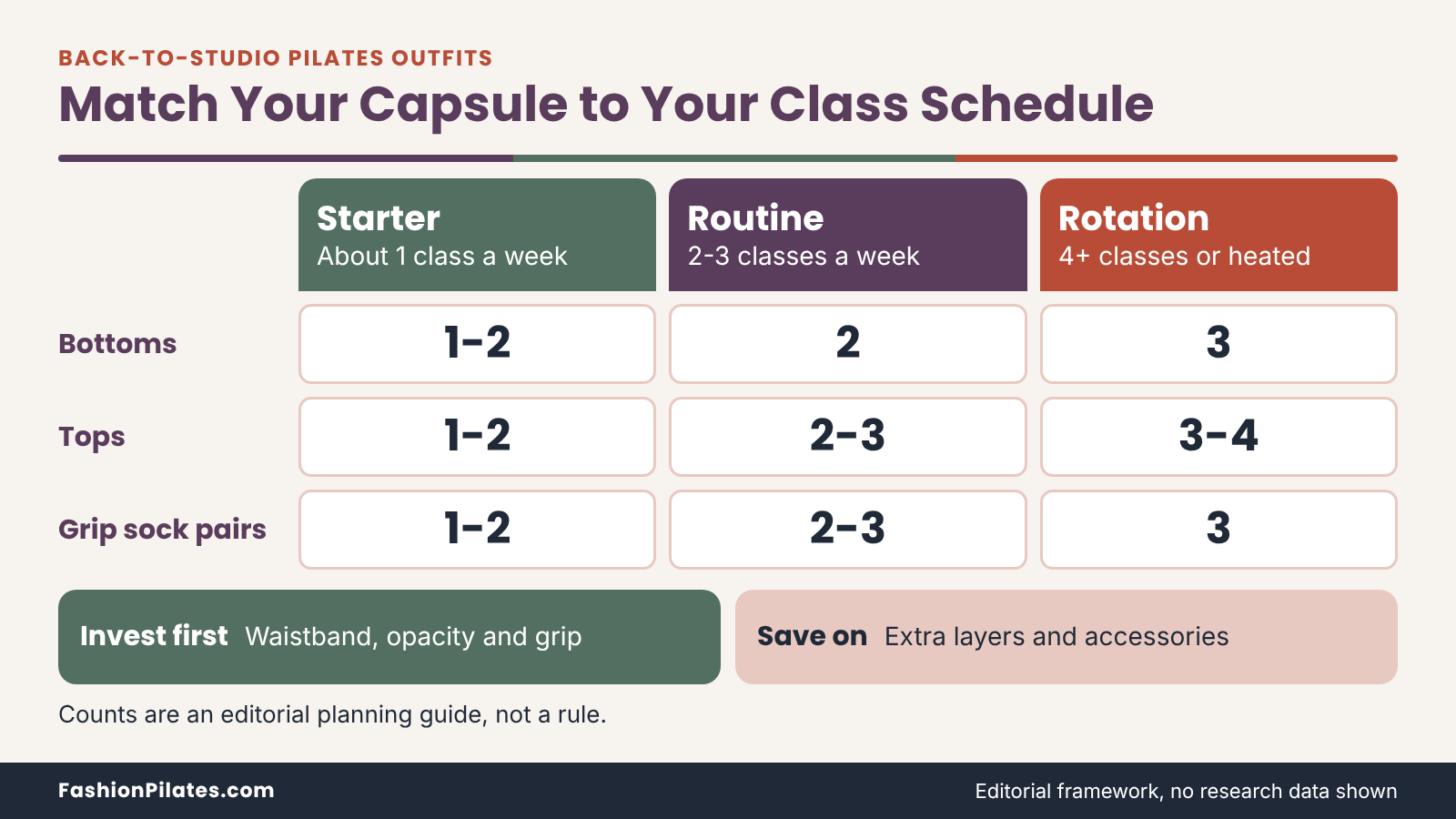
If you plan one class a week, the starter tier is realistic, and you can use the audit results to fill any gap. If you plan two to three classes, the routine tier removes most laundry pressure. Add the rotation tier only if you attend four or more classes, or if you add a heated format, because wash cycles stack up quickly. Whichever tier you pick, run the home checks before buying duplicates.
| Tier | Best for | Bottoms / tops / socks | Spending logic |
|---|---|---|---|
| Starter | About one class a week while you decide if the routine sticks | 1-2 bottoms / 1-2 tops / 1-2 sock pairs | Fill only the gaps the audit found; avoid duplicates until the routine is steady |
| Routine | Two to three classes a week | 2 bottoms / 2-3 tops / 2-3 sock pairs | Prioritize waistband, opacity and grip; trim extras |
| Rotation | Four or more classes, or a heated format added | 3 bottoms / 3-4 tops / 3 sock pairs | Add a lighter top for heat and a spare sock pair; buy gradually |
Adjusting a tier to your laundry rhythm
The counts assume you wash once or twice a week. If you wash daily, you can often drop a tier without trouble, and if you wash only on weekends, move up one. Also consider where you keep your gear: a student who changes at the studio and has a locker may want one more sock pair than someone who wears the outfit from home. Adjust the numbers to fit the way your week actually runs, not the way an ideal week might.
Dressing for Mat, Reformer, Tower and Heated Classes
One well-chosen outfit can cover several formats, but each format stresses clothing in a different spot. Knowing where the stress lands helps you decide which pieces to bring and which to leave at home.
Mat and Reformer Classes
Mat and reformer are the two most common formats for returning students, and they ask slightly different things from your clothes. The words are easy to mix up: Mat Pilates is the workout, while a Pilates mat is the cushioned surface you may lie on, and if you want a refresher on the workout, see beginner Mat Pilates workout.
Mat classes
On the floor, you spend a lot of time rolling, lying down and shifting between prone, supine and side-lying positions. Prioritize flat seams, a waistband that does not dig, and a top that does not ride up when you roll. Whether you need socks depends on the studio: some mat classes are barefoot, others ask for grip socks. Ask before you assume. A longer top can help during roll-ups and bridging.
Reformer classes
On the reformer, you push and pull against springs while sitting, lying and kneeling on a moving carriage, so grip and fit matter more. Grip socks are the norm in this format, and Club Pilates describes them as a stability and safety requirement. Back zippers, bulky waistband pockets and loose hardware are bad ideas because you will be lying on upholstered surfaces. Keep jewelry off and hair tied back so nothing catches on straps or springs.
Tower and Heated Classes
Tower classes (the wall-mounted spring system, sometimes combined with a mat) and heated classes bring their own considerations. Heated formats in particular deserve a few extra precautions.
Tower and apparatus classes
Tower work often includes spring-loaded straps and bars, so a snug top and bottoms that do not catch on hardware matter more than they do on a mat. Ask what apparatus the class uses. Socks are typically still required for equipment work, but each studio decides. Ask your instructor about the specific setup.
Heated studios
Heated classes raise a different question: how your body copes. A Henry Ford Health article on hot workouts notes that heat can raise heart rate and blood pressure, drive heavy sweating and dehydration, and carry a risk of heat illness, and it recommends checking with a doctor first if you are older, pregnant, out of shape or have conditions such as heart disease or diabetes, in its hot workout safety explainer. The Centers for Disease Control and Prevention advises starting slowly, drinking more water than usual and stopping at faintness or weakness, in its heat and athletes guidance. Choose breathable layers, bring water, and treat dizziness as a stop sign.
A Format-by-Format Cheat Sheet
The table that follows summarizes what each format asks of your outfit. Treat it as a planning aid, and check with your studio when its rules differ.
Using the table for one format
Look at the format you attend most, then read across. If you attend several formats, pack for the most demanding one, which is usually the reformer or the heated room. Remember that the studio’s own rules override any general guide, and if you are unsure about heat, speak with a clinician before booking a heated class.
| Format | Main clothing stress | Footwear | Pack extra |
|---|---|---|---|
| Mat | Rolling and floor transitions; seams and rise | Studio decides; ask first | Longer top, small towel |
| Reformer | Lying on a moving carriage; fit, zippers, hardware | Grip socks commonly required | Spare grip socks, hair ties |
| Tower | Spring-loaded bars and straps; snug fit | Studio decides; ask first | Light layer for warm-up |
| Heated | Sweat and heat; breathability and drying | Studio decides; ask first | Water, second top, extra towel |
Packing when you attend several formats
Students who split their week between a mat class and a reformer class do not need two wardrobes. Pack for the most demanding format, which means fitted bottoms that pass every check, a top without loose hems and grip socks in the bag even on mat days, in case the instructor asks for them. A single well-chosen outfit that works in both rooms beats two outfits that each work in only one, and it makes the bag lighter.
Gym Bag, Locker Room and Care Logistics
A returning routine lives or dies on logistics. A bag that is packed on Sunday night and cleaned out on Thursday will do more for your attendance than any outfit. The aim is a bag that is almost always ready, with clean gear returning to it after every wash.
Packing the Class Bag
Treat the bag as a small kit with a fixed list, not a place where items accumulate. A fixed list also makes it easy to spot what is missing before you are standing at the front desk.
The core list
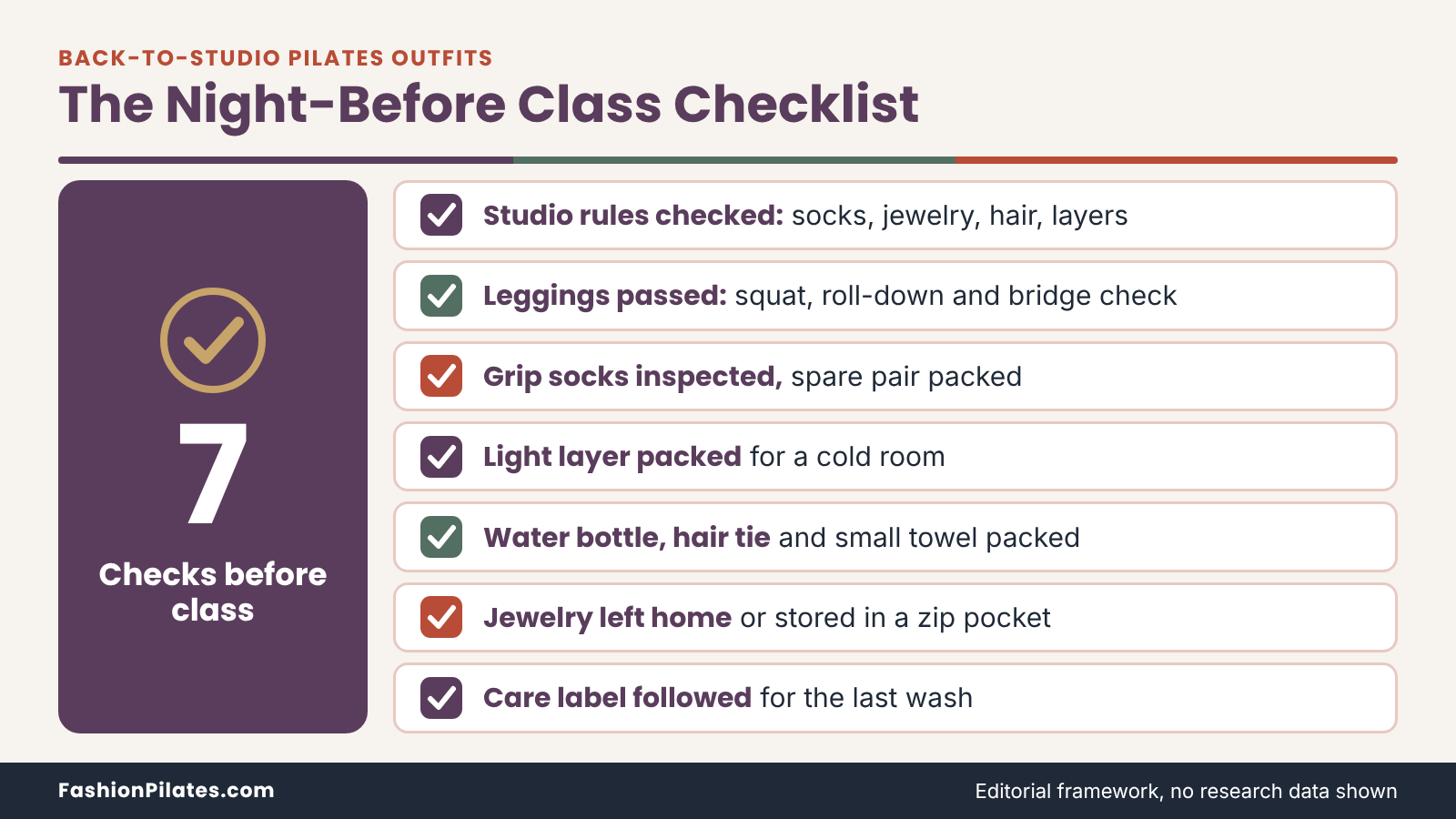
The core list is short: grip socks, a spare pair, a water bottle, a hair tie, your layer, a small towel, and a clean change of top if you will be going somewhere afterward. Club Pilates asks students to bring grip socks and a reusable water bottle, a reminder that the basics matter more than extras. Put socks in a small pouch so they do not touch dirty items, and keep any jewelry in a zip pocket you can reach without unpacking the whole bag.
Arrival timing and changing
If you change at the studio, arrive early enough to put your things in a locker or cubby, change calmly and warm up. ABC Fit Studio asks students to arrive on time so they can warm up appropriately, and it is a good rule. If you wear your outfit to the studio, the main logistic is layers and shoes: wear easy shoes you can remove, and put grip socks on once you are inside, since the soles may pick up dirt on the way in.
Hygiene and Fabric Care
Moisture, shared floors and repeated wearing make clean habits worth the effort. Good habits also extend the life of the gear you just audited, which is the whole point of a reset.
Feet, socks and shared spaces
The American Academy of Dermatology notes that athlete’s foot fungus thrives in warm, moist places and advises wearing shower shoes or sandals around gyms, showers and locker areas, drying feet fully, choosing natural-fiber or moisture-wicking socks, changing socks when wet, and not sharing towels or shoes, in its prevention guidance. For Pilates, that translates to wearing clean grip socks every class, taking them off promptly afterward and letting them air out instead of sealing them in a bag.
Washing leggings and grip socks
Start with the care label; the Federal Trade Commission’s rule requires clothing makers to attach care instructions that stay legible, as explained in its care labeling guidance. Whirlpool’s leggings advice recommends cold water, a gentle cycle, a mild detergent without built-in softeners, turning pieces inside out, using a mesh bag and air drying, since softeners can leave a coating that hurts moisture-wicking and high heat can damage synthetic fibers, in its washing leggings guide. Apply the same logic to grip socks and keep the grip side from catching on other laundry.
Between Washes and Storage
Not every piece needs a full wash after each class, but they all need to dry. What happens between classes affects how long your gear lasts and how it smells.
Airing and drying
Hang leggings and tops to air once you are home, and lay socks flat or hang them rather than leaving them in the bag. Sweat that sits in fabric is what causes the lingering odor people complain about, so even five minutes of airing can make a difference. A drying rack near a window is usually enough, and it keeps you from relying on a hot dryer, which the manufacturer guidance above says can harm stretch fabric.
Storing the clean kit
Keep clean gear in one drawer or a dedicated bag so a class day never begins with a search. Fold leggings loosely rather than stuffing them in a corner, and keep grip socks paired. Once a week, check the grip soles again, especially if you attend several classes. A thirty-second check is a good habit and means you will never be surprised in the lobby.
The First Four Weeks: Reorder Timing
The smartest way to assemble back to studio Pilates outfits is slowly, one decision at a time. Your first month back tells you which pieces you reach for, which ones annoy you and what the routine actually looks like once real life gets involved. Spread purchases across that month instead of buying everything in one hopeful afternoon.
Week-by-Week Buying Timeline
The timeline below assumes you are restarting at two or three classes a week. If your schedule differs, stretch or compress it, but keep the order: test, observe, then buy.
Weeks one and two: test before you buy
Spend the first two weeks wearing what passed the audit. Note, after each class, anything that annoyed you: a waistband, a sock, a layer that got in the way. Replace only what failed the home checks and grip socks if they are worn out, because those two items affect safety and stability most. Hold off on anything cosmetic. A pair of leggings is easier to judge after a real class than after a mirror check.
Weeks three and four: fill the gaps
By week three your notes show a pattern. If a piece was uncomfortable twice, it is out. If you wished you had a spare pair of socks or a lighter top, that is what to buy. Check the retailer’s current delivery estimate and return window before ordering, and place orders early enough that a delay does not leave you with nothing clean on class day. Leave a few days between arrival and your next class so you can run the movement check.
The Four-Week Table
A table makes the sequence easy to scan. Use it as a planning template, and adjust the actions to your own audit results.
How to use the schedule week to week
Print the table or copy it into your notes, then add the specific pieces from your audit under each week. The point is not to buy something every week; the point is to know what you are deciding on each week. If there is nothing to buy, enjoy the savings. If you add a heated class or change studios mid-month, restart the table from week one for that format.
| Week | Focus | Decide | Reorder only if |
|---|---|---|---|
| Before week 1 | Audit and home checks | Keep, repair or replace each piece | Grip socks fail, or no bottoms pass the movement checks |
| Week 1 | Wear what passed; take notes | Which pieces needed no adjusting | A piece failed in class despite passing at home |
| Week 2 | Check cold-room and layer needs | Whether your layer helps or gets in the way | You were cold or hot enough to affect focus |
| Week 3 | Look at laundry rhythm | Whether you ran out of clean gear | You need a second bottom or a spare sock pair |
| Week 4 | Review the month | Which pieces earn a permanent spot in the bag | A repeated annoyance remains unsolved |
When real life interrupts the timeline
Travel, illness or a busy stretch at work can break the sequence, and that is normal. If you miss a week, do not compress the buying; simply pick up where you left off, and treat the first class after the gap as a fresh week one for any piece you have not yet tried. If you miss several weeks, repeat the quick audit, because gear that sat unused may have aged in storage. The timeline serves the routine, not the other way around.
Easing Back and What It Means for Clothes
How you return to movement shapes what you need to wear. A gentler first month, with fewer classes and lower intensity, often needs less than a ramped-up one, and the guidance on pacing is widely shared.
Pace yourself
Health sources agree that restarting is best done gradually. A health-system article on restarting exercise advises starting slow and building intensity gradually, scheduling rest days, and consulting a doctor beforehand to identify potential risks, in its restart guide. The Centers for Disease Control and Prevention adult guidelines, which call for muscle-strengthening on two or more days a week alongside aerobic activity, note that some activity is better than none, in its adult activity overview. Those are general-population targets, not a Pilates prescription, so let your instructor set the pace.
Let the routine decide the wardrobe
If your first month is two classes a week, the starter or routine tier from earlier will cover you. Resist the urge to buy for the routine you hope to have by January. If the habit settles into a third or fourth class, you can scale the capsule up; if it stays small, you will have saved the money. The wardrobe should follow the routine, never the other way around, which is also why a separate seasonal build, such as fall Pilates capsule wardrobe, belongs after the routine is steady.
Common Mistakes When Dressing for a Return
Most returning-student clothing problems fall into a handful of repeat patterns. Seeing them in advance is the cheapest way to avoid them, and each has a straightforward fix.
Shopping Mistakes
Mistakes made before class tend to be about speed and optimism. They cost money and, more annoyingly, they cost the first few classes.
Buying a new look before knowing what failed
It is easy to treat a restart as a reason to buy a whole new set, and sets are designed to be bought together. Without the audit, you may replace pieces that were fine and keep one that was not. Run the checks first, write down what failed, and shop for the problem. A single replacement pair of leggings that passes the movement list does more for your class than a full set that has never been tested.
Forgetting that socks are equipment
Many students plan the visible pieces and treat socks as an afterthought. But when a studio makes socks mandatory, as the Club Pilates help center says, a worn or missing pair can delay the start of class or require a last-minute purchase at the desk. Replace socks as part of the reset, not when the front desk asks, and keep a spare pair in the bag.
Class-Day Mistakes
These are the mistakes that show up once you are in the room. They are small and fixable, but they steal attention you wanted to spend on the work.
Dressing for the walk in, not the carriage
An outfit can look excellent in the lobby and fail on a moving carriage. A long sweatshirt, a layered scarf, a dangling bracelet or a top with a back zipper may be fine on the street and a problem on equipment. Dress for the work first, then add layers that can come off in seconds. If something feels questionable, leave it in the locker; nobody ever regretted a missing necklace during a leg-spring series.
Skipping the post-class reset
People often toss damp gear into a bag, then wonder why the socks smell and the grip gives up early. Airing your gear after class, washing it according to the care label and rotating pairs are the simple habits that preserve the audit work. Put a reminder in your calendar for laundry day if you need one, and repack the bag the same evening so you never start class day at zero.
What This Research Can and Cannot Tell You
A guide like this one is useful for decisions and limited for certainty. It helps to be plain about both, so you know when to rely on it and when to ask someone who can see you in the room.
How This Guide Was Built
The method is research-based and criteria-led, with no hands-on product testing involved. That is a limit, and it shapes what the guide does and does not claim.
The sources behind it
The guide draws on published studio policies and style guides, a dermatology organization’s foot-care guidance, federal health and labeling pages, a health-system article on hot workouts, a manufacturer’s laundry advice and a general restart article. Each source speaks to a narrow point, and where a source is a few years old, such as the 2021 style guides, the guide uses it for its logic rather than as a current policy. Product names are avoided on purpose because a criteria-led guide holds up better than a list that goes stale.
What was not done
Nobody wore and compared specific leggings or socks for this article, so there are no rankings, wear-test results or durability claims. The capsule counts are editorial planning guides rather than data, and prices are left out because they change quickly and vary by retailer. If a particular product matters to your decision, check its current manufacturer page for materials, care instructions and return terms before buying.
When to Ask Someone Else
Some questions are beyond the reach of a clothing guide. Knowing when to hand off is part of using one well.
Fit that touches on health
If a garment seems to cause pain, numbness, rashes or breathing discomfort, or if you are pregnant, postpartum, recovering from surgery or managing a health condition, ask a qualified clinician or Pilates professional about what to wear and what movements are appropriate. This guide is general fitness education and does not offer individualized medical advice. Stop any movement that causes sharp pain, dizziness or numbness.
Studio-specific questions
Your instructor and front desk know the equipment, the room temperature and the house rules, and they are the best source for any question this guide cannot answer. Ask about socks, layers, jewelry, hair and what to wear for a specific apparatus. For the rest of your wardrobe, Pilates Sets & Outfit Ideas hub collects related outfit guides, and Pilates activewear buying guide covers fabric and construction in more depth.
Frequently Asked Questions
Do I really need new grip socks when I go back to class?
Not necessarily, but you should inspect the ones you own before assuming they still work. Look for distinct grip dots across the ball of the foot and heel, a heel that holds its shape and a cuff that stays at the ankle. If the grip is worn smooth or peeling, replace the pair, because traction does not come back once it is gone. Many studios require grip socks for equipment classes and sell them at the desk, so a last-minute purchase is usually possible.
What should I wear to my first Pilates class back after a long break?
Wear fitted, comfortable pieces that you have already tested at home with a squat, a roll-down and a bridge. A high waistband that stays flat, a top that does not ride up and a medium-support bra are a reliable base. Add grip socks that match your studio’s policy and a light layer for a cold room. Leave dangling jewelry at home and tie your hair back, since both can catch on equipment.
Can I wear my old leggings, or is it time to replace them?
Keep them if the waistband springs back flat, the fabric stays opaque when you stretch and the seams are intact. Replace them if the waistband rolls or creeps, the fabric has gone shiny or sheer or the knees stay bagged after you stand. A quick movement check at home is the fairest test, because a pair can look fine on a hanger and fail on a bridge. Retired pairs can still work for walking or lounging.
Are jewelry and watches allowed in a reformer class?
It depends on the studio, so ask before you arrive. Several published studio and education sources advise removing metal accessories, since they can damage upholstery or get tangled in equipment. Rings and a small watch may be fine at some studios and not at others. If you are unsure, leave jewelry at home or store it in a zip pocket of your bag.
How should I wash grip socks and leggings so they last?
Follow the care label first, because makers are required to include usable instructions. Manufacturer guidance for stretch leggings generally points to cold water, a gentle cycle, a mild detergent without built-in softeners, a mesh bag and air drying. High dryer heat can damage synthetic stretch fibers, so use low heat or no heat if you must machine dry. Turn grip socks inside out and keep the grip side away from rough items.
What should I wear to a heated Pilates class?
Choose breathable, lightweight layers that dry quickly, and bring a second top and extra water. Health sources note that heat can raise heart rate and increase the risk of dehydration and heat illness, so start slowly and stop if you feel faint or weak. Ask your studio about its temperature and policies on socks and towels. If you have a heart condition, are pregnant or have another health concern, check with a clinician before attending.
How many outfits do I need if I take two or three classes a week?
A practical minimum is two pairs of bottoms that pass your movement checks, two or three fitted tops and two or three pairs of grip socks. That lets one set dry while you wear another without doing laundry every night. Add a lighter top if you try heated classes, and a spare sock pair if you ever leave one in a locker. Counts like these are a planning guide rather than a rule, so adjust them to your own laundry rhythm.
Should I buy a whole new outfit before restarting?
Usually not, because you do not yet know what your routine will look like. Audit what you own, replace only what fails the checks and wear the rest for two weeks. Then use your notes to fill the specific gaps you found. A staggered approach costs less and gives you better information than a single big order.


Trackbacks/Pingbacks