Direct answer: The best pilates studios los angeles offers are the ones that match your neighborhood and commute, your preferred class format (reformer, mat, tower, or Lagree-style), a class size where the instructor can actually see you, and a pricing structure you can leave without a fight. No single studio wins on all of those for every person, so the reliable method is to shortlist two or three studios within a realistic drive or ride, book one intro class at each, and judge the teaching, the room, and the contract terms before committing.
This guide is for adults in Los Angeles County who are new to studio Pilates, returning after a break, or relocating and starting over. It explains the formats, how to choose by geography, what pricing and ClassPass policies look like on official pages, how to prepare for a first class, and what to read before you sign anything. It is general fitness education, not individualized medical advice, and it names only a handful of studios whose own websites were checked on October 7, 2026.
What “Best” Actually Means for a Los Angeles Pilates Studio
Los Angeles County is enormous and its studio scene is crowded, so “best” is a slippery word here. A studio that is perfect for someone who works in Santa Monica can be a nonstarter for someone who lives in Pasadena and wants a 6 a.m. class before work. Before comparing any names, it helps to define what you are actually optimizing.
Why the best Pilates studios Los Angeles offers depend on your week
Think of a studio choice as a three-way trade between format, place, and price. You rarely get all three at their ideal setting, and the first job is deciding which one you will not compromise on.
The three variables that decide fit
Format is what happens in the room: a reformer class with springs and a sliding carriage, a mat class, or a more athletic machine-based format. Place is the realistic travel time at the hour you will go, not the distance on a map. Price is the total monthly cost once you count packs, memberships, parking, and any fees. Rank those three honestly and most of the shortlist writes itself. A person who values small, technical classes may accept a longer drive and a higher price. A person who wants to go three times a week before work will usually value a ten-minute commute above nearly everything else.
Why a star rating cannot settle it
Public ratings are useful for catching disasters, such as chronic late starts, broken equipment, or aggressive upselling. They are weak at telling you whether a teaching style works for your body and your temperament. A class that one reviewer calls “challenging and precise” may feel rushed to a newcomer, and a class that feels gentle to a returning athlete may be exactly right for someone rebuilding confidence. Ratings also lean toward the crowds who leave reviews, which tends to be regulars rather than first-timers. Use them as a filter for the obvious problems, then let your own intro class do the real judging. As a rule of thumb, the instructor’s cueing matters more than the playlist, though the playlist does tend to be louder.
How this guide was built, and what it does not do
You deserve a straight account of the method, because local “best of” lists can imply a level of testing that rarely exists. This one is deliberately different, and the difference shapes everything that follows.
A research-based comparison, not a ranking
This guide is a research-based comparison built on public studio pages, ClassPass help documentation, national physical activity guidance, a published summary of clinical evidence, and California consumer-protection information. We did not visit, take classes at, or test any studio, and nothing here is a ranking or an endorsement. Where a price or policy appears, it comes from an official page checked on October 7, 2026, and prices change often, so check the current listing before you rely on a number. If a studio’s page and this article disagree, the studio’s page wins.
Why so few studios are named
Los Angeles studios open, rebrand, relocate, and close at a steady clip, and a list that names twenty of them goes stale quickly. The few studios mentioned below were chosen only because their own websites could be read directly and clearly describe what they offer. Naming them is an illustration of how to read a studio page, not a claim that they beat anyone else. ClassPass publishes its own Los Angeles reformer list drawn from verified member reviews, and that list spans neighborhoods from West Hollywood to Arcadia, Porter Ranch, and Cerritos, which neatly shows how spread out the options are. Treat any list, including that one, as a place to start your research rather than the end of it.
Class Formats You Will See Across Los Angeles
Studio menus can read like a foreign-language restaurant card, partly because equipment names are inconsistent and partly because studios invent branded class titles. Knowing the underlying formats lets you decode almost any schedule. If you want the full equipment background first, our explainer on what is reformer Pilates covers the machine in depth.
Reformer, tower, and chair classes
Apparatus classes use the equipment Joseph Pilates designed, or modern versions of it, with springs providing adjustable resistance. They tend to dominate Los Angeles schedules, and the details of how a studio teaches them vary more than the names suggest.
Reformer classes: classical and contemporary
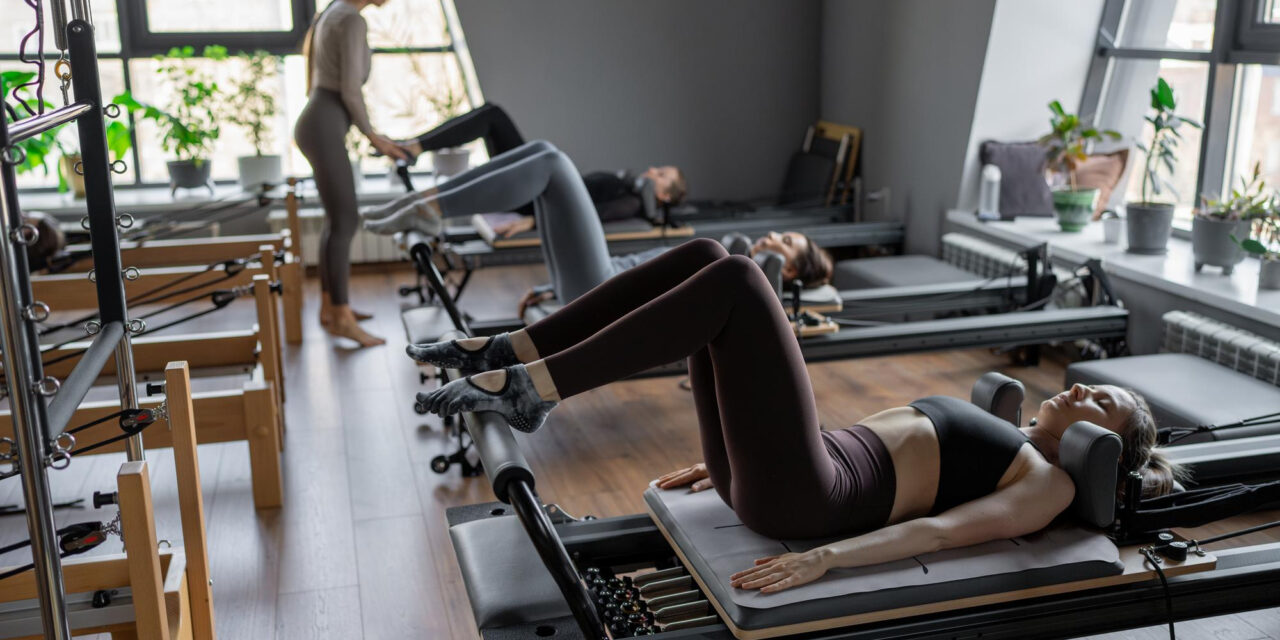
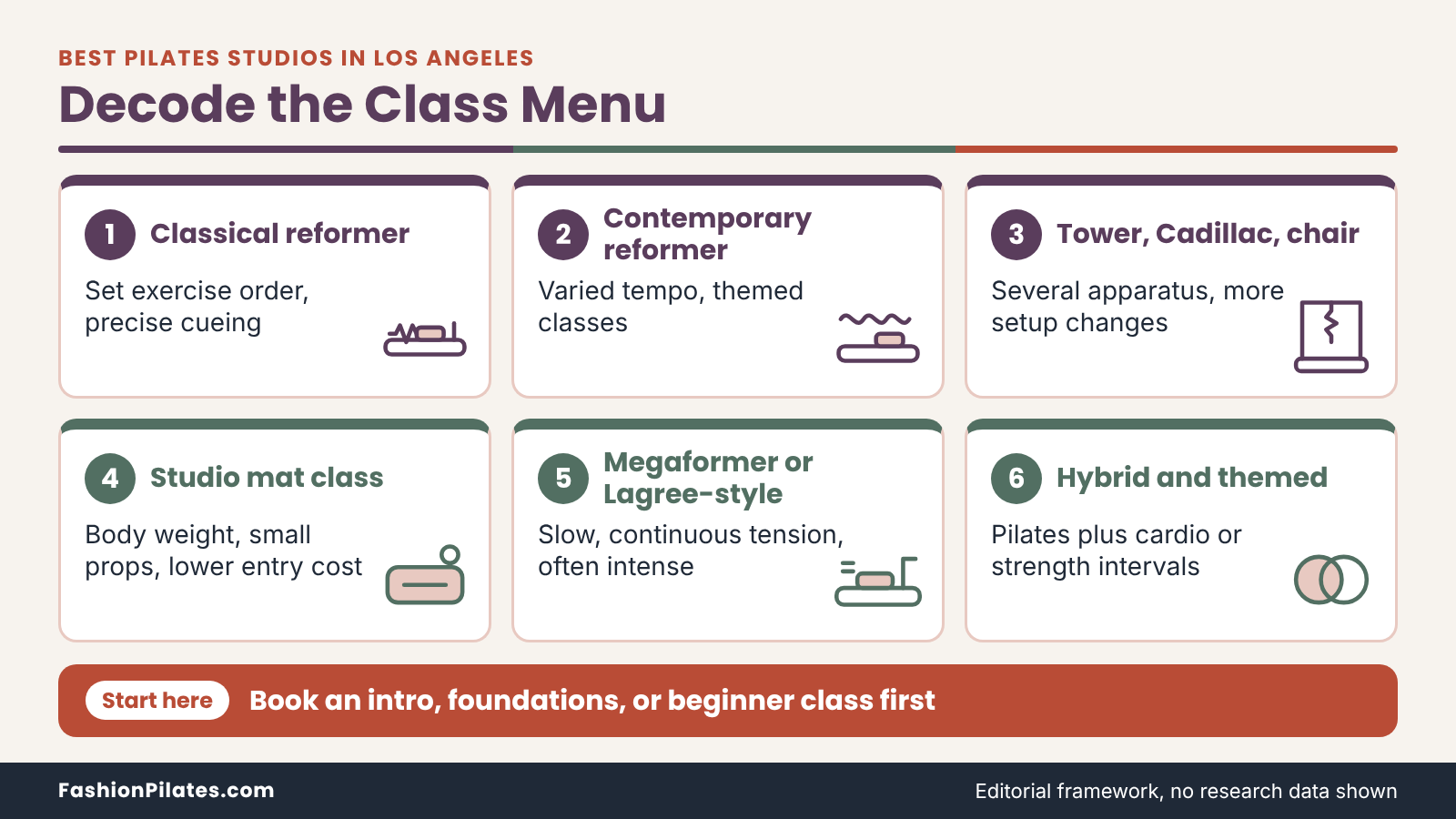
A reformer is a sliding carriage on a frame, with springs you adjust for more or less resistance, plus a footbar and straps. Classical studios generally teach a set exercise order drawn from the original repertoire, while contemporary studios blend that repertoire with newer exercises, tempo changes, and themed classes such as glutes or cardio. Neither is automatically better. Classical classes can suit people who like predictable structure and precise cueing, and contemporary classes can suit people who want variety. Spring settings are not standardized across brands, so a “medium” in one studio may feel different in another. Always follow your instructor’s setup and the manufacturer’s manual rather than copying someone else’s numbers.
Tower, Cadillac, and chair work
Some studios add a tower (a vertical frame with springs, often attached to a reformer), a Cadillac (also called a trapeze table), or a Pilates chair. Pilates Boutique in West Hollywood, for instance, describes classes that use the reformer, Cadillac, and Pilates chair, which is a good illustration of a multi-apparatus format. These setups let an instructor offer more variety in one session and sometimes allow gentler or more supported options. They also make classes feel more complicated at first, so a newcomer may want a Foundations or intro class before jumping into a rotation across several machines.
Mat, Lagree-style, and hybrid formats
Not every studio class runs on springs and carriages. Floor-based and machine-based variations all show up on Los Angeles schedules, and each has a different learning curve and intensity profile.
Mat Pilates classes in a studio
A studio mat class uses body weight, sometimes with small props such as a ring, ball, or light weights. It is typically the lowest-cost way to sample a studio and an excellent way to learn breathing, pelvic position, and abdominal control before moving to equipment. If you want to practice the method at home, start with our guide to a beginner Mat Pilates workout. If you instead need a physical mat, that is a separate shopping question with its own criteria, and our hub on Pilates mats and flooring covers it.
Megaformer and Lagree-style classes
Lagree classes use a machine called the Megaformer, which the company describes on its own site as a low-impact, high-intensity method built around time under tension with spring-based resistance. In plain English, time under tension means moving slowly so muscles stay loaded for longer. The name sounds like a superhero’s sidekick, but the practical difference from reformer Pilates is mostly tempo and intensity: slower, more continuous, and often more demanding. It is a related but distinct format, so do not assume a Lagree class and a classical reformer class feel alike.
Hybrid, heated, and themed classes
Many studios now run hybrids that mix reformer work with cardio intervals, strength circuits, or stretching, and a few add heat or candlelit evening classes. Mighty Pilates, which lists locations in Santa Monica, Culver City, and Westwood Village, describes a range that runs from Foundations for newcomers to Power Pilates, plus specialty sessions such as a candlelit stretching class. Themed classes can be a fun add-on, but they are rarely the best way to learn fundamentals. Start with a class labeled intro, foundations, or beginner, then branch out once the basic setup feels familiar.
The table below puts the common formats side by side so you can match them to your goals and comfort level.
| Format | What it feels like | Best for | Think twice if |
|---|---|---|---|
| Classical reformer | Set exercise order, precise cueing, steady flow | People who like structure and technique detail | You want constant novelty or high-energy music |
| Contemporary reformer | Blends repertoire with varied tempo and themes | People who want variety and a workout feel | You are brand new and need slow, repeatable basics |
| Tower, Cadillac, chair | Several apparatus in one session, more setup changes | Returning students and those wanting supported options | Switching equipment makes you anxious as a beginner |
| Studio mat class | Body weight, small props, floor-based | Learning breath and core control at a lower price | You want spring resistance specifically |
| Megaformer or Lagree-style | Slow, continuous tension on a larger machine | People who enjoy intensity and endurance challenges | You want traditional Pilates repertoire |
| Hybrid and themed | Pilates mixed with cardio, strength, or recovery | Experienced students who want variety | You have not yet learned the fundamentals |
Choosing by Neighborhood and Commute
Finding the best pilates studios los angeles has near you is partly a geography exercise, and geography is the most underrated factor in whether a studio habit survives past month two. Los Angeles rewards planning around travel time at the hour you will actually go, because a ten-mile trip can take twenty minutes at one hour of the day and an hour at another. Distance in this city is measured less in miles than in podcast episodes.
Westside, coast, and Culver City
The Westside and beach communities have a dense cluster of studios, which means more choice and also more competition for the popular class times. Parking and traffic patterns differ sharply from block to block, so the best approach is to test the trip itself.
Santa Monica, Venice, Brentwood, and Westwood
Studios in these neighborhoods often draw people who live and work nearby, so mid-morning and lunchtime classes can fill quickly. Mighty Pilates, for example, lists a Santa Monica and a Westwood Village studio on its site, which gives you a sense of how a single brand can span nearby neighborhoods with slightly different schedules. If you work on the Westside, check whether a studio near your office offers early or lunch classes, because that is usually the easiest habit to protect. Weekend classes near the coast can be crowded, so book early if you plan to go on Saturday morning.
Culver City and the mid-Westside
Culver City sits at a useful crossroads between the Westside, Mid-City, and the South Bay, which makes it a practical choice for people who split their week between areas. The same Mighty Pilates site also lists a Culver City studio, so a person with a flexible commute can compare locations from one brand without learning a new booking system. When you scan the map, look for studios close to your route home rather than your home itself. A class you pass on the way back from work is far more likely to happen than one that requires a separate trip.
Hollywood, West Hollywood, and Central Los Angeles
Central neighborhoods blend residential streets, entertainment-industry schedules, and a lot of boutique fitness. Class times here often stretch into early evening and late morning to fit irregular work hours.
West Hollywood and the Beverly Grove area
West Hollywood has a high concentration of boutique studios. Pilates Boutique, for example, gives its address as 470 N Doheny Drive in West Hollywood and describes a reformer, Cadillac, and chair format with personalized attention. Small boutique studios can offer high attention per student, but they also have fewer class slots, so a studio near you may only run a few classes at the time you prefer. If your schedule is tight, scan the weekly timetable before you fall for the room.
Hollywood, Mid-City, and Downtown
Further east and south, studios tend to cater to people who work downtown or in creative offices, with schedules clustered around early mornings, lunch, and after-work slots. Parking is often paid or limited, and public transit is a real option along some corridors. If you plan to arrive by transit or bike, check the studio’s own location page and consider whether you can reach it in cycling or work clothes without feeling rushed. A relaxed arrival is part of the class, since first-timers usually need time to set up equipment and talk to the instructor.
Eastside, the Valleys, South Bay, and Long Beach
Outside the Westside and central core, you may find larger classes, easier parking, or simply fewer options. The trade-off between choice and convenience flips as you move away from the coast.
Silver Lake, Pasadena, and the San Gabriel Valley
East of the core, the options include neighborhood boutiques and some larger franchises. The ClassPass Los Angeles reformer list, built from reviews between January 2025 and February 2026, includes a Lagree studio in Arcadia, a reminder that San Gabriel Valley options include machine-based formats as well as springs and carriages. Because supply is thinner here, check both the class schedule and the cancellation terms. A studio with only a few weekly reformer classes can be frustrating if your preferred slot sells out.
San Fernando Valley, South Bay, and Long Beach
The Valley and the South Bay tend to have more parking and more car-based commutes, which can make early morning or weekend classes the easiest to protect. The same ClassPass list also includes spring-based studios in Porter Ranch and Cerritos, which illustrates that strong options exist well outside the Westside postcodes. If you are shopping for a franchise, such as Club Pilates, use the studio locator on the brand’s own site to see which locations are actually near you, because a national homepage will not tell you what is open on your street.
This table turns the geography into quick decisions you can make before you open a map.
| If your priority is | Look first at | Watch out for |
|---|---|---|
| A class before or after work | Studios along your daily route, not near your home | Peak-hour traffic doubling your trip time |
| Lots of schedule choice | Dense areas such as the Westside and West Hollywood | Popular times filling quickly and higher drop-in prices |
| Easy parking | Valley, South Bay, and some eastside locations | Fewer class slots at your preferred time |
| Trying several styles | Areas with many boutiques within a short drive | Spending intro offers faster than you can compare them |
| Transit or biking | Studios near major transit corridors | Limited changing space and bike storage |
Judging the Teaching, the Room, and the Equipment
Once you have a shortlist by location and format, the quality of the teaching and the room is what separates a studio you will love from one you will quietly stop attending. These factors are harder to read from a website, which is why an intro class is worth more than any amount of browsing.
Instructor training and credentials
Teacher training standards vary widely from studio to studio, which makes it reasonable to ask politely about a teacher’s background.
What certification can and cannot tell you
The National Pilates Certification Program describes its mission as setting standards for teacher credentialing and continuing education, and says its credential reflects passing competency-based exams that show entry-level competence. In other words, a credential is a floor, not a guarantee of great teaching. It tells you someone met a standard, but it cannot tell you whether they cue clearly, adapt well to a stiff shoulder, or notice when you are gripping your neck. Use credentials as one piece of information alongside how the teacher actually coaches you in class.
Questions worth asking about training
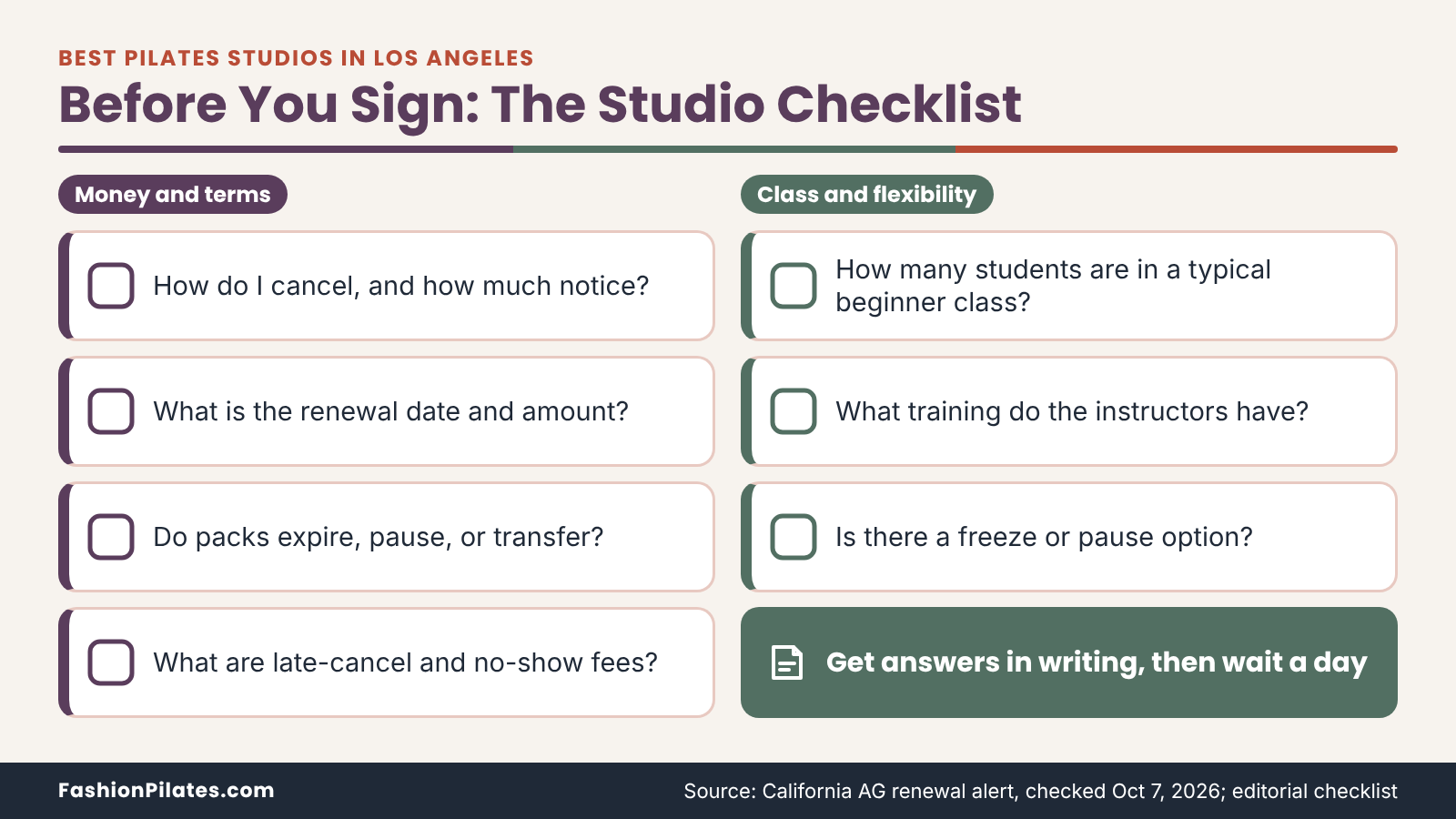
Studios usually welcome simple questions, and the answers are revealing. Ask which training program the instructor completed and roughly how many hours it involved, whether they teach beginners regularly, and how they handle people with injuries or limitations. Club Pilates, for example, states on its homepage that its instructors complete more than 450 hours of training, which shows how a franchise may publish a training standard you can compare. A studio that cannot explain its teacher training in a sentence or two deserves a little extra caution. Also ask whether the teacher you enjoyed in your intro class teaches at times you can attend, since a great instructor who teaches only at 11 a.m. on Tuesdays may not help your Thursday evening plans.
Class size, equipment, and the room
The physical setting shapes the quality of attention you receive. Small details, such as how far apart the machines sit, tell you a great deal about what a class will feel like.
Class size and how much individual attention you get
Reformer classes in Los Angeles can range from a handful of students to rooms with a dozen or more machines. Smaller classes tend to allow more hands-on correction, which matters when you are learning setup and alignment. Larger classes can still be excellent when the instructor is experienced and the cues are clear, but they can leave a first-timer feeling lost. Ask directly how many students are in a typical beginner class and whether the instructor circulates during the class. If you have a specific limitation, a private session or a small group may be a better starting point than a full room.
Equipment condition and spring guidance
Look at the machines when you arrive. Springs, straps, and footbars should look maintained, and the carriage should glide smoothly without catching. A good instructor will set your springs and explain them, because spring resistance varies by brand and there is no universal color code you can rely on. Do not adopt a spring setup from a video or from the person on the next machine. If something feels wobbly or the carriage sticks, tell the instructor immediately and pause rather than pushing through. Equipment that is cleaned between classes and mats that are wiped down are also reasonable expectations, and they are easy to observe in a ten-minute window before class starts.
Pricing, Packs, and Memberships in Plain English
Los Angeles studio pricing is not hard to understand once you separate the three basic structures: single classes, packs, and recurring memberships. The tricky part is that studios mix them, add intro offers, and attach rules about expiration and cancellation that change what a “cheap” price really costs you.
How studios structure prices
Almost every studio uses some version of the same menu. Learning the pattern helps you compare unlike offers fairly, even when the branding differs.
Drop-in, packs, and monthly memberships
A drop-in is the highest per-class price and the most flexible. A pack discounts the per-class cost in exchange for paying upfront, usually with an expiration date. A membership gives you a set number of classes each month, often at the lowest per-class price, but it typically renews automatically until you cancel. To compare them, divide the total price by the number of classes you will realistically attend, not the number on the package. If you will go twice a month, a ten-class monthly pass is not a bargain no matter how attractive the per-class math looks on paper.
What two studio price pages show
Two public examples show how wide the range can be, and both should be rechecked on the live pages because prices change. Pilates Boutique’s site lists a $59 single class, a $39 first-time class, memberships of four to eight classes a month, and month-to-month terms with 30 days’ notice to cancel. Mighty Pilates lists five classes for new clients and a monthly pass with ten classes, with the Los Angeles price shown on the site at the time of checking. These are illustrations of structure, not recommendations, and a lower price does not mean lower quality any more than a higher price guarantees better teaching.
The table below summarizes the three standard structures and who each tends to fit.
| Structure | Best for | Avoid if | Check before buying |
|---|---|---|---|
| Drop-in | Trying a studio or a casual schedule | You plan to attend weekly or more | Whether first-timer rates apply |
| Class pack | Flexible schedules and travelers | You tend to lose track of expiration dates | Expiration window and transfer rules |
| Monthly membership | Steady weekly routines | Your schedule changes month to month | Auto-renewal terms and notice period |
| Private sessions | Injury history, specific goals, or nervous beginners | You want a group energy and a lower price | Package validity and cancellation rules |
| Intro offer | Comparing studios before committing | You would rather not be sold a package afterward | New-client eligibility and expiration |
Costs that sit outside the price tag
A fair comparison includes everything you will pay, not just what appears next to the class name. The extras are modest individually but add up across a year.
Parking, socks, and small add-ons
Some neighborhoods charge for parking, and a paid garage can add a meaningful amount over a month of classes. Many reformer studios require or strongly recommend grip socks, which are sold at the front desk or online, and they are a rare case where the accessory is genuinely useful for traction on the footbar and carriage. Others may sell water, retail, or workshops. None of these costs is a reason to avoid a studio, but if you are choosing between two similarly priced options, the one with free or inexpensive parking can quietly save you more than a promotional discount.
Expiration, freezes, and cancellation terms
Pack expiration is the cost people notice last. Pilates Boutique’s page notes validity periods ranging from two to six months depending on pack size and offers a 30-day membership freeze once a year, which is a useful example of the kinds of terms to look for. Ask what happens if you move, get sick, or travel for work. A studio that explains freezes and pauses clearly is usually one that has thought about what happens when real life interrupts, and that tends to correlate with a smoother overall relationship.
Trial Classes and ClassPass: Sampling Before You Commit
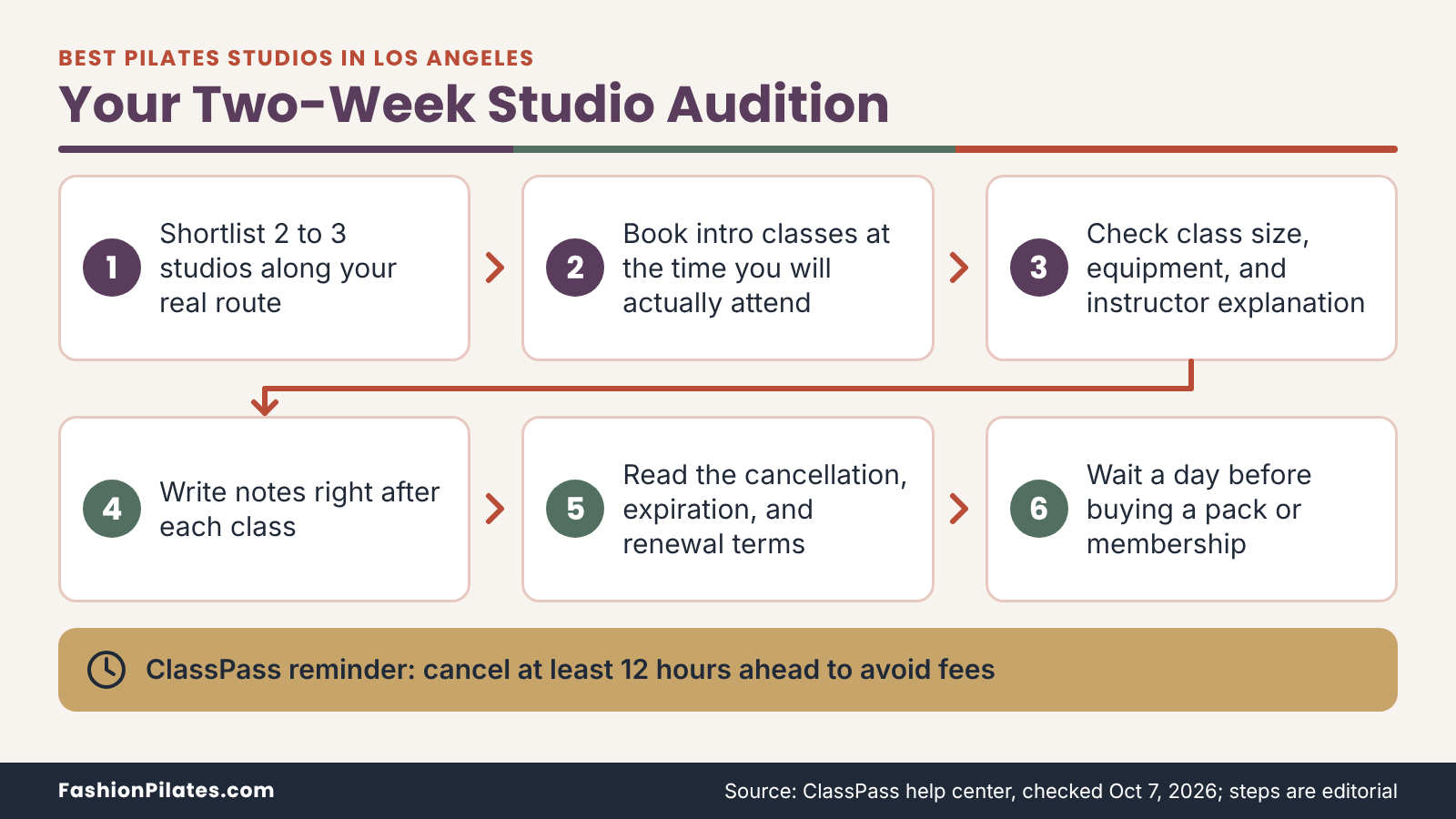
The cheapest way to find the right studio is to treat the first two weeks like a short audition. Intro offers and ClassPass are the two tools most people use, and each comes with its own rules.
Using intro offers well
Intro offers are discounted first visits aimed at new clients, and they exist because studios know a good first class is the best marketing they have. Used deliberately, they let you compare teaching styles for very little money.
How intro offers are usually shaped
Typical intro offers include a discounted single class, a short pack of three to five classes, or a discounted private session. Club Pilates describes a 30-minute complimentary intro class with no credit card required, in which the instructor explains every movement and you arrive about 15 minutes early for setup. Mighty Pilates and Pilates Boutique each advertise first-timer pricing on their own pages. The details change, so read the eligibility rules, the expiration window, and whether you must book within a certain period after buying.
A simple three-class sampling plan
Book three intro classes in one to two weeks, ideally at different studios and at the time of day you will actually attend. Take notes right after each one while the impressions are fresh: how clearly the instructor explained the equipment, whether you felt seen, whether you understood the movements, and how you felt the next morning. Do not buy a membership at the front desk on the day you try a class. Sleep on it, compare the notes, and then decide. A good studio will still be there tomorrow and will honor a reasonable window to purchase.
How ClassPass fits into the picture
ClassPass is a booking marketplace that lets you reserve classes at many studios using one account, which can be a handy way to sample different styles. It has rules of its own, and those rules are the part people tend to skim.
Credits and why they move
ClassPass classes are booked with credits, and the number of credits a class costs is not fixed. According to ClassPass’s help page, the number of credits can change with demand, how close you book to class time, promotions, and dynamic pricing chosen by the businesses themselves. For you, that means a popular Saturday morning reformer class may cost more credits than a weekday midday one, and the same class may cost a different number next week. If you want a specific popular class, book early and check the credit cost before you commit.
Cancellation and missed-class fees
This is where ClassPass can cost you real money. Its cancellation policy says reservations can generally be canceled up to 12 hours before the start time at no charge, and that late cancellations and missed reservations carry fees. At the time of checking, the page listed US late-cancel fees ranging from $10 to $56 and missed-reservation fees from $12 to $62, with the specific amount disclosed before you book. The page also says frequent cancellations can affect future bookings, and that some reservations may be non-cancelable. Read the fee shown at checkout every time, and set a calendar reminder for the 12-hour deadline if you book early-morning classes.
Your First Studio Class: Preparing, Participating, and Staying Safe
A first reformer class is mostly about learning the choreography of the equipment: where to sit, how to hold the straps, when to move the carriage. That is entirely normal, and good instructors plan for it. A bit of preparation lets you spend your attention on the movement rather than the logistics.
Before you go
Small choices before you leave the house change how the class feels. Most of them cost nothing.
What to wear and bring
Choose fitted but comfortable clothing that lets the instructor see your joints, such as leggings and a snug top, because loose fabric can hide alignment and catch on straps. Skip heavy jewelry, long necklaces, and anything that could snag on springs or hooks. Bring grip socks if the studio requires them, or plan to buy a pair at the front desk, and bring water. For outfit ideas that hold up under a reformer, see our guide to Pilates outfit ideas. Arrive 10 to 15 minutes early so you can check in, get a quick tour of the equipment, and meet the instructor without rushing.
What to tell the instructor
Before class starts, tell the instructor about anything that affects how you move: past or current injuries, recent surgery, pregnancy or postpartum status, joint problems, balance concerns, and anything your clinician has told you to avoid. You do not need to share your whole medical history, just the practical pieces. This is also the moment to say you are new, so the instructor can offer simplified options and extra setup help. A good teacher will thank you for the information rather than treating it as an inconvenience.
In the room
Once class begins, your main job is to move with control and listen to your body rather than the person beside you. Studio classes move quickly, so knowing your options ahead of time makes the hour more comfortable.
Spring tension, modifications, and pace
Spring resistance is not standardized across brands, so follow your instructor’s setup rather than numbers you saw online. Heavier tension is not automatically harder or better. Some exercises are more challenging with lighter springs because you have to control the carriage yourself. If an exercise feels too intense, ask for a regression, which is simply an easier version. If it feels too easy, ask for a progression. Modifying is part of the method, not a failure, and the shaking in your legs during a slow hold is just your muscles doing exactly what the instructor asked.
When to stop, and who should check first
Stop and tell the instructor if you feel sharp pain, dizziness, numbness, tingling, chest discomfort, or unusual shortness of breath. Slow, mild muscle fatigue is expected, but sharp or worsening pain is not. If you are pregnant or postpartum, have osteoporosis, recent surgery, an acute injury, or a chronic condition, check with a qualified clinician or an experienced Pilates professional before joining a general group class. This article is general fitness education and cannot replace advice tailored to your body.
Reading the Fine Print: Contracts, Auto-Renewals, and Red Flags
Most studio disputes are not about Pilates at all. They are about an auto-renewing membership that was easy to start and surprisingly hard to end. A few minutes of reading before you sign, and a basic grasp of California’s rules, can save you months of unwanted charges.
California’s auto-renewal rules in practice
California tightened its automatic renewal law in 2025, which affects many subscription-style memberships sold to consumers in the state. Rules and exceptions can be technical, so treat this as orientation rather than legal advice.
What the law asks businesses to do
The California Attorney General’s office describes its consumer alert on the updated law, effective July 1, 2025, as requiring clear disclosure of terms, express consent before charging for renewals, and an easy cancellation method through the same channel used to sign up. If you enrolled online, you should be able to cancel online without obstruction. The alert also describes reminder notices for certain subscriptions and notice before a trial longer than 31 days converts into a paid plan. How those requirements apply to a specific studio membership depends on the contract, so read your own terms.
If cancellation turns into a maze
Keep a written record: the date you asked to cancel, how you asked, and any confirmation you received. Ask for a written confirmation by email, and compare it against your next statement. According to the Attorney General’s alert, consumers who run into trouble cancelling can file a complaint through the office’s reporting page at oag.ca.gov/report. Start by contacting the studio politely and clearly, because most issues are simple misunderstandings, and escalate only if the studio does not respond. Some payment providers also let you dispute charges, but that is a last step.
Red flags and green flags at the front desk
Studios differ in how openly they discuss terms. Watching how a studio handles your questions is a good preview of how it will handle your account later.
Red flags worth walking away from
Be cautious if a studio pressures you to sign on the spot, will not show you the cancellation terms in writing, or cannot tell you the notice period. Other warning signs include a vague answer about how to cancel, an intro offer that quietly converts into a recurring charge without a clear notice, and a promotion that expires at the end of the day. Pressure is a business tactic, not a feature of Pilates. A good class does not need a countdown timer attached to it.
Green flags that suggest a healthy studio
Look for plain-language terms posted on the website, a clear notice period for cancelling, a freeze or pause option, and staff who answer questions without hurrying you. Pilates Boutique’s page, for example, states that its memberships are month to month and cancelable with 30 days’ notice, which is the kind of specific, readable policy worth looking for. A studio that tells you to take a day to decide is usually confident in what it offers. Instructors who ask about your goals and limitations before class, rather than after, are another encouraging sign.
This table puts the warning signs and the reassuring ones next to each other so you can scan them at the front desk.
| Topic | Question it if | Welcome it if |
|---|---|---|
| Cancellation | Steps are vague or only possible in person | The method and notice period are written down |
| Renewal | An intro offer converts without a clear notice | The renewal date and amount are stated upfront |
| Sales approach | Same-day deadlines and pressure to sign | You are encouraged to take time to decide |
| Pack rules | Expiration is not stated or is very short | Validity periods are listed by pack size |
| Health questions | No one asks about injuries or limitations | The instructor asks before class begins |
Making Studio Pilates Part of a Real Week
Choosing a studio is only half the job. The studio that works is the one you actually attend, and that depends on how it fits alongside work, family, and everything else on your calendar.
How often to go, and how it fits with national guidance
There is no single correct frequency, and the right number depends on your current activity, recovery, and goals. A few anchors help you set expectations that you can sustain.
How studio classes relate to activity guidelines
The US Physical Activity Guidelines recommend that adults get 150 to 300 minutes of moderate-intensity aerobic activity each week and muscle-strengthening activity on at least two days. A studio class can contribute to the muscle-strengthening piece when it genuinely challenges major muscle groups, though the guidance summary does not single out Pilates, so that is a judgment call rather than a rule. Many people pair one or two Pilates classes with walking, cycling, or swimming to cover aerobic activity as well. Our hub on Pilates studios and classes explores how different class types can fit into that mix.
Combining studio sessions with home practice
If studio prices or schedules make frequent visits difficult, a hybrid approach works well: one or two studio sessions a week, plus short sessions at home to reinforce the basics. Our comparison of online Pilates vs studio looks at when each option makes sense. Start with a realistic target, such as twice a week, and adjust after a month. Consistency over several months tends to matter more than the number of classes in any single week, and a plan you can keep is better than an ambitious one you abandon.
What the research can and cannot tell you
Studio marketing sometimes implies that Pilates will transform your body or fix a long list of problems. The research is more modest and more interesting than that, and knowing its limits helps you set realistic expectations.
What reviews of low back pain research found
A Cochrane review summarized for clinicians by the American Academy of Family Physicians looked at 10 randomized trials with 478 participants and concluded that Pilates taught by certified instructors may improve pain and disability in people with chronic low back pain in the short and intermediate term. The evidence was rated low to moderate in quality, the results were not clearly better than other forms of exercise, and no trial followed participants beyond 12 months. In plain terms, Pilates is a reasonable exercise option for some people, not a proven cure, and anyone with back pain should discuss exercise choices with a clinician.
Setting realistic expectations for your first months
A sensible expectation is that you will learn new movement vocabulary, feel more aware of how you brace and breathe, and notice that some exercises that felt confusing at first become more comfortable. Strength, balance, and coordination may improve with consistent practice, as they can with other types of regular exercise. Appearance changes, weight changes, and pain relief are individual and not guaranteed, and no studio can promise them. Treat the first three months as an experiment: choose a studio that makes you want to return, track how you feel, and adjust. That, more than any ranking, is how you end up with one of the best pilates studios los angeles has to offer, for you specifically.
Frequently Asked Questions
How much do Pilates classes cost in Los Angeles?
Prices vary widely by studio, format, and neighborhood, so there is no single number to rely on. Public price pages show drop-in classes, discounted new-client offers, packs, and monthly memberships, and a boutique reformer studio may charge noticeably more per class than a larger franchise. Compare studios by dividing the total price by the number of classes you will really attend. Always check the studio’s current listing, because prices and intro offers change often.
Is reformer Pilates better than mat Pilates for beginners?
Neither is automatically better, because the right choice depends on what you want to learn. Reformer classes use springs for support and resistance, which some beginners find helpful, while mat classes build breath and core control at a lower price. Many people start with a foundations or intro class on either one and then add the other. If you have injuries or specific concerns, a private session can help you decide.
Can I try a Pilates studio before I buy a membership?
Yes, and you should. Many studios offer discounted first classes, short new-client packs, or complimentary intro sessions, and ClassPass can also be used to sample different studios. Read the eligibility rules and expiration dates before you book. Take notes after each class, and wait a day before you buy anything.
What does ClassPass charge if I cancel a class late?
ClassPass says reservations can generally be canceled up to 12 hours before class with no charge. After that, it lists late-cancel fees that vary, with a US range of $10 to $56 on the page we checked. Missed reservations carry their own fees, which were listed at $12 to $62. The exact amount is shown before you book, so read it at checkout and confirm the current policy.
What should I wear to my first reformer class?
Fitted, comfortable clothing is the safest choice because it lets the instructor see your alignment and keeps fabric away from the springs and straps. Leave off long necklaces and dangling jewelry. Many studios require grip socks, which you can usually buy at the front desk. Arrive early so you have time to set up and ask questions.
How many Pilates classes a week should a beginner take?
Many beginners start with one or two classes a week and adjust after a few weeks. This gives your body time to adapt and gives you time to learn the equipment. National activity guidance recommends muscle-strengthening activity on at least two days a week for adults. If you feel unusually sore, dizzy, or have pain, reduce your frequency and talk with a clinician.
Is Lagree the same as Pilates?
No, though they are related. Lagree uses a machine called the Megaformer and emphasizes slow, continuous tension, while classical and contemporary Pilates use reformers and other apparatus with their own exercise repertoire. The two can feel quite different in pace and intensity. If you want traditional Pilates, check that the class description names Pilates and the apparatus used.
How do I cancel a Pilates membership in California?
Start by reading your membership terms for the notice period and the cancellation method. California’s updated automatic renewal law, effective July 1, 2025, requires an easy cancellation method for covered subscriptions, including online cancellation if you enrolled online. Ask for written confirmation of your request and keep a copy. If the studio does not respond, the Attorney General’s office accepts consumer complaints.