Direct answer: The mat pilates trend is real, and the reason is more practical than mystical. Mat Pilates needs little beyond a cushioned surface and a bit of floor space, so it is cheaper to try, easier to fit into a week, and simpler for studios and gyms to schedule than reformer classes. ClassPass reported that Mat Pilates bookings on its platform grew 114% year over year in its 2025 report, faster than reformer or high-intensity Pilates, but a growth rate is not the same as a head count. Take it as a good reason to try a class, not as proof that mat work does something special.
This article is for readers who keep seeing Mat Pilates everywhere, from gym schedules to social feeds, and want to know what is behind it before they rearrange a routine or buy anything. It is a research-based editorial built on published booking data, industry commentary, and peer-reviewed or Cochrane evidence; we did not conduct hands-on testing or visit studios. It covers the data, the history, the drivers, the evidence, and how to try it sensibly. For a first workout, see 15 minute beginner Mat Pilates mobility workout, and for the wider conversation, browse the Pilates Trends & Culture hub. This is general fitness education, not individualized medical advice.
What the Mat Pilates trend actually is
A trend is only useful if you know what is being counted. Before the reasons and the advice, it helps to pin down what the numbers say and which version of “mat Pilates” they describe.
The numbers behind the headline
Most of the public evidence for the surge comes from booking platforms, which see what people reserve rather than what they practice at home. That makes it a useful signal and a narrow one.
What ClassPass reported for 2025
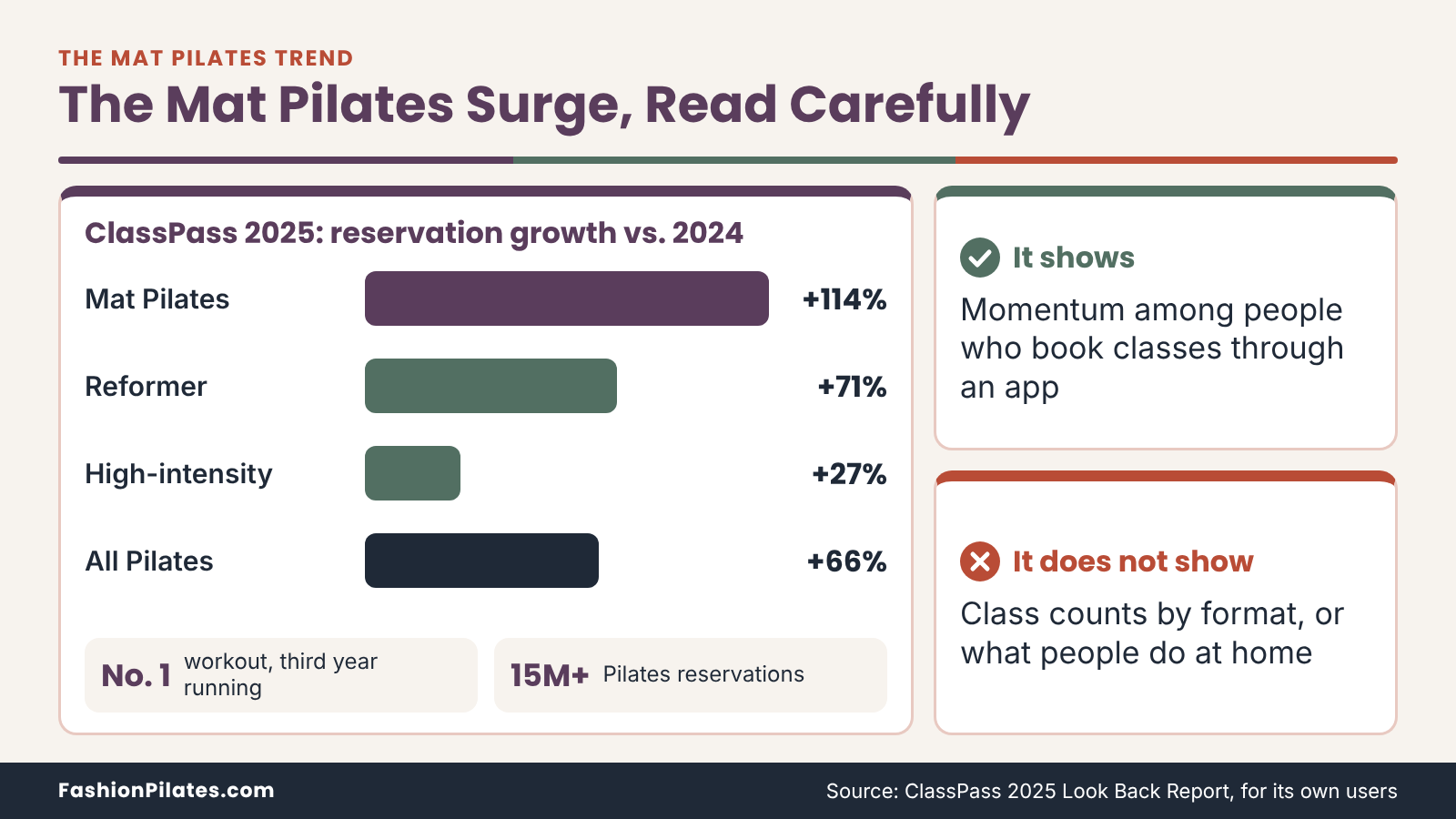
In its 2025 Look Back Report, ClassPass said Pilates held the number one spot among workouts for the third year in a row, with reservations up 66% from 2024. The report also said Pilates was the most frequently booked class for new users and the most rebooked workout across regions. Within Pilates, it listed reformer up 71%, high-intensity Pilates up 27%, and Mat Pilates up 114%. It described more than 15 million Pilates reservations that year, and over 27 million searches for the word.
| Format | Reported year-over-year change | How to read it |
|---|---|---|
| Mat Pilates | +114% | Fastest growth of the three, starting from a base the report does not state |
| Reformer Pilates | +71% | Strong growth, probably from a larger base |
| High-intensity Pilates | +27% | Slower growth, a smaller and more specialized slice |
| All Pilates | +66% | Across all Pilates reservations on the platform |
Why a percentage is not a crowd
A 114% jump means bookings roughly doubled. It does not mean Mat Pilates is now bigger than reformer, and the report excerpt we could verify does not give absolute numbers by format. If a format starts small, it can double while still being the minority option. There is a second limit: ClassPass users are people who already buy class access, so they are not a random sample of Americans. Think of the figure as a strong sign of momentum inside the booking-app crowd, which is exactly the crowd that sets many studio schedules.
What “Mat Pilates” means in this conversation
The label gets stretched. Some people mean a classical sequence on the floor, others mean any floor-based class with a Pilates logo, and some mean a viral clip with a wall and a resistance band.
Mat Pilates the method
In plain terms, Mat Pilates, also called matwork, is Pilates done on the floor using body weight as the main resistance, usually with attention to breathing, control, and moving from the center of the body. The Pilates Method Alliance describes Pilates as a method of exercise and physical movement designed to stretch, strengthen, and balance the body, combining systematic exercises with focused breathing. On the mat, there are no springs, straps, or moving carriage to guide you, so your own control does the job those parts do on a machine.
Where the label blurs
Gyms often schedule “mat” classes that mix Pilates moves with strength intervals, and studios may add a ring, a band, or small weights. Social media adds wall Pilates, where a wall is used for support or resistance. Those variants are not wrong, but they are not interchangeable with a traditional matwork class, and booking data may group them differently from one platform to the next. When you read that Mat Pilates is booming, ask which of these people actually did.
Where matwork came from and why it feels new again
The word “comeback” is a bit generous. Mat Pilates never left; it was the original format. What changed is who is paying attention and where they are finding it.
A century-old floor routine
Joseph Pilates called his system Contrology, and the floor sequence is closer to the center of it than many newcomers realize. Knowing that helps you judge whether a “new” trend is actually new.
The original mat sequence
Joseph Pilates described his floor work in his book Return to Life Through Contrology, which presents a set of 34 exercises. A guide from the Alo Moves blog notes that he emphasized doing them in a set order, and that they can be done on a mat alone or adapted to apparatus such as the reformer. That is a secondary, instructional source rather than an archival one, so treat the details as a summary. The takeaway is simple: the mat is the foundation that the machines were built around, not a diluted version of them.
How the method reached everyday gyms
The Pilates Method Alliance says Joseph Pilates, born in Germany in 1883, moved to the United States in 1926 and opened a New York studio with his wife, Clara. It adds that the method first drew dancers, later spread nationally, and gained wider medical attention in the 1980s and 1990s. It also notes that a 2000 trademark ruling treated “Pilates” as a generic term, which opened the door to broad commercial use. That legal change is part of why you can now find “Pilates” on a gym timetable without any particular lineage attached.
Why a long-standing format reads as a comeback
Interest tends to arrive in waves, and each wave has a favorite format. The current one appears to have started with the reformer and is now widening.
The reformer wave and the wider funnel
This part is interpretation, not measurement. Reformer studios became highly visible, and visible things get booked and posted about. A reformer class can be a high-priced, small-group experience, which makes the mat class look like the friendlier door into the same world. When people want to try Pilates before committing to a machine-based membership, matwork is the obvious first step, and the growth rate follows the size of that funnel.
Why reformer growth and mat growth can coexist
It is tempting to frame this as mat beating reformer. The ClassPass figures do not say that, since reformer reservations rose 71% in the same report. A more careful reading is that Pilates as a whole is expanding and Mat Pilates is catching a large share of the new arrivals. For a plain explanation of the machine side, see reformer Pilates explained. Our job here is to explain why the floor version is having its moment, which is a different question.
Why minimal equipment is winning
No single study explains why a format spreads. What we have are booking figures, trade commentary, and a few plain facts about cost and space. Putting them together gives a reasonable, clearly labeled picture of why a cushioned floor is competing with a machine.
Access, cost, and the “no reformer at home” problem
The simplest driver is also the least glamorous. Most people do not own a Pilates machine, and most will not.
Why classes became the main way in
An Athletech News report on ClassPass booking connects Pilates demand to the fact that most people do not have a reformer at home, so they book classes to get the work done. It also says studios have been adding mat classes to their schedules as demand rises. Both points support the same practical story: machine-based Pilates requires an outside venue, while floor-based Pilates can be offered in far more places, from a small studio room to a group fitness hall.
How to think about cost without inventing prices
We are not quoting class or equipment prices here, because they vary widely by city and studio and change often. What you can do is compare on a consistent basis: price per class, how many classes a month you will realistically attend, and what extra purchases the format requires. The Pilates Anytime blog, which is operated by an online Pilates platform, notes that mat practice needs no special equipment beyond a soft, supportive surface. That low entry cost does not make a studio class cheap, but it does mean the equipment line item can shrink to a single purchase.
Space, schedules, and everyday logistics
Convenience carries more weight than people admit. A workout that fits into a Tuesday is a workout that happens.
Small spaces and unpredictable weeks
A mat unrolls in a living room, a hotel room, or a spare corner of an office, and it rolls back up in seconds. That matters if you share space, travel for work, or have a schedule that changes weekly. For setups that go beyond a single mat, home Pilates studio setup guide covers the larger decisions. Minimal kit also means fewer excuses, which is either a feature or a mild insult depending on your Tuesday.
Why gyms can say yes more easily
Mat classes are easier for gyms and community centers to run because they need floor space rather than a room of machines, and one instructor can often lead a larger group. We do not have verified data on class sizes, so treat that as reasoning about logistics, not a reported fact. It does fit the Athletech observation that studios are adding mat classes, and it helps explain why you may now see matwork on a gym timetable between a spin class and a stretch session.
Who the trend serves best, and who it may leave out
A format that is easy to offer is not automatically easy for everyone to use. Matching the format to the person is the part trend coverage tends to skip.
Readers it fits well
Mat Pilates tends to suit people who are new to Pilates and want to learn its basic vocabulary, people with unpredictable schedules, frequent travelers, and anyone who wants to practice in the same movement language at a studio and at home. It also fits people who like the idea of paying for instruction rather than for a machine. If you are building a routine around a small apartment, an occasional hotel stay, or a few free evenings, a floor-based format removes several of the usual obstacles at once, which is a large part of its appeal.
Readers who may need more support
Floor work has a hidden requirement: getting down to the floor, rolling, and getting back up. People with limited mobility, balance concerns, joint problems, or certain medical conditions may find those transitions difficult, and that is a practical reason to ask about supported options before booking. Some studios offer chair-based or equipment-supported classes, and a qualified instructor can often adapt a sequence. This is also where a clinician’s advice matters most, because the right choice depends on your health history rather than on what is trending.
Mat versus reformer: an honest comparison
Comparing the two is useful only if you keep the question narrow. Neither format is better in general; each is better at a few specific things, and a few of those things are things you might not want.
What each format gives you
A Pilates machine and a mat ask different things of your body and your attention. The differences are easier to see when you separate resistance, feedback, and effort.
Resistance and feedback
On the mat, the main load is body weight, and gravity does much of the work. A reformer uses springs and pulleys, and its straps, bars, and moving carriage give your body physical cues about position. The Pilates Anytime comparison describes the machine as a very efficient form of exercise with tactile feedback, while mat work leaves you largely on your own. Spring settings are not standardized across brands, so follow your instructor and the manufacturer’s manual rather than any universal “light or heavy” rule.
The learning curve most trend pieces skip
The same source says mat exercises can be quite challenging, especially for beginners, because nothing external tells you when your form drifts. That is a useful corrective to the idea that “no equipment” means “easy.” Less gear can mean more reliance on your own coordination, breathing, and awareness. A good instructor, live or recorded, matters more here, not less. If you are new, Pilates for beginners guide explains what to expect in a first month.
How to decide for yourself
The right question is not “which is more effective.” It is “which one will I actually do, safely, with the support I have.”
| Question | Mat Pilates | Reformer Pilates |
|---|---|---|
| Main resistance | Body weight and gravity | Springs and pulleys, set by instructor or manual |
| Equipment needed | A cushioned surface; optional small props | A machine, usually in a studio |
| Feedback on form | Mostly your own awareness and the instructor | Added cues from straps, bars, and carriage |
| Best for | Easy repeatability, travel, small spaces, low entry cost | Guided resistance, variety of loads, supported positions |
| Consider something else if | You need extra support or guidance to feel steady | Access, schedule, or budget make regular visits unlikely |
Choose mat first if
Start with the floor if you want a low-commitment trial, travel often, live in a small space, or want something you can repeat on short notice. It also suits people who like understanding the basic vocabulary of the method before adding machine settings. Classes are widely available, and the equipment line item is small. If you are curious about the studio-versus-screen question as well, online Pilates versus studio classes compares those paths.
Choose reformer, or combine, if
Reformer work tends to suit people who want guided resistance and a wider range of supported positions, and who can reach a studio often enough to benefit. Many people end up doing both, which fits the hybrid trend that equipment maker Merrithew describes in its 2026 industry trends post, where studios blend Pilates with other training styles. That source sells equipment, so treat its framing as industry perspective rather than neutral research. The practical point is that the two formats are not rivals in your calendar.
What the research says, and what it does not
Popularity and proof are different things. A format can sell out its classes and still have a thin research base, and the reverse is also true. It is worth separating the two, especially because Pilates marketing tends to blend them.
Healthy adults: modest, useful, and hard to generalize
Most people trying the mat pilates trend are healthy adults who want to move better and feel stronger. The research on that group exists, but it is older and more limited than the buzz suggests.
What a 2011 systematic review found
A 2011 systematic review in the Archives of Physical Medicine and Rehabilitation by Cruz-Ferreira and colleagues looked at 16 randomized controlled trials of Pilates in healthy people. The authors reported strong evidence for improvements in flexibility and dynamic balance, and moderate evidence for muscular endurance, measured at the end of the training periods. In plain English, people who did Pilates in those trials tended to improve on those measures compared with the groups they were compared against. That is a reasonable, unexciting result, and it is worth taking at face value.
Why that result has limits
The same review rated the trials’ quality as low, with an average PEDro score of 4.1 (that scale rates trial design on a 0 to 10 scale), and it called for better blinding, tracking of adherence, and longer follow-up. The summaries we could read also do not separate mat work from machine work, so the findings describe Pilates in general, not matwork specifically. The review is also more than a decade old. It supports the idea that Pilates may be a reasonable way to train flexibility, balance, and endurance, and it stops there.
Back pain, clinical claims, and the “popular means proven” trap
Back pain is the claim most often attached to Pilates, which is why it deserves a careful look. It is also a health topic, so the language matters.
What the Cochrane review concluded
A Cochrane review of Pilates for low back pain, published in 2015, pooled 10 trials with 510 participants. It found low to moderate quality evidence that Pilates was more effective than minimal intervention for pain and disability, and no conclusive evidence that it was better than other forms of exercise. The authors suggested the choice could reasonably rest on preference and cost. That reads as a fair deal for a reader: Pilates is a plausible option among exercise types, not a unique solution.
How to hold claims lightly
When an article says Pilates fixes posture, flattens the stomach, or cures pain, it is going beyond what these reviews support. The more defensible wording is that Pilates may support strength, flexibility, balance, and confidence with movement, and that people with persistent pain should talk with a clinician before treating a class as therapy. Popularity does not change that. If anything, a surge in attention is exactly when marketing claims tend to outrun the studies, so a bigger crowd calls for a more careful reading, not a looser one.
| Source | Population and design | Main finding | Main limit |
|---|---|---|---|
| Cruz-Ferreira and colleagues, 2011 | Healthy people; 16 randomized trials | Strong evidence for flexibility and dynamic balance; moderate for muscular endurance | Low trial quality; mat and machine not separated |
| Cochrane review, 2015 | People with low back pain; 10 trials, 510 participants | Better than minimal intervention; not shown to beat other exercise | Low to moderate quality evidence; no high-quality evidence |
| ClassPass 2025 report | Booking data from platform users | Mat Pilates reservations up 114% | Shows demand, not outcomes or total volume |
How to try Mat Pilates: classes and a simple home setup
If the data has made you curious, the next question is practical. You can start in a room with other people, on your own at home, or with a mix of both. The details below apply to all three.
Picking a class that fits
Class names are not standardized, and “mat” on a schedule can mean very different sessions. A few questions up front save a disappointing first visit.
Questions worth asking before you book
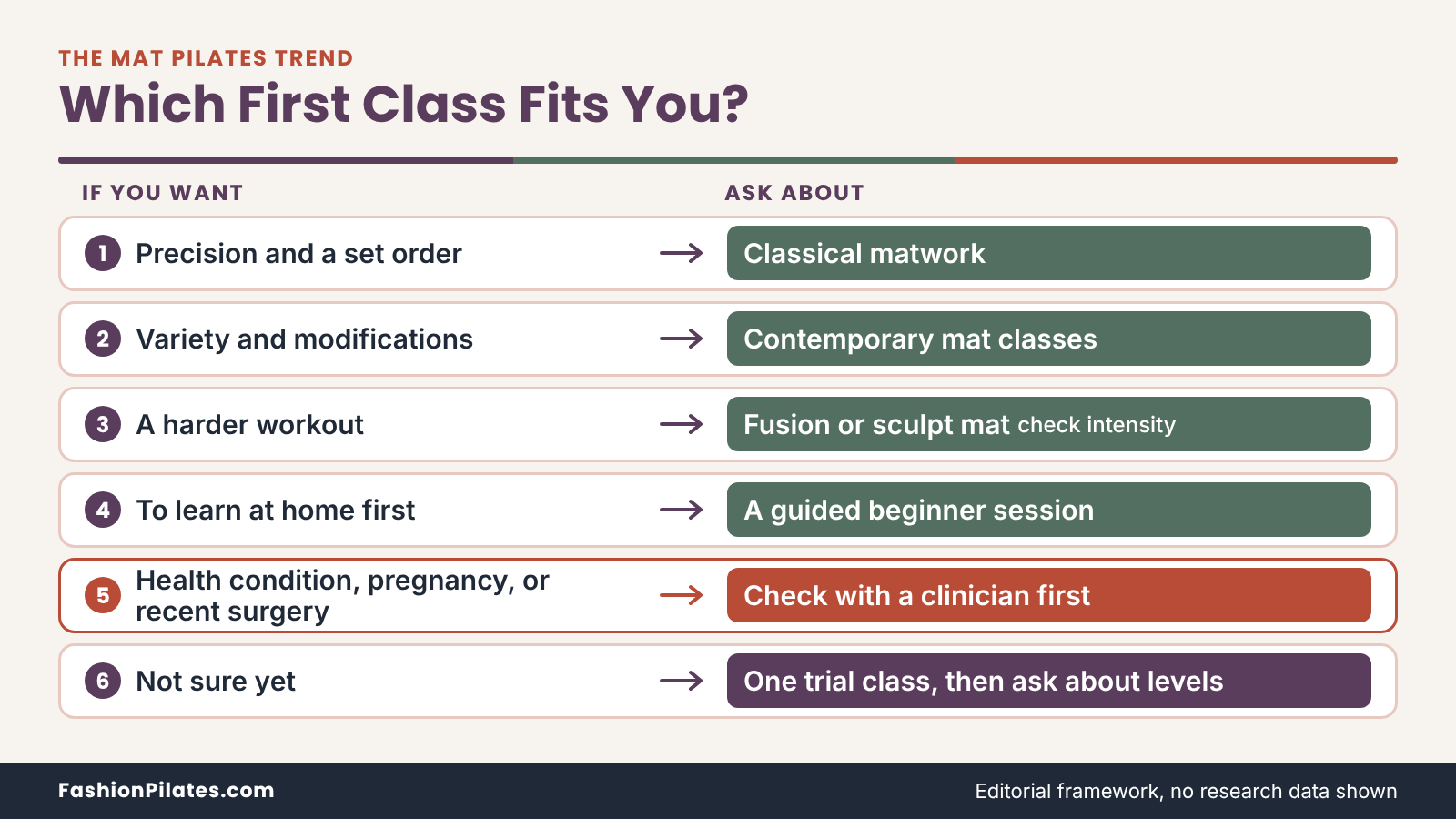
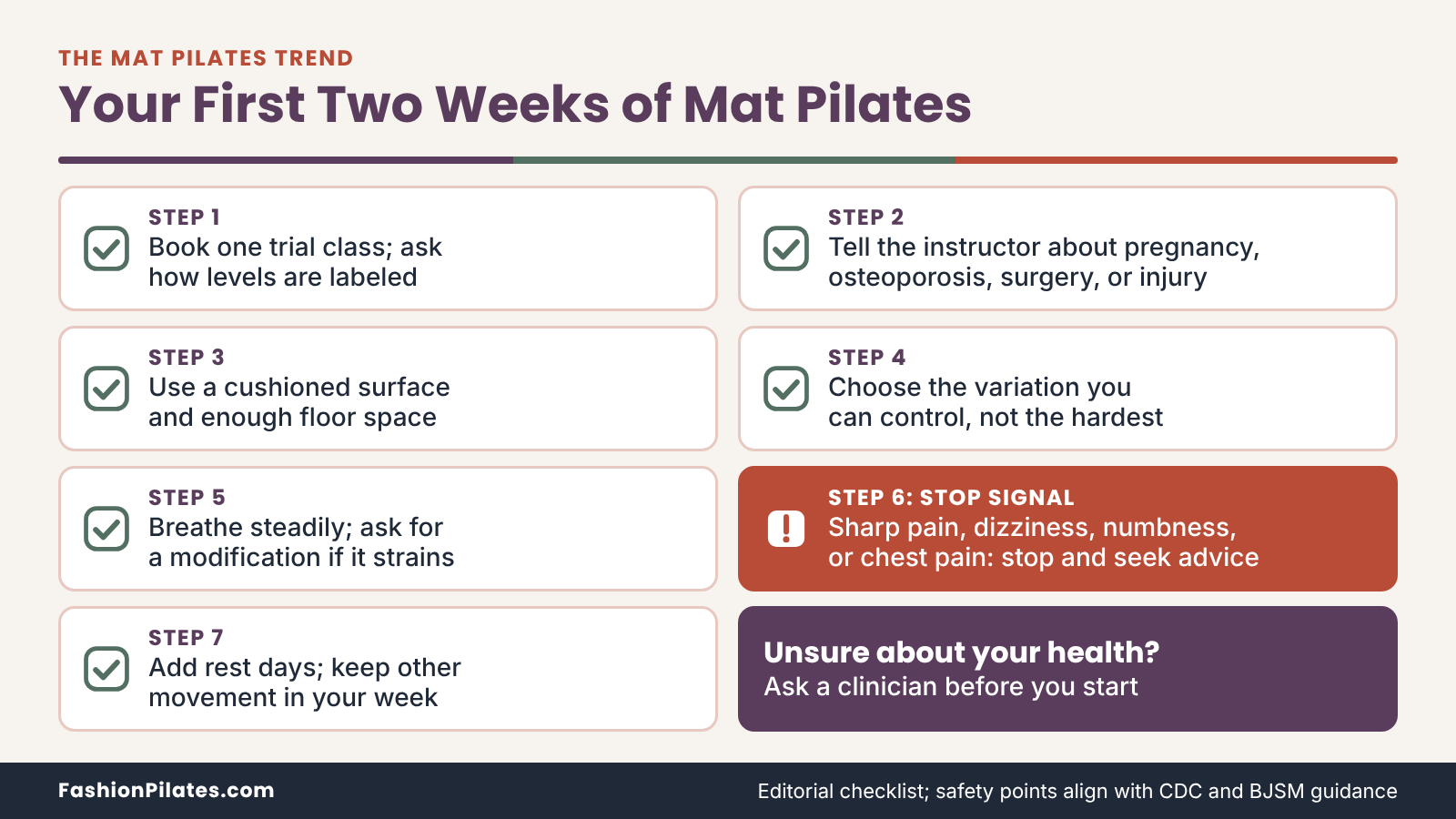
Ask how the studio labels levels and what “beginner” includes, how many people are in a typical class, whether the instructor offers modifications, and how new clients are introduced to the basic vocabulary. Ask whether props such as bands or small balls are provided or expected. Ask what to wear and whether the studio recommends grip socks for mat work; policies vary. For outfit logic, back-to-studio Pilates outfits covers what to bring. If you have pregnancy, postpartum, osteoporosis, recent surgery, or an acute injury, say so when you book, and check with a clinician first.
Reading the label: classical, contemporary, fusion
As a rough guide, classical classes lean toward the original sequence and order, contemporary classes adapt movements and add modern exercise science, and fusion or “sculpt” classes blend in strength or cardio intervals. None of these is automatically better. Which one suits you depends on whether you want precision, variety, or a harder workout. The Merrithew post mentions studios blending Pilates with weight training and conditioning, so a class titled “mat” may hold more intensity than the name implies. Read the description and, if in doubt, ask.
A minimal setup at home
The appeal of the format is that your kit can be nearly empty. That does not mean every surface works.
The surface matters more than the accessories
Pilates Anytime’s guide to Pilates mats says about a half inch (around 12 mm) is a good thickness, because much of the repertoire is performed lying on the back and the mat’s job is to cushion the spine and other joints. It contrasts that with a yoga mat, which is designed to keep feet from slipping and can feel thin during rolling exercises. Treat that as one platform’s view rather than a standard, and note it is about comfort, not safety. When you are ready to shop, best Pilates mat under $100 explains how to evaluate options.
What you actually need, and what can wait
Everything past the mat is optional. A towel, a firm pillow, or a folded blanket can stand in for props on many days, and a wall or sturdy chair may be enough support for balance work. Resist the cart full of accessories. Several pieces of “essential” gear tend to end up in a closet by March.
| Item | Status | Why |
|---|---|---|
| Cushioned mat, about half an inch thick | Essential | Cushions the spine and joints for rolling and lying-down work |
| Clear floor space | Essential | Long enough to lie down with arms overhead and room to turn |
| Folded towel or small pillow | Helpful | Can support the head or hips if your instructor suggests it |
| Resistance band, ring, or small ball | Optional | Adds variety once the basics feel familiar |
| Dedicated “Pilates” accessories bundle | Can wait | Buy only what your class or routine actually asks for |
What to expect from a first session
A little preparation takes most of the stress out of a first class. None of it requires experience, only a willingness to ask questions.
Before you arrive
Arrive a few minutes early so you can meet the instructor, mention any health considerations, and find out whether the studio supplies mats or expects you to bring your own. Wear clothes that stay put when you lie back and roll, and bring water. If the booking page is vague about the level, send a short message asking whether the session suits a first-timer. Most studios are glad to answer, and the reply tells you something about how they teach.
During and after class
Expect a lot of attention on breathing and on moving slowly, which can feel odd at first. Mild muscle fatigue afterward is common, and the shaking that shows up during a slow hold is a famous rite of passage that every instructor has seen. Sharp pain, dizziness, or numbness is different, and it means you should stop and tell the instructor. Afterward, note what felt manageable and what you want to ask about next time, so your second visit starts from information rather than guesswork.
Practicing well: rhythm, mistakes, and who should check first
Trying a trendy workout is easy; sticking with it without overdoing it takes a little planning. This section covers how a mat routine can fit into a normal week, where beginners commonly go wrong, and which readers should talk to a professional before starting.
A sustainable weekly rhythm
The best schedule is the one you can repeat in a busy month. A few reference points make it easier to set expectations.
Where Mat Pilates sits against national guidelines
The CDC’s adult physical activity guidance says adults need 150 minutes of moderate-intensity activity a week, or 75 minutes of vigorous activity, plus at least 2 days of muscle-strengthening activity that works all the major muscle groups. A summary of the SFIA 2026 Topline Report in Rec Management says only 32% of Americans meet the 150-minute guideline. The CDC page does not mention Pilates by name, so whether a given mat class counts toward the strengthening target depends on how challenging it is. A gentle mobility session is a fine habit, but it is not automatically a substitute for strength work or for brisk walking.
A sample week to adapt
The table below is an illustration of how one or two mat sessions can sit alongside other movement. It is not a prescription, and it assumes a healthy adult with no medical restrictions. Adjust it to your level, your class schedule, and your clinician’s advice.
| Day | Activity | Purpose |
|---|---|---|
| Monday | Mat Pilates class, 45 to 55 minutes | Skill practice and full-body work |
| Tuesday | Brisk walk, 20 to 30 minutes | Moderate aerobic activity |
| Wednesday | Rest or light stretching | Recovery |
| Thursday | Mat Pilates, guided home session, 20 to 30 minutes | Reinforce what you learned in class |
| Friday | Strength session with weights or bands | Muscle-strengthening on another day |
| Saturday | Longer walk or an easy bike ride | Aerobic activity you enjoy |
| Sunday | Rest | Recovery |
Here is how that might look in practice. Imagine a reader with three realistic windows a week: a lunch hour, one evening, and a weekend morning. She might book a studio mat class for the evening so she gets live instruction, use a short guided session at home on the weekend to repeat what she learned, and keep the lunch hour for a walk. If a month later the evening class has become the thing she skips, the plan is the problem, not her. Moving the class to the weekend, or swapping it for a recorded session, is a perfectly good revision. The point of any schedule is to survive an ordinary month.
A second example flips the situation. Someone who travels every other week may never keep a fixed class time, so a short routine that works in a hotel room becomes the anchor, and a studio class becomes a bonus when they are home. Both people are following the trend, and neither is following the same plan, which is how it should be. The principle is the same either way: build around the week you actually have.
Common mistakes and who should check first
Mat work looks simple from the outside, which is part of the trap. A few habits catch beginners often, and a few medical situations call for a conversation first.
Five mistakes worth avoiding
First, chasing difficulty: picking the hardest variation because it looks impressive, rather than the one you can control. Second, holding your breath, which tends to tighten the neck and shoulders. Third, pulling on the head or neck to get up in curling movements. Fourth, copying social clips without an instructor’s cues, since a clip shows the shape but not the setup. Fifth, skipping rest days because the work feels short. Ask for a modification any time something feels strained, since modifications are part of good teaching, not a lower tier.
Who should check first, and when to stop
Talk with a qualified clinician or Pilates professional before starting if you are pregnant or postpartum, have osteoporosis, a recent surgery, an acute injury, or a chronic condition. This matters for Mat Pilates in particular because many floor exercises involve curling or rolling the spine. A UK consensus statement on exercise for osteoporosis, published in the British Journal of Sports Medicine, advises people with osteoporosis to avoid postures with a high degree of spinal flexion, especially sustained, repeated, or end-range flexion, and recommends individualized physiotherapist advice for those with vertebral fractures. Stop and seek medical advice if you feel sharp pain, dizziness, numbness, tingling, chest pain, or unusual shortness of breath.
Reading the hype and what comes next
Any trend this visible comes with marketing, shortcuts, and bold promises. A reader who can spot those is better prepared to enjoy the real benefits without being sold the rest.
Spotting hype in Mat Pilates content
The claims people repeat are rarely malicious, just enthusiastic and under-sourced. A few patterns repeat often enough to recognize.
Promises that go past the evidence
Be cautious with anything that promises a changed body shape, targeted fat loss, or fixed posture in a set number of days. The research cited above covers flexibility, balance, endurance, and back pain, with the usual limits, and says nothing about spot reduction or transformation. Also be careful with “reformer results without a reformer,” since the two formats load the body differently and the research does not compare them head to head in the sources we reviewed.
Wall Pilates and other viral variants
Wall Pilates is a good example. A Country & Town House explainer describes it as mat exercises done with a wall for support or resistance, with no official set of moves, and quotes an instructor who says matwork done properly gives results and the wall adds variation. In other words, it is a useful twist on the familiar mat routine. It is not a separate method with its own research base, and its effectiveness depends on form and consistency like anything else.
Where the trend may go next
This is informed interpretation rather than prediction, and it rests on what industry sources are already describing.
Qualified instruction and hybrid classes
The Merrithew trends post highlights demand for qualified instructors, hybrid classes that mix Pilates with other training, connected equipment, and studios acting as community hubs. It does not specifically address Mat Pilates, so applying it here is our reading. The practical implication is that as floor classes multiply, the quality gap between them may widen, and your best protection is to ask about training and class structure. Instructor credentials and teacher education are central concerns for the Pilates Method Alliance as well.
The look of a minimal-equipment lifestyle
Minimal equipment shifts attention to what is left: the mat, the outfit, and the bag. That helps explain why the trend shows up in fashion and lifestyle coverage as well as fitness coverage, though we have no verified data on spending patterns, so treat that as observation. Keep two ideas separate: “Mat Pilates” is the practice, and a “Pilates mat” is the product you may buy for it. Good gear is nice, but your class will not be better because the mat matches the leggings.
Frequently Asked Questions
Is Mat Pilates really more popular than it used to be?
The available booking data says yes, with caveats. ClassPass reported that Mat Pilates reservations on its platform rose 114% year over year in its 2025 report, and that Pilates overall was its most-booked workout for the third straight year. Those figures come from one company’s users, so they describe demand among people who book classes through an app. They do not tell us how many people practice at home, and they do not give a total number of mat classes. Think of them as a credible sign of momentum rather than a census.
Is Mat Pilates easier than reformer Pilates?
Not necessarily, and many beginners find the opposite. A reformer provides springs, straps, and a moving carriage that offer physical cues, while mat work relies on your own awareness and body weight. One Pilates education platform describes mat exercises as quite challenging for beginners for exactly that reason. Mat work is simpler to access, but simple to access is not the same as simple to do. A good instructor and a willingness to use modifications make a large difference.
What do I need to start Mat Pilates at home?
You need a cushioned surface and enough clear floor to lie down with your arms overhead. A mat around half an inch thick is often suggested because many exercises are done lying on the back or rolling along the spine, and a thin yoga mat can feel uncomfortable for that. A towel or small pillow can replace most props on many days. Resistance bands, rings, and small balls are optional extras once the basics feel familiar. Start with a guided beginner session so you are not guessing at the movements.
How often should I do Mat Pilates?
There is no single right number, and the best schedule is one you can keep for months. Many people start with one or two sessions a week and build from there as the movements feel familiar. The CDC recommends at least two days a week of muscle-strengthening activity that works all major muscle groups, plus aerobic activity, so Pilates can be one part of a broader week. Whether a particular class counts as strengthening depends on how challenging it is. If you have a health condition, ask your clinician what is appropriate for you.
Will Mat Pilates help me lose weight?
The sources reviewed for this article do not evaluate weight loss, so no promise is made here. The research we cite looks at flexibility, balance, muscular endurance, and low back pain, with limits on quality. Body weight is affected by many factors beyond any single class, including overall activity, eating patterns, sleep, and medical history. If weight is your main goal, a physician or registered dietitian can give you individualized guidance. Pilates may still be a worthwhile habit for other reasons, such as building familiarity with movement and strength.
Is wall Pilates the same as Mat Pilates?
Wall Pilates is best understood as a variation of Mat Pilates rather than a separate method. It adapts floor exercises by using a wall for support, stability, or resistance, and there is no official set of wall exercises. A magazine explainer quoting an instructor describes it as adding variety to matwork rather than replacing it. Its results depend on form and consistency, just like any other mat routine. If a clip promises dramatic changes from the wall alone, treat that as marketing.
Can I do Mat Pilates if I am pregnant or have back pain or osteoporosis?
Talk with a qualified clinician or Pilates professional first, because the answer depends on your situation. Pregnancy, the postpartum period, osteoporosis, recent surgery, and acute injuries can each change which movements are appropriate. A UK consensus statement on osteoporosis advises avoiding postures with a high degree of spinal flexion, and many floor exercises involve curling the spine. A Cochrane review found that Pilates may help with low back pain compared with minimal intervention, but it was not shown to beat other exercise. Stop and seek care if you notice sharp pain, dizziness, numbness, or chest pain.
How can I tell if a Mat Pilates class is good?
Look for clear level labels, a manageable class size, and an instructor who offers modifications without making you feel behind. A good class explains the setup for each movement and the breathing cue, not only the count. Ask about the instructor’s training and about how new clients are introduced to the basics. Be cautious with classes that lean on dramatic promises about body change. A single trial class is the fastest way to check whether the pace and teaching style suit you.