Direct answer: A good morning mobility pilates session is about 15 minutes of slow, breath-led movement that takes the spine, hips, ribs and shoulders through comfortable ranges before the day starts. Think of it as an easy start rather than a workout: nine simple moves, no equipment beyond a patch of floor, and a pace that leaves you feeling more awake instead of more tired. The routine below fits that description and comes with shorter versions, modifications and clear reasons to stop.
This guide is for adults who wake up stiff, foggy or rushed and want a repeatable routine they can do before email, before the commute and, yes, before the coffee finishes taking credit for your alertness. It is general fitness education, not individualized medical advice, and it is built as a research-based, expert-informed comparison of public health guidance and published studies. We did not conduct hands-on testing, and nothing here replaces advice from your own clinician or a qualified Pilates professional.
What Morning Mobility Pilates Is (and Isn’t)
Before the routine, it helps to agree on terms, because “morning mobility” gets used for everything from a lazy cat-cow to a full-body sweat session. Here it means a short, low-effort sequence that borrows Pilates principles: moving with the breath, controlling the pace and paying attention to how each part of the spine and pelvis participates.
The vocabulary: mobility, flexibility, and stretching
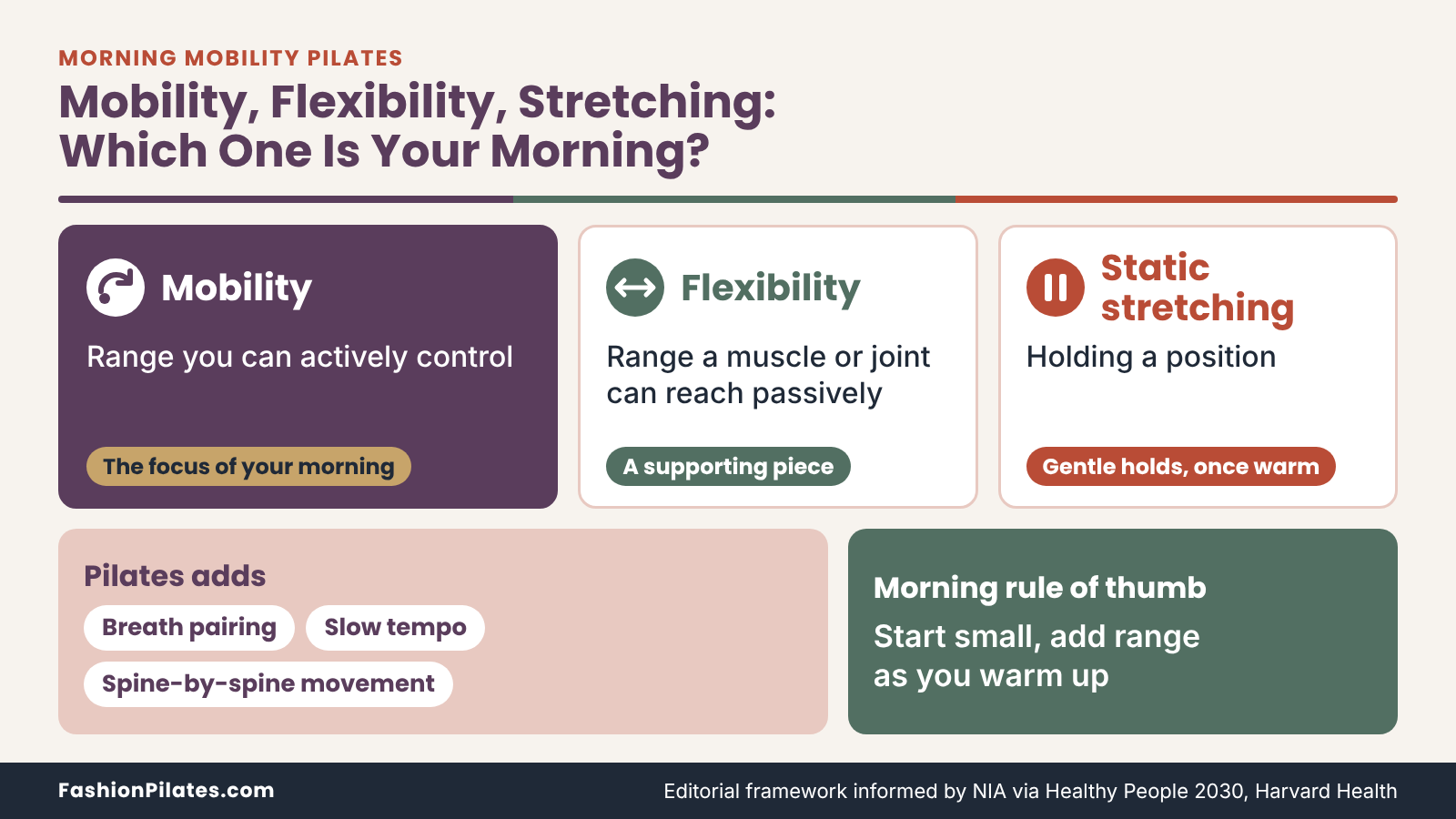
These three words overlap, but they are not interchangeable, and the difference changes what you should do in the first minutes of the day.
Mobility is movement you can control
Mobility is the range of motion a joint can use while you actively move it. Reaching overhead without arching your lower back, rotating your ribcage without cranking your neck, and bending a hip deeply without the pelvis tucking under are all mobility tasks. The word that matters is control. A joint that moves a long way only when someone pushes it is flexible, but not necessarily mobile in the sense of being usable in everyday life or in a Pilates class.
Flexibility and static stretching are related, not identical
Flexibility describes how far a muscle or joint can be taken passively, and static stretching is holding a position to explore that range. The National Institute on Aging lists flexibility as one of four types of exercise, alongside endurance, strength and balance, which is a useful reminder that it is one piece of fitness rather than the whole of it, according to the Healthy People 2030 summary of that resource. A morning routine can include a few gentle holds, but it leans on movement rather than long stretches.
What Pilates brings to a morning routine
Plenty of mobility routines exist, so the fair question is why bother filtering it through Pilates. The answer is less about mystique and more about method.
Breath, pace, and one instruction at a time
Pilates exercises are traditionally paired with specific breathing patterns and slow tempos, which gives a stiff, half-asleep body a simple structure to follow. A typical cue is to exhale during the effortful part of a movement and inhale as you return, and the pelvic curl at the center of this routine is taught exactly that way in the exercise descriptions published by North Carolina State University’s Pilates textbook. Having a breath to count also quietly prevents the most common morning mistake, which is rushing.
Spine-by-spine movement instead of one big heave
Many Pilates exercises ask you to move the spine one segment at a time rather than as a single block. That sequential quality is the whole point of the roll down and the pelvic curl, and it is a handy way to notice where your back feels quiet and where it feels stuck. If you are new to the method, the Pilates for beginners guide explains the core vocabulary, and the complete guide to Mat Pilates shows how this style of floor work is normally organized.
What the research does and does not say
It would be easy to promise that fifteen minutes of morning movement will loosen everything for good. The evidence is more modest, and it is worth knowing where the edges are.
Pilates and flexibility: promising, not settled
A 2016 systematic review and meta-analysis in the Journal of Sports Medicine and Physical Fitness pooled nine randomized trials of healthy adults. According to the repository record for the paper, Pilates improved abdominal endurance compared with no exercise, but the pooled flexibility difference was not statistically significant. Some individual trials did report benefits for dynamic balance and back flexibility. The honest reading is that Pilates is a reasonable way to practice moving through range, while the data do not show it is a guaranteed flexibility fix.
Time of day and warm-up: small studies, useful hints
A study published in 2026 in Chronobiology International compared flexibility at several times of day in 16 recreationally active adults, half of them extreme morning types and half extreme evening types. According to its university repository page, several measures, including whole-body flexibility and lateral spinal movement, were higher later in the day than at 8:00 a.m., and a 30-minute morning warm-up improved whole-body flexibility compared with a 5-minute one. The sample was tiny and the warm-up was cycling, not Pilates, so treat it as a hint: mornings are a stiffer time to move, and a gradual warm-up helps.
Why Mornings Feel Stiff and Slow
Almost everyone has a version of the same first-ten-minutes experience: heavy limbs, a back that complains on the way to the bathroom and a brain that is still buffering. Understanding what is behind that feeling makes it easier to design a routine that works with it instead of fighting it.
Sleep inertia: the fog that comes before the stiffness
Some of what feels like a tight body is really a sluggish nervous system. Knowing the difference helps you pace the first few minutes.
What sleep inertia is and how long it lasts
Sleep inertia is the grogginess and mental fog right after waking. The Sleep Foundation describes it as usually fading within about 15 to 60 minutes, though it can linger longer, and notes that its exact cause is unknown. In practical terms, that means the first stretch of the morning is a poor time for anything demanding, and a great time for movement that requires attention without requiring effort. Slow Pilates sequences fit that description well, because the tempo itself keeps you from muscling through while your coordination catches up. You can read the Sleep Foundation overview of sleep inertia for the full picture.
Coffee first or movement first?
The Sleep Foundation lists moderate caffeine among the things that may help alertness, so there is nothing wrong with coffee. The question is only about order, and the answer is personal. Some people feel steadier with a few minutes of movement first because it wakes up the body without needing a stimulant. Others, honestly, need the mug in hand before they can follow a breathing cue. Either way, a glass of water and a bathroom stop first are sensible, and anyone who is jittery on an empty stomach can simply flip the order without guilt.
Why the body feels tight at 7 a.m.
Beyond grogginess, the physical sense of stiffness has several ordinary explanations, and most of them respond to gentle movement.
Cool tissue and a slow start
After hours in one or two positions, muscles and joints are cooler and less used to moving. The 2026 study described above found that body temperature and several flexibility measures were lower at 8:00 a.m. than later in the day, and that a longer warm-up in the morning raised both. Harvard Health makes a related practical point, advising a few minutes of dynamic stretching, meaning gentle movement that mimics what you plan to do, before exercise and saving longer static holds for after muscles are warm. For a mobility session that is itself the warm-up, the lesson is simple: begin with the smallest, easiest range and earn the bigger one.
Stiffness that eases versus stiffness that lingers
Brief stiffness that loosens within a few minutes of moving is common. The NHS notes that morning stiffness from osteoarthritis usually eases within roughly half an hour of getting up, whereas stiffness linked to rheumatoid arthritis often lasts longer than 30 minutes. That is not a way to diagnose yourself, and plenty of other things cause stiffness. It is, though, a reason to mention it to a clinician if your mornings are consistently slow to ease, especially with swelling, warmth or a change over time. The NHS rheumatoid arthritis symptoms page explains the pattern.
Before You Start: Setup, Safety, and Who Should Adjust
A morning routine succeeds or fails on logistics. It also needs a safety frame, because the sleepiest part of the day is not the moment to improvise with an unfamiliar movement.
Setting up so it actually happens
The fewer decisions between waking up and starting, the better the odds you will do it. A little preparation the night before removes most of the friction.
Space, surface, and clothing
You need roughly the footprint of a yoga mat plus a bit of room to extend an arm, and a surface that is firm but not slippery. A Mobility and Stretching routine like this one does not need a studio mat, and a carpeted floor with a folded towel under the knees is enough for most people. Wear whatever lets your ribs expand and your hips move: soft pajamas work if they are not restrictive, and nothing here needs special gear, however loudly an accessory ad insists otherwise. Place the surface somewhere you will actually see it when you wake up.
The first two minutes before the first move
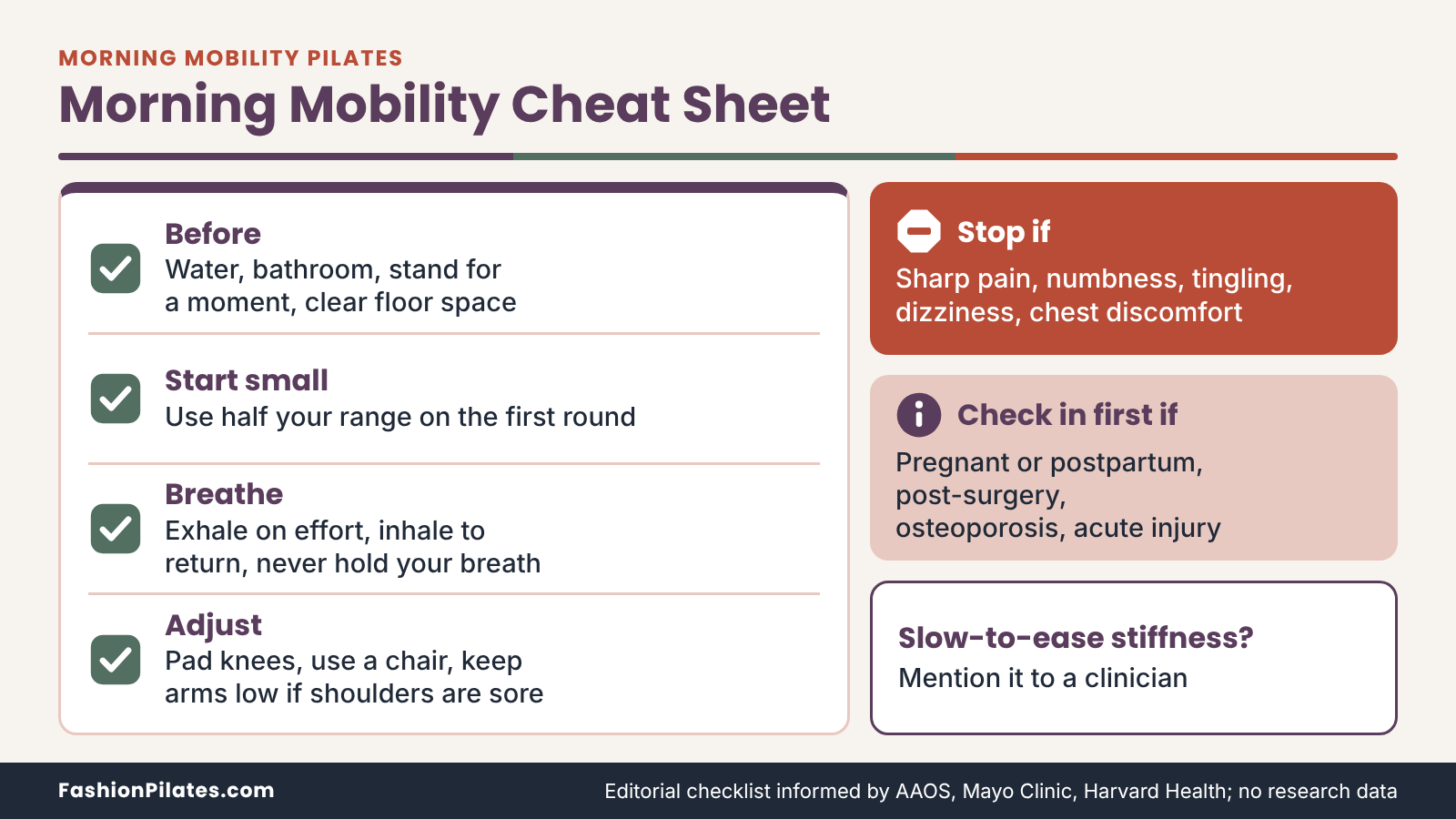
Drink some water, use the bathroom and stand up for a few moments before lying on the floor. If you slept badly or feel lightheaded when you rise, sit on the edge of the bed for a minute and breathe before you start. The routine below opens with a short breathing sequence that doubles as a check-in, and it is perfectly acceptable to make the whole first minute smaller than the instructions suggest.
Who should modify or check in first
For most healthy adults, gentle mobility work is low risk. Some situations, though, call for professional input before you copy a routine from a website.
Conditions that call for a clinician or Pilates professional
If you are pregnant or postpartum, recovering from surgery, managing an acute injury, living with osteoporosis or low bone density, or dealing with a chronic condition, check with a qualified clinician or an experienced Pilates professional before starting. The Mayo Clinic advises people with osteoporosis to avoid bending forward at the waist and twisting at the waist, and to avoid stretches that flex the spine, and to ask their health care provider which movements suit them. Several moves in this routine involve gentle spinal flexion or rotation, so they may need to be skipped or reshaped. The Mayo Clinic osteoporosis exercise guidance is a good starting point for that conversation.
Stop signals and the line between stretch and pain
Stop and seek advice if you feel sharp pain, numbness, tingling, dizziness, chest discomfort or unusual shortness of breath. Mild tension in a muscle is expected during mobility work, but pain is not. The American Academy of Orthopaedic Surgeons says stretching should not hurt, and recommends easing into a gentler position if it does, while Harvard Health advises staying within a mild stretch and continuing to breathe. A useful rule is to leave about a quarter of your available range unused on the first rounds, then see how you feel. You can read the OrthoInfo warm-up and flexibility guide for the full wording.
The 15-Minute Routine, Part One: The Floor Sequence
The full routine has nine moves and runs about 15 minutes including short pauses between them. This first half covers moves one through four, which take roughly six and a half minutes and happen mostly on the floor. Work slowly, treat every exhale as the effortful part and keep the size of each movement well within what feels easy today. The table below shows the whole session at a glance so you can see where each move sits before reading the detail.
Use the schedule as a map, not a stopwatch. If you want a slower day, drop reps instead of rushing through all nine.
| Move | Position | Time | Reps or holds | Main focus |
|---|---|---|---|---|
| 1. Ribcage breathing | Lying on back | 1.5 min | 6 to 8 breaths | Ribs, breath rhythm |
| 2. Cat stretch | Hands and knees | 1.5 min | 6 to 8 slow rounds | Spine flexion and return |
| 3. Pelvic curl | Lying on back | 2 min | 6 to 8 reps | Spine articulation, hips |
| 4. Knee sways | Lying on back | 1.5 min | 6 per side | Gentle low-back and hip rotation |
| 5. Thread the needle | Hands and knees | 2 min | 5 per side | Upper-back rotation, shoulder |
| 6. Seated side bend | Sitting | 1.5 min | 5 per side | Side body, ribs |
| 7. Half-kneeling hip stretch | Half kneeling | 1.5 min | 2 holds of 20 sec per side | Front of hip |
| 8. Standing roll down | Standing | 1.5 min | 4 to 5 reps | Spine, hamstrings |
| 9. Ankle rise and overhead reach | Standing | 1.5 min | 8 rises, 4 reaches | Ankles, shoulders, finish |
Minutes 0 to 3: Wake up the ribs and the spine
The opening pair gives your breathing and your spine a gentle first assignment. Neither move asks for strength, and both give you immediate feedback about how stiff today really is.
Move 1: Ribcage breathing (about 1.5 minutes)
Lie on your back with your knees bent, feet flat and roughly hip-width apart, and rest your hands on the sides of your lower ribs. Breathe in slowly through your nose and notice the ribs widen sideways under your hands and the back of your ribcage soften toward the floor. Breathe out through softly pursed lips and let the ribs glide back together without forcing your belly in. Take six to eight full breaths. If your neck feels strained, place a thin pillow under your head, and if getting onto the floor is the hard part, do the same breaths sitting upright in a chair.
Move 2: Cat stretch on hands and knees (about 1.5 minutes)
Come onto hands and knees with wrists under shoulders and knees under hips, spine long and neutral. Breathe out and slowly round your back, letting the tailbone curl down, the belly draw gently in and the head drop. Breathe in as you return to a flat, neutral back, without arching hard into the lower spine. Complete six to eight slow rounds, treating each one as a small exploration rather than a stretch to maximize. If wrists complain, rest on your forearms or make loose fists, and add a folded towel under the knees. Anyone told to avoid spinal flexion should keep the rounding very small or skip this move.
Minutes 3 to 6.5: Roll the pelvis and loosen the hips
Back on the floor, the next two moves ask the pelvis and hips to take part. These are the moves that tend to feel most satisfying on a cranky morning, which is also why they are the easiest to overdo.
Move 3: Pelvic curl (about 2 minutes)
Lie on your back, knees bent, feet flat and hip-width apart, arms resting by your sides with palms down. The exercise description published by North Carolina State University has you breathe out as you tighten the lower abdomen and roll the pelvis and spine off the floor from the bottom up, then lower slowly one vertebra at a time, keeping the neck, shoulders and lower back relaxed. For a morning version, lift only until your hips are comfortably up, pause for an easy breath, and exhale as you roll down. Do six to eight slow reps. If your lower back grips or your ribs flare, shrink the lift, and if your hamstrings cramp, move your feet slightly closer to your hips.
Move 4: Knee sways (about 1.5 minutes)
Stay on your back with knees bent and feet a little wider than your hips. Breathe out and let both knees lower slowly toward one side, keeping your shoulders heavy on the floor and stopping well before anything pinches. Breathe in as you draw the knees back to center, then repeat to the other side. Six sways per side is plenty. This move is a gentle rotation for the lower spine and hips, so keep the range small when you are very stiff, and place a pillow under the lowered knees if the stretch is too strong. Skip it, or ask a professional to adjust it, if it pinches the front of the hip or the back of the pelvis.
The 15-Minute Routine, Part Two: Rotation and Standing Finish
The second half moves the upper back, side body and hips through a bit more range, then brings you to standing so you leave the floor ready to walk, carry a bag and answer a message without wincing. These five moves take about eight minutes, and a few of them deserve a little more caution than the first four because they involve rotation, side bending or folding forward.
Minutes 6.5 to 10: Rotate and side bend
Rotation and side bending are the movements most people skip in a normal day, which may be part of why they feel so rusty at 7 a.m. Take both slowly.
Move 5: Thread the needle (about 2 minutes)
From hands and knees, place your right hand under your left shoulder, palm facing up, and breathe out as you slide it along the floor. Let your right shoulder and the side of your head rest toward the floor while your hips stay roughly level over your knees. Breathe in and press through the left hand to unwind, then breathe out and repeat. Do five slow reps on one side, then switch. If your shoulder or neck feels pinched, rest on a cushion and reduce the reach, or swap in an open-book version lying on your side. Keep the movement in your upper back instead of cranking your neck.
Move 6: Seated side bend (about 1.5 minutes)
Sit tall, either cross-legged on the floor or on the front half of a chair, with one hand resting on the floor or your thigh. Breathe in as you sweep the other arm overhead and lengthen upward. Breathe out as you lean sideways over the supporting hand, imagining you are sliding between two panes of glass so the chest stays open and does not twist. Return on an inhale and complete five reps before switching sides. The arm can stay low if the shoulder is sore. If sitting on the floor is uncomfortable, the chair version is just as useful, and you can raise your seat height with a folded blanket.
Minutes 10 to 15: Open the hips and stand up tall
The last three moves bring the hips, the spine and finally the ankles and shoulders into the picture. Stand up slowly between them, and let any lightheadedness pass before you continue.
Moves 7 and 8: Half-kneeling hip stretch and standing roll down (about 3 minutes)
For the hip stretch, kneel on one padded knee with the opposite foot in front, tuck the pelvis lightly under, and shift forward a little until you feel a stretch at the front of the back-leg hip. Hold for 20 seconds, twice per side, breathing steadily. Harvard Health suggests holding a static stretch for at least 15 seconds and notes that the American College of Sports Medicine range is 10 to 30 seconds. Then stand with feet hip-width apart for the roll down: nod the chin, breathe out and roll forward one segment at a time with soft knees, breathe in at the bottom, and breathe out as you stack back up. Let your hands travel only as far as thighs or shins. Skip the roll down if you have been told to avoid forward bending, feel dizzy, or have a disc or bone-density concern that your clinician has flagged.
Move 9: Ankle rises and an overhead reach (about 1.5 minutes)
Finish standing tall near a wall or counter for balance. Rise onto the balls of your feet for eight slow reps, lowering with control instead of dropping, then circle each ankle a few times if they feel stiff. To close, breathe in as you reach both arms up and slightly forward, then breathe out as you lower them in a wide arc to your sides. Do four reps. Ankles carry more of the morning’s load than most people expect, so a slow finish here is time well spent. For a deeper session on the arm half of the finish, a dedicated shoulder routine is covered in the sections ahead.
Adapting the Routine to Your Time and Your Body
A routine that only works on perfect mornings is a weekend project, not a habit. The solution is to decide in advance what the short, medium and rough-day versions look like, so that a bad night of sleep changes the dose without ending the streak.
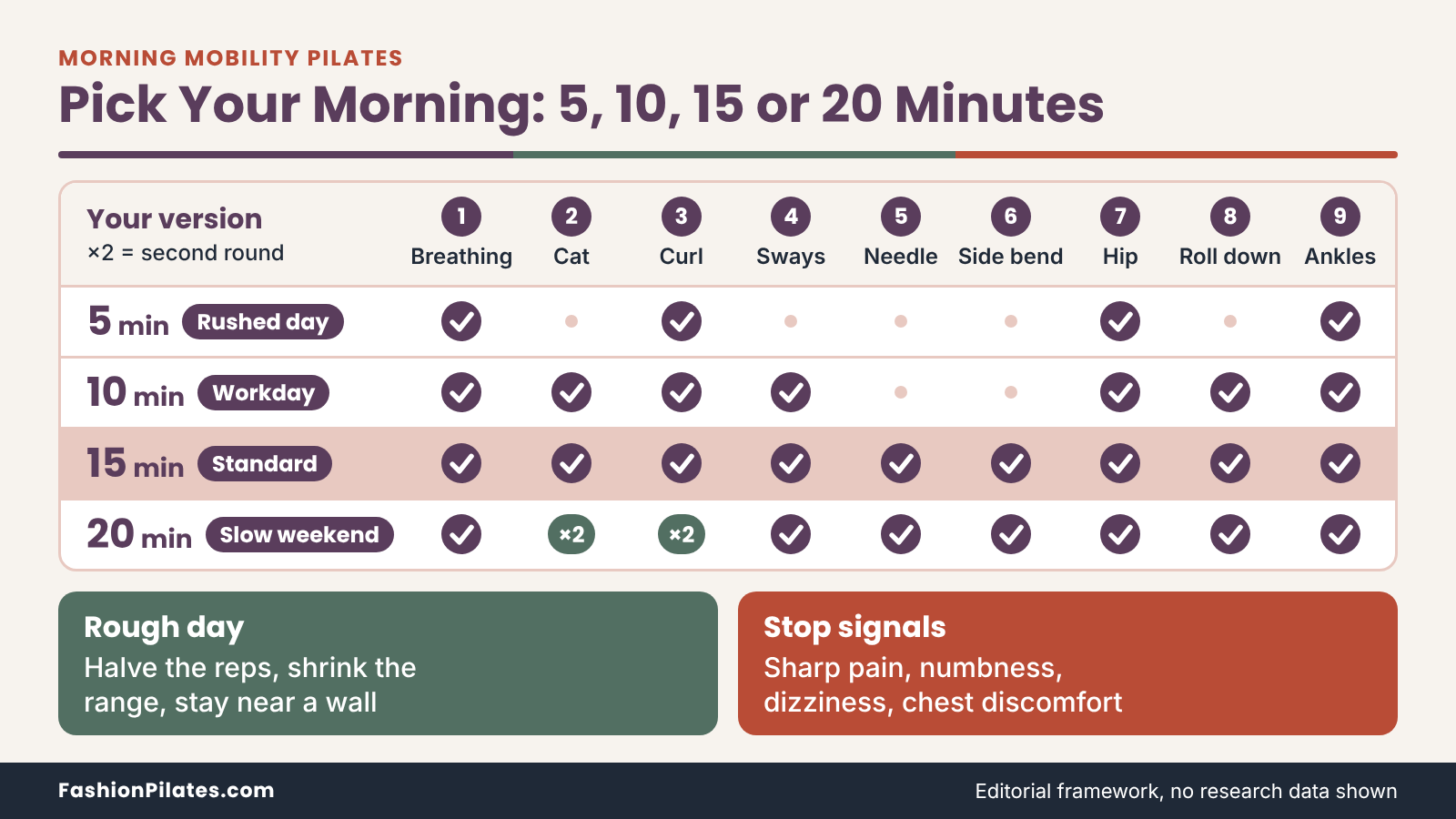
Time-based versions: 5, 10, 15, and 20 minutes
The nine moves can be rearranged without losing their logic. The idea is to keep one move from each group of the body: breath, spine, hips, and a standing finish.
The 5-minute reset and the 10-minute version
The 5-minute reset is for mornings when the school run, the dog or a looming meeting has already eaten the clock. Do about a minute of ribcage breathing, four slow pelvic curls, one set of the hip stretch per side and finish with the ankle rises and overhead reach. The 10-minute version adds the cat stretch, knee sways and the standing roll down, and drops thread the needle and the seated side bend. It keeps something for every region while removing the moves that take the most setup, which is why it is a popular compromise for weekday mornings.
The 15-minute standard and a 20-minute weekend version
The full 15 minutes is the sequence from the previous sections, with nine moves and brief pauses. On slower weekend mornings, you can stretch it to about 20 minutes by adding a second round of the pelvic curl and cat stretch, holding the hip stretch for a third pass, or following the routine with a few extra minutes of easy walking. Resist the urge to add intensity, because the point is to leave feeling looser and calmer, not tired. If you want to go further after a mobility start, the 15-minute beginner mat Pilates mobility workout offers a second, slightly different sequence to rotate in.
The table below shows which moves belong in which version, so you can decide on the spot without recalculating.
| Version | Moves included | Best for | Skip if |
|---|---|---|---|
| 5-minute reset | Ribcage breathing, pelvic curl (4 reps), hip stretch (one hold per side), ankle rises and reach | Rushed weekdays, travel mornings | You have no clear, safe patch of floor |
| 10-minute version | Moves 1, 2, 3, 4, 7, 8 and 9 in trimmed form | Typical workdays | Rotation or folding forward is off limits for you right now |
| 15-minute standard | All nine moves | Days with a little room to breathe | You feel unwell, lightheaded or in pain |
| 20-minute weekend | All nine plus a second round of moves 2 and 3 | Slow weekends, post-travel mornings | You want a workout; this is still mobility |
Body-based adjustments that keep it comfortable
The most useful modification is usually the boring one: make it smaller. Bodies differ, and so do mornings, so these adjustments are less about conditions and more about common sticking points.
Wrists, knees, shoulders, and neck
If kneeling bothers your knees, pad them generously or swap the hands-and-knees moves for seated or standing versions: pelvic tilts in a chair for the cat stretch, and a standing reach-and-rotate for thread the needle. If your wrists are touchy, use forearms or fists. For shoulder sensitivity, keep arm reaches below shoulder height and let the arm travel less far. For the neck, a thin pillow under the head in lying positions often solves more than any cue does. Anything that produces sharp or radiating pain is a reason to stop and check in with a professional.
Stiff-back days, poor-sleep days, and low-range days
On days when your lower back feels like a closed door, lean on breathing, pelvic curls with a very small lift and knee sways in a tiny range, and skip the roll down. After a poor night of sleep, the fog described earlier usually makes balance and coordination slightly worse, so keep the standing moves close to a wall. On any day your range is limited, cut the reps in half and stop at the first point of resistance, not at the point of effort. A tiny honest range beats a heroic one every time, and the shaking that sometimes shows up in slow holds is simply a signal to ease off.
Making the Routine a Habit That Survives Real Mornings
Knowing the moves is the easy part. Doing them at 6:40 a.m. on a Tuesday, with a half-packed lunch and a missing shoe, takes some design. The principles below apply to nearly any small habit, and they are especially kind to a routine that is meant to feel easy.
Fit it to the morning you actually have
Plans built around an ideal morning rarely survive contact with the real one. Build around the fixed points that already exist instead.
Anchor it to something you already do
Attach the routine to an event that happens every day without effort: brushing your teeth, the kettle starting, the shower warming up. The benefit of an anchor is that it removes the question of when. Lay your surface out the night before, put a water glass next to it, and keep the first move so small, such as one minute of ribcage breathing, that starting is never the obstacle. Often, once you are on the floor, you will continue; if you do not, the minute still counts, and tomorrow’s attempt starts from a lower barrier.
Coffee sequencing and the not-quite-awake days
If the kettle is the anchor, use the wait. A French press or drip machine gives you three or four minutes that would otherwise be spent staring at the counter, which is plenty for the 5-minute reset. If you need coffee in hand to function, drink a few sips, set the mug down on something stable and begin the seated or lying moves, saving the standing roll down for after the cup so you are not folding forward while holding something hot. The coffee does not mind waiting, and the credit can be shared.
Tracking what changes without obsessing
Mobility is slow to change and easy to misjudge. A few quiet markers beat constant measuring.
Everyday markers over perfect numbers
Pick two or three observations that matter in your life: how easily you put on socks, how your neck feels while looking over your shoulder to reverse the car, whether your hips feel less locked after sitting. Note them once a week, not every day. The same logic runs through guidance on how to know you are getting better at Pilates, which treats changes in control and ease as meaningful signs, not just changes in range. A bad Thursday is information about sleep and stress, not a verdict on your routine.
How it counts toward weekly activity
The Centers for Disease Control and Prevention recommends that adults get at least 150 minutes of moderate-intensity aerobic activity per week, or an equivalent amount of vigorous activity, plus muscle-strengthening work on at least two days. Its guidance on physical activity for adults does not set a flexibility target. A gentle 15-minute mobility session is not moderate aerobic activity and is not strengthening, so it should sit beside your main training rather than replace it. Think of it as the opener and the connective tissue between the sessions that carry the weekly total.
Common Mistakes and Easy Fixes
Most problems with a morning mobility session are problems of dose and attitude, not of exercise selection. The same few errors show up again and again in gentle routines, and each one has a simple fix.
Effort and tempo mistakes
The first set of errors comes from treating a mobility session like a stretching contest or a race against the alarm.
Forcing range while the body is still cold
It is tempting to chase a deep stretch right away, especially when something feels tight. But the research on time of day suggests flexibility is lower early in the day, and the AAOS notes that stretching should not hurt and that bouncy stretching can cause injury. The fix is to treat the first round of each move as a warm-up round at about half your available range, then add a little on the second round if everything feels fine. You are not trying to prove anything to your hamstrings at 6:50 a.m., and they will still be there tomorrow.
Rushing through the moves to finish
A 15-minute routine can be sped through in six, and that is when the benefits tend to evaporate, because slow breathing and control are what separate this from flailing. If you notice you are holding your breath or counting reps instead of feeling them, slow the tempo and cut the reps. A reasonable pace is one full breath cycle per movement phase, so a pelvic curl takes about three breaths, from lifting to lowering. If that sounds too slow, the shorter versions in the previous section exist so that you never need to rush a long one.
Expectation and setup mistakes
The second set of errors is about what the session is supposed to do, and what to do when your body gives you an unexpected answer.
Treating it as a replacement for training
Because the routine feels productive, it is easy to start counting it as your exercise for the day. As covered earlier, public health guidance asks for moderate aerobic activity and muscle-strengthening on two or more days, and a gentle mobility session does not supply either. The fix is straightforward: keep mobility as the opener, and put your strength or aerobic sessions elsewhere in the week. The 30-minute morning reformer Pilates workout is an example of a session that does the training job for readers who have studio or home equipment.
Ignoring one-sided differences and pain signals
Many people discover during a thread-the-needle or knee sway that one side is clearly stiffer. That is normal and often not a problem, but do not force the tight side to match the easy one. Work to the point of comfortable resistance on each side and let them be different. If the difference is new, if one side hurts instead of just feeling tight, or if you notice numbness or tingling, stop and ask a clinician. Treat pain as information to act on, not an obstacle to push through before the coffee kicks in.
The table below collects the most common slips in one place, so you can scan it before a session.
| Mistake | Why it backfires | Easy fix |
|---|---|---|
| Going to full range on the first rep | Tissue is cool and the nervous system is still waking up | Use about half range first, add a little on round two |
| Bouncing in a stretch | Ballistic, bouncy stretching can cause injury, according to the AAOS | Ease in, hold still and keep breathing |
| Rushing the tempo | You lose the control that makes it Pilates-style | Match each movement phase to one breath |
| Counting it as your workout | Mobility is not moderate aerobic or strength work | Pair it with real training sessions |
| Forcing the tight side to match | Pushes into discomfort without any gain in control | Work to comfortable resistance on each side |
| Folding forward fast after lying down | Lightheadedness is more likely after rising quickly | Stand for a few breaths first, then roll down slowly |
Where It Fits in Your Pilates Week
A morning mobility session is useful on its own, but it is also a flexible building block. It can sit before a class, fill a rest day or bridge between harder sessions, and the best placement depends on how the rest of your week looks.
Pairing it with other Pilates sessions
If you already take classes or follow a plan, the mobility routine can make the main session easier to start, or give your off days some structure.
As a warm-up before a class or workout
On days when you plan a longer session, the routine can act as an early warm-up: do it at home, then head to the class with your joints and breathing already engaged. Harvard Health recommends dynamic stretching before exercise and static holds after, so if you are following with something demanding, consider shortening the half-kneeling hip stretch to one brief hold per side and saving longer holds for the end. Beginners who are still learning terminology can read a plain-English overview of Pilates basics before their first session so the movement names feel familiar.
On rest days and low-energy days
On rest days, the routine can stand alone as light movement that keeps the habit alive without adding training load. The 10-minute version works well here, followed by a walk if you like. If you find that you are tired for days in a row, treat that as feedback and reduce your training volume before you reduce your mobility time. This is a general principle, not individualized advice, and anyone managing a medical condition should confirm the plan with their care team.
Companion routines and recovery tools
No single routine covers everything, and a few related practices complement what you do in the morning without duplicating it.
Focus on the shoulders and upper back
This routine touches the shoulders through thread the needle and the overhead reach, but it does not give them a full session. If desk work or sleeping posture leaves your shoulders feeling locked up, a dedicated sequence will serve you better. The shoulder mobility Pilates routine goes deeper on reach and rotation, and the two work well on alternating mornings so that neither feels repetitive.
Foam rolling and slower evening work
Foam rolling is a separate tool with its own logic, and many people find it fits better after a workout than before breakfast. The foam rolling after Pilates routine covers the full-body version. Evening sessions have a different purpose from morning ones: they tend to emphasize unwinding rather than waking up. If your mornings feel impossible, moving a version of this routine to the end of the day is better than skipping it, as long as it leaves you comfortable and not wired.
The table below compares three common times for a mobility session, so you can pick the one that matches your goal.
| Timing | Best for | Watch out for |
|---|---|---|
| Morning, before the day | Waking up stiff joints, building a consistent habit | Lower range early in the day, lightheadedness on standing moves |
| Right after a workout | Static holds while muscles are warm | Skipping it when you are tired, or stretching too hard after fatigue |
| Evening, before bed | Unwinding and easing out of a desk-heavy day | Too much effort, which can leave you more alert than intended |
Realistic Expectations and When to Get Help
A short routine can make mornings feel better without being a miracle, and being clear about that is the best way to avoid disappointment. It is also worth knowing when a stiff morning stops being a routine problem and becomes a reason to check in with a professional.
What to expect, and when
Some benefits arrive almost immediately, while others take weeks of steady practice and may never fully show up. Separating the two keeps the habit sustainable.
What may change within days
You may feel a little looser, calmer or more awake right after a session, which makes sense given the gentle movement, slow breathing and a few minutes of focus. That is a short-term effect and you should not expect it to carry through the day unchanged. It is also not a promise. Some mornings you will finish feeling the same as when you began, and that is not a failure. The routine is still giving your joints a rehearsal of everyday ranges, and a calm start has value of its own.
What takes weeks, and what may not change
Gains in comfortable range, control and confidence with the moves tend to build over several weeks of consistent practice, but the evidence for large flexibility changes from Pilates is mixed, as the meta-analysis discussed earlier shows. Some stiffness has little to do with muscle length and a lot to do with joint structure, sleep, stress or health conditions, and no routine will change that. Expect better movement habits and perhaps easier mornings, and treat anything bigger as a bonus.
When to bring in a professional
This guide is general education. A professional can tailor the work to your body and rule out problems that exercise alone will not solve.
A qualified Pilates instructor
A certified Pilates instructor can watch how you move, adjust cues for your proportions and suggest modifications that a written routine cannot anticipate. This matters most for rotation, spinal flexion and any move you are unsure about. A private session or two is one way to make a home routine more confident and more precise. Look for someone who asks about your health history before they start.
A clinician, for red flags and persistent stiffness
See a doctor or physical therapist if stiffness is persistent and slow to ease, if it comes with joint swelling or warmth, or if you have numbness, weakness or pain that wakes you at night. Check in with a clinician before starting if you are pregnant or postpartum, recovering from surgery, living with osteoporosis or managing a chronic condition. A professional can confirm which of these moves are suitable and which should be changed or dropped, and that conversation is worth more than any routine you find online.
Frequently Asked Questions
Should I do morning mobility before or after coffee?
Either order is fine, and the right one is the one you will actually follow. Moderate caffeine is listed by the Sleep Foundation among the things that may help alertness, so a few sips first can make the breathing cues easier to follow. Some people prefer to move first because it wakes them up without a stimulant. If you do have the coffee first, set the mug down before any standing fold, and drink some water either way.
How long does it take for morning mobility Pilates to feel easier?
You may notice a looser, calmer feeling within a single session, although that is a short-term effect. Gains in comfortable range and control usually build over several weeks of steady practice, and they vary from person to person. A systematic review of nine trials found no statistically significant flexibility difference for Pilates compared with no exercise, so large changes are not guaranteed. Track everyday markers such as how easily you reach your shoes rather than chasing a number.
Can I do this routine every day?
For most healthy adults, a gentle, low-effort routine like this one can be repeated most days. Harvard Health suggests stretching most days, even for a few minutes, when the effort stays mild. Keep the range comfortable and reduce reps if you feel sore or unusually tired. If a particular move leaves you with lingering pain, drop it and ask a clinician or Pilates professional about an alternative.
Do I need a Pilates mat or any special equipment?
No special equipment is required for this routine. A firm, non-slip surface and a folded towel for your knees are enough, and a chair helps with the seated versions. Wear clothing that lets your ribs expand and your hips move freely. A dedicated exercise mat is a nice comfort upgrade but never a requirement.
Is this safe if I have a stiff or sensitive back?
Mild stiffness is common, and gentle movement is often comfortable, but sensitive backs vary a great deal and this is general education rather than medical advice. Keep the pelvic curl and knee sways very small, and skip the standing roll down on days when forward bending feels wrong. Stop at once if you feel sharp pain, numbness, tingling or dizziness. Check with a clinician before starting if you have osteoporosis, a recent injury, recent surgery or a chronic condition, because some moves may need to be changed or dropped.
Should I stretch before I warm up?
It is better to warm up first. Harvard Health recommends a few minutes of dynamic stretching, meaning gentle movement that resembles your planned activity, before exercise, and holding static stretches once muscles are warm. This routine is built that way, with breathing and small ranges first and the longer hold placed late in the sequence. If you want deeper static stretching, save it for after a walk or a workout.
Can this replace a Pilates class or a workout?
No, it works best alongside training rather than instead of it. Public health guidance from the Centers for Disease Control and Prevention calls for at least 150 minutes of moderate-intensity aerobic activity each week plus muscle-strengthening on two or more days. A gentle mobility session does not meet either of those targets by itself. Use it as an easy opener and keep your classes, strength work or walks for the heavier lifting.
Why does my body feel stiffer in the morning than in the afternoon?
Several ordinary factors overlap. Muscles and joints are cooler after hours of staying still, and grogginess from waking can make movement feel heavier. A 2026 study of 16 recreationally active adults found several flexibility measures were lower at eight in the morning than later in the day, though the sample was small. Stiffness that is slow to ease, or that comes with swelling or warmth, is worth mentioning to a clinician.