
Direct answer: Pilates travel posture is the practice of moving between comfortable positions through a travel day instead of holding one “perfect” pose. In practice that means setting your seat up so your ribs sit roughly over your pelvis, breathing into the sides and back of your ribcage, doing small Pilates-inspired mobility moves every so often, and getting up to walk when you can. It lines up with CDC travel guidance on regular movement during long trips, and this article is general fitness education, not individualized medical advice.
This guide is for anyone whose back, neck, hips or shoulders feel stiff after hours in a plane seat, a train carriage or a driver’s seat, and who wants a plan that fits inside a carry-on routine rather than a gym membership. It covers how to set up a seat, a short set of seated and standing moves, an arrival reset on a hotel floor, the mistakes that undo good intentions, and the situations where you should check with a clinician first. For trip-specific plans, two sibling guides go deeper: airline travel mobility with Pilates covers before, during and after a flight, and 7-day hotel-room Pilates plan covers a full week of room-sized workouts.
What Pilates Travel Posture Really Means
Before any exercises, it helps to be clear about the goal, because “travel posture” can sound like a rule book. It is closer to a set of habits: how you sit down, how often you shift, how you carry things, and how you wake your body up when you finally stop moving. Pilates offers a useful vocabulary for those habits, and the research offers some useful limits.
Posture Is a Habit of Changing, Not a Pose to Hold
Most of us picture good posture as a tall, still, military-style stack. Travel exposes why that picture is unhelpful: nobody can hold a stack for seven hours in a seat that tilts the wrong way.
Why “perfect posture” is a shaky goal
Workplace safety guidance has moved away from the single ideal position. OSHA’s computer workstation guidance describes several neutral positions, including upright, declined and reclined sitting, and says that changing among them reduces strain, while holding any one posture for a long time does not help. An article from the International Association for the Study of Pain goes further and cites a systematic review that found no association between occupational sitting and low back pain. The practical lesson for travelers is modest: you do not need to hunt for the perfect angle, but you do benefit from variety.
What travel days add to the picture
A regular desk day at least gives you a kitchen, a hallway and a chair you can adjust. A travel day strips those options away. Seat angles are fixed, legroom is negotiated with strangers, and bags arrive in your hands at the exact moment you are already tired. Add a phone screen at lap height, a cold cabin and an hour of shuffling in a queue, and you can end up with long stretches in one shape followed by a sudden heavy lift. Pilates travel posture is mostly an answer to that pattern: shorten the long holds, soften the sudden loads, and give the spine and hips some range between the two.
Where Pilates Thinking Fits In
Pilates is a system of exercise that Joseph Pilates developed in the early twentieth century, built around controlled movement, breathing and trunk stability. Hospitals now use it too: the Hospital for Special Surgery describes Pilates sessions with certified teachers aimed at core support and more balanced movement patterns. For travel, a few of its habits translate neatly into a seat or a boarding line.
Borrowed ideas: breath, stacking, and articulation
Three ideas do most of the work. The first is breath: slow inhales that widen the lower ribs sideways and back, with a longer exhale that gently draws the lower belly in. The second is stacking, meaning the ribcage rests over the pelvis rather than flaring forward, with the head balanced on top instead of poking toward a screen. The third is articulation, which is the Pilates word for moving the spine one segment at a time rather than as a single block. None of these needs a mat or a machine, and all of them can be practiced in a few breaths.
What this guide is and is not
This is a research-based, expert-informed guide built from public health guidance, peer-reviewed summaries and published exercise descriptions. We did not conduct hands-on testing of seats, products or routines, and nothing here is a treatment for pain or a medical condition. The movements are gentle and widely used, but bodies differ, and a certified Pilates instructor or clinician who knows your history will always outrank a general article. Where a point needs that kind of check, the text says so plainly.
The Travel Day Posture Map
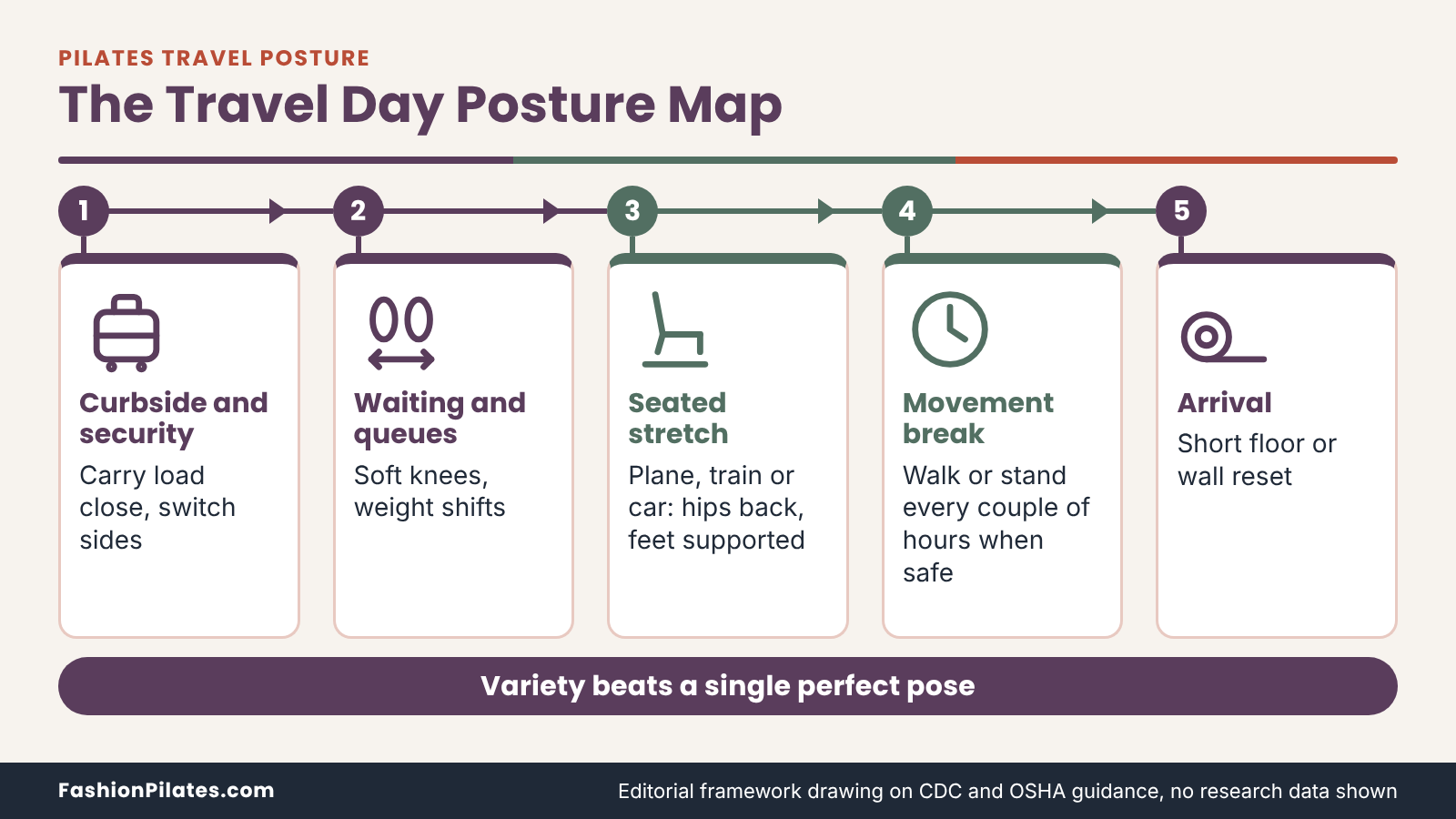
A useful way to plan is to list the positions your day will actually contain, then give each one a small counter-move. The table below is an editorial planning aid built from the situations most travelers meet, not a clinical assessment.
| Travel position | Typical stress point | Pilates-inspired counter-move |
|---|---|---|
| Airplane seat | Lower back, hips, calves, neck | Seated ankle pumps, side-body breathing, small spinal roll |
| Passenger seat or train | Neck, upper back, hips | Shoulder blade glides, seated rotation, standing breaks at stations |
| Driving | Lower back, shoulders, hip flexors | Seat setup first, stops every couple of hours for standing resets |
| Standing in lines | Feet, calves, lower back | Weight shifts, heel raises, soft knees |
| Carrying luggage | Shoulders, one-sided trunk, grip | Switch sides, hip hinge, load close to the body |
Seated Stretches of the Trip: Plane, Train, Car
Seated time is where most of the hours go, and each seat has its own personality. Treat these as three different setup problems rather than one.
Airplane seats: fixed angle, little choice
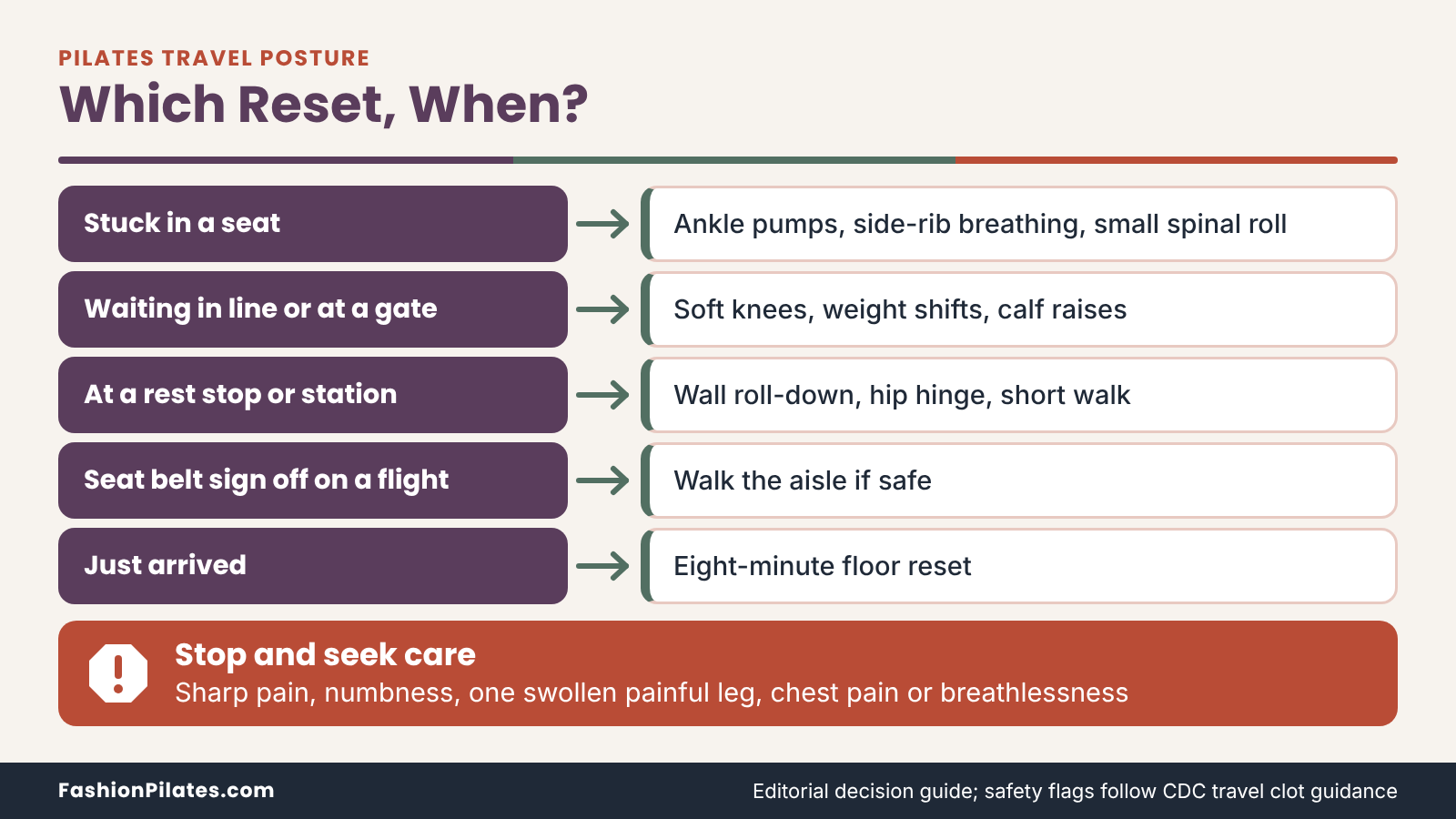
On a plane you cannot move the seat much, so you adjust everything else. Slide your hips all the way back so the seat back supports your pelvis, rather than perching on the front edge. Place both feet on the floor, or on a small bag under the seat if your legs dangle. The CDC advises walking the aisle about every two to three hours on a long flight when it is safe to do so, and suggests seated calf work such as raising and lowering your heels while your toes stay down. Treat the seat belt sign as the boss of your schedule.
Trains, buses, and passenger seats
These seats tend to offer more room and more tilt, which is both a gift and a trap. A recliner angle can let the pelvis slide forward until the lower back rounds, and a table invites a head-down laptop posture. Aim to keep the pelvis tucked back into the seat, put the screen closer to eye level using a bag or a rolled jacket, and stand and stretch when the vehicle stops. Rotation is a good fit here: a gentle seated twist while the vehicle is stationary or smooth offers your spine something other than forward flexion.
Driving: the one seat where you are the pilot
When you are driving, safety comes first and exercises wait for a parked car. Set up before you start: seat close enough that your knees stay slightly bent at the pedals, backrest slightly reclined rather than bolt upright, headrest close to the back of your head, and mirrors adjusted so you do not crane your neck. Then build a stop into your plan. The CDC suggests scheduled breaks to stretch and walk during long drives, and a short standing reset at each one beats a single long stop at lunch.
Standing, Waiting, and Carrying
Standing sounds like an upgrade over sitting, and it often is, but travel standing has its own quirks: hard floors, locked knees and a heavy bag pulling on one shoulder.
Lines, gates, and the slow shuffle
The most common standing habit in a queue is locking the knees and leaning on one hip. It is comfortable for about four minutes. Try the opposite: soften the knees, keep your weight over the middle of both feet, and shift gently from side to side or rock slightly from heels to toes every minute or so. If you have a wall or a pillar, you can lean the back of your pelvis lightly against it and let your shoulder blades rest too, which turns waiting into a very small wall exercise.
Luggage: lifting, carrying, and the overhead bin
The American Academy of Orthopaedic Surgeons has practical tips for lifting and carrying luggage. They include bending at the knees rather than the waist, keeping the bag close to your body, turning your whole body instead of twisting, and splitting your belongings across several smaller bags. For the overhead bin, it suggests lifting the bag onto the seat first and then using both hands to hoist it. Carrying a bag on one shoulder for a long stretch is something to avoid, so alternate sides often. A good travel posture routine has more to do with how you handle your bag than with any stretch you do afterward.
Seat Setup, Props, and What to Wear
The easiest posture win on a travel day happens before you move at all. A minute spent adjusting the seat and sorting your belongings changes how every later hour feels, and it costs nothing. The aim is not to force an ideal angle but to give your pelvis, ribs and head a place to rest that you can sustain, then leave yourself room to shift.
Setting Up the Seat in Under a Minute
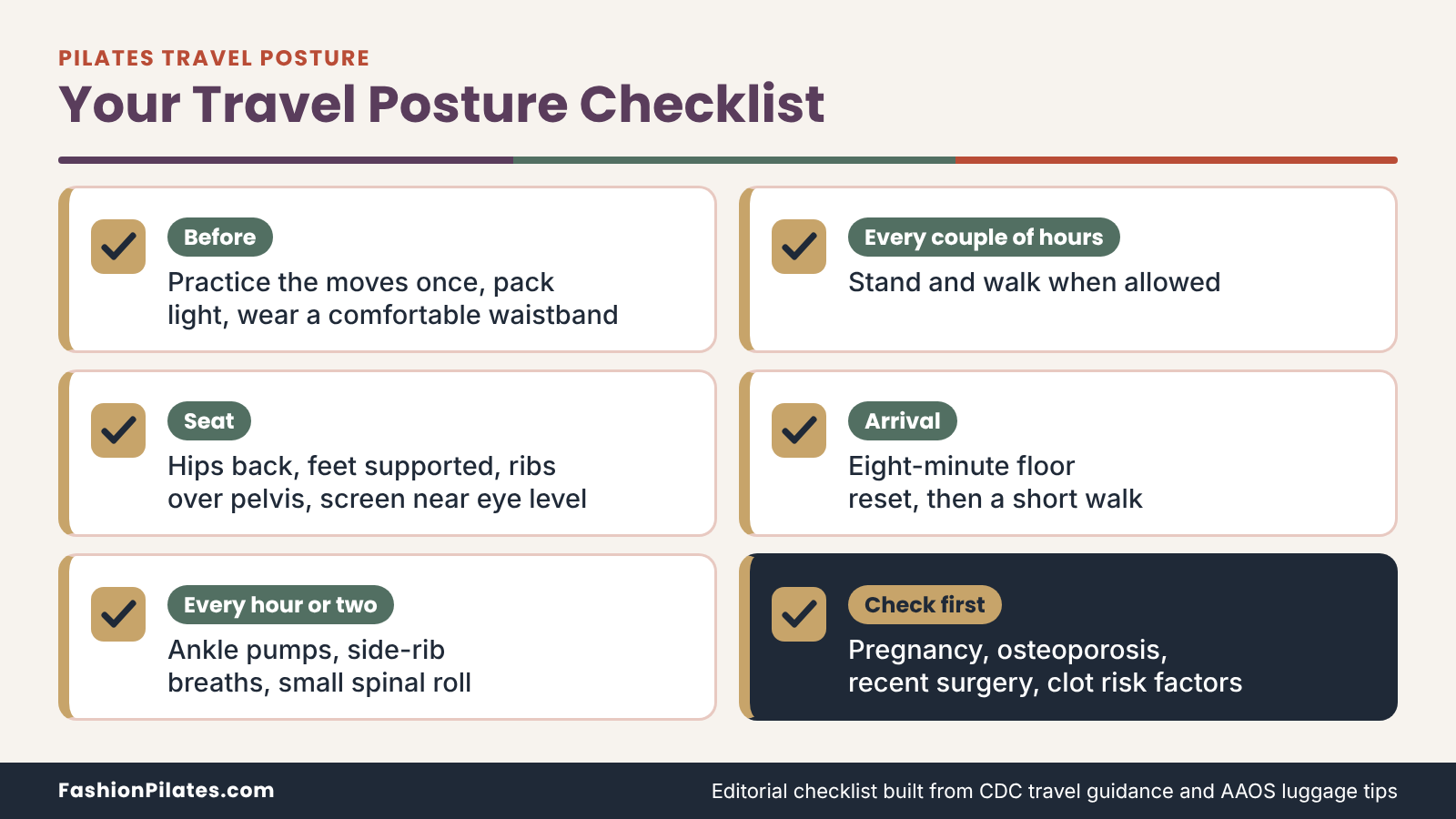
Think of this as a quick checklist you can run every time you sit down, whether the seat is in a car, a carriage or a departure lounge. It is built from general ergonomic principles, including OSHA’s description of neutral positions, rather than from any single study of travel seats.
Pelvis and lower back first
Start at the base. Sit back until your pelvis touches the seat back, with your hips and knees bent roughly to a right angle or a little more open. If the lower back has a gap behind it, a small rolled sweater or travel pillow can fill the space so the seat is carrying some of the load, but it should feel like gentle support, not a fist in your spine. Feet go flat on the floor or a stable support. If you notice you are sliding forward over time, which almost everyone does, reset by scooting back and lengthening upward before you do anything else.
Head, shoulders, and screens
Once the base is steady, work upward. Let the ribcage stack over the pelvis rather than flaring forward, let the shoulders hang softly instead of hiking toward the ears, and let the head balance over the shoulders. Screens are the usual culprit here. A phone held at lap height pulls the head forward and down for as long as you scroll, so raise it toward eye level by resting your elbows on the armrest or a bag in your lap. OSHA’s guidance on working postures keeps the head level and balanced with the torso, and the same idea applies to a phone on a plane.
Props and Clothing That Help or Just Add Clutter
Travel accessories are a crowded category, and the quality varies from helpful to purely decorative. The table below compares the common options by the decision a traveler actually faces; it is a criteria-based comparison, with no brands named and no hands-on testing behind it.
| Aid | What it does | Best for | Skip or rethink if |
|---|---|---|---|
| Rolled sweater at the lower back | Fills the gap between the seat and your lumbar curve | Seats that feel flat or too deep | It pushes your ribs forward or you feel pinching |
| Neck pillow | Supports the head if you doze | Sleeping upright on a long journey | It pushes your head forward or restricts turning |
| Small footrest or bag under the seat | Gives dangling feet a surface | Shorter travelers, tall seats | It leaves your knees higher than your hips and cramps your hips |
| Light resistance band | Allows seated arm or ankle work | Longer trips with room to move | You are in a very tight seat or would bump a neighbor |
| Compression socks | Apply graded pressure to the lower legs | Only after a clinician’s advice if you have clot risk factors | You have not been advised to use them |
Neck pillows, lumbar rolls, and rolled sweaters
Travel pillows come in so many shapes that choosing one can feel like a part-time job. Use a simple test: does it keep your head and neck in a neutral, stacked position while you rest, or does it push your chin down and forward? If it pushes, skip it, because a fancier pillow will not make a bad angle better. A rolled sweater, a folded scarf or a small jacket often does the job for the lower back at no cost, and you will already be carrying one. Whichever prop you choose, test it for a few minutes and take it out if it makes anything feel worse.
Clothing, shoes, and compression decisions
Clothing is part of your posture setup, because a waistband that digs makes you slouch away from it. Pick fabrics with some stretch, a waist that stays comfortable when you sit for hours, and layers you can add or remove without leaving your seat. The NHS suggests loose clothing, plenty of water and avoiding alcohol on long journeys, alongside walking around when you can. Compression socks are a medical decision rather than a fashion one: the CDC advises talking with a doctor about them if you have additional clot risk factors. Shoes should be easy to remove and comfortable for long walks through terminals.
Seated Pilates-Inspired Moves
These moves are small enough to do in a standard seat and gentle enough for most healthy adults. Do them only as a passenger or in a parked car, and keep your seat belt fastened whenever the crew or driver requires it; everything in this section works with a belt on. Stop if you feel sharp pain, dizziness, numbness or tingling, and speak with a qualified clinician or Pilates professional before starting if you are pregnant or postpartum, have osteoporosis, are recovering from surgery or an acute injury, or manage a chronic condition.
Breath and Alignment Cues to Learn First
Learn these two cues once, ideally at home, and every later move gets easier. They take about a minute each and set up the way you will do the rest of the sequence.
Side-rib breathing in a seat
Starting position: sit tall with your pelvis back in the seat, feet flat, and your hands resting on the sides of your lower ribs. Action: inhale slowly through the nose for about four counts and imagine the ribs widening sideways into your hands and slightly toward the back. Exhale through softly pursed lips for about six counts, feeling the ribs knit gently inward and the lower belly draw back without gripping. Repeat for five to eight breaths. If your shoulders climb on the inhale, let them drop on the exhale and try a smaller breath.
The ribs-over-pelvis check
Starting position: sit as above with your hands on your thighs. Action: take a breath in, and as you breathe out, notice whether the front of your lower ribs is poking forward. If it is, let the ribs soften down and back by a small amount, as if the ribcage were settling onto the pelvis like a lid on a box. Keep your head balanced rather than pulling your chin back hard. Hold this loose alignment for three easy breaths, then let go and move. This is a habit of checking in, not a position to maintain for hours.
A Four-Minute Seated Sequence
Run through these in order once every hour or two on a long journey, or whenever you notice yourself slumped. Each is a single action; do not rush from one to the next.
Feet, ankles, and calves
Starting position: sit back with both feet flat on the floor. Action one: keep your toes down and raise both heels, then lower them, for about 15 repetitions. Action two: keep your heels down and lift your toes, then lower them, for another 15. The CDC describes exactly these heel and toe lifts, along with tightening and releasing the leg muscles, for sitting travelers. Then draw slow ankle circles, five in each direction per foot. Breathe naturally throughout. This takes about a minute and adds movement where the calves need it most on a long journey.
Spinal roll and rotation
Starting position: sit tall with your hands resting on your thighs. Action one, the roll: inhale to lengthen upward, then exhale as you nod your chin and slowly round your upper back, moving down the spine one segment at a time to a small, comfortable range. Inhale at the bottom, then exhale as you stack back up from the base of the spine to the head. Do five slow rolls. Action two, the rotation: with your hips facing forward, cross your arms over your chest and turn your ribs gently to the right on an exhale, return on the inhale, and repeat to the left, five times each side. Keep the movement in your ribcage, not your neck.
Shoulder blade glides and side reach
Starting position: sit tall, arms relaxed by your sides. Action one: glide your shoulder blades slightly down and back, as if sliding them into your back pockets, hold for two breaths, then relax. Repeat eight times. Action two, the side reach: rest your right hand on the seat beside you, raise your left arm to a comfortable height, and lean gently to the right, lengthening the left ribs on the inhale. Return and switch sides, three times each. Keep your elbows soft, and skip any arm lift if the seat next to you is occupied or the range would be uncomfortable.
Standing Resets and Walking Breaks
Seated moves keep things ticking over, but nothing replaces actually getting up. Standing resets work in a gate area, at a rest stop, beside a train platform or in a quiet corner of a terminal, and they take less time than finding a charger. The idea is to restore a little range to the hips, spine and calves, then walk.
Three Standing Moves for Aisles, Gates, and Rest Stops
Do each of these on a stable surface, wearing shoes with grip, and not while carrying bags. Move slowly, and stand up gradually afterward if you tend to feel lightheaded.
Wall roll-down and stack-up
Starting position: stand with your back against a wall, feet hip-width apart and about a foot in front of the wall, knees soft. Action: exhale, nod your chin, and begin to peel your head, then upper back, then mid-back away from the wall, letting the arms hang as you roll down to a comfortable depth. Inhale at the bottom without forcing. Exhale and stack back up, lower back first, until the head touches the wall again. Do four to six slow rounds. Skip this one if you feel dizzy when you bend forward, and ask a clinician first if you have osteoporosis.
Standing calf raises and weight shifts
Starting position: stand with feet hip-width apart, one hand lightly on a wall or railing for balance. Action: exhale and lift both heels slowly, pause for a breath, then lower with control, for ten repetitions. Then shift your weight to the right foot for a few breaths, to the left for a few breaths, then to the middle, keeping the knees soft. These moves wake up the calves and rebalance the feet after long sitting. They are also invisible, which suits anyone who would rather not stretch in public.
Hip hinge and a standing side reach
Starting position: stand tall with your hands on your hips, feet hip-width apart, knees soft. Action one, the hinge: inhale, then exhale as you send your hips back, tilting from the hip joints while the spine stays long, then stand back up by pressing your feet into the floor. Do six repetitions. It is good practice for handling luggage, where the orthopedic tips favor bending the knees, using the legs and keeping the load close. Action two, the side reach: raise one arm overhead and lean gently to the opposite side for two breaths, then switch, three times each.
Walking as the Main Event
If you only have time for one thing, walk. It is the simplest tool in this article, and public health guidance supports it far more clearly than any individual stretch does.
How often to move
For flights, the CDC says to walk about every two to three hours, and for car travel it advises scheduled breaks to stretch and move around. That sets a practical rhythm: on a six-hour drive, plan stops about every two hours, and on a long flight, use the aisle when the seat belt sign is off. Beyond travel days, the CDC’s adult physical activity guidelines recommend at least 150 minutes of moderate-intensity activity a week plus muscle-strengthening on two days, and its general message is to move more and sit less. Any movement counts.
Walking cues that borrow from Pilates
You do not need a special gait, but a few Pilates-flavored cues make walking feel more intentional. Let the ribs stack over the pelvis, keep your gaze level so the head rests on top of the spine, and let your arms swing in opposition to your legs, which gives the rib cage a gentle twist with every step. Breathe at a pace you could chat at. If you are carrying a bag, switch sides at every gate change so the same shoulder is not doing all the work.
The Arrival Reset on a Hotel Floor
Once you are finally somewhere flat, the body usually wants a few minutes lying down before you do anything else. That can be a smart use of floor time, provided it is short and gentle. This eight-minute sequence is meant as a reset after a travel day, not a workout. If you want something longer, the beginner session in 15 minute beginner Mat Pilates mobility workout gives you more structure.
An Eight-Minute Floor Sequence
You need a carpeted space or a towel, and about the length of a yoga mat. The table gives the order and timing; the notes under it explain each move. As with the seated set, stop for sharp pain, numbness or dizziness.
| Move | Starting position | Reps or time | Breath |
|---|---|---|---|
| Lying breath | Back, knees bent, feet flat | About 1 minute | Slow side-rib inhale, longer exhale |
| Pelvic curl | Back, knees bent, arms by sides | 6 reps, about 2 minutes | Exhale to lift, inhale at top, exhale to lower |
| Knee sways | Back, knees bent together | 6 each side, about 1 minute | Exhale as knees travel |
| Cat-cow | Hands and knees | 6 slow rounds, about 1.5 minutes | Exhale to round, inhale to lengthen |
| Thread the needle | Hands and knees | 4 each side, about 1.5 minutes | Exhale as you rotate |
Pelvic curl and knee sways
For the pelvic curl, lie on your back with knees bent, feet flat and hip-width apart, arms by your sides. An exercise description from the North Carolina State University Pilates program has you exhale, draw the abdominals in, and curl the pelvis and then the lower, middle and upper back off the mat in sequence, then lower back down vertebra by vertebra. Go only as high as feels comfortable. For knee sways, keep the knees together and let them drift a few inches to one side, then the other, with the shoulders heavy on the floor.
Cat-cow and thread the needle
Come onto hands and knees, wrists under shoulders, knees under hips. For cat-cow, exhale to round the back gently toward the ceiling, then inhale to lengthen the chest forward and lift the tailbone slightly, keeping the neck long. For thread the needle, slide your right arm along the floor under your chest, turning gently through the upper back, and return as you inhale. Four rounds per side is enough. If your wrists object, make fists or use forearms, and skip any kneeling that bothers your knees.
Finishing slowly
End on your back for three or four breaths, with a pillow under the knees if that is more comfortable. Roll to one side, press up with your hands, and stand slowly rather than springing up. Take a few steps and notice how your seat, your legs and your lower back feel compared with an hour ago. The point is to change the feeling a little, not to chase a specific sensation, and if you feel nothing dramatic, you still did what you came to do: moved.
Hotel Desk, Bed, and Bag Habits
The reset does not end when you get off the floor. Hotel rooms have a way of creating new fixed positions, and a bag you never unpacked is a standing invitation to bend at the waist.
Working from a hotel desk or bed
If you need to work, resist the temptation to settle into the bed with a laptop on your knees, which is usually a head-down, rounded-back arrangement. Use the desk if there is one, bring the screen closer to eye level with a stack of books or a pillow underneath, and keep your feet supported. OSHA’s guidance on positions suggests varying your posture, standing for some tasks, and taking short breaks to move, which suits a hotel desk well. Take a short walk after every hour of screen time, even if it is just to the ice machine.
Sleeping and the morning after
Hotel pillows vary wildly in height, and the point is not to find a perfect sleeping position but to avoid bending the neck sharply. If the pillow is too tall or too flat, fold or stack to keep your neck roughly in line with your spine. In the morning, give yourself two minutes before the day: five side-rib breaths, a few knee sways, and a wall roll-down. When you pack, set the bag on a chair or bed so you can lift it with a hip hinge rather than a deep bend.
Common Mistakes, Red Flags, and Who Should Adjust
Most travel posture problems come from a handful of predictable habits, and most can be fixed by doing less, not more. The more serious part of this section is about knowing when a stiff leg is just stiff and when it is worth a phone call.
Mistakes That Undo Good Intentions
These are the patterns that turn a sensible plan into another source of soreness. Each has a simple fix.
Chasing a rigid pose
The first mistake is treating posture as a position to defend. Squaring the shoulders hard, pulling the chin back and clenching the abdominals for hours turns a rest into a workout nobody asked for. The research summarized earlier suggests the exact shape matters less than variety, so allow yourself to slouch a little, then shift. Check your stacking cue a few times an hour, then let it go. If you notice your jaw, shoulders or glutes gripping, that is a signal to soften, not to try harder.
Stretching hard into stiffness
After hours of sitting, tight tissues feel like they want a big stretch, and the temptation is to pull hard at the end of the range. A better approach is gentle, repeated movement within a comfortable range, using the breath to guide how far you go. Bouncing, forcing a twist or cranking the neck sideways is more likely to irritate than relax. If a movement produces a pinch, a sharp pain or tingling down an arm or leg, stop that move and choose a gentler one, or skip the rest of the sequence.
Skipping the walk because the stretches felt productive
It is easy to do a neat seated routine and then stay put for another four hours, feeling virtuous. But a seated sequence is a supplement, not a substitute, for getting up. The CDC’s guidance on long trips lists walking, and its adult activity guidelines emphasize moving more and sitting less. Treat the stretches as the minimum between walks, and use every real opportunity to stand, whether that is a platform, a gate area or the aisle when the crew allows it.
Red Flags and Who Should Check First
General exercise education cannot tell you whether a symptom is routine or serious. What it can do is list the common signals and suggest who to ask. The table below is an editorial summary of safety principles, not a diagnostic tool.
| What you notice | Reasonable response | When to get care |
|---|---|---|
| General stiffness that eases as you move | Keep moving gently, walk, repeat a short reset | If it keeps getting worse over several days |
| Mild muscle fatigue after a floor reset | Rest, shorter ranges next time | If it does not settle within a day or two |
| Sharp pain or a pinch during a move | Stop that move and avoid repeating it | If it persists after you stop |
| Numbness or tingling | Stop and change position | If it continues or returns, or comes with weakness |
| Swelling, pain, warmth or redness in one leg | Do not massage or stretch it; arrange urgent care | Seek medical care immediately |
| Chest pain, trouble breathing, fast heart rate, or coughing blood | Treat as an emergency | Seek emergency care immediately |
Clot warning signs and risk factors
The CDC lists swelling, pain and warm, red skin as signs of a deep vein clot, and difficulty breathing, a fast heart rate, chest pain, coughing up blood and lightheadedness as signs of a clot in the lungs, and it says to seek medical care immediately if you have symptoms. It also lists risk factors, including a previous clot, a family history, clotting disorders, recent surgery, estrogen-based birth control, pregnancy, older age, obesity, and cancer. If any of those apply, talk with your doctor before a long trip about whether you need compression stockings or other precautions. Pilates-inspired movement is a gentle habit, not a clot treatment.
Other situations that call for a clinician or instructor first
Check with a qualified clinician or an experienced Pilates professional before you use these moves if you are pregnant or postpartum, have osteoporosis or low bone density, are recovering from surgery or an acute injury, have a spinal condition, or live with a chronic condition that affects balance, circulation or pain. Stop immediately for sharp pain, dizziness, numbness or anything that feels alarming. Teachers who work with these groups exist; the Hospital for Special Surgery, for example, describes teachers who work with referring physicians and therapists. A short consultation before the trip is easier than sorting out concerns mid-journey.
Building a Routine for Your Kind of Trip
Good intentions evaporate in a busy terminal, so it helps to decide the plan in advance. The plan does not need to be elaborate; it needs to be simple enough to remember when you are tired. Which pieces you keep depends on the trip.
Before You Leave
Preparation is mostly about removing friction. If the moves are unfamiliar, you will skip them; if the setup requires digging in a bag, same result.
Practice the moves once at home
Spend ten minutes the day before running through the seated sequence, the three standing moves and the floor reset. You will learn which ones feel natural, which need a smaller range, and which you would rather not repeat. This is also the time to get comfortable with side-rib breathing, which is the cue most people find oddly difficult at first. If you want a longer foundation, the beginner programs in beginner Mat Pilates workout and the broader Pilates for beginners guide build the same skills with more guidance.
Pack and dress for movement
Choose clothing with a comfortable waistband that stays put when you sit, shoes you can walk in and take off, and a layer for cold cabins. Pack lighter than your instincts suggest, because the orthopedic luggage tips favor lightweight bags and spreading items across several smaller ones rather than one heavy case. Keep heavy items low and close to your back if you carry a backpack, and use both straps. Put anything you will need in-flight, such as a small water bottle and your phone charger, within reach so you are not twisting for it.
Sample Plans by Trip Type
The table lays out a starting point for three common situations. Adapt it to your own body and your clinician’s advice, and treat the timings as rough guides, not rules.
| Trip type | Before you sit | During the journey | On arrival |
|---|---|---|---|
| Road trip day | Adjust seat, mirrors, and headrest | Stop about every two hours for a standing reset and a short walk | Wall roll-down, then the floor reset |
| Flight or train day | Hips back, feet supported, bag close | Seated sequence each hour or two, walk when allowed | Floor reset, then a longer walk |
| Work trip or conference | Plan the first seat and desk setup | Stand for calls, walk between sessions | Two-minute morning reset, floor reset in the evening |
Road trip day
Set up the driver’s seat before you pull out, then plan breaks around your route instead of your mood. At each stop, do the wall roll-down or a hip hinge, a minute of calf raises and a short walk, which takes about five minutes. Passengers can add the seated sequence while the car is moving, with the seat belt on. Swap drivers if you can, so nobody holds the same seat for the whole route. At the end of the day, the floor reset is a pleasant way to say goodbye to the steering wheel.
Flight or train day
Make seat setup the first job once you are settled, then run the seated sequence about every hour or two. Time your walks to the crew’s rules on a flight and to station stops on a train. Drink water, which the NHS lists among its long-journey tips, and keep your carry-on light enough to lift without twisting. For a full guide to the flying part specifically, see airline travel mobility with Pilates. On arrival, do the floor reset before you unpack, then take a short walk outside.
Work trip or conference days
Conference days add hours of chairs, lanyards and standing in conversation. Choose seats near an aisle so you can stand without a fuss, move the laptop up using a book or a stack of folders, and take a lap of the corridor between sessions. A two-minute morning reset sets the tone, and an evening floor reset helps when your back feels like it has been in meetings all day. A deliberately tiny routine beats an ambitious one you abandon by Tuesday.
What the Research Supports and Where It Runs Out
It is fair to ask how much of this is established and how much is sensible practice. The honest answer is a mix: the evidence for regular movement on long journeys is reasonably clear, the evidence for Pilates as an exercise method is promising in specific populations, and nobody has tested these particular travel sequences in a trial. Knowing the difference keeps expectations realistic.
What We Know About Pilates and Back Pain
Most of the Pilates research that touches posture-adjacent complaints looks at chronic low back pain, which is a different situation from stiffness after a flight. It is still the best-quality evidence on the method, so it is worth reading carefully.
The Cochrane review
A Cochrane systematic review of Pilates for low back pain pooled ten randomized trials in people with non-specific chronic low back pain. It found Pilates more effective than minimal intervention for pain and disability in the short and intermediate term, but no clear advantage over other exercise. The authors rated the overall quality of evidence as low to moderate, with no high-quality evidence for any comparison, and follow-up never extended beyond six months. That is useful support for Pilates as a reasonable exercise choice, and it says nothing about how it affects travel stiffness.
The family-physician summary
The American Academy of Family Physicians published a clinical summary of Pilates for low back pain that reached a similar view. It described low- to moderate-quality evidence, rare adverse effects that were mostly mild muscle soreness, and a note that current guidelines recommend any form of exercise therapy rather than Pilates specifically. It also noted that the studies covered chronic rather than acute pain. For a traveler, the takeaway is modest: Pilates-style movement appears to be a safe, reasonable option, and the form of exercise you will actually do matters more than its name.
Posture, Sitting, and Movement: What Is Settled and What Is Not
Posture is a topic with plenty of confident advice and surprisingly thin evidence. A careful reading separates a few well-supported points from a lot of folklore.
What the sitting and posture research suggests
The International Association for the Study of Pain article cited earlier describes a systematic review that found strong, consistent evidence of no association between occupational sitting and low back pain, and no dose-response relationship. That does not mean sitting is harmless for everything, and it does not tell us about long-haul flights. It does argue against catastrophizing a slouch. OSHA’s emphasis on varying position and taking short breaks fits this picture and is cautious in its claims, which is a good reason to follow it.
Movement during travel: guidance, not proof of these exact moves
The recommendation to move during long trips is well established. The CDC advises walking and calf exercises, the NHS lists walking and hydration, and the National Blood Clot Alliance publishes in-flight exercises such as ankle circles, foot pumps and knee lifts. What nobody has done is test the specific Pilates-inspired sequences in this article against a control group of travelers. Treat them as gentle, sensible movement based on general principles, and adjust to what your body, clinician and instructor say.
Frequently Asked Questions
Does Pilates actually improve posture for travel days?
Pilates builds habits that can make long sitting more comfortable, such as steady breathing, awareness of your ribs and pelvis, and moving the spine in small segments. Research on Pilates mostly studies chronic low back pain, not travel, so the benefit for a specific trip is not proven. It is better to think of it as a useful skill set than a guarantee. Practicing the moves at home before you leave makes them easier to use in a cramped seat. A certified instructor can tailor the cues to your body.
How often should I get up on a long flight?
The CDC suggests walking about every two to three hours on a long flight. Follow the crew’s instructions and stay seated when the seat belt sign is on. Between walks, do ankle pumps and heel raises at your seat. If you have clot risk factors, ask your doctor for a personal plan before you fly. That plan may be stricter than the general advice.
What is the most comfortable way to sit on a plane?
Slide your hips back so the seat supports your pelvis, and place both feet on the floor or a stable support. A small rolled layer behind the lower back can fill a gap if the seat feels flat. Bring your phone toward eye level instead of bending your head to it. Change position every so often because no single pose stays comfortable for hours. If something pinches or goes numb, shift immediately.
Can I do these moves while driving?
No, leave the exercises for stops and for passengers. The driver’s job is safe driving, so set up the seat and mirrors before you start. Then plan breaks about every couple of hours, which matches CDC advice for road trips. Use each stop for a standing reset such as a wall roll-down, calf raises and a short walk. Passengers can do the seated sequence with their belts on.
Do I need compression socks for a long trip?
Not necessarily, and the decision belongs with your doctor. The CDC says to ask about compression stockings or preventive medicine if you have additional clot risk factors, such as a previous clot, recent surgery, pregnancy or estrogen-based birth control. If you have none of those, your doctor may still have a view based on your history. Socks are not a substitute for moving. A poor fit can be uncomfortable, so get advice on size and type.
What can I do about neck stiffness after sleeping upright?
Start with gentle movement rather than a hard stretch. Try a few slow side-rib breaths, a small chin nod, and shoulder blade glides, keeping everything within a comfortable range. Walk for a few minutes to let your whole body warm up. A pillow that supports your head in a neutral position next time may help. If you notice numbness, arm pain or stiffness that lingers for days, see a clinician.
Is the arrival floor reset safe if I already have back pain?
That depends on the cause of your pain, so check with a clinician or an experienced Pilates professional first. Many people with ongoing back discomfort are encouraged to stay gently active, but the right movements vary from person to person. Begin with a very small range and stop if anything sharpens, tingles or goes numb. Skip the floor work if getting down and up is difficult, and use the seated and standing moves instead. Your clinician can advise whether any should be changed.
When is soreness after travel a reason to call a doctor?
Ordinary stiffness that loosens as you move is common after a long day of sitting. Call a doctor promptly if one leg is swollen, painful, warm or red, or if pain, numbness or weakness keeps getting worse. Seek emergency care right away for chest pain, trouble breathing, a fast heart rate, coughing up blood or lightheadedness. Do not massage a painful, swollen leg. When you are unsure, it is better to ask.



Trackbacks/Pingbacks