Pilates has a vocabulary problem, and it starts on your very first day. An instructor says “find your neutral spine” or “scoop from your Powerhouse,” and unless someone hands you a decoder ring, you’re left nodding along while quietly panicking about which muscle is supposed to move. This Pilates glossary exists to fix that — one plain-language definition at a time, organized the way terms actually surface in a real class rather than alphabetically.
We’ve grouped more than 70 terms into the categories where you’ll actually encounter them: the core concepts you’ll hear in week one, the equipment names that sound more like a car dealership than a gym, the classic exercise names instructors rattle off without slowing down, the studio jargon printed on a class schedule, the named methods and training lineages you’ll see on a certificate, and the cueing phrases that finally make sense once someone translates them. Search this page for the word that stumped you, or read straight through if you’d rather build the whole vocabulary at once before you ever set foot in a studio.
The quick answer
A Pilates glossary, at its simplest, is a reference list translating the specialized words instructors, studios, and equipment makers use into plain English. You don’t need to memorize any of it before your first class — nobody arrives fluent, and a good instructor explains terms as they come up, usually while your body is already doing the movement they’re describing. What actually helps is knowing where to look something up afterward, which is exactly what this page is for: a single, organized place to return to instead of guessing or feeling embarrassed to ask.
A few orientation points before the full list, since the categories below aren’t arbitrary:
- Body and principle terms (Powerhouse, neutral spine, concentration) describe how you move and where a movement originates from, not what equipment you’re standing on.
- Equipment terms (reformer, Cadillac, Wunda Chair) name specific machines and apparatus, most of them designed by Joseph Pilates himself nearly a century ago.
- Exercise names (The Hundred, Teaser, Criss-Cross) are proper nouns for specific, named movements, not general categories like “core work” or “stretching.”
- Method names (Classical, Contemporary, STOTT PILATES, BASI) describe teaching lineages and training organizations that certify instructors, not different physical exercises you’d choose between.
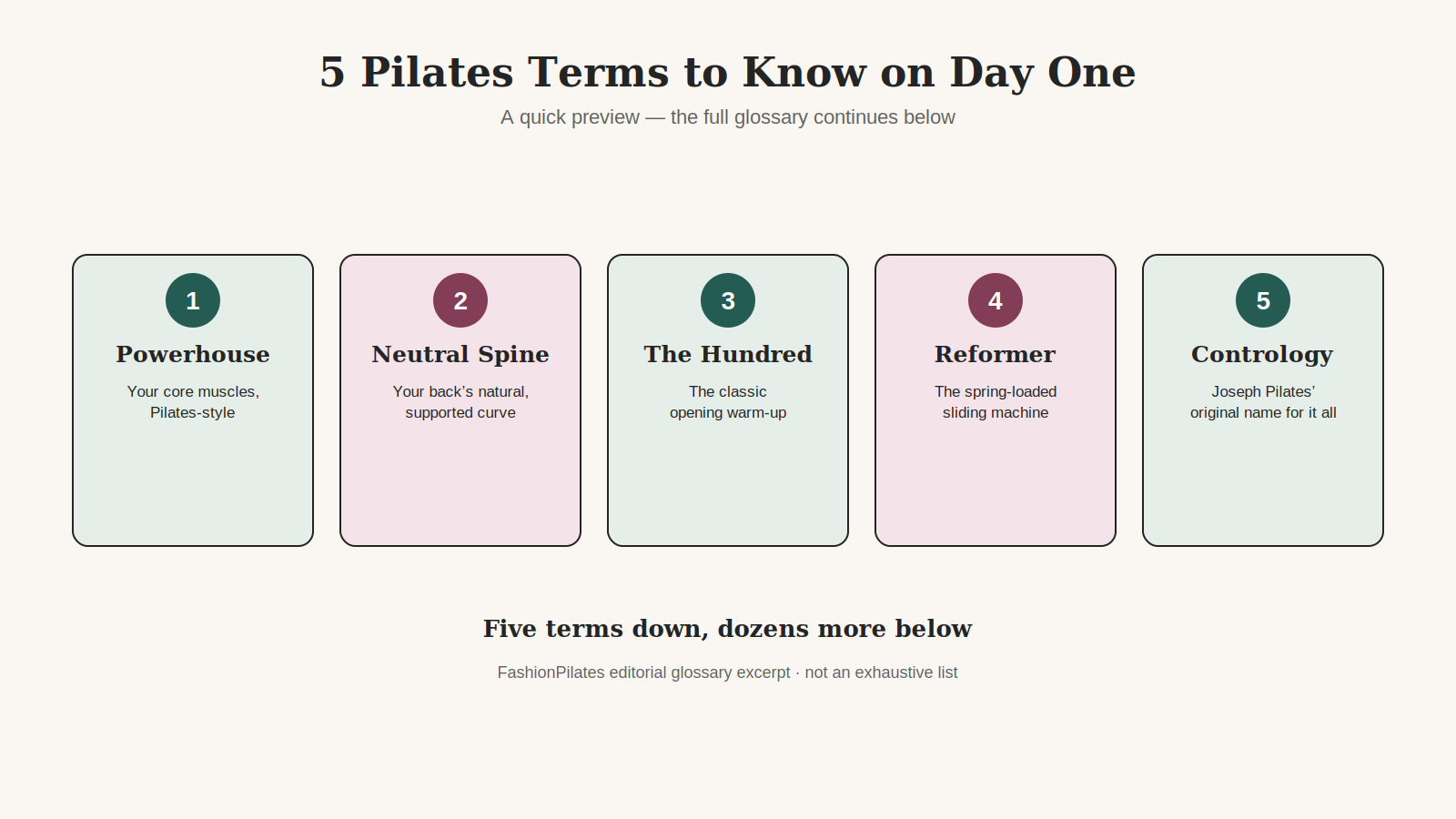
Five Pilates terms to know on day one — a quick preview from the full glossary below.
Complete text equivalent of the infographic above:
- Powerhouse — your core muscles, Pilates-style.
- Neutral Spine — your back’s natural, supported curve.
- The Hundred — the classic opening warm-up.
- Reformer — the spring-loaded sliding machine.
- Contrology — Joseph Pilates’ original name for it all.
These five are just a starting point — the full Pilates glossary below covers more than 70 terms in total, grouped by where you’ll actually run into them.
Foundational Pilates terms and principles
Before equipment or exercise names, most classes lean on a small set of core vocabulary describing how you’re supposed to be moving, breathing, and holding your body. These terms show up constantly, often stacked two or three at a time in a single cue (“scoop your Powerhouse and keep a neutral spine”), which is exactly why beginners describe their first class as sounding like a second language. Master this section and the rest of the glossary gets noticeably easier, since equipment and exercise names tend to lean on this same foundational vocabulary to explain themselves.
Terms about your body and center
This first group covers how instructors talk about your torso, spine, and the muscles that anchor nearly all Pilates movement. If you only learn six terms before your first class, make it these.
| Term | What it means |
|---|---|
| Powerhouse | The group of deep abdominal, lower back, hip, and glute muscles that most Pilates movement starts from. It’s roughly equivalent to what other fitness disciplines call your “core,” though the Pilates version includes a slightly broader set of muscles and carries a specific meaning tied to Joseph Pilates’ own writing. |
| Core | A general fitness term for your trunk muscles, used across nearly every exercise discipline. Pilates instructors more often say “Powerhouse” instead, though the two terms overlap heavily and get used somewhat interchangeably in casual conversation without causing real confusion. |
| Neutral spine | A spine position that keeps your lower back’s natural, slight curve, rather than pressing flat into the mat or arching away from it. Instructors check for it constantly, since it protects your back during loaded movements and is the default position for most exercises unless a cue says otherwise. |
| Imprint | Gently pressing your lower back into the mat, flattening its natural curve on purpose. It’s used selectively, usually to protect the spine during a leg-lowering or overhead movement, not as a default position you should hold throughout an entire class. |
| Alignment | The relationship between your joints and body segments during an exercise. An instructor’s correction about shoulder position or pelvis tilt is an alignment cue, not nitpicking — poor alignment is one of the more common ways people strain something during an otherwise protective workout. |
| Centering | One of Joseph Pilates’ six core principles — initiating every movement from your Powerhouse rather than your arms or legs. Skip this step and an exercise stops being Pilates in any meaningful sense; it just becomes a generic stretch with extra steps. |
Body-position and movement-quality terms
A second, smaller set of terms describes body positions and the quality of a movement itself — less about where an exercise starts, more about how it’s supposed to look and feel while it’s happening.
| Term | What it means |
|---|---|
| Tabletop position | Lying on your back with hips and knees bent to 90 degrees, shins parallel to the floor. It’s a neutral starting position for many abdominal and leg exercises, and instructors reference it constantly as a reset point. |
| Prone | Lying face-down, used to describe the starting position for back-extension exercises like Swan and the Leg Kick series. |
| Supine | Lying face-up, the starting position for the majority of classical mat exercises, including the Hundred and the Roll-Up. |
| Articulation | Moving through the spine one segment at a time, rather than as a single rigid unit — the quality that makes a Roll-Up look meaningfully different from simply sitting up off the floor. |
| Opposition | Two body parts working against each other in a controlled way, such as the crown of the head reaching one direction while the tailbone anchors the other, creating length instead of tension. |
| Scapular stability | Keeping the shoulder blades set and controlled against the ribcage during arm and upper-body movement, rather than letting them ride up toward the ears under load. |
| Pelvic clock | An awareness exercise that maps small pelvic movements onto an imagined clock face, used to teach fine control over subtle pelvic tilts before layering on bigger movements. |
Terms about breath and the six principles
The third foundational group covers the disciplined, breath-driven side of Pilates — the vocabulary that separates it from simply stretching on a mat, and the closest thing the method has to its own philosophy. Joseph Pilates wrote about these ideas directly, and most teacher-training programs still organize their curriculum around some version of this same list.
| Term | What it means |
|---|---|
| Lateral breathing | A breathing style that expands your ribcage sideways and back rather than your belly. It lets your deep abdominal muscles stay engaged throughout a movement instead of releasing with every inhale, which is why it takes real practice to feel natural. |
| Percussive breath | A short, forceful exhale pattern used in exercises like the Hundred, where breath is pumped out in counted bursts rather than one long exhale. It’s meant to keep your Powerhouse actively engaged rather than passively holding a position. |
| Precision | One of the six core principles — placing your body correctly rather than doing more repetitions sloppily. Five well-aligned reps count for more than fifteen rushed ones, which is why a printed repetition count is really a guideline, not a scoreboard. |
| Flow | One of the six core principles — linking exercises smoothly into each other rather than stopping and resetting between every single one, so a full session reads as one continuous sequence rather than a list of isolated moves. |
| Contrology | Joseph Pilates’ original name for his complete exercise system, built on the idea that the mind should direct the body’s movement rather than momentum carrying it. “Pilates” became the popular name only after his death in 1967. |
| Concentration | One of the six core principles — staying mentally present in a movement instead of going through the motions while your mind wanders elsewhere. Instructors can usually tell within a few reps whether a student is actually concentrating. |
Equipment and apparatus terms
Pilates equipment names sound like they escaped from a furniture showroom — Cadillac, Wunda Chair — and that’s a real part of why a class schedule can feel intimidating before you’ve even walked in the door. Joseph Pilates designed most of this equipment himself, originally to rehabilitate injured dancers and, as the well-documented story goes, to train fellow internees during World War I using springs rigged onto hospital beds. Nearly every major piece of apparatus you’ll see in a studio today traces back to that same original design work, even after a century of manufacturing refinements.
Reformer parts, named
The reformer is the piece of equipment most people picture when they hear “Pilates,” and it’s also the one with the most individually named parts. Knowing these terms makes an instructor’s setup instructions (“add a riser,” “grab the straps”) actually parseable on your first visit, instead of a string of confusing nouns.
| Term | What it means |
|---|---|
| Carriage | The flat, padded platform that slides back and forth along the reformer’s rails, moved by pushing against the footbar or pulling the straps. It’s the surface you’ll spend most of a reformer class lying, sitting, kneeling, or standing on. |
| Footbar | The padded bar at one end of the reformer that you push against with your feet or hands to move the carriage. Most footbars adjust to several angles and heights to suit different exercises and body sizes. |
| Springs | Color-coded resistance springs that connect the carriage to the frame. More springs, or heavier springs, mean more resistance — not necessarily more difficulty, since lighter springs can actually demand more control to move slowly and smoothly. |
| Risers | Short posts that lift the strap pulleys higher off the frame, changing the angle of resistance for certain arm and leg exercises. Not every reformer has them, and not every exercise needs them. |
| Straps and pulleys | The loops and cabling system that let you move the carriage with your arms or legs instead of your feet on the footbar, opening up a much wider range of exercises than footwork alone. |
| Shoulder rests | Padded blocks near the head end of the carriage that keep your body from sliding off during forceful pushing exercises, especially footwork done at higher spring tension. |
| Headrest | The raised, often adjustable pad at the head end of the carriage, supporting your head and neck during supine exercises so your neck doesn’t have to work to hold your head up. |
Other Pilates apparatus
The reformer gets most of the attention, but several other pieces of equipment show up regularly on a well-equipped studio floor, and a comprehensive-certified instructor will typically know how to teach on all of them.
| Term | What it means |
|---|---|
| Cadillac (trap table) | A raised platform with an overhead frame of bars and springs, used for both gentle supported work and advanced suspension exercises. It’s one of Joseph Pilates’ largest and most elaborate original designs. |
| Wunda Chair | A compact box with a spring-loaded pedal, used for balance and single-limb strength work in a smaller footprint than a reformer. Small studios sometimes favor it precisely because of that space savings. |
| Spine Corrector | A curved, barrel-shaped prop that supports specific spinal extension and stretch exercises, giving your back a shape to work over that a flat mat can’t provide. |
| Ladder Barrel | A taller barrel with a small attached ladder, used for exercises that combine flexibility and control, often standing or kneeling rather than lying down. |
| Magic Circle | A flexible ring with padded handles, squeezed or pressed to add light resistance to mat exercises. Also sold simply as a “Pilates ring,” and one of the cheapest, most portable pieces of Pilates equipment you can own. |
| Jump Board | An attachment that clips onto a reformer’s footbar, turning it into a low-impact, spring-resisted jumping platform, sometimes used for a cardio segment within an otherwise low-impact class. |
| Tower | A smaller, wall-mounted or reformer-attached version of the Cadillac’s spring-and-bar system, common in studios with limited floor space that still want to offer Cadillac-style exercises. |
Small props and accessories
Beyond the large apparatus, a few small, portable props show up constantly in both studio classes and home practice, and they’re worth naming separately since they’re the pieces most beginners actually end up buying.
| Term | What it means |
|---|---|
| Resistance band (Pilates band) | A long, flat elastic band used to add resistance to mat exercises, often substituting for reformer-style spring resistance during home practice. |
| Sliders (gliding discs) | Small flat discs placed under the hands or feet to let them glide across the floor, adding a stability and control challenge to otherwise familiar mat exercises. |
| Small ball (mini ball) | A soft, inflatable ball roughly the size of a grapefruit, squeezed between the knees or hands to add light resistance and body-awareness feedback. |
| Foam roller | A firm cylindrical prop used both for self-massage and for balance-challenging exercises performed lying or sitting on top of it. |
| Grip socks | Socks with rubberized traction patterns on the sole, required by many studios for hygiene and slip prevention on the equipment. |
| Stretch strap (Pilates strap) | A looped fabric strap used to extend your reach during stretches, common in both mat classes and independent home practice. |
Classic exercise names, decoded
Joseph Pilates named and ordered a specific sequence of mat exercises in his 1945 book Return to Life Through Contrology, and instructors still reference many of these names directly, whether or not a given class follows his original order start to finish. This section defines the names so you can follow along without stopping to ask “wait, what’s a Teaser?” mid-flow; for actual step-by-step instruction on how to perform them, FashionPilates’ Pilates Workouts coverage walks through full routines with modifications.
Mat classics everyone eventually meets
These are the names you’re most likely to hear in a mat class, roughly in the order Joseph Pilates originally sequenced them, though most contemporary classes reorder or select from this list rather than running it start to finish.
| Name | What it is |
|---|---|
| The Hundred | The traditional opening warm-up — pumping the arms in a held position while breathing in a counted pattern, named for the 100 total pumps most versions build toward. |
| Roll-Up | A slow, controlled roll from lying flat to sitting upright and back down, one vertebra at a time, testing articulation more than raw strength. |
| Roll-Over | An exercise that lifts the legs up and over the head, then rolls the spine back down with control, usually reserved for intermediate or advanced classes. |
| Rolling Like a Ball | A balance exercise that rocks the body in a tucked position along the length of the spine, doubling as a gentle self-massage for the back. |
| Single Leg Circles | Lying on the back, tracing circles in the air with one leg to mobilize the hip while the Powerhouse and pelvis stay still and stable. |
| Single & Double Leg Stretch | Core exercises that pull one or both knees toward the chest while coordinating breath with limb extension, staples of nearly every beginner mat sequence. |
| Spine Stretch Forward | A seated forward stretch that articulates the spine one segment at a time, often used as a palate-cleanser between more demanding exercises. |
| Open Leg Rocker | A balance exercise similar to Rolling Like a Ball, performed with the legs extended into a wide V, demanding more flexibility and control than its predecessor. |
| Corkscrew | An advanced exercise that circles the legs around the body while the torso stays still and stable, a genuine test of the centering principle. |
| Saw | A seated, twisting reach toward the opposite foot, used to stretch the spine and hamstrings while building rotational control. |
| Swan (Swan Dive) | A back-extension exercise performed lying face-down, often with a dynamic rocking variation that’s as fun to watch as it is challenging to perform. |
| Single & Double Leg Kicks | Prone exercises that stretch the front of the hip and strengthen the back of the body, typically performed right after the Swan. |
| Teaser | A balance exercise that lifts the torso and legs into a V-shape, balanced on the sit bones, often treated as a benchmark of overall mat progress. |
| Criss-Cross | A twisting abdominal exercise that brings opposite elbow and knee together in a bicycle-like motion, working the obliques specifically. |
| Side Kick Series | A set of exercises performed lying on one side, working the outer hip and leg through several small, controlled movements in sequence. |
| Shoulder Bridge | A bridge position with the hips lifted, sometimes performed with single-leg kicks added at the top for an extra stability challenge. |
| Boomerang | An advanced, flowing exercise that combines a roll, a Teaser-like balance, and an arm stretch in one continuous sequence, often used to close an advanced class. |
Reformer-specific exercise terms
A handful of exercise names apply only on the reformer, since they depend on the carriage, straps, or footbar to work at all.
| Name | What it is |
|---|---|
| Footwork | A foundational reformer sequence pressing the carriage out and in using several different foot positions on the footbar, almost always the first thing done in a reformer class. |
| Elephant | Standing on the carriage in a forward-fold position, pressing it back and forth to articulate the spine and strengthen the backs of the legs. |
| Long Stretch | A plank-position exercise performed with hands on the footbar, pressing the carriage out and in with control while maintaining a straight line from head to heels. |
| Short Spine | An advanced exercise where the legs are hooked into the straps and lifted overhead, then the spine articulates down slowly, demanding real trust in your own control. |
| Knee Stretches | A kneeling reformer sequence, often used as a core and shoulder-stability warm-up before standing or supine work later in class. |
Class and studio vocabulary
Beyond the exercises themselves, a studio’s class schedule and pricing page come with their own small vocabulary — genuinely useful to know before you’re staring at a booking screen trying to guess what a “duet” costs or whether “apparatus rotation” means you’ll be doing more work than you signed up for.
| Term | What it means |
|---|---|
| Drop-in class | A single class booked without a package or membership commitment, usually priced higher per session than a bundled option, since studios reward commitment financially. |
| Mat class | A group or private class performed on the floor, with little or no apparatus involved, usually the least expensive and most widely available class type. |
| Group reformer class | Several reformers set up in one room for an instructor-led class, similar in feel to a group fitness class, though with more individual attention than a large gym class. |
| Duet / semi-private | A session with two students and one instructor, splitting the cost and attention of a fully private lesson, a common option for friends or family who want to train together. |
| Apparatus rotation | A studio format where students move between several types of equipment (reformer, chair, barrel) during one session, common in comprehensive-style studios. |
| Comprehensive certification | An instructor training program covering mat, reformer, and most other apparatus, typically requiring several hundred training hours — worth asking about if credentials matter to you. |
| Intro package | A discounted set of classes offered to new students, meant to let them test a studio before committing to full-price membership pricing — almost always worth asking about before your first visit. |
Method and lineage terms
Walk into enough studios and you’ll start noticing method names on certificates hanging near the front desk, or in an instructor’s bio: Classical, Contemporary, STOTT PILATES, BASI. None of these describe a different set of muscles worked or a fundamentally different exercise — they describe different teaching lineages, each tracing back to Joseph Pilates’ original studio in one way or another, usually through a specific chain of teachers who trained the next generation.
After Joseph Pilates died in 1967, his original students — sometimes called “the Elders” — each carried a slightly different emphasis forward. Some prioritized preserving his exact sequence; others began incorporating what they were learning from physical therapy and sports science as those fields developed. Both paths are legitimate continuations of the same source material, which is worth remembering the next time a studio’s marketing implies its particular method is the only “real” one.
| Term | What it means |
|---|---|
| Classical Pilates | An approach that follows Joseph Pilates’ original exercise sequence in a fixed order, taught largely as his first-generation students learned it directly from him. |
| Contemporary Pilates | An approach that keeps the same underlying principles but incorporates newer biomechanics and rehabilitation research, often reordering or adapting exercises for an individual student. |
| Romana’s Pilates | A classical lineage named for Romana Kryzanowska, a direct student of Joseph Pilates who continued teaching his original studio’s method for decades after his death. |
| BASI Pilates | Body Arts and Science International — a contemporary teacher-training organization that blends classical exercises with anatomy-based modifications and a strong emphasis on functional movement. |
| STOTT PILATES | A contemporary method developed by Moira and Lindsay Merrithew, taught through the Merrithew Corporation’s education and equipment programs since 1988. |
| The Elders | An informal name for Joseph Pilates’ original group of students, who went on to teach and preserve his method after his death in 1967, each opening their own studios and training programs. |
None of these lineages is more “correct” than another — they’re different, well-documented paths back to the same source, and plenty of accomplished instructors trained across more than one of them over a long career. If a certification name on an instructor’s bio means nothing to you, that’s a completely reasonable thing to ask about directly; most instructors enjoy talking about their training background.
Cueing language, decoded
Pilates instructors lean on a specific, recurring vocabulary for corrections and cues, repeated so often that regular students eventually start saying them under their breath along with the instructor. Translating this list early saves you from nodding along while quietly confused about what your ribs are supposed to be doing.
| Cue | What it means |
|---|---|
| “Find your neutral spine” | Let your lower back keep its natural curve instead of pressing flat into the mat or arching away from it. |
| “Scoop” or “hollow” your abs | Draw your lower belly in and up, toward your spine, without holding your breath while you do it. |
| “Lengthen through the crown” | Imagine the top of your head reaching away from your tailbone, which keeps your neck from compressing under effort. |
| “Zip up” | Engage your deep abdominals as if closing a zipper from the pubic bone to the ribs, often cued right before an exercise begins. |
| “Articulate the spine” | Move through your spine one vertebra at a time, rather than lifting or lowering it as one stiff unit. |
| “Stack your joints” | Keep shoulders over wrists, or hips over knees, so weight travels straight through a joint instead of at an angle. |
| “Reach long” / “grow taller” | Actively lengthen your limbs or spine during a movement, rather than just holding a static position. |
| “Find your two-way stretch” | Resist in two directions at once — for instance, reaching the crown of your head one way while grounding your tailbone the other. |
| “Hinge from your hips” | Bend forward or backward by folding at the hip joint, keeping the spine long, rather than rounding through the lower back to get there. |
| “Peel your spine off the mat” | A variation on articulation cueing, usually said during a bridge or roll-down, describing a slow, segment-by-segment lift or lower rather than one abrupt motion. |
Commonly confused terms
A handful of term pairs trip up even students who’ve been practicing for months, usually because the words sound close enough, or get used loosely enough in casual conversation, to blur together. This Pilates glossary separates them out explicitly so you have a clean reference the next time one comes up.
| Pair | The distinction |
|---|---|
| Pilates vs. Contrology | “Contrology” is Joseph Pilates’ original name for the method; “Pilates” became the popular term after his death and is now the legally generic name for the whole practice, usable by any studio. |
| Core vs. Powerhouse | “Core” is a general fitness term for trunk muscles; “Powerhouse” is the Pilates-specific term for a similar, slightly broader muscle group, tied to Joseph Pilates’ own original writing. |
| Reformer vs. Cadillac | Both are Joseph Pilates’ original spring-resistance equipment, but the reformer is a sliding carriage used mostly lying down, while the Cadillac is a raised platform with an overhead frame, used for a wider range of positions. |
| Classical vs. Contemporary Pilates | Classical follows the original fixed sequence; contemporary adapts and reorders it using newer research, without abandoning the same underlying principles. |
| Mat Pilates vs. Yoga | Both value breath and mind-body focus, but Pilates centers on precise, repeatable exercises tied to specific muscle groups, while yoga centers on held poses within a broader tradition. |
Reading a real class schedule, decoded
Glossaries are useful in the abstract, but the real test is whether you can actually parse a studio’s website once you’re trying to book something. Here’s a realistic example, decoded line by line using terms already covered above.
Sample listing: “Reformer Fundamentals — Group Reformer Class, Apparatus Rotation (Reformer + Wunda Chair), All Levels, Grip Socks Required, Comprehensive-Certified Instructor.”
- “Reformer Fundamentals” tells you the class centers on the reformer and is aimed at students still building comfort with its vocabulary and setup, not a fast-paced advanced session.
- “Group Reformer Class” means several reformers are set up in one room, led by one instructor watching the whole group rather than working one-on-one with you.
- “Apparatus Rotation (Reformer + Wunda Chair)” tells you the session splits time between two pieces of equipment, so expect a brief setup change partway through class.
- “All Levels” signals modifications are available for both first-timers and experienced students working in the same room.
- “Grip Socks Required” is a studio policy note — check whether the studio sells them at the front desk if you don’t already own a pair.
- “Comprehensive-Certified Instructor” tells you this instructor trained across multiple types of apparatus, not just the reformer alone.
Run that same exercise on your own studio’s website before booking, and most of what looked like an intimidating wall of jargon should resolve into a handful of concrete, answerable questions instead.
How to use this Pilates glossary
Trying to memorize this whole page before your first class is exactly backward — terms stick far faster once you’ve heard an instructor use them while your body is actually doing the movement. A more realistic plan: skim the foundational-terms section once, then treat the rest of this Pilates glossary as a reference you return to after class, when you’re trying to remember what your instructor meant by “imprint your spine” or why everyone keeps talking about a Cadillac.
Nobody is quietly judging you for asking an instructor to repeat a term. They’ve answered “what’s a Wunda Chair” more times than they can count, and most instructors genuinely enjoy the question — it means you’re paying attention, not that you’re behind. If anything, instructors tend to remember the students who ask specific questions more fondly than the ones who silently struggle through a confusing cue.
If you’re prepping for a specific class type, read that section closely beforehand: the equipment tables before a first reformer session, the cueing table before a technique-focused mat class, the method table if you’re studio-shopping and keep seeing unfamiliar certifications listed on instructor bios. Everywhere else, bookmark the page and let real classes teach you which words you actually need, at the pace your own practice actually requires.
One last practical note: if you’re the type who likes a system, try keeping a running mental list of just two or three new terms per class instead of the whole page at once. Trying to absorb everything in a single sitting is a reliable way to feel more overwhelmed walking out of class than you did walking in, and that’s the opposite of what a reference page like this one is supposed to do for you.
Frequently asked questions
What’s the difference between “Pilates” and “Contrology”?
Contrology is Joseph Pilates’ original name for his complete exercise system, reflecting his belief that the mind should control the body’s movement rather than momentum carrying it. “Pilates” became the popular shorthand only after his death in 1967, as his method spread beyond his original students and into the wider fitness world. A 2000 U.S. federal court ruling found that “Pilates” had become a generic term for the exercise method, similar to “yoga,” rather than a protected trademark belonging to any one studio. Today, both words describe essentially the same practice, though “Contrology” shows up mostly in classical-lineage studios and historical references rather than everyday conversation.
Do I need to memorize this whole glossary before my first class?
No, you don’t need to memorize this glossary before your first class — a good instructor explains terms as they come up, not before you’ve walked in the door. Trying to front-load dozens of definitions is likely to make you more anxious about class, not better prepared for it. A more useful approach is skimming the foundational-terms section once and returning to the rest as reference material after specific classes prompt a question. Most students pick up the core vocabulary naturally within four to six sessions of regular practice.
Why does so much Pilates equipment have unusual names, like Cadillac or Wunda Chair?
Joseph Pilates designed and named most of his equipment himself, and some names reflect his personality more than any strict naming convention. “Cadillac” is widely believed to be an informal nickname referencing the car brand’s luxury reputation at the time, since the apparatus is one of Pilates’ largest and most elaborate designs. “Wunda Chair” likely nods to the equipment’s compact, almost surprising versatility packed into a small box. Equipment names were never standardized industry-wide the way medical terminology is, so a little idiosyncrasy has simply stuck around for close to a century. Newer manufacturers occasionally introduce their own branded names for similar equipment, which is part of why two studios can describe what’s functionally the same machine with two completely different words.
Is “reformer” a specific brand, or a general term?
Reformer is a general term for the entire category of spring-loaded, sliding-carriage Pilates equipment, not a single manufacturer’s brand name. Many companies — Balanced Body, Merrithew, Peak Pilates, and others — make their own reformer models, each with small design differences in springs, footbar shape, or carriage material. The underlying concept, a wheeled carriage moved against spring resistance, traces back to Joseph Pilates’ original design from nearly a century ago. A “Merrithew reformer” and a “Balanced Body reformer” are both reformers, simply made by different companies with their own engineering choices.
What does “core” mean if instructors usually say “Powerhouse” instead?
Core is a general fitness term for your trunk muscles, used across nearly every exercise discipline, while Powerhouse is the Pilates-specific term for a closely related, slightly broader muscle group. In casual conversation, most instructors and students use the two words interchangeably without much confusion resulting. The distinction matters mainly in a classical Pilates context, where “Powerhouse” carries Joseph Pilates’ original, more specific meaning tied directly to his own teaching. If an instructor says either word, they’re pointing you toward the same general area of your body regardless. Fashion and fitness writing outside Pilates almost always defaults to “core,” so don’t be surprised if a class description uses one word and the instructor herself uses the other once class actually starts.
Why are there so many different named Pilates methods?
Different named methods exist because Joseph Pilates trained a small group of students directly, and after his death in 1967, each went on to teach, interpret, and eventually brand his method somewhat differently. Classical lineages like Romana’s Pilates aim to preserve his original sequence closely, while contemporary organizations like STOTT PILATES and BASI Pilates incorporated newer biomechanics and rehabilitation research into their training. None of these represents a completely different exercise system — they’re variations on the same foundation, taught through different training organizations with their own certification programs. Most instructors can tell you which lineage trained them if you simply ask.
Do all Pilates studios use the exact same terminology?
No, most core terminology (Powerhouse, neutral spine, reformer) is consistent across studios, but some phrasing varies by training lineage or individual instructor habit. One instructor might say “zip up” where another says “scoop,” meaning roughly the same engagement cue in either case. Equipment names are more standardized than cueing language, since the equipment itself was designed and named by Joseph Pilates directly and hasn’t changed much since. If a cue confuses you, asking your instructor to rephrase it is completely normal and usually gets you a quick, specific answer rather than a blank look.
What’s the fastest way to actually get comfortable with Pilates vocabulary?
The fastest way to get comfortable with Pilates vocabulary is consistent class attendance, not additional reading — your body remembers a cue faster once it’s paired with the actual movement it describes. Asking your instructor to repeat or rephrase an unfamiliar term in the moment reinforces it far better than looking it up later at home from memory. Keeping a mental note of two or three new terms per class, rather than trying to absorb everything at once, prevents the overwhelm that makes people quit early. Within a month of regular practice, most of this Pilates glossary stops feeling like a foreign language and starts feeling like your own.
Does this glossary cover every term I’ll ever hear in a Pilates class?
No, this glossary is intentionally broad rather than fully exhaustive, and an individual studio, instructor, or regional dialect of Pilates-speak may use additional terms not listed here. It covers the vocabulary that shows up across most classical and contemporary lineages consistently, which is the overwhelming majority of what a typical student will actually encounter. Highly specialized clinical or rehabilitative Pilates terminology, used mostly by physical therapists, falls outside this page’s everyday-student scope. If you run into a term this glossary doesn’t cover, asking your instructor directly remains the fastest and most reliable source.
Why isn’t this glossary organized alphabetically?
This Pilates glossary is organized by where terms actually come up in a real class or studio experience, not alphabetically, because that’s closer to how you’ll actually need to use it. An alphabetical list works well for looking up one specific word you already know, but it does little to teach you which words belong together conceptually, like all the parts of a reformer or every name in one exercise sequence. Grouping related terms also means you can skim just the section relevant to your immediate situation, such as studio vocabulary before booking a first class, without wading through unrelated equipment names. If you’re hunting for one specific word regardless, your browser’s find function works faster on a page like this than scrolling through it manually.
Sources and editorial notes
This guide is desk research and editorial synthesis — no products are reviewed or recommended, and no claim here relies on hands-on testing or a first-person account. The sources below informed the article; each entry notes which part of the guide it supports.
- Encyclopaedia Britannica, “Pilates” — supports the history of Contrology and Joseph Pilates’ early life referenced throughout the “foundational terms” and “method and lineage” sections.
- Pilates Method Alliance, “History of Pilates” — supports the general history of Joseph Pilates’ studio and his original students, referenced in “method and lineage terms.”
- Pilates.com, “The Pilates Lawsuit” — supports the 2000 federal court ruling described in the “Pilates vs. Contrology” FAQ answer and the confused-terms table.
- Pilates Anytime, “The 34 Pilates Mat Exercises” — supports the classic mat exercise names and their traditional order in “classic exercise names, decoded.”
- BASI Pilates, “The Classical Pilates Mat Exercises Listed” — cross-checked the mat exercise list above, and supports the BASI Pilates entry in “method and lineage terms.”
- Merrithew, “What Is Pilates? Everything You Need to Know About Pilates” — supports the STOTT PILATES / Merrithew entry in “method and lineage terms.”
Reformer part names (carriage, footbar, springs, risers, straps, shoulder rests, headrest) were cross-checked across multiple manufacturer assembly guides and instructor training manuals rather than a single flagship source, since these are standard mechanical terms rather than one organization’s original claim.
FashionPilates tip: keep this page open on your phone during your first few classes instead of trying to memorize it beforehand. A quick glance between exercises — “oh, that’s what a Magic Circle is” — teaches you faster than any amount of studying ever will, and nobody in class can tell you’re peeking.