Direct answer: The clearest pilates progress beginner signs are about control, not appearance. You need fewer reminders from your instructor, your breath stays with the movement, holds feel steadier, and you recover faster between sets. Those changes usually show up well before the mirror has anything to say, and they are the heart of any pilates progress beginner checklist worth keeping.
This guide is for people in their first few months of Pilates, on a mat or a reformer, who wonder whether all that careful, slow effort is doing anything. It covers what to notice in class, how to keep a simple log, how to read soreness and effort, what research does and does not say, and how to know when an exercise is ready to get harder. It is general fitness education, not individualized medical advice.
What Progress Actually Means in Your First Months of Pilates
Most beginners arrive with a vague hope and no scoreboard. Pilates doesn’t hand you one: there are no miles logged, no weights stacked, and the best moments in class tend to look like nothing is happening. A working definition of progress makes the next few thousand words a lot more useful.
Pilates is a skill before it is a workout
You are learning a movement vocabulary
Early classes ask you to learn a new set of patterns at once: where your ribs sit, how your pelvis moves, how to breathe while your arms and legs do something unrelated. That is a coordination task before it is a conditioning task. When something like the Hundred (a lying exercise where you curl your head and shoulders up and pump your arms while breathing in a set count) finally feels organized instead of chaotic, that is real progress, even if your heart rate barely changed.
Why early gains can feel invisible
Improving at a skill often feels like less effort for the same task, and less effort is hard to notice. You may not feel stronger in week three, but you might realize you no longer stare at the instructor’s feet to figure out which leg goes where. A practical way to think about it: the first stretch of Pilates is largely about learning to find the right muscles and positions, and strength, endurance and range build on top of that. Treat “I understand what this movement is asking” as a milestone rather than a consolation prize.
What this guide measures, and what it leaves out
How this guide was built
This is a research-based, expert-informed guide. It draws on published public-health guidance, a systematic review of Pilates studies in healthy adults, and medical-center pages about exercise soreness and Pilates basics. We did not run a hands-on study of any class or program, so nothing here is presented as personal testing. The checkpoints and checklists are editorial frameworks meant to organize your own observations, not clinical benchmarks or norms.
Topics that need a professional, not a checklist
Weight change, body composition, pain relief and posture “correction” are deliberately outside this article’s promises. They depend on your health history, your whole week of movement and factors a general guide can’t see. If any of those are your main goal, or if you are pregnant or postpartum, recovering from surgery, living with osteoporosis, or managing an injury or chronic condition, check with a qualified clinician or Pilates professional before judging your progress by those yardsticks.
Signs You’re Improving During Class
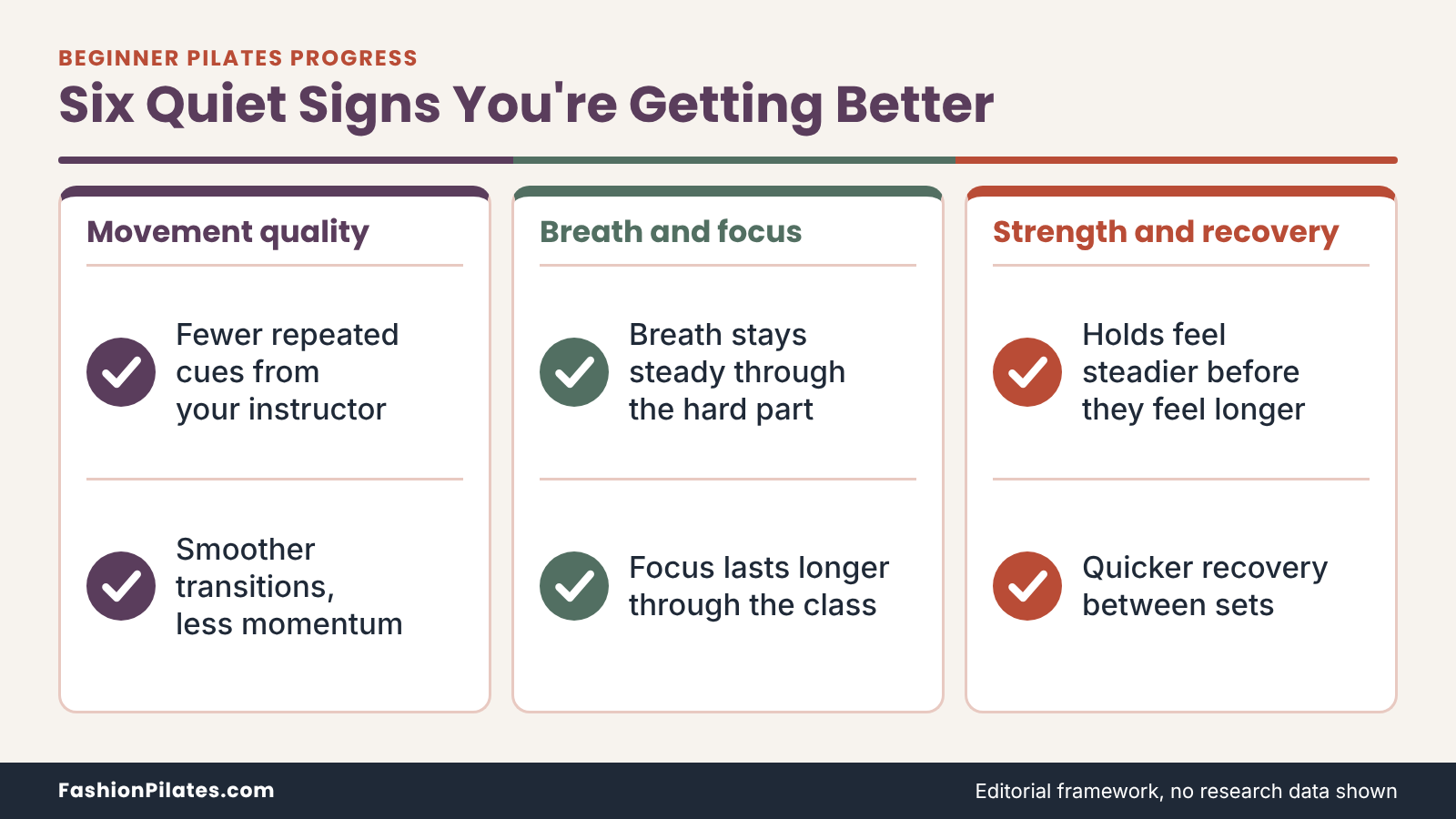
The most useful evidence of progress happens while you are on the mat or reformer. These signs are observable, free and show up well before any visible change. Think of them as three clusters: how you move, how you breathe and focus, and how your body handles effort.
Movement quality
You need fewer reminders
In your first classes, an instructor may repeat the same cue three or four times: ribs down, shoulders away from ears, tailbone heavy. A clear early sign of progress is when the reminders thin out. You might still get corrections, but they become more specific (“a little less tuck”) instead of the same basics. If you catch yourself fixing a position before anyone mentions it, that is your body learning the pattern.
Movements get smoother, not just bigger
It is tempting to measure progress by range: a higher leg, a deeper stretch, a longer reach. Smoothness is often a better early sign. Look for transitions that flow instead of lurching, a leg circle that stays even without the hips rocking, a Roll-Up (rolling up from lying to sitting one section of the spine at a time) that doesn’t rely on a swing of momentum. A smaller, steadier version of an exercise usually shows more skill than a bigger, wobblier one.
Breath and focus
Your breath stops fighting the movement
Controlled breathing is a core idea in the method; a Cleveland Clinic overview of Pilates lists concentration, precise flowing movement and controlled breathing among its guiding elements. For beginners, the first sign is usually that you stop holding your breath at the hard part. Many instructors cue breathing into the sides and back of the ribs, and that cue goes from baffling to automatic over time. You will know it is working when you can exhale through the effortful phase without the movement falling apart.
Your attention lasts longer
Early on, focus tends to scatter: you remember your arms but forget your feet, or nail the breath and lose the pelvis. Progress looks like attention that stays on the work for more of the class, with fewer moments where you suddenly realize you drifted. You will also start noticing small things, such as one side feeling different from the other or your neck taking over. Noticing is not a flaw; it is the skill you are building, and it is the raw material your instructor can work with.
Strength, stability and recovery
Holds get steadier before they get longer
A plank-style hold or a lifted-leg position that used to shake from the first second may stay calm for several breaths, even if it is not any longer in total time. That steadiness is a legitimate sign of improving control and strength endurance. Some trembling is normal when a muscle is working near its limit, and it can be a harmless side effect of any slow hold. Treat the shake as information about effort, and count it as progress when it arrives later or settles faster.
You recover faster between sets
Pay attention to the minute after a demanding sequence. If you used to need a long rest after the Hundred and now you are ready for the next exercise within a breath or two, your endurance for that work is improving. The same goes for how the rest of your day feels: ending class pleasantly tired rather than wrung out, and being ready for the next session without dread, are both signals that your workload suits you. If you are consistently exhausted or lightheaded, that is a reason to talk with your instructor, not to push harder.
Pilates Progress Beginner Checkpoints From Week 1 to Week 12
Everyone wants a timeline, and no honest one exists: people start from different places, attend different numbers of classes and learn at different speeds. What follows is an editorial map of what often happens, written for someone attending roughly two or three classes a week. If you go once a week, stretch each window; if you are building up gradually after a break, that is fine too.
Use the table as a set of conversation starters, not a pass/fail test. Missing a checkpoint tells you nothing about your potential, only about what to ask your instructor next.
| Window | What many beginners notice | A useful thing to track | Worth a conversation with your instructor if |
|---|---|---|---|
| Weeks 1 to 4 | New vocabulary, some confusion, soreness in unfamiliar spots, a few “oh, that’s what that means” moments | Whether you can set up the starting position of a few core exercises without watching someone else | You are unsure how a movement is supposed to feel, or any exercise causes sharp pain |
| Weeks 5 to 8 | Fewer repeated cues, steadier breathing, smoother transitions, less time spent figuring out what comes next | Three repeat exercises you will revisit monthly, plus notes on where effort or shaking shows up | One side always feels very different from the other, or you keep gripping with your neck or hands |
| Weeks 9 to 12 | Choices appear: staying with a base version, trying a variation, or asking to be challenged | Which exercises feel easy enough to modify, and which still need your full attention | You feel ready for more but are not sure which single change to make first |
Weeks 1 to 4: learning the language
What is normal at the start
Expect to feel a little clumsy. The names are odd, the cues are specific, and your body will find muscles you didn’t know had opinions. Soreness in new places a day or two after class is common with unfamiliar exercise, and the later section on reading soreness explains what is typical and what is not. Confusion is not a sign that Pilates is not for you; it is the cost of entry for any movement system with its own vocabulary.
What to track in the first month
Keep the bar low and concrete. Can you get into the starting position of a few foundational exercises without copying someone? Can you name where your breath is supposed to go in one of them? Do you have one exercise you actually like? Those three answers tell you more at this stage than any measure of how hard you worked. If you are choosing your first routine, a beginner-friendly session like our beginner Mat Pilates workout gives you a consistent set of movements to revisit.
Weeks 5 to 8: patterns start to settle
What often changes in the middle weeks
Somewhere in this window, many people notice that class feels shorter. That is usually a sign that you are spending less mental energy decoding instructions. You anticipate what comes next, your transitions get tidier and the cues you used to need for basic setup fade into the background. Strength and endurance may also feel different, but the more reliable signal is fluency: the work looks and feels more organized than it did a month ago.
What to track in this stretch
Pick three exercises you will see again and again, such as the Hundred, a pelvic curl (lifting the hips off the mat by peeling the spine up one segment at a time) and a leg circle. After each class, write a few words on how they felt: where the effort sat, whether the breath held up, whether one side lagged. Notes like “less neck today” or “left hip shifted again” are gold later. They turn vague impressions into patterns you can discuss with your instructor.
Weeks 9 to 12: choices begin to appear
You start deciding, not just following
By the third month, many students find the options in class become real decisions. An instructor may offer a variation, or you may notice the base version has stopped asking for much attention. That is the cue to think about what a sensible next step looks like, which a later section covers in detail. Staying with the base version is also a perfectly good choice when the quality is still improving.
Run a first review
At the three-month mark, read back through your log. Look for themes rather than dates: Which exercises feel more automatic? Which still wobble? What did you used to be confused by that now seems obvious? Then pick a single focus for the next block, such as breathing through the Roll-Up or keeping the pelvis still in leg circles. Twelve weeks is a convenient review point, not a deadline by which Pilates must have worked, and plenty of changes continue to unfold well beyond it.
How to Track Progress Without Obsessing
Tracking should make you calmer, not more anxious. The goal is a small number of repeatable observations that you can compare over months, not a daily report card. If a method makes you dread class, drop it.
A one-page log that takes two minutes
What to write after each class
Keep it short enough that you will actually do it: the date, the type of class, a 0 to 10 effort rating, one thing that felt easier than before and one thing you are unsure about. The 0 to 10 scale is the same perceived-exertion idea the Centers for Disease Control and Prevention describes, where 0 is sitting and 10 is maximum effort. Skip the urge to buy a gold-foil journal; any scrap of paper you use beats a beautiful one you don’t.
Why the “one question” line matters
The question line turns your log into a conversation tool. “Why does my right shoulder hike during the Hundred?” is something an instructor can answer in thirty seconds, while “I feel off today” is not. Over a few weeks, you will also notice that some questions disappear on their own, which is a satisfying record of progress in itself. Bring the page to class, or snap a photo of it, and ask your instructor to look at one line.
Repeatable self-checks that stay safe
Same exercise, same conditions
A self-check is only useful if you can repeat it fairly. Choose a movement you already know well, perform it at the same point in your session (for example, after the warm-up) and note qualitative things: how smooth the movement felt, whether breath and motion matched, how long before form started to slip. A simple standing option is a single-leg balance beside a counter or wall you can touch if needed. These are personal reference points, not tests with norms, so compare only with your own earlier notes.
Ground rules for any self-check
Never chase a number into discomfort. Stop if you feel sharp pain, dizziness, numbness or tingling, and talk to a clinician or qualified Pilates professional about it. Don’t test when you are unusually tired, ill or rushed, and keep a firm surface and nothing breakable nearby. If you are pregnant or postpartum, recovering from surgery, living with osteoporosis or managing an injury or chronic condition, ask a professional which self-checks are suitable before trying any.
Video and instructor feedback
Short clips beat long ones
A fifteen-second clip of the same exercise every month is one of the most honest progress records you can keep. Film from the same angle (side-on works well for spine and pelvis position) and keep the clip for your own use; you are comparing control, not performance. You may be surprised: what felt like nothing changing can look obviously steadier on screen. If filming makes you self-conscious, skip it, because the log and instructor feedback cover most of what you need.
Ask a specific question
“Am I doing it right?” invites a polite yes. “What is one thing that has changed since last month, and what should I work on next?” invites an actual assessment. Instructors see dozens of bodies a week and are well placed to compare your movement over time, particularly if you attend the same teacher regularly. If your classes are mostly online, an occasional in-person or live-coached session can fill the feedback gap; our online Pilates vs studio comparison covers how to weigh the two.
If you want the options above side by side, this table compares them by what each shows, how often to use it and what to watch for.
| Method | What it shows well | How often | Watch out for |
|---|---|---|---|
| Two-minute class log | Patterns in effort, confusion and what feels easier | After each class | Turning it into a chore; keep it to five lines |
| Repeat-exercise notes | Fluency and control in the same three exercises | Weekly notes, monthly review | Comparing with a good day versus a tired one |
| Short side-on video clip | Visible steadiness, pelvis and rib position, transitions | Monthly | Judging appearance instead of control |
| Instructor check-in | Expert comparison of how you move now versus before | Every four to six weeks | Vague questions that get vague answers |
| Effort rating (0 to 10) | Whether the same work feels less demanding over time | After each class | Rating comfort or mood instead of effort |
Reading Soreness, Fatigue, and Effort
Beginners often ask whether feeling sore means it is working, or whether feeling nothing means it is not. Neither is a reliable verdict. What matters is learning to tell ordinary training effects from signals that deserve attention.
Normal soreness versus signals to stop
What delayed-onset soreness looks like
Delayed-onset muscle soreness, usually shortened to DOMS, is the achy tenderness that arrives after unfamiliar exercise. Cleveland Clinic explains that it starts one to three days after a workout and usually lasts a few days, rarely more than five. The NHS Inform guidance gives a similar window of two to five days. Slow, controlled Pilates can still produce it, especially in muscles you haven’t used this way before, such as the deep abdominals, inner thighs or the muscles around the shoulder blades.
Signals that mean stop or get checked
Soreness fades a little more each day and doesn’t stop you from moving. Different signs call for a different response. Stop the exercise if you feel sharp pain, dizziness, numbness or tingling, and tell your instructor. Cleveland Clinic lists pain that is sharp and constant, severe swelling, unusually dark urine, pain lasting longer than a week, or discomfort that limits your movement as reasons to see a health care provider. NHS Inform similarly advises seeking help if pain lasts beyond five days or gets worse.
This table pairs common sensations with a sensible first response, and it is a general reference rather than a diagnostic tool.
| What you notice | Often consistent with | Sensible first response |
|---|---|---|
| Dull ache in worked muscles one to three days later | Delayed-onset soreness after unfamiliar exercise | Move gently, note it in your log, and mention the area to your instructor |
| Trembling during a long hold | A muscle working near its limit | Shorten or modify the hold, and note when the shaking starts |
| Sharp, pinching or constant pain during a movement | A signal to stop that movement | Stop, tell your instructor, and see a clinician if it lingers |
| Dizziness, numbness or tingling | Something that needs qualified advice | Stop, rest, and get professional guidance before repeating the exercise |
| Soreness that lasts beyond about a week or keeps worsening | Not typical post-exercise soreness | Contact a health care provider |
Effort scales: the talk test and the 0 to 10 rating
What public-health guidance says
The Centers for Disease Control and Prevention describes two simple ways to gauge intensity. The talk test says a person doing moderate-intensity aerobic activity can talk but not sing, while vigorous activity leaves you unable to say more than a few words without pausing for breath. The 0 to 10 scale puts sitting at 0 and maximum effort at 10, with moderate effort around 5 to 6 and vigorous effort starting around 7 to 8.
Using the scales in a Pilates class
Those scales were designed with aerobic activity in mind, so treat them as rough tools here. Pilates breath cues, such as exhaling through the hardest part, make the talk test awkward, and a slow, controlled hold can feel very demanding without raising your heart rate much. The 0 to 10 rating works better as a personal comparison: if the same sequence used to feel like a 7 and now feels like a 5, your capacity for that work has probably grown. Compare yourself with yourself, not with the person on the next mat.
When to check with a professional first
Situations that call for clearance
Cleveland Clinic’s Pilates overview advises speaking with a doctor before starting, particularly with chronic conditions, existing injuries or recovery from surgery. The same caution applies to pregnancy and postpartum, osteoporosis, and any acute injury. A clinician or Pilates professional can help you pick which movements suit you now, and what “progress” even means for your situation, which may be quite different from the average beginner’s.
What to tell your instructor
Before class, mention anything that could change what you should do: surgeries, injuries, pregnancy, conditions that affect balance or bone density, or anything that has been painful in the past. Plain language is fine. A good instructor will offer modifications without making a fuss, and you can ask them to flag any exercise they think needs a different approach for you. If they seem dismissive of a concern, that is a reason to look for a different teacher, not to stay quiet.
When and How to Make Exercises Harder
Progress is not only something you notice; it is something you act on. The skill is knowing when a movement has earned a change and choosing a change that doesn’t wreck the quality you just built.
Signs an exercise is ready to get harder
Quality holds up when you are tired
The best test is the last few repetitions. If your alignment, breath and control stay intact through the end of a set, the exercise may be ready for a change. Harvard Health’s strength-training tips put form ahead of load and suggest increasing resistance gradually once exercises become easier. Mayo Clinic’s strength training overview makes the same point in simpler words: when you can easily do more repetitions, add resistance gradually.
Your log and your instructor agree
Two independent signals are better than one. If your effort rating for an exercise has drifted down over several weeks and your instructor has started offering you a variation, those are strong hints. If only one of them is true, wait. Feeling ready is useful information, but form that someone else can see is better evidence than confidence alone, especially in the first few months when your internal sense of position is still being calibrated.
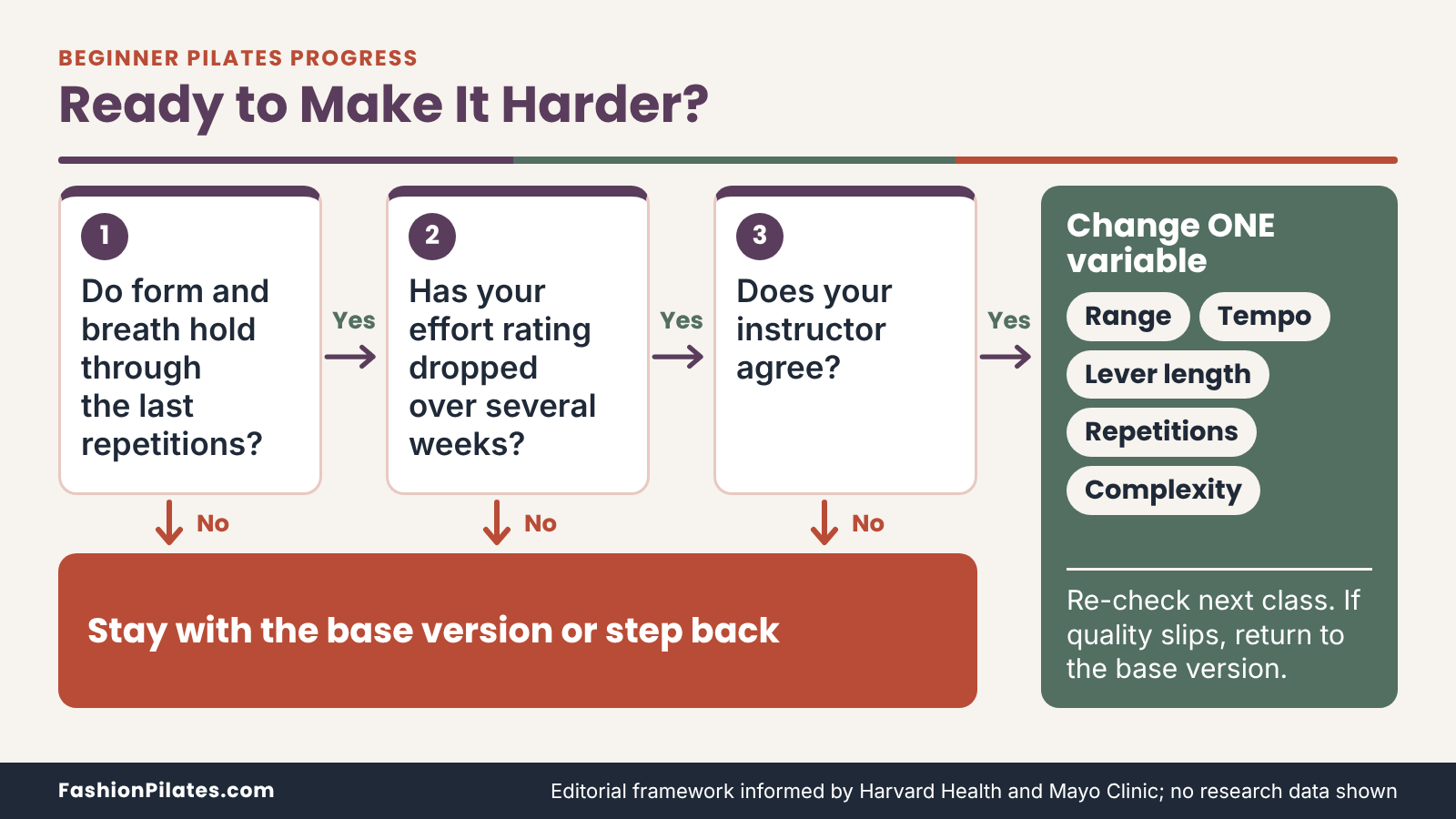
Ways to change difficulty, one variable at a time
Range, tempo, lever length and repetitions
Pilates exercises can be made harder in several ways, and each should be changed on its own. You might enlarge the movement slightly, slow the tempo, lengthen a lever (straightening a bent leg, for example), or add a breath or two to a hold. Changing three things at once makes it impossible to tell what went wrong when control slips. If your leg circles start to rock the pelvis after you make them bigger, shrink them back and own the smaller version a bit longer.
Resistance, springs and props
On a reformer, spring resistance is not standardized across brands, so a spring setting that is light in one studio may feel different in another. Follow your instructor and the manufacturer’s manual rather than copying a number from a video or a friend. On the mat, small props or light hand weights are available, but your own body weight already offers plenty of options. If a thin or slippery mat is undermining your stability, that is a gear problem rather than a skill problem, and our guide to choosing a Pilates mat covers it.
The table below lines up the six most common ways to add challenge, so you can pick one and know when to avoid it.
| Variable | Example change | Best when | Avoid if |
|---|---|---|---|
| Range | Slightly larger leg circles | Control is steady at the current size | The pelvis rocks or the ribs flare |
| Tempo | Slower lowering phase | You notice yourself using momentum | You start holding your breath |
| Lever length | Straighter legs in a lying exercise | The bent-knee version feels easy and calm | The neck or lower back takes over |
| Repetitions or hold time | One or two extra breaths in a hold | Form lasts through the final repetitions | Shaking is joined by sharp or pinching discomfort |
| Resistance (springs, props) | A modest increase as your instructor directs | Your teacher agrees and your control is clear | You are guessing from another studio’s settings |
| Complexity | Adding an arm pattern to a leg exercise | The base pattern runs on autopilot | You are still thinking about the basics |
When to stay put or step back
Staying with the base version is a choice
There is no prize for the fanciest Roll-Up in the room. If the base version is still improving, still occasionally wobbly or still teaching you something, it has more to give. Many instructors encourage students to keep refining the foundational exercises for a long time, because a clean basic movement carries over to everything else. Moving on when you are simply bored is a separate decision from moving on when you are ready, and your instructor can help you tell the difference.
Stepping back is a tool, not a failure
Tired days, illness, a long break or a stressful week can all make a familiar exercise feel harder than it did last month. Dropping to an easier version on those days is smart pacing, and it protects the quality you have built. If a step back is needed because something hurts, that is a different situation: stop the exercise, tell your instructor, and check with a clinician if the pain persists or returns.
What the Research Says (and Doesn’t)
Pilates attracts a lot of confident claims. A few careful sources are more useful than a pile of enthusiastic ones, and they also show why your own observations matter.
What a systematic review found in healthy adults
The 2011 review of healthy people
A systematic review in Archives of Physical Medicine and Rehabilitation by Cruz-Ferreira and colleagues looked at sixteen studies of Pilates in healthy people. The authors reported strong evidence that Pilates improved flexibility and dynamic balance, and moderate evidence for improved muscular endurance. Those categories line up loosely with the in-class signs from earlier: steadier holds, smoother movement and quicker recovery are the everyday versions of balance and endurance.
How to read its limits
The same review points out that the quality of the included studies was low overall, with scores of 3 to 7 on the 10-point PEDro scale, averaging about 4. Its searches ended in 2011, so newer trials are not covered, and the authors noted that the evidence applied at least to the end of training, leaving open what happens afterward. In plain terms: the findings are encouraging and worth knowing, but they are not a guarantee of any particular result for you.
What research can’t tell you about your own progress
Group averages are not personal forecasts
A study might find that a group improved on average. That says little about whether you, with your history, schedule and class type, will improve by a specific amount in a specific number of weeks. Some people in any trial improve a lot, others barely at all. This is another reason to measure yourself against your own earlier notes instead of against an advertised timeline.
Appearance, weight and pain are not covered here
This guide doesn’t make claims about weight, body shape or pain relief, because the research on those outcomes is mixed, depends heavily on the population, and shouldn’t be reduced to a beginner checklist. If one of those is your main reason for starting, set expectations with a qualified clinician and your instructor. Meanwhile, progress in control, breath, steadiness and confidence is a perfectly legitimate result on its own terms.
How general activity guidelines frame your week
What the Centers for Disease Control and Prevention recommends
The CDC’s adult physical activity guidelines call for 150 minutes of moderate-intensity activity a week, or 75 minutes of vigorous activity, plus two days of muscle-strengthening activity that works all the major muscle groups. The same page stresses that some activity is better than none. These are general targets for adults, not Pilates-specific prescriptions, and they are minimums rather than ceilings.
Where Pilates may fit
Depending on the class, Pilates may count toward muscle-strengthening time, but a gentle class won’t necessarily provide much aerobic activity. Cleveland Clinic’s overview quotes an expert suggesting Pilates three to five times a week as part of a well-rounded routine that still includes cardio and upper-body strength work. For a beginner, the best schedule is the one you can repeat without dreading it, so two sessions a week that actually happen beat five that never do. Our Pilates for beginners guide explains how to build a first routine.
To keep the evidence in perspective, this table sums up each source and where its usefulness for your own progress runs out.
| Source | What it reports | Limit for a beginner’s progress |
|---|---|---|
| Systematic review of Pilates in healthy people (2011) | Strong evidence for flexibility and dynamic balance, moderate for muscular endurance, across sixteen studies | Low study quality, older search date, results shown at least to end of training |
| CDC adult activity guidelines | 150 minutes of moderate activity and two days of muscle strengthening per week | General adult targets, not specific to Pilates |
| CDC intensity measurement page | Talk test and 0 to 10 effort scale | Built around aerobic activity; rough in slow Pilates work |
| Cleveland Clinic and NHS Inform soreness pages | Typical soreness timeline and signs that call for medical advice | General guidance, not an assessment of your situation |
| Cleveland Clinic Pilates overview | Guiding elements of the method, practice frequency suggestion, advice to consult a doctor | Expert overview, not trial data |
Common Mistakes and Plateaus
Even attentive beginners hit a stretch where nothing seems to change, or where they sabotage the progress they are making. Both are normal and fixable, and most of the fixes involve doing less guessing rather than more effort.
Mistakes that hide real progress
Comparing your mat to someone else’s
Every body in the room has a different history, proportions, and number of years behind it. The person who floats through a Teaser (a V-shaped balance where legs and torso lift together) may have trained for a decade or may simply have levers that make it easier. Comparison tells you almost nothing about your own trajectory. Your earlier notes, your own video clips and your instructor’s observations are the only fair benchmarks.
Chasing range or intensity instead of control
Higher legs, bigger reaches and faster tempos look like progress, but they often cost the quality that made the exercise worthwhile. Warning signs include using momentum, holding your breath, hiking the shoulders toward the ears or losing the position of the pelvis. When in doubt, take a smaller version that you can control. You can always make it bigger next month, and a precise small movement is easier to build on than a sloppy large one.
Troubleshooting a plateau
Check consistency and recovery first
Before assuming you have hit a wall, look at the boring stuff: how often you actually attended, whether the last few weeks were unusually stressful, and whether you are recovering between sessions. Harvard Health’s strength-training tips suggest giving muscles at least 48 hours between strength sessions, which matters if Pilates sits on top of other strength work. Irregular attendance can make every class feel like starting over, which is easy to mistake for lack of progress.
Change one thing and wait
If consistency looks fine, make a single adjustment and give it two to three weeks. Ask your instructor for one new cue, try a different class format or add a short plan with a clear focus; a 30 day Pilates challenge can work as a menu of ideas as long as you do not treat it as a test. Resist the urge to overhaul everything at once, because you will not know what helped. Plateaus are a normal part of learning, and they often end with a sudden “oh, that finally clicked” moment.
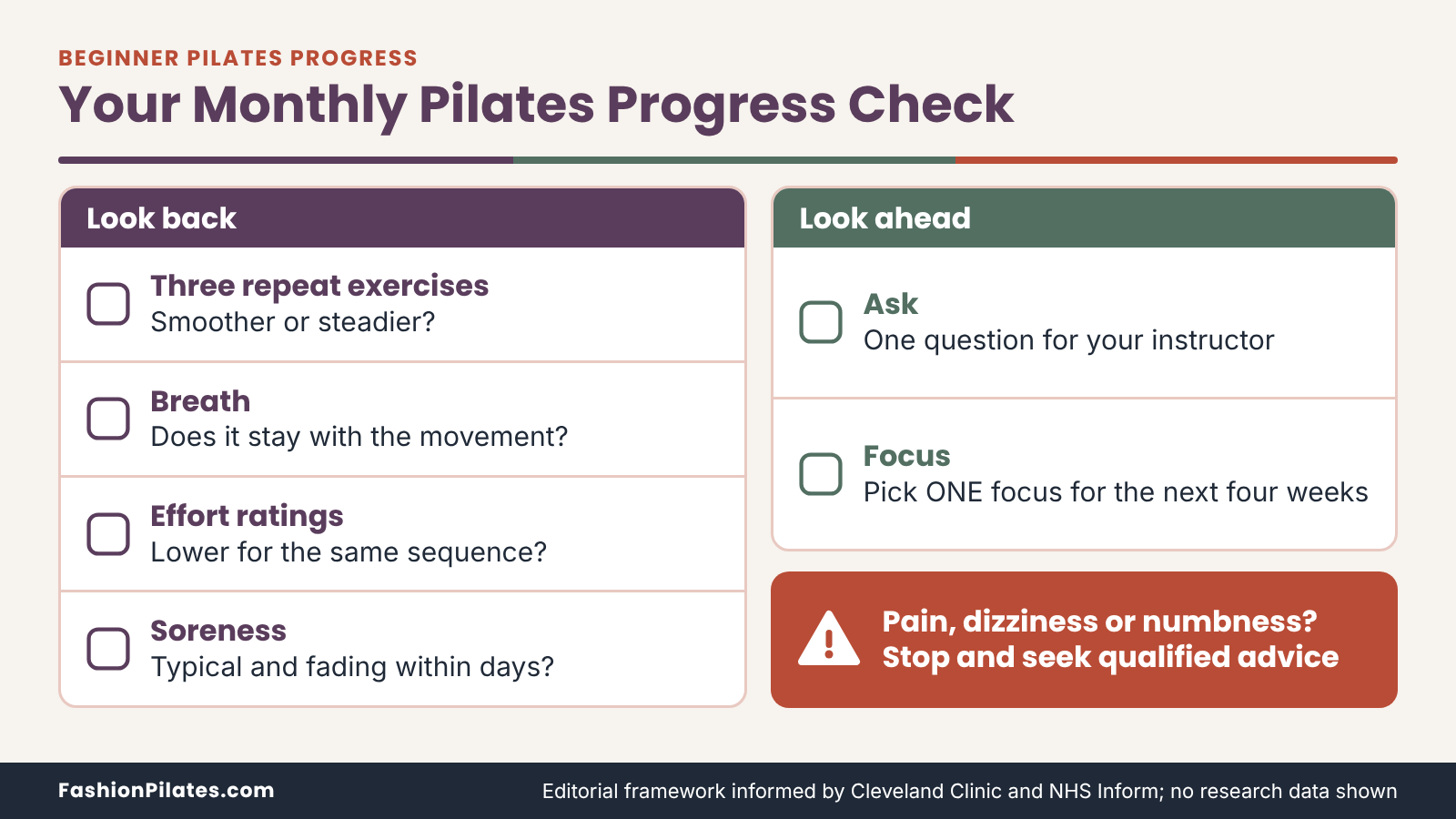
Working With an Instructor and Planning Your Next Three Months
Your instructor is the closest thing to a progress instrument that Pilates offers, and your log is how you make the most of one. This last section covers how to use both, and how to turn a few months of observations into a plan.
Getting useful feedback
Questions worth asking
Specific questions get specific answers. Try asking which one habit you could change to improve the most, which exercise has changed the most since you started, and whether anything about your setup or alignment looks different from last month. You can also ask whether a particular exercise should stay in its base form for now. Instructors generally appreciate students who want to understand the reasoning behind a cue, and a thoughtful question is also a sign of engaged progress.
Finding a qualified teacher
If your current class doesn’t give you much individual attention, consider adding a small-group session or a private lesson now and then. The Pilates Method Alliance describes accreditation programs for teacher training in mat, reformer and comprehensive work, and offers a membership directory for finding credentialed professionals. Credentials are not a guarantee of a good fit, so notice whether a teacher watches you, explains clearly and respects your limits. If you are curious about equipment-based classes, our explainer on what a reformer is is a good next read.
Setting your next goals
Process goals beat outcome goals
“Attend two classes a week for the next month” and “keep my breath steady through the Roll-Up” are goals you control. “Look different by spring” is not, and it can leave you feeling like a failure when you are in fact improving. Process goals also match what the research and guidelines can support, since the sources above are about activity and function rather than guaranteed outcomes. Pick one or two goals at a time, and write them at the top of your log.
A simple three-month frame
One workable structure is to spend the first month consolidating, using the same routine and noticing what gets easier. In the second month, choose one exercise and one variable to adjust, following the single-change approach described earlier. In the third month, review your notes, compare your video clips and set the next block of goals with your instructor. For more help structuring the early weeks, see the Pilates for Beginners category hub.
Frequently Asked Questions
How long does it take to see progress in Pilates as a beginner?
There is no single timeline, because progress depends on how often you attend, what you did before and what you are measuring. Many beginners notice changes in coordination and breathing within the first several weeks, while strength and endurance changes tend to take longer to feel. Research on Pilates in healthy adults is encouraging but varies in quality, so no study can promise a date. A better approach is to compare your own notes every four to six weeks and look for small shifts in control and effort.
How do I know Pilates is working if I am never sore?
Soreness is a poor yardstick, because it depends on how unfamiliar the work is and how your body responds, not on how effective the class was. Look instead for steadier holds, smoother transitions, quieter breathing and fewer repeated cues from your teacher. Lower effort ratings for the same sequence are another useful sign. If you never feel challenged at all, ask your instructor about changing one variable at a time.
Is it normal to shake during a Pilates hold?
Trembling is common when a muscle is working near its limit, especially in slow, controlled positions. It is not usually a sign that something is wrong. Notice when it starts, and see whether it arrives later or settles faster as weeks go by. Ease off or shorten the hold if the shaking comes with sharp pain, dizziness, numbness or loss of control, and tell your instructor.
How often should a beginner do Pilates to improve?
The best frequency is the one you can keep up without dread, and for many beginners that means two or three sessions a week. Public-health guidance for adults suggests at least two days of muscle-strengthening activity per week, plus regular aerobic activity, so Pilates may be one part of a wider routine. One medical center overview quotes an expert suggesting three to five sessions a week for those who want more. Build up gradually and watch how you recover between classes.
Should I make my exercises harder every week?
No, because a steady rhythm of consistent practice matters more than constant escalation. Make an exercise harder only when your form and breath hold up at the end of a set, your effort ratings have dropped over several weeks and your instructor agrees. Change a single variable at a time, such as tempo or range, so you can tell what helped. If control slips, return to the previous version without any embarrassment.
Can I track Pilates progress with body measurements or photos?
You can, but measurements are a narrow view of what Pilates changes and they are easy to over-interpret. Changes in weight or body shape depend on many factors outside of class, and this article does not promise them. Many people find that function-based notes, such as steadier balance or easier breathing, feel more useful and less stressful. If body composition is a goal, discuss it with a qualified clinician so your expectations are realistic.
What should I do if I feel stuck after a month?
One month is early, and learning curves in coordination-heavy activities are rarely smooth. Start by checking attendance, rest and whether you are actually repeating the same exercises long enough to notice change. Then ask your instructor for one specific cue and try it for two or three weeks before judging. If you still feel stuck after that, a different class format or a private lesson may help.
When should I talk to a doctor about soreness after Pilates?
Typical post-exercise soreness starts a day or two after class and fades within about five days. Contact a health care provider if pain is sharp and constant, if swelling is severe, if your urine turns unusually dark, or if the discomfort lasts longer than a week or limits your movement. Stop exercising right away if you feel dizziness, numbness or tingling during class. Tell your instructor about any recurring pain so they can adjust your program.