
Direct answer: A workable pilates travel plan is seven short floor sessions of 10 to 25 minutes, drawn from a small menu of quiet, mat-style exercises that fit in roughly the footprint of a bath towel. Start with a gentle reset on day one, build to a fuller session around day five, and keep at least one day deliberately light. No equipment is required, and every session below has a shorter fallback for the days when the trip wins.
This guide is for anyone heading out for a week of work, family, or vacation who wants a routine that survives a hotel room: limited floor, thin walls, an unpredictable schedule, and a body that spent yesterday in a car seat or an airplane seat. It is general fitness education, not individualized medical advice, so the safety section matters as much as the exercises. If you are specifically trying to manage a long flight or an everyday posture habit while moving around, we cover those separately in Pilates airline travel mobility and Pilates travel posture.
What a Travel Plan Has to Do
A home routine assumes a reliable mat, a reliable schedule, and a door you can close on the laundry. Travel removes all three. Before choosing a single exercise, it helps to be clear about what a good plan is actually solving, because that decides what goes in and what stays out.
Why Travel Breaks Routines
Most people don’t skip movement on trips because they stop caring. They skip it because the usual scaffolding disappears. The plan below is built around the three things that tend to fail first.
The three constraints: space, time, and energy
Space is the obvious one. A typical hotel room offers a strip of floor between the bed and the desk, sometimes two feet wide, sometimes less once a suitcase is open. Time is the second: a day of meetings, sightseeing, or relatives rarely leaves a clean 45-minute window. Energy is the sneaky third, because travel days are tiring in a way that doesn’t show up on a calendar. A plan that ignores any of these gets abandoned by day three, so this one caps most sessions at 20 minutes, keeps every position within a footprint of about 6 by 2.5 feet (1.8 by 0.8 meters), and gives every day a lighter fallback.
What the activity guidelines make room for
The CDC’s adult guidance lists a weekly target of 150 minutes of moderate-intensity activity plus at least two days of muscle-strengthening work, and notes that the time can be spread across the week rather than done in one block. The federal Physical Activity Guidelines for Americans go further: the second edition removed the old 10-minute minimum, so shorter bouts of movement count. That is useful permission for a hotel week. A 12-minute session in your room and a long walk to dinner both belong in the same tally, and this plan assumes you’ll pair its floor work with ordinary walking rather than treating Pilates as your only activity.
What Pilates Can and Cannot Do in a Hotel Room
Pilates travels better than most exercise styles, partly because the original method was built around controlled bodyweight work on a mat. It also has real limits on the road, and naming them keeps expectations sane.
Mat-style work needs very little
Victoria’s state health service describes Pilates as exercises inspired by calisthenics, yoga, and ballet, with an emphasis on controlled movement, breathing, and core strength, and it notes that mat-based work uses body weight and gravity for resistance while equipment-based work uses spring-loaded machines. That’s the good news for travelers. Everything in this plan belongs to the first category: slow, precise movements where the resistance is your own limbs and the quality of each repetition matters more than the count. If you’d like a longer, more detailed mat session once you’re home, our beginner Mat Pilates workout picks up where this plan leaves off.
The honest limits, and how this guide was built
A hotel floor is not a reformer, and there is no instructor watching your ribcage. Without springs, you can’t add resistance gradually, and without feedback, small form drifts go uncorrected. This guide is a research-based, expert-informed editorial plan assembled from public health guidance, published exercise descriptions, and category knowledge; it has not been hands-on tested by our team in hotel rooms. The exercises are deliberately conservative for that reason. If you already work with a Pilates professional, ask them which of these movements suit your body, and treat their advice as the tiebreaker whenever it differs from ours.
Setting Up a Hotel Room or Small Space
Ten minutes of thought before you unpack saves a week of awkward floor work. The goal is a repeatable spot you can claim in under a minute, with a surface that won’t slide, flex, or embarrass you in front of the room below.
Reading the Room
Every room has one workable patch of floor, and it’s rarely where you’d guess. Find it on arrival, then use it all week so setup stays automatic.
Measuring your footprint
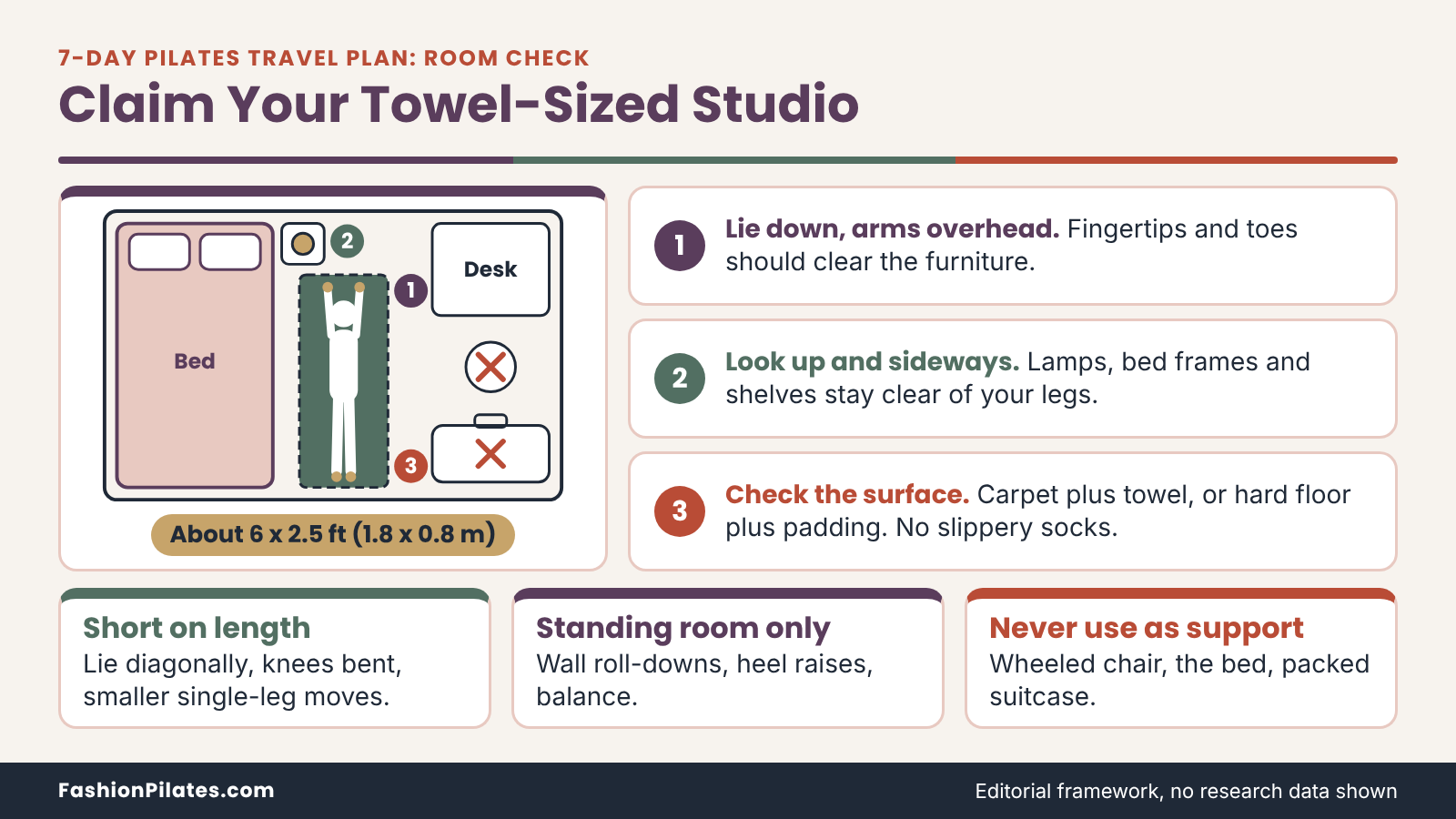
Lie down on the floor beside the bed with your arms overhead and see whether your fingertips and toes clear the furniture. Most of the plan needs a rectangle of about 6 feet by 2.5 feet, which is also the size of a standard bath towel laid lengthwise with a little room on each side. If the gap is narrower, rotate to lie diagonally, or drag the desk chair out of the way. Check overhead too: lamps, bed frames, and low shelves become real hazards when you lift your legs to tabletop. The table below turns the measurements into a quick decision.
| Floor space you have | What fits comfortably | How to adapt the plan |
|---|---|---|
| About 6 by 2.5 feet (1.8 by 0.8 m) or more | Full lying, side-lying, hands-and-knees, and seated work | Follow the plan as written. |
| Wide enough to lie down, too short for full leg extension | Lying work with bent knees; side-lying and hands-and-knees work | Lie diagonally, or keep legs bent and use the smaller single-leg variations. |
| Standing room only (about 3 by 3 feet, or 0.9 by 0.9 m) | Standing roll-downs, heel raises, balance work, side bends | Use the standing blocks on days 3, 6, and 7 on every day instead. |
| Shared room, no clear floor | Seated and standing mobility only | Use the 8-minute fallback in the adapting section, or move the session to a hallway, balcony, or the gym if one exists. |
Floor surface, noise, and the neighbor downstairs
Carpet is usually the best case: forgiving under the spine and quiet. Hotel carpet has also seen things, so layer a clean towel (or a travel mat, if you packed one) between you and the floor. Hard floors such as tile or wood are fine for mat-style work, but you’ll want extra padding under the knees and tailbone, and you’ll want to watch for slipping, especially in socks. Most of this plan is quiet by design because Pilates movements are slow and controlled, but anything that involves lifting legs and lowering them should be lowered gently. A guest below you will notice a thud long before they notice any good intentions.
What to Bring, and What to Leave Home
The plan is fully doable with zero equipment. Anything you pack should earn its suitcase space by solving a specific problem on the road.
A minimal kit that earns its space
The sensible kit is short: a bath towel (your own, or a spare from the room), a folded second towel or small pillow for padding under your head or hips, and non-slip socks or bare feet for standing work. A folding or ultra-thin travel mat is a reasonable luxury if you travel often, and the questions that matter there are thickness, grip, and weight rather than brand; our guide to a best Pilates mat under $100 walks through those criteria for the physical product. A light resistance loop or band is optional and adds variety on a few lower-body exercises, but nothing here requires one, and bands should be checked for nicks before every use.
Hotel-room substitutes and what to avoid
A wall works as a balance reference and a roll-down guide. A sturdy desk edge can support one hand during standing leg work, provided it’s heavy and fixed in place. Pillows can pad knees and support your neck during head-lifted work. What not to use: a wheeled desk chair for support, the bed as an exercise surface (it moves, and your spine won’t thank you for the instability), a half-packed suitcase as a step or prop, or any furniture that shifts when you lean on it. If you’re unsure whether something is stable, assume it isn’t and use the wall.
Safety, Screening, and Effort
Exercise on the road deserves slightly more caution than exercise at home. You’re tired, you’re in an unfamiliar room, and the usual cues from your own mat and your own instructor are missing. A few ground rules keep a good plan from becoming a bad week.
Who Should Check First
Gentle floor work is suitable for many people, but not everyone should start a new routine without a conversation first. Two groups of conditions are worth separating: those that call for a professional check before you begin, and those that are specific to traveling.
Situations that call for a professional check
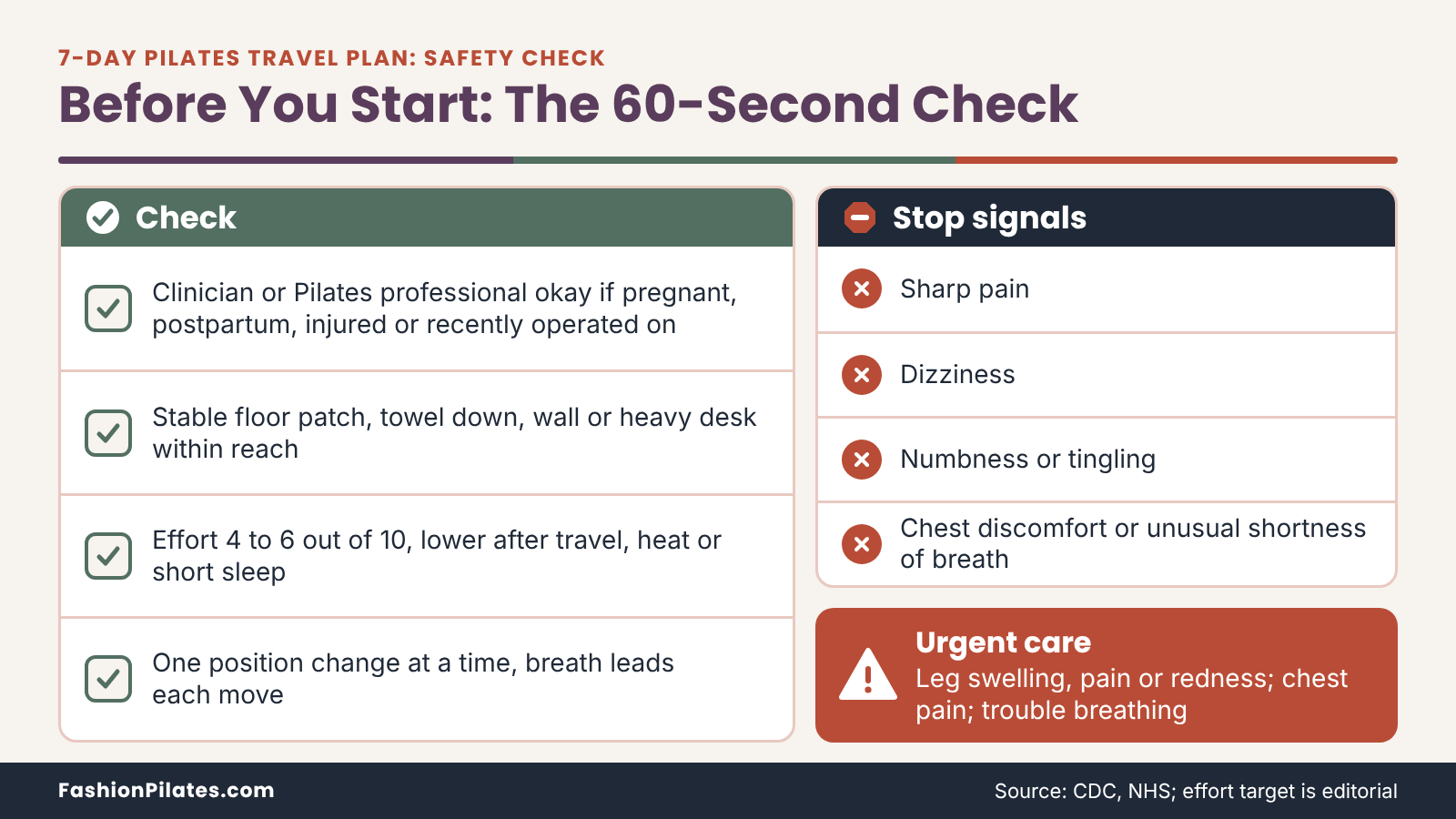
The NHS advises talking to a healthcare professional before starting Pilates if you have a health condition, an injury, or a recent medical event, if you’re pregnant or postpartum, or if you simply aren’t sure whether your fitness level is a match. Better Health Victoria’s overview adds recent surgery, musculoskeletal injuries, and long periods of inactivity to the list of reasons to get screened first (see the NHS beginner guidance). People with osteoporosis or low bone density should also ask a clinician or Pilates professional which spinal flexion, rounding, and twisting movements are appropriate, since several exercises below involve those actions. If any of this applies, use the plan as a conversation starter with your clinician rather than a prescription.
Travel-specific cautions
Long trips add their own considerations. The CDC’s travel health page on blood clots lists higher-risk groups that include people with a previous clot, recent surgery, pregnancy, estrogen-containing contraceptives, cancer, and certain other conditions, and tells travelers to seek urgent medical care for leg swelling, pain, or redness, or for chest pain, trouble breathing, or coughing up blood. Gentle movement is part of the usual travel advice, but if you arrive with a swollen, painful, or reddened calf, that is a reason to call a clinician, not to exercise it off. For flight-day specifics, see Pilates airline travel mobility.
Stop Rules and How Hard to Work
Knowing when to quit, and how hard to push when you don’t, matters more in a hotel room than anywhere else. Nobody is grading you, and there’s no instructor to make the call for you.
Clear signals to stop
Stop an exercise and rest if you feel sharp or pinching pain, dizziness or lightheadedness, numbness or tingling, chest discomfort, unusual shortness of breath, nausea, or strain in the neck rather than the abdomen. The NHS tells exercisers to stop at once if pain or illness develops and to seek advice if symptoms persist, and a hospital physiotherapy leaflet from the Wirral University Teaching Hospital NHS Foundation Trust puts the same idea more gently: some discomfort can be normal, but avoid pushing into pain and contact a clinician if pain lingers. Muscle effort and a mild shake in a held position are expected. Pain is something else.
Setting an effort level you can repeat
Use a simple 10-point scale where 1 is lying still and 10 is the hardest effort you could possibly give. Most sessions in this plan should sit around 4 to 6: you can talk in short sentences, your form stays tidy, and you finish feeling like you could do a little more. Travel adds hidden loads such as dehydration, heat, short sleep, and altitude if your destination is high up, any of which can make the same movement feel harder. On those days, drop a point or two and consider it a successful session. A plan that feels slightly easy and gets done seven times beats a hard one that gets done twice.
The Exercise Menu
Instead of memorizing seven different routines, learn about twelve movements and reuse them in different combinations. Each one below includes the starting position, the action, a breathing cue, and an easier option. Move slowly, and do only one action at a time.
Breath, Pelvis, and Trunk Work
These are the movements that open every session and carry most of the plan’s abdominal work. They are also the quietest, which makes them good first choices on a tired night.
Breathing and pelvic control
Three simple movements begin nearly every session.
- Ribcage breathing: lie on your back, knees bent, feet flat and hip-width apart, with your hands resting on the sides of your lower ribs. Inhale through your nose for about three seconds and feel the ribs widen into your hands, then exhale slowly through softly pursed lips and feel them draw back in. Do five to eight breaths.
- Pelvic tilt: from the same position, exhale and gently tip your tailbone toward the floor so your lower back flattens lightly, then inhale and return to a relaxed neutral. Do eight slow repetitions, keeping your feet and shoulders heavy.
- Bent-knee fallout: exhale and let one knee open to the side only as far as your pelvis stays level, then inhale and bring it back. Do six per side. If your pelvis rolls, shorten the range.
Hospital exercise leaflets, including the NHS physiotherapy handout above, include both bridge and bent-knee fallout among foundation Pilates exercises, which fits their role as warm-up material here.
Abdominal work: Hundred prep, single-leg stretch, toe taps
These three build in order of difficulty, and you can stop at the first one on a short day.
- Toe taps: lie on your back and lift one knee at a time to tabletop (knees over hips, shins parallel to the floor). Exhale as you lower one set of toes toward the floor, inhale as it returns. Do six per side, keeping your lower back steady rather than arching.
- Hundred prep: from tabletop or with feet on the floor and your head resting down, lift your arms an inch or two and pump them in small, quick beats. Inhale for five beats, exhale for five, and repeat for five cycles (50 beats). The classic Hundred runs ten cycles with head and shoulders lifted, so treat this as the entry version, and rest your head if your neck takes over.
- Single-leg stretch: Pilates Anatomy by Rael Isacowitz and Karen Clippinger, in an excerpt published by Human Kinetics, describes drawing one knee in while the other leg extends, switching with breath, five repetitions per leg, while keeping the trunk steady and lower back controlled. A beginner variation keeps the bent knee thigh just past vertical with both hands on the knee. Start with your head down and add the head-and-shoulder lift only when your neck feels comfortable.
Spine, Hips, Shoulders, and Legs
The second half of the menu covers mobility and strength: gentle spinal movement in several directions, plus the glute, hip, and back work that helps after sitting in transit.
Spine mobility and stretches
These quiet movements work well after travel days and as cool-downs.
- Cat-cow: on hands and knees, hands under shoulders, knees under hips. Exhale and round your spine gently from the tailbone, inhale and lengthen forward through the crown. Six slow cycles.
- Thread the needle: from hands and knees, slide one arm under your chest and rest your shoulder and ear on the floor, exhaling as you rotate. Hold three to five breaths per side. Keep hips roughly over knees, and place a pillow under the shoulder if the reach feels strained.
- Seated spine twist: sit tall on a folded towel with legs crossed or extended, arms crossed over your chest. Inhale to grow tall, exhale to rotate from the middle of your back, return on the next inhale. Four per side.
- Mermaid side bend: sit cross-legged, place one hand on the floor beside you and sweep the other arm overhead, bending sideways on the exhale. Four per side.
- Wall roll-down: stand with your heels a few inches from a wall, knees soft, back to the wall. Nod your chin, roll down slowly from the head, hands sliding toward your shins, and stack back up on an inhale. Five repetitions.
Strength for hips, back, and legs
Strength work is where a quiet hotel session earns its keep, since most of it is slow and low in volume.
- Spine curl (bridge): lying with knees bent and feet hip-width, exhale to tilt the pelvis and peel your hips up one segment at a time to a long diagonal from shoulders to knees. Inhale at the top, exhale to roll down. Six to eight repetitions. A smaller lift is a legitimate version.
- Clam: lie on your side with knees bent and hips stacked, head on your arm. With feet together, lift the top knee without rolling the pelvis back, then lower. Ten per side.
- Side kick (small range): in the same side-lying position, extend both legs slightly forward of your torso, lift the top leg to hip height, swing it forward a short way, then back without arching your lower back. Eight per side.
- Breaststroke prep: lie face down with forehead on stacked hands. Exhale to lift your head and upper chest a few inches, drawing the ribs gently forward, then lower. Five to six repetitions, skipped if lying face down is uncomfortable or you’re pregnant.
- Forearm plank: with forearms down, elbows under shoulders, hold a straight line from head to knees (knees down) or heels (knees lifted) for 15 to 20 seconds. Exhale steadily and stop if your lower back sags.
- Standing heel raises, small squats, one-leg balance: twelve slow heel raises, eight to ten partial squats with arms forward, and 20 seconds of balance on each leg near a wall.
The table below collects the whole menu in one place, with the footprint each movement needs and who should modify or skip it.
| Exercise | Position and footprint | Noise | Easier option | Modify or skip if |
|---|---|---|---|---|
| Ribcage breathing | Lying, small | Silent | Seated in a chair | Breathlessness or dizziness occurs |
| Pelvic tilt and fallout | Lying, small | Silent | Smaller range | Pelvic or hip pain |
| Toe taps | Lying, small | Low | Heel slides | Lower back strain |
| Hundred prep | Lying, small | Low | Feet on floor, head down | Neck strain, pregnancy, recent abdominal surgery |
| Single-leg stretch | Lying, medium | Low | Head down, hands on knee | Neck or lower back pain |
| Cat-cow and thread the needle | Hands and knees, medium | Silent | Pillow under knees or shoulder | Wrist or shoulder pain |
| Seated twist and side bend | Seated, small | Silent | Sit on a chair | Osteoporosis, until cleared |
| Spine curl | Lying, small | Low | Smaller lift | Recent back or hip surgery |
| Clam and side kick | Side-lying, medium | Low | Clam only | Hip pain on the lying side |
| Breaststroke prep | Face down, medium | Silent | Smaller lift | Pregnancy, back pain |
| Forearm plank | Face down, medium | Silent | Knees down, 10 seconds | Shoulder or wrist pain |
| Standing balance work | Standing, small | Silent | Two hands on a wall | Dizziness or unsteadiness |
The 7-Day Plan, Day by Day
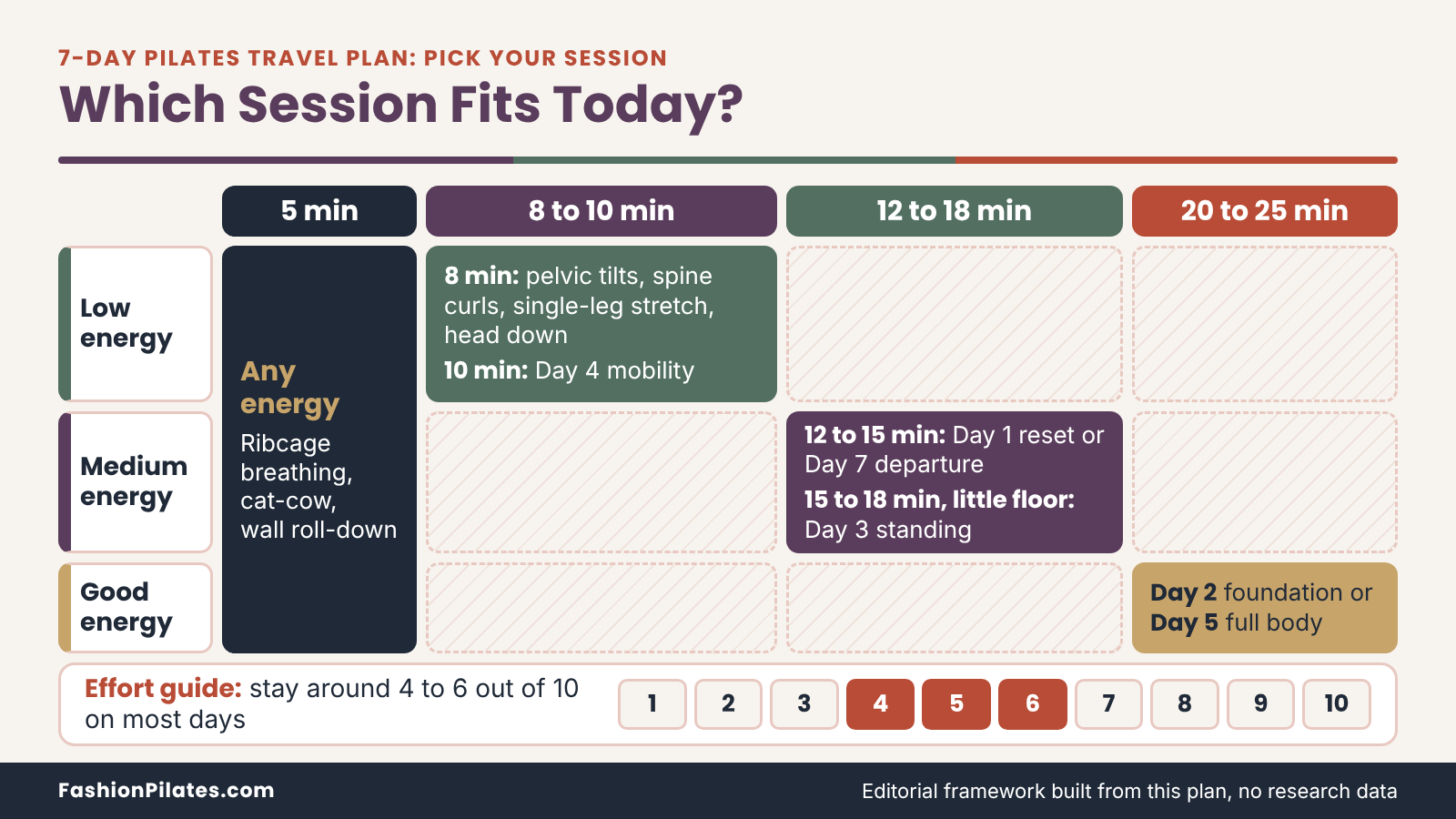
The week climbs gently from a 12-minute arrival reset to a 25-minute full-body session on day five, then tapers for travel home. Every day lists exercises in the order to do them, so you change position as rarely as possible: lying first, then side-lying, then face down, then hands and knees, then seated or standing. Rest 20 to 30 seconds between rounds, and use the movement notes in the menu above for any cue you need.
| Day | Focus | Minutes | Effort (1 to 10) | Five-minute fallback |
|---|---|---|---|---|
| 1 | Arrival reset | 12 | 3 to 4 | Ribcage breathing, pelvic tilts, cat-cow |
| 2 | Foundation core and hips | 20 to 22 | 4 to 5 | Toe taps, spine curls, clams |
| 3 | Standing and balance | 15 to 18 | 4 | Wall roll-downs, heel raises, one-leg balance |
| 4 | Gentle mobility | 10 | 2 to 3 | Cat-cow, thread the needle |
| 5 | Full body | 25 | 5 to 6 | Single-leg stretch and a bridge |
| 6 | Pick two blocks | 15 to 20 | 3 to 5 | One block, 5 minutes |
| 7 | Departure session | 12 to 15 | 3 to 4 | Spine curls and a wall roll-down |
Days 1 to 3: Settle In and Build
The first three sessions are about teaching your body the routine and your room the footprint. Resist the urge to do extra on day one just because you finally have a quiet minute.
Day 1: Arrival reset (about 12 minutes)
This session is meant to loosen up after the trip, not to challenge you. Do each item once through, with calm breathing.
- Ribcage breathing, six breaths.
- Pelvic tilt, eight repetitions.
- Bent-knee fallout, six per side.
- Spine curl, six repetitions, with a smaller lift if your lower back feels stiff.
- Cat-cow, six cycles, then thread the needle for three breaths per side.
- Rest sitting back toward your heels with forearms on the floor for five breaths, or sit on a folded towel if kneeling bothers you.
If you traveled for many hours, keep everything below effort 4. The aim is simply to find the floor, move through your spine, and learn the room.
Day 2: Foundation core and hips (about 20 to 22 minutes)
Day two introduces abdominal work and the side-lying leg exercises. Do two rounds of the abdominal block, with a short rest between.
- Warm-up on your back: ribcage breathing (six breaths), pelvic tilt (eight), fallout (six per side).
- Toe taps, six per side.
- Hundred prep with head down, five breath cycles.
- Single-leg stretch with head down, five per leg. Rest 30 seconds, then repeat the toe taps, hundred prep, and single-leg stretch once more.
- Spine curl, eight repetitions.
- Side-lying: clam ten per side, then small side kick eight per side.
- Hands and knees: cat-cow six cycles, thread the needle three breaths per side.
If your neck complains during any head-down exercise, put a folded towel under your head. If your lower back arches during the single-leg stretch, keep both hands on one knee and shorten the range.
Day 3: Standing and balance (about 15 to 18 minutes)
This is the quietest strength day, and it works anywhere there’s a wall, including a hallway or a tiny room. It also suits early mornings, when you’d rather not wake the neighbors.
- Stand with feet hip-width apart and take six ribcage breaths.
- Wall roll-down, five repetitions.
- Heel raises, twelve slow repetitions.
- Partial squats with arms forward, eight to ten repetitions, twice with a pause between.
- Standing side bend, five per side, reaching one arm overhead.
- One-leg balance near the wall, two rounds of 20 seconds per side.
- Finish with a walk: a flight of stairs, a hallway lap, or a short stroll outside.
Choose a stable surface near your hand for balance work and keep one fingertip on the wall for the first round. Dizziness or wobbling that doesn’t settle is a reason to sit down.
Days 4 to 7: Deepen, Choose, and Wrap Up
The second half adds variety and a little more challenge, then eases off so you land back home in a good place so you head home feeling steady.
Day 4: Gentle mobility (about 10 minutes)
Many trips put a heavy activity day around day three or four, such as hiking, a long conference day, or a family event. This session is your pressure valve.
- Ribcage breathing, six breaths, lying down.
- Cat-cow, eight cycles.
- Thread the needle, five breaths per side.
- Seated mermaid side bend, four per side.
- Seated spine twist, four per side.
- Wall roll-down, four repetitions.
Keep effort around 2 or 3. If you’re hurting from a long walking day, these slow movements are a better choice than skipping.
Day 5: Full-body session (about 25 minutes)
This is the longest and most demanding day of the week, so schedule it when you’re rested, not after a late dinner.
- Warm-up on your back: ribcage breathing, pelvic tilt, fallout, as on day two.
- Toe taps, six per side. Hundred prep, eight cycles, with head and shoulders lifted only if comfortable.
- Single-leg stretch, six per leg, two rounds.
- Spine curl, eight repetitions, adding a three-breath hold at the top on the last repetition if it feels easy.
- Side-lying: clam ten per side, small side kick eight per side, two rounds.
- Face down: breaststroke prep, six repetitions, twice. Then forearm plank for 15 to 20 seconds, three times (knees down is a valid choice).
- Hands and knees: cat-cow and thread the needle. Finish with the seated twist, four per side.
If time is tight, drop the face-down block first. If energy is low, do one round of everything instead of two.
Day 6: Pick two blocks (about 15 to 20 minutes)
Day six hands you the steering wheel. Open with two minutes of ribcage breathing and pelvic tilts, pick two blocks, and always finish with block C or D so your session ends with mobility rather than strength.
- Block A, core: toe taps, hundred prep, single-leg stretch (about 7 minutes).
- Block B, hips and legs: spine curls, clams, small side kicks, partial squats (about 8 minutes).
- Block C, mobility: cat-cow, thread the needle, mermaid, seated twist (about 6 minutes).
- Block D, standing: wall roll-down, heel raises, side bends, one-leg balance (about 7 minutes).
After a big walking or hiking day, A plus C is a sensible choice. After a day of sitting, B plus D tends to feel good.
Day 7: Departure session (about 12 to 15 minutes)
On travel-home day, the point is to wake the body up without wearing it out. Do this before you leave the room, ideally an hour or more before heading to the airport or station.
- Ribcage breathing, six breaths.
- Spine curl, six repetitions.
- Single-leg stretch with head down, five per leg.
- Cat-cow, six cycles.
- Wall roll-down, four repetitions.
- One-leg balance, 20 seconds per side.
Then take two minutes to note which five movements felt best this week. That list becomes your short routine at home, and it dovetails neatly with a structured follow-up like our 30 day Pilates challenge.
Adapting the Plan to Your Trip
No itinerary matches the plan exactly. A good week of travel Pilates bends around the trip rather than competing with it, so this section covers the situations that most often knock a routine off course.
When Your Schedule Won’t Cooperate
Time-zone changes, early meetings, and late dinners are the usual culprits. Each has a workable answer, and none of them involves skipping the week.
Time zones and jet lag
The CDC Yellow Book describes jet lag as a mismatch between your body clock and local time that can bring sleep disruption, daytime sleepiness, and a general sense of feeling off, and it puts most of its emphasis on the timing of bright light: morning light tends to move your clock earlier, evening light later. It says very little about exercise as a jet-lag tool, so this plan doesn’t claim that Pilates fixes anything. What it can do is fit around the light-and-sleep advice. After traveling east, pair a gentle morning session with some time outdoors. After a long westbound trip, keep the day-one reset short and mild, and avoid anything strenuous close to your intended bedtime if you find that it leaves you wired.
The eight-minute minimum for packed days
Some days will be swallowed whole by a conference, a wedding, or a theme park. That’s what the fallback sessions are for, and having them decided in advance means you never negotiate with yourself at 10 p.m. Here is how the plan scales down.
| Time you have | What to do | Best for |
|---|---|---|
| 5 minutes | Ribcage breathing (six breaths), cat-cow (six cycles), wall roll-down (four) | Late arrivals, hotel mornings before a meeting |
| 8 minutes | Add pelvic tilts, spine curls (six), and single-leg stretch with head down (five per leg) | Conference days, sightseeing days |
| 12 minutes | Use the day 1 or day 7 sequence unchanged | Evenings when you still have some energy |
| 20 minutes or more | Use day 2, day 5, or two blocks from day 6 | Open mornings, rest days, rainy afternoons |
The rule of thumb is simple: a short session on a hard day counts, and a missed day doesn’t mean the week is ruined. Pick up the plan where you are, not where you left it.
Rooms, Companions, and Unusual Spaces
Not every trip comes with a king-size room and a quiet corridor. The plan holds up in more cramped or crowded setups with a few small changes.
Shared rooms and family trips
If you share a room, timing is your best tool. Early morning, before anyone else is awake, is often the only reliably private slot, and Day 3 and Day 4 are built to be nearly silent for exactly that reason. Keep music off, use only silent exercises such as breathing, cat-cow, thread the needle, and seated work, and save the side-lying leg exercises for when you have the room to yourself. With children along, a short session can double as a game: let them copy the cat-cow or hold the balance with you. Keep the strength work for when nobody else is likely to wander into your footprint, since unexpected contact in a tabletop position is a quick way to get hurt.
Cabins, rentals, and the hotel gym
Cruise cabins and city rentals can be tighter than a standard hotel room, with less floor but sometimes more places to hold on. If you can only lie down diagonally, use the lying exercises with bent knees and rely on standing work for the rest. Never use a balcony railing, deck rail, or ship furniture for support, since these aren’t designed for it. A hotel gym often has a stretching area with a better mat and more room, which can make it an upgrade for the longer days, but even there you’ll want to keep your session short and your effort level honest, as machines and unfamiliar equipment are a different topic from this plan.
Common Mistakes and Fixes
Almost every failed travel routine fails the same few ways. Naming them in advance makes them easier to dodge.
Planning Mistakes
These errors happen before you ever step onto the towel, and they cause more abandoned routines than any exercise problem.
Building a plan the trip can’t support
The classic version is promising yourself an hour a day for a week in a city you’ve never visited. By day two, the plan is a source of guilt rather than energy. The fix is to schedule fewer, shorter sessions than you think you’ll manage and treat anything extra as a bonus. Three to five sessions across the week is a perfectly respectable result. Count each one honestly, including the five-minute versions, and notice that those fallback sessions are what make a plan survive the first chaotic day.
Starting hard after a long journey
After many hours of sitting, joints and muscles can feel stiff, and the temptation is to push hard to make up for lost time. A softer start is wiser: begin with the day 1 reset, keep effort low, and build over the week. This matters most if you arrived after a long flight with any of the leg symptoms described in the safety section. When in doubt, walk first, move gently second, and get medical advice if you notice swelling, pain, or redness in one leg.
Execution Mistakes
Once you’re on the floor, a different set of small errors tends to appear. They’re easy to fix once you can spot them.
Rushing, breath-holding, and neck strain
Fast repetitions and held breath are the two most common errors in mat-style work. Slow every repetition to the pace of your breath, and let each exhale do part of the work. In head-lifted exercises, watch for the chin jutting forward or the neck gripping; if either happens, rest your head, add a folded towel, or switch to the head-down version. The Hundred is the usual offender because the pumping tempts people to hold their breath, so count the beats aloud in your head and keep the inhale and exhale at five beats each.
Slippery floors and unstable props
Socks on hardwood, a towel that skids on tile, and a half-closed suitcase used as a step all share one trait: they move when you don’t expect it. Check your footing before every standing session, place the towel on carpet if you can, and use a heavy fixed surface for hand support. If the only available floor is slick, switch to the lying and seated work and skip standing balance on that day. A quiet, grippy patch of floor is worth more than any piece of gear.
| Mistake | Why it happens | Fix |
|---|---|---|
| Planning daily hour-long sessions | Optimism about free time | Plan 3 to 5 sessions, 10 to 25 minutes each |
| Going hard on day 1 | Feeling stiff and behind | Use the arrival reset at effort 3 to 4 |
| Holding the breath during Hundred prep | Concentrating on the pumping | Five beats in, five beats out, head down if needed |
| Neck gripping in head-lifted work | Abdominals tiring early | Rest the head or use a folded towel |
| Slipping on hotel floors | Socks, tile, wood | Use a towel on carpet or stick to lying work |
| Using unstable furniture for support | Convenience | Use a wall or a heavy fixed desk edge |
What the Evidence Says and How to Keep Going
A fair guide should say what the research supports, what it doesn’t, and how to carry a one-week plan into the rest of your life. The honest answer is that the evidence is encouraging but doesn’t map neatly onto a 12-minute hotel session.
What the Research Does and Doesn’t Say
Reviews of Mat Pilates exist, but their participants and routines differ from a traveler’s week. Reading them accurately means keeping those differences in view.
What reviews of Mat Pilates suggest
One often-cited summary from the UK’s National Institute for Health and Care Research looked at nine randomized trials with 415 adults aged 60 and over, compared with no exercise. The authors reported improvements in dynamic balance, lower-limb strength, lower-body flexibility, and cardiorespiratory fitness, from sessions that ran 50 to 60 minutes, two to four times a week, for 4 to 24 weeks. The same summary cautions that most study personnel knew which group participants were in, which could have favored Pilates, and that it dates from 2018. In plain terms, regular Mat Pilates over weeks appears to be associated with better fitness measures in healthy older adults, and that’s about as far as the claim goes.
What this plan cannot promise
A seven-day plan with sessions of 10 to 25 minutes is much shorter and lighter than those trials, and it was built for a general adult audience rather than adults over 60. It can’t promise weight loss, body-shape changes, posture correction, or pain relief, and we haven’t built it around any of those goals. What it plausibly offers is more modest and still worthwhile: a way to keep moving through a disrupted week, practice good movement habits, and make it easier to resume your usual routine at home. Treat anything bigger as a claim that needs a qualified professional and a longer timeline.
Tracking Progress and Taking the Habit Home
The last day of a plan is when most travel routines quietly die. A small amount of tracking and a clear next step keeps the habit from stopping at the airport.
Tracking what matters
Skip the body measurements and use signals that actually reflect what a week of gentle floor work can change. Write down which days you completed, your effort rating from 1 to 10, and one sentence about how the session felt. Over a week, you may notice small things: you got up from the floor more easily, a balance hold felt steadier, or a movement that felt awkward on day two felt smoother by day five. Those notes are more useful than any score, and they’ll tell you which five movements to keep in your short routine at home.
Returning to your usual routine
Once you’re home, you have several options, and none requires starting over. You can repeat the week with a longer pace, graduate to a fuller session such as our Pilates for beginners guide, or follow a structured program from the Pilates Plans & Challenges hub. If you attend studio classes, mention to your instructor that you’ve been practicing a short mat sequence on the road, and ask for feedback on the movements that felt least certain. An instructor can check what no article can: how your ribcage, pelvis, and neck are actually moving.
Frequently Asked Questions
What is a pilates travel plan?
A pilates travel plan is a short, structured set of mat-style sessions designed to be done in a hotel room or other small space with little or no equipment. It usually fits around a trip schedule rather than a regular class timetable. The plan in this guide uses seven sessions of 10 to 25 minutes, with five-minute fallbacks. Each session reuses a small menu of exercises so there is little to remember. The goal is consistency during a disrupted week rather than a full training block.
Can I really do Pilates in a hotel room without a mat?
Yes, because most mat-style movements need only a clean, padded patch of floor about the size of a bath towel. Carpet usually works well with a towel laid on top, while hard floors call for extra padding under the knees and tailbone. Slippery surfaces are the main thing to watch. If the floor is unsuitable, standing and seated work still covers a good portion of the plan. A travel mat is a convenience, not a requirement.
How long should each session be on a trip?
Most sessions in this plan run 10 to 25 minutes, with a five-minute fallback for packed days. Federal activity guidance removed the old 10-minute minimum for counting activity, so shorter bouts still count toward weekly totals. Quality matters more than duration, since slow, controlled repetitions are the point of the method. Choose a length you can repeat on your busiest day. A short session you actually do beats a long one that never happens.
Is it safe to exercise after a long flight?
Gentle movement is generally part of standard travel advice, but safety depends on how you feel and on your personal risk factors. The CDC lists previous clots, recent surgery, pregnancy, and certain other conditions as higher-risk situations, so check with a clinician if any apply. Leg swelling, pain, or redness, chest pain, or trouble breathing needs urgent medical care rather than exercise. If you feel well, start with the lowest-effort day-one session. Walk around first and keep the intensity low.
Will hotel-room Pilates disturb the guests below me?
Usually not, because most of the exercises are slow and controlled, and many are silent. The noisiest moments come from lowering legs or dropping onto a hard surface, so lower everything gently. Carpet and a towel absorb most of the sound. Avoid jumping or any quick, repeated impacts in a hotel room. Early morning sessions are best if you share walls with light sleepers.
What if I miss a day or two?
Nothing is lost, and the plan doesn’t require a perfect streak. Pick up with whichever session fits the time and energy you have that day, using the five-minute fallback if needed. You can skip ahead to the lighter days instead of repeating what you missed. The activity guidelines focus on weekly totals rather than unbroken daily routines. Treat the week as a menu, not a contract.
Can I use this plan if I’m pregnant, postpartum, or recovering from an injury?
Check with your doctor, physical therapist, or a qualified Pilates professional before starting. Several exercises involve abdominal work, spinal flexion, rotation, or lying face down, which may need changes at different stages of pregnancy or recovery. Recent surgery, osteoporosis, and chronic conditions are additional reasons to ask first. The NHS and Better Health Victoria both advise screening in these situations. Use the plan as a starting point for that conversation, not as individualized advice.
Do I need to bring anything besides a towel?
No, a towel is enough for the whole plan. A thin travel mat, a small pillow for padding, and non-slip socks are optional extras. A light resistance band can add variety, though nothing here requires one. Check any band for nicks before you use it. Choose items for what they solve, not how they look in the suitcase.


Trackbacks/Pingbacks