Direct answer: The best pilates reformer with tower is the one whose tower design, footprint, ceiling clearance, spring system and warranty match your room and the way you plan to train, not the one with the longest feature list. Most buyers end up choosing among three layouts: a reformer with a fixed tower, a reformer with a removable vertical frame, or a reformer paired with a half Cadillac frame. Compare those layouts first, then confirm every measurement and warranty term on the manufacturer’s current page before you order.
This guide is for readers who are weighing a combination machine for a home studio, a private practice room, or a small boutique space, and who want to understand the trade-offs before spending several thousand dollars. It covers what a tower adds, how to measure for one, which build details matter, how six named systems differ on paper, and how to avoid the mistakes that make people return a very large box. If you are still deciding whether you need a reformer at all, start with what is a Pilates reformer and come back.
A note on method. This is a research-based comparison built on manufacturer specification pages, published equipment-safety guidance and category criteria. Nobody on the editorial team has used the machines named here, and the guide does not rank them as if we had. Specs and prices change between model years, so treat every number as something to confirm on the current listing, and expect a shortlist with trade-offs rather than a single winner.
What the Best Pilates Reformer With Tower Really Means
“Best” is a slippery word on equipment pages, because it usually means “best for the person writing the page.” Before comparing anything, it helps to be precise about what you are buying and what job you want it to do. A reformer with a tower is two classic Pilates apparatus sharing one frame, and each half carries its own set of decisions.
What a Reformer With a Tower Actually Is
The tower half borrows its ideas from older apparatus, so a quick vocabulary pass keeps the rest of the guide readable.
The reformer half: carriage, springs, footbar and ropes
The reformer is a low frame with a sliding carriage that moves on rails against spring resistance. You push or pull the carriage using a footbar, ropes with handles or foot loops, and your own body weight as the load. Springs come in different strengths, and changing which ones are attached changes how hard a movement feels. Most reformer work happens lying, seated, kneeling or standing on the carriage. If you want the wider picture, the guides gathered in Reformers & Pilates Machines hub cover it, and the footbar gets its own explainer in Pilates footbar explained.
The tower half: a frame, springs and bars above a platform
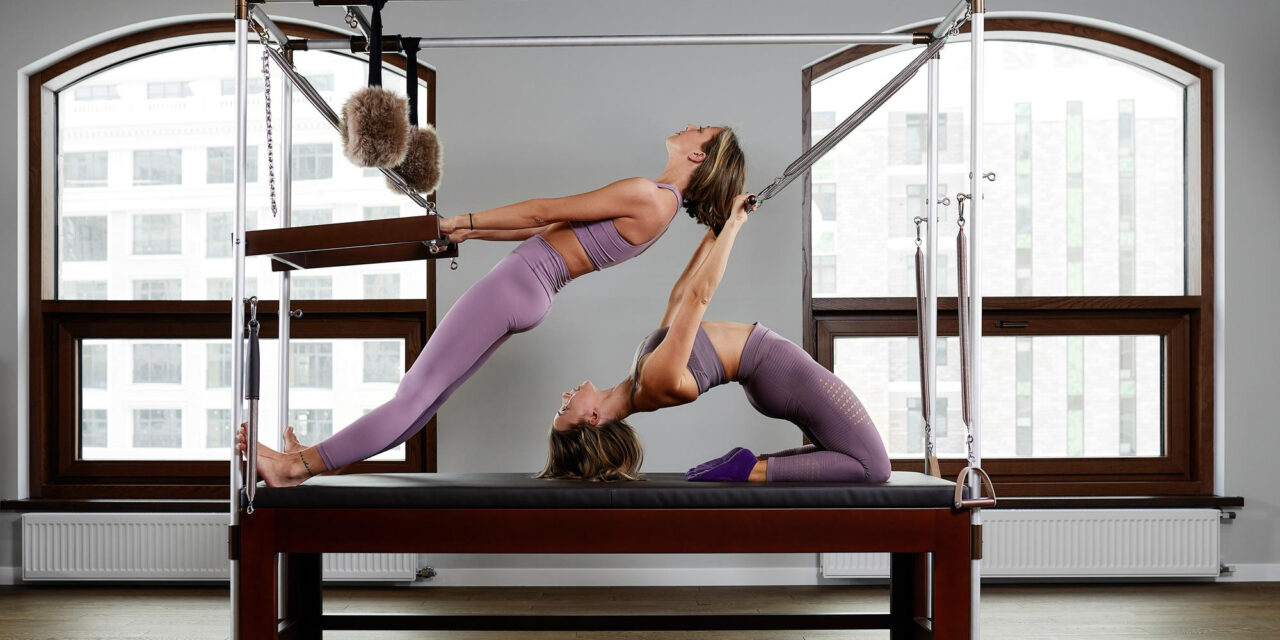
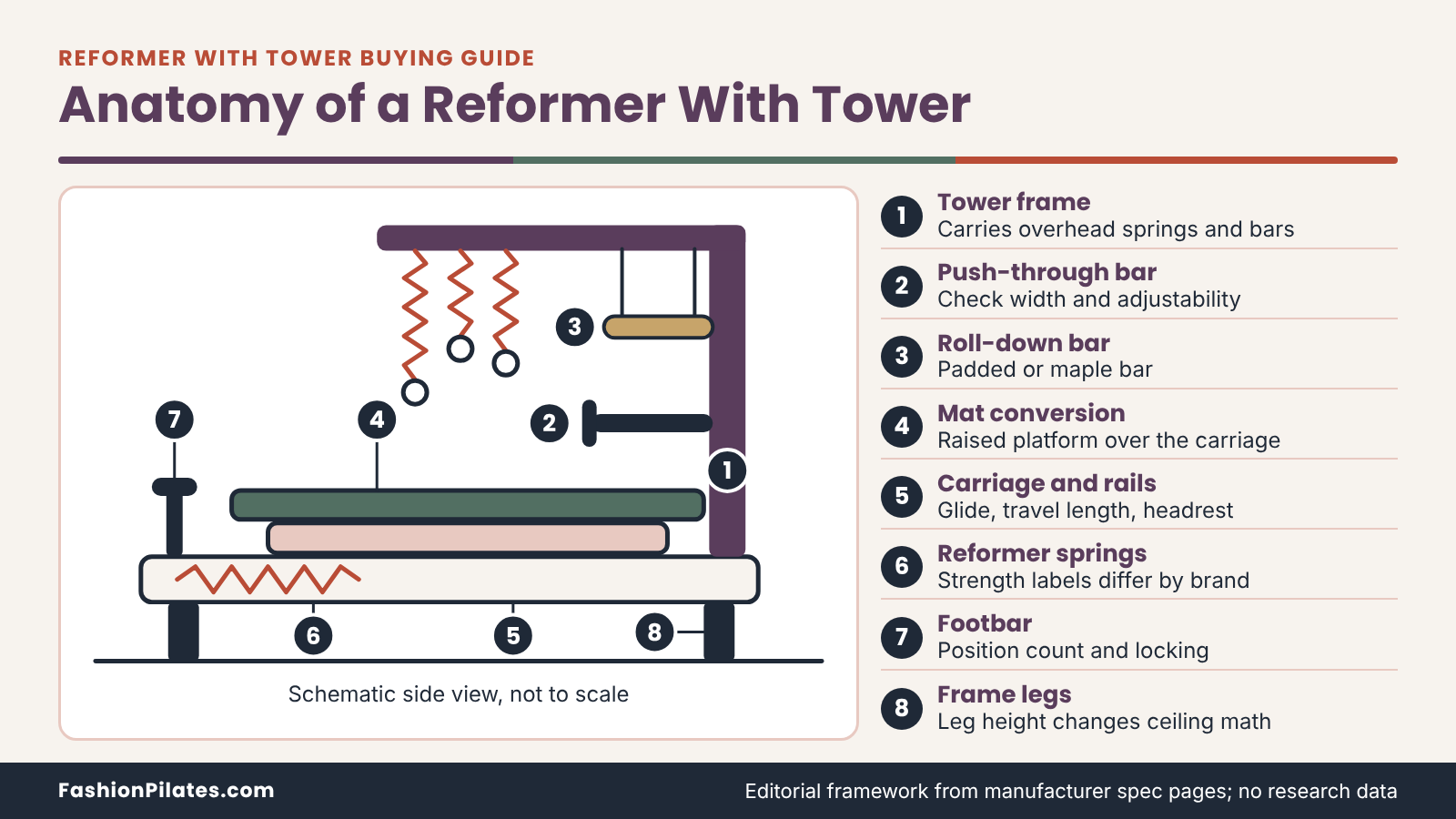
A tower is a vertical frame that rises above the reformer, carrying springs, a push-through bar and a roll-down bar. One manufacturer’s educational page describes the tower as a space-saving, wall-mounted cousin of the Cadillac, a larger apparatus with a raised padded table and a frame around it. The same page notes that many modern machines combine reformer and tower units, and that most Cadillac exercises can be done on a tower. For you, the practical meaning is simple: a tower lets you lie on a padded surface and work against springs overhead, which is a different feel from pushing a carriage.
Why People Pair a Reformer With a Tower
Combining the two in one machine is mostly an argument about space, variety and learning curve.
One footprint, two kinds of work
The main appeal is footprint. A standalone reformer and a standalone Cadillac or tower would each want their own corner. A combination unit gives you carriage work and spring-assisted mat-style work in roughly the floor area of one reformer. Balanced Body’s page for its Allegro 2 system says as much, calling the combination especially appealing for home studios where maximum functionality is needed from a single piece of equipment, provided the room can handle the size and ceiling height. That is a manufacturer’s marketing position, but the geometry behind it is real: you trade a bit of extra height for a lot of extra floor.
A gentler way to learn spring resistance
A PilatesAnytime article on reformer-and-tower combinations argues that the lying-down work on the platform can be a more stable place to build familiarity with springs before the balance demands of standing on a moving carriage. That is an opinion from a class-library publisher, not a study, and nobody should treat it as a guarantee. It does point to a sensible pattern, though: if you are new, having stable, supported positions available can make a home practice less intimidating. It still does not replace instruction, which comes up again in the safety section.
Best for Whom? Three Buyer Types
Because “best” shifts with the buyer, this guide is written around three common profiles, and you will see them again in the model comparisons and the decision section.
The home practitioner with a dedicated corner
This buyer has a spare room, a finished basement or a generous bedroom corner and wants a machine that can serve a long practice. Priorities are ceiling clearance, a stable frame, smooth carriage travel and a warranty that covers the parts that wear. This reader can usually afford to prioritize a durable machine over a compact one, but still needs to plan the mat platform, since flat conversion pieces take up storage room. The home studio guide at home Pilates studio setup guide covers the room-planning side.
The instructor or small-studio owner
Instructors who teach private or semi-private sessions often want one machine that handles reformer work, tower work and mat-level work without a floor plan full of apparatus. They care about how the machine looks to clients, how quickly it can be reconfigured between sessions, and whether replacement parts are easy to source. For this buyer, the commercial-minded lines from established manufacturers will usually be the relevant shortlist, and a certified instructor’s opinion on spring and footbar choices matters more than any spec sheet.
Tower Types and Configurations Explained
Product pages use “tower,” “Cadillac,” “half Cadillac,” “vertical frame” and “mat conversion” almost interchangeably, which is how a simple purchase turns into a vocabulary quiz. Sorting the layouts by how the tower attaches and what happens to it when you are not using it makes the shortlist much clearer.
Fixed Towers, Removable Frames and Half Cadillacs
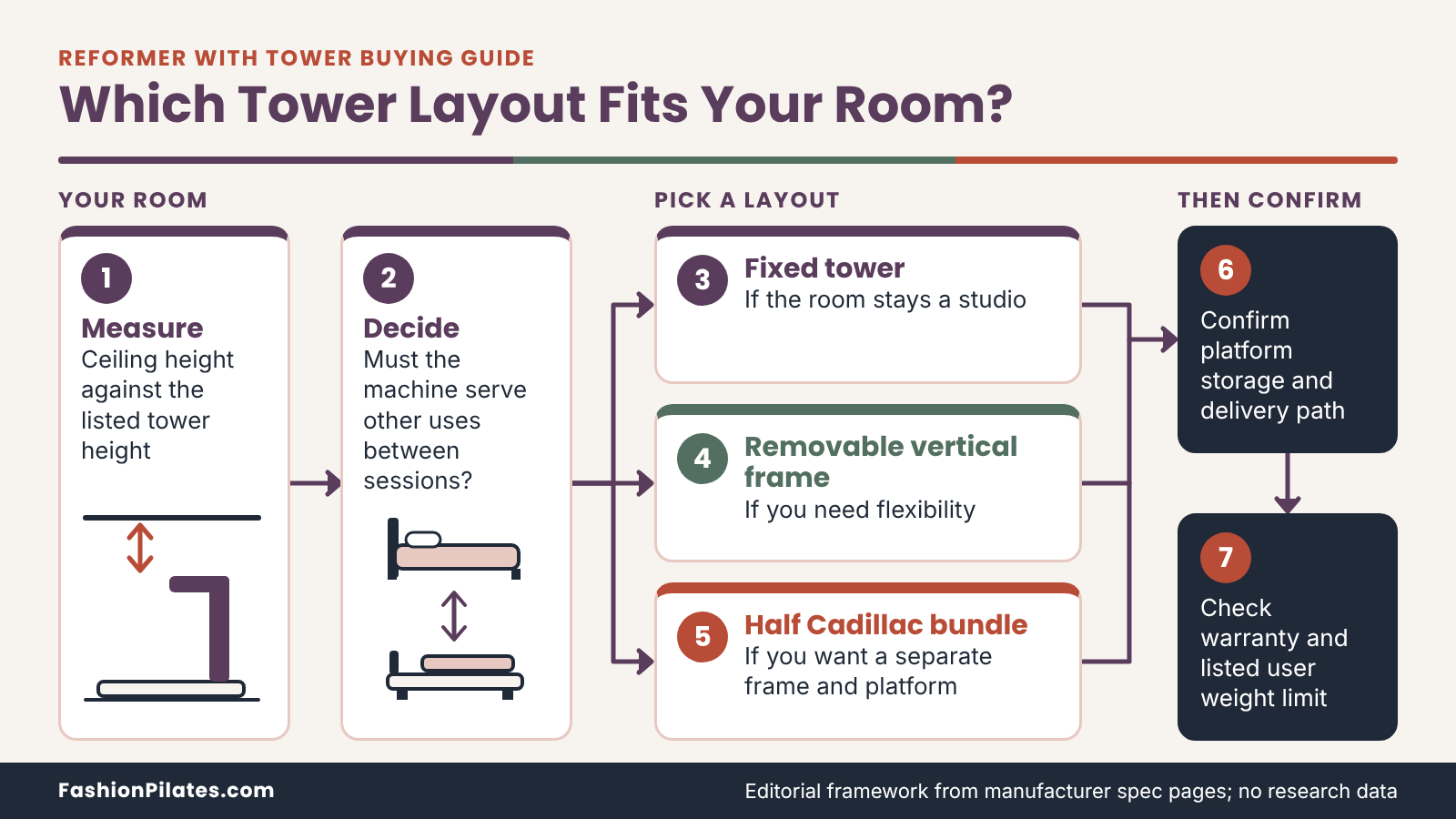
Three attachment styles cover most of the machines sold for home and small-studio use, and each one changes what you live with day to day.
Fixed or permanently secured towers
Some systems treat the tower as part of the machine. Balanced Body’s Studio Reformer with Tower and Mat page describes the tower as rigidly secured and neither removable nor foldable. The upside is stiffness and a clean, finished look, plus no reassembly between sessions. The downside is that the machine is always as tall as the tower, so ceiling height and doorways are decided on day one. This layout suits a room that will stay a studio for years, and it asks for more certainty than a spare bedroom can offer.
Vertical frames and half Cadillac brackets
Other systems add the tower as a separate frame. Merrithew’s SPX Max Plus Reformer page lists a vertical frame that is 68.5 inches tall, weighs 36 pounds and can be removed when you stack reformers for storage. Align-Pilates sells its A8-Pro reformer with a half Cadillac, which includes a frame, brackets and a mattress converter. Naming is not standardized, so ignore the label and read the parts list: what posts, bars, springs and platform actually come in the box?
The Mat Conversion Question
The padded platform that sits over the carriage is the part buyers forget to plan for, and it decides how the tower half is actually used.
What the platform adds
A mat conversion, sometimes called a mat platform or mattress converter, turns the carriage area into a flat, raised surface so you can lie under the tower springs. Balanced Body lists the Allegro 2 conversion as a one-piece upholstered unit about 47 inches long, 26 inches wide and 2 inches high, while the Studio Reformer conversion is listed at about 93 inches long and 3.5 inches high. Merrithew describes its converter as enabling matwork and Cadillac-style exercises on a comfortable, raised surface. Without the platform, a tower is far less useful, so confirm it is included rather than sold separately.
Where it lives when you are not using it
PilatesAnytime points out that flat conversion pieces need dedicated storage, usually wall space to lean them against, and that this becomes a real problem in smaller rooms. That matches common sense: a long upholstered board with no handles and strong opinions about doorways does not disappear on its own. Before buying, decide where the platform will rest during carriage work, whether the room allows it to stay on the floor beside the machine, and who will lift it. Twin mat pieces, which the Peak Pilates and CenterLine listings mention, can be easier to handle than a single long panel.
Measure First: Footprint, Ceiling, Floor and Delivery
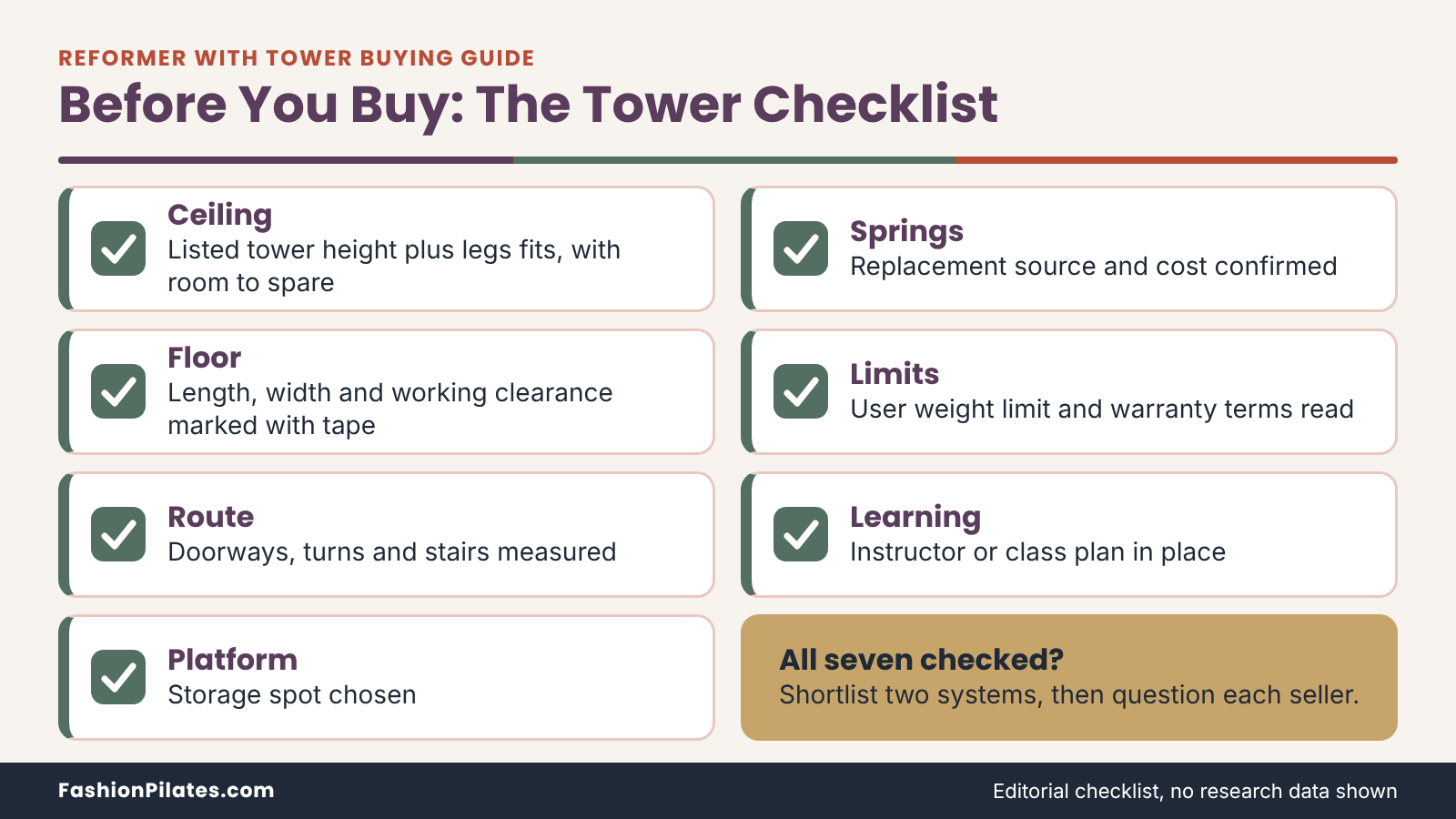
Most returns and regrets in this category are measurement problems, not quality problems. A reformer with a tower is longer than many hallways are wide and taller than many ceilings are generous, so the tape measure deserves as much attention as the spec sheet. The same planning logic appears in the full room guide at home Pilates studio setup guide, so this section stays focused on tower-specific math.
Footprint and Ceiling Arithmetic
Two numbers do most of the damage: how much floor the machine claims and how much vertical space the tower claims.
Floor footprint and working clearance
Listed lengths vary more than you might expect. Balanced Body shows the Allegro 2 system at about 94 inches long and 34 inches wide, while Peak Pilates lists its MVe reformer at roughly 103.6 inches long and 29 inches wide, a difference of nearly 10 inches before anyone has stepped on or off. Those are machine dimensions only. A common planning habit is to add working room on every side so you can mount, dismount and adjust springs, and to confirm the manufacturer’s own recommended clearance. The tape test is cheap: mark the listed length and width on the floor, then walk around it carrying a pretend water bottle.
Ceiling height: how the numbers are measured
Tower height is where spec sheets quietly disagree. Balanced Body lists the Allegro 2 tower at 61 inches above the reformer frame, with a total installed height of 76 inches including legs. Its Studio Reformer tower is listed at 83.5 inches when installed on the tallest frame, and the CenterLine tower is also listed at 83.5 inches. The MVe tower is listed at 72 inches, and Merrithew’s vertical frame at 68.5 inches with a stated minimum ceiling of 77 inches for installation. Same word, different baselines, so ask whether a number includes the legs.
Now do the room math. A standard 8-foot ceiling is 96 inches, which leaves roughly 20 inches above a 76-inch installed tower and 12.5 inches above an 83.5-inch one. Installation is only half the story, though. Merrithew’s page says a reformer needs at least 97.5 inches of ceiling for standing exercises with the hands overhead, using a 5-foot-8 person as its example. A taller person, a taller leg option or a ceiling fan changes the answer, so check your own height and your own ceiling.
Floor Load and Delivery
Once the machine fits in the air, it still has to fit through the door and sit safely on the floor.
Weight, floors and what to ask a professional
These are heavy objects. Balanced Body lists the Allegro 2 system at 177.5 pounds and the Studio Reformer with tower at 188 pounds. Peak Pilates lists the MVe reformer at 135 pounds plus an 80-pound tower, and Merrithew lists its SPX Max Plus reformer at 164 pounds plus a 36-pound vertical frame. Those weights are modest next to a piece of furniture, but they sit on a small contact area. If the room is above a garage, over a crawlspace or on an upper floor, ask a contractor or the manufacturer how to spread the load, and protect finished floors under the legs.
Doorways, stairs and assembly
Delivery is a project. Measure every doorway, hallway turn and stair landing on the route, and ask the seller whether the machine ships assembled, partly assembled or in flat boxes. Peak Pilates lists the MVe reformer width at 29 inches and Balanced Body lists the Allegro 2 frame at 25 inches, so narrow doors are less of an issue than long hallway turns with a 94-inch or longer reformer. Plan for two adults for lifting, and read the assembly instructions before opening a single box, because the tower and any safety strap are things you want installed exactly as the manual says.
Frame, Carriage and Springs: What Build Quality Looks Like
Spec sheets can tell you size, weight and what comes in the box. They cannot tell you how a carriage feels under your hands, which is why the criteria below focus on what you can verify on paper and what you should insist on checking before the return window closes.
Frame and Carriage
The frame and carriage are the part you use every second of every session, so small differences compound.
Frame material, leg height and rails
Manufacturers describe frames in different ways. The CenterLine listing from Balanced Body describes a solid maple wood frame with a stainless steel tower, while the Align-Pilates A8-Pro page describes precision aluminum runners with eight polyurethane wheels. Neither description tells you which is better, only what to ask about. Leg height is a quieter decision with big consequences: the Studio Reformer is listed in 14, 18 and 24-inch frame heights, the Allegro 2 system with a 15-inch leg kit, and the Align A8-Pro with low, standard and high legs of 28, 42 and 64 centimeters. Taller frames are easier to step onto and also eat ceiling height.
Carriage size, travel and glide
Carriage dimensions help you judge whether a machine suits your body and your practice. Merrithew lists its SPX Max carriage at 22 inches wide and 38.5 inches long, and Align lists its carriage at 67 by 91 centimeters, about 26.4 by 35.8 inches, with 113 centimeters (roughly 44.5 inches) of travel. A larger carriage can feel roomier for broad movements, and travel length matters for taller users. Glide is the one thing spec sheets cannot show. A buying guide from the Pilates Style site names a smooth, quiet glide as a core quality, so a generous return policy and a chance to try the machine in a studio are worth more than any number.
Springs and Resistance
Springs are where the sales language gets slippery, so it pays to understand what the colors and counts do and do not mean.
Reformer springs: why color labels do not transfer
Spring resistance is not standardized across brands. Peak Pilates lists its MVe set as one red spring described as heavy, two yellow described as medium and two blue described as light. Balanced Body’s Studio Reformer lists one green, three red and one blue, while the Merrithew SPX Max Plus uses percentages: three springs rated 100 percent, one at 50 percent and one at 25 percent. A red spring on one machine is not the same load as a red spring on another, so never buy against a color chart from a class video. Use light, medium and heavier tension as general ideas, and follow your instructor and the manufacturer’s manual for how to set up each exercise.
Tower springs: count, length and replacement
Tower springs are usually a separate set, often described as arm springs, leg springs and a push-through spring. Balanced Body lists eight tower springs for the Allegro 2 system, in short and long versions, and the CenterLine system lists eight as well, again with short and long options. Peak Pilates lists a leaner set of two arm, two leg and one push-through spring on the MVe tower. More springs give more resistance choices but more parts to maintain. Ask what replacement springs cost, whether you can buy them directly, and what the maintenance schedule in the manual says, because an equipment-safety author writing for IDEA suggests inspecting springs quarterly and replacing them every two to three years under heavy use.
Tower Features That Change How It Feels
Two machines can list the same tower height and still feel different because of the bars, straps and attachments that hang from it. This section is about the details that only appear in the fine print of a parts list.
Push-Through Bar and Roll-Down Bar
These two bars are the tower’s signature accessories, and each has its own comfort and safety considerations.
Push-through bar: width, adjustability and grip
The push-through bar is the hinged bar you press up and away from your body when working under the tower. Balanced Body describes the Allegro 2 version as an extra-wide, three-sided bar that is 2.5 inches wider than the original, and the Studio Reformer version as anodized aluminum with adjustable heights. The CenterLine system pairs a wooden push-through bar with a maple roll-down bar. When comparing, look at width relative to your shoulders, how many height settings exist, how the bar locks, and whether its finish is comfortable with bare hands.
Roll-down bar and the safety strap
The roll-down bar sits on the tower frame and is pulled down toward the platform in certain exercises. Balanced Body lists the Allegro 2 roll-down bar as solid maple and the Studio Reformer version as padded and 23 inches wide. Both systems also list a safety strap and carabiner, which are generally there to hold the push-through bar in place. Treat that strap as non-optional hardware: install it exactly as the manual says, check it as part of your regular inspections, and ask an instructor how the tower is meant to be used before attempting anything unfamiliar.
Loops, Handles and Extras
Soft parts and accessories are where machines differ most in what is included, and they are the parts that wear out first.
Loops, ropes and handles
Different listings describe different attachments. Balanced Body lists SoftTouch single padded loops with the Allegro 2 tower, Peak Pilates lists adjustable ropes, double loops and retractable handles with the MVe, and Merrithew lists a retractable rope system with traveling pulleys on its SPX Max Plus bundle. Padded loops are kinder to wrists and ankles than thin straps, and retractable ropes can reduce clutter. Peak Pilates also lists only 60 days of warranty coverage on upholstery, straps and loops, so factor in replacements for the parts you touch most.
Boxes, jump boards, footbar styles and add-ons
Inclusion lists vary widely. The MVe listing includes long and short boxes and a jump board, while the Align A8-Pro half Cadillac listing includes a sitting box and a platform extender, and Merrithew’s bundle lists a reformer box with footstrap, a padded platform extender and a maple roll-up pole. Footbar options differ as well: Merrithew and Peak both list four positions, Align lists six lockable positions, and Balanced Body offers four footbar styles on the Studio Reformer. Price a machine with the accessories you would actually use, not the ones in the product photo, and read Pilates footbar explained to understand why footbar position count matters.
Named Systems Compared on Paper
Here is where the criteria meet actual products. Everything below comes from manufacturer pages read on the research date, and every figure is the maker’s own, so treat the section as a way to learn how listings differ rather than a ranking, because the best pilates reformer with tower depends on your ceiling, your floor and your teaching goals. Prices appear only where an official page showed one, and several pages ask you to contact a local representative instead, which tells you something about how these machines are sold.
The table that follows lines up the headline numbers so you can see the gaps at a glance. A dash-style entry such as “not listed” means the page reviewed did not state the figure, not that the machine lacks it.
| System | Listed size | Listed weight | Tower or frame height | User weight limit | Frame warranty | Price shown |
|---|---|---|---|---|---|---|
| Balanced Body Allegro 2 with Tower and Mat | 94 in L x 34 in W (system) | 177.5 lb system | 76 in installed, with legs | Not listed | 10-year limited | Contact representative |
| Balanced Body Studio Reformer with Tower and Mat | 93 in L x 27 in W | 188 lb total | 83.5 in on the 24 in frame | Not listed | Limited lifetime | Contact representative |
| Balanced Body CenterLine with Tower and Mat | 91 in L x 25.5 in W | 149 lb (frame only) | 83.5 in tower | Not listed | Limited lifetime | Contact representative |
| Peak Pilates MVe Reformer and Tower | 103.6 in L x 29 in W | 135 lb reformer plus 80 lb tower | 72 in tower | 300 lb | Tower structure 2 years; other parts 1 year | $5,995 listed |
| Merrithew SPX Max Plus Reformer Bundle | 99.5 in L x 26 in W | 164 lb reformer plus 36 lb frame | 68.5 in vertical frame | 350 lb | Limited lifetime on frame and rails | $6,799 listed |
| Align-Pilates A8-Pro with Half Cadillac (UK listing) | 263 cm L x 75 cm W (about 103.5 x 29.5 in) | 75 kg reformer only (about 165 lb) | 213 cm with standard legs (about 84 in) | 150 kg (about 331 lb) | Not detailed on page | Listed in pounds sterling |
Balanced Body Systems
Balanced Body sells several reformer-with-tower systems, three of which are described here because their pages list full numbers and they sit at different points on the studio-to-home spectrum.
Allegro 2 Reformer with Tower and Mat
The Allegro 2 system page lists the complete bundle as a reformer with a 15-inch leg kit, a tower and a mat conversion, with 13 springs in total (five on the reformer, eight on the tower). The extra-wide three-sided push-through bar, solid maple roll-down bar and padded single loops are all part of the listing, and the frame carries a 10-year limited warranty. It is a strong candidate for a home studio where the ceiling can accommodate a 76-inch installed tower, and a weaker one if you need a posted user weight limit on the page you are reading.
Studio Reformer and CenterLine with Tower and Mat
The Studio Reformer page positions the system for studios offering private or semi-private sessions and for facilities with limited space, and it lists a rigid, non-removable tower. The CenterLine page targets teaching that emphasizes alignment, symmetry and precision, which in practice points toward classical-leaning instruction. Both list limited lifetime warranties on the reformer frame and neither shows a price. If a studio-grade finish and fixed tower appeal to you, these two are worth a closer look, with the caveat that you should confirm weight limits directly.
Peak Pilates, Merrithew and Align-Pilates
These three manufacturers approach the tower differently, and each page contains details that set it apart from the Balanced Body listings.
Peak Pilates MVe Reformer and Tower
The MVe page is unusually complete. It lists a $5,995 price (check the current listing), a 300-pound maximum user weight, a four-position footbar with a safety latch, a five-spring reformer set and a long list of included pieces such as boxes, a jump board, loops, ropes and twin mats. The tower itself is listed at 72 inches and 80 pounds, with a two-year limited warranty on its structural components. The trade-off is length: at roughly 103.6 inches, it is the longest reformer in this comparison, so it needs the most room.
Merrithew SPX Max Plus and Align-Pilates A8-Pro
The SPX Max Plus Reformer Bundle pairs a reformer with a 68.5-inch vertical frame and a mat converter. The page lists a $6,799 price (check the current listing), a 350-pound user weight limit and a limited lifetime warranty on the frame and rails. The Align A8-Pro with Half Cadillac listing reviewed is the UK version, with a 150-kilogram user limit, six lockable footbar positions and stackable, wheeled storage; US buyers should confirm availability, shipping and warranty terms before considering it.
Use the second table to see where each system fits and where it might not.
| System | Best for | Not ideal if |
|---|---|---|
| Allegro 2 with Tower and Mat | Home studios that want one machine for reformer and tower work and have ceiling room for a 76 in installed tower | You need a posted user weight limit on the product page, or a room with a low ceiling |
| Studio Reformer with Tower and Mat | Private or semi-private teaching spaces that want a fixed, studio-grade tower and a choice of footbar styles | You want to remove the tower between sessions |
| CenterLine with Tower and Mat | Instructors who teach in a classical-leaning, precision-focused style with a wooden frame | You want a posted price or weight limit without calling a representative |
| MVe Reformer and Tower | Buyers who want a clear price, listed weight limit and a long included-accessories list | Your room cannot spare about 104 inches of length |
| SPX Max Plus Reformer Bundle | Buyers who want a removable vertical frame and a 350 lb listed limit | You want a full fixed tower rather than a frame-and-converter setup |
| A8-Pro with Half Cadillac | Buyers comfortable importing or sourcing from a UK listing who value six footbar positions and stacking | You need US-market warranty and delivery details on the page |
Matching a Machine to Your Home, Budget and Goals
Specs are only useful once they meet a real room and a real routine. This section walks through situations that come up again and again, then through the money, because the sticker price is rarely the whole bill.
Room and Household Scenarios
Think of these as worked examples rather than prescriptions; your own measurements always win.
The small apartment or low-ceiling room
Picture a bedroom with an 8-foot ceiling, a closet door that swings into the floor space and a doorway 30 inches wide. A tower with 76 inches of installed height fits under that ceiling with room to spare, but the floor plan is the bigger problem, because a 94-inch reformer plus working room consumes most of a small bedroom. In that case a removable vertical frame, like the one Merrithew lists at 68.5 inches, can make more sense than a fixed tower, since you can take the frame down when the room needs to go back to being a bedroom.
A spare room, a shared household and a long practice
Now picture a dedicated room with a 9-foot ceiling and two people who will share the machine. Here the fixed tower looks better, because stiffness and a studio-grade finish matter, and nobody is trying to stow anything. The questions shift to adjustability: Can both users change footbar and headrest positions quickly? Is the listed user weight limit comfortably above the heaviest user? Are the safety strap and spring attachments easy to inspect? Household members of different heights benefit from adjustable bars and several footbar positions, and a stable platform is easier for everyone to use when it does not have to be moved between sessions.
Budget and Ownership Cost
The purchase price is the first line of a budget that includes freight, floor protection, accessories and wear parts.
What price pages do and do not show
Official pages are inconsistent. Peak Pilates shows $5,995 for the MVe reformer and tower, and Merrithew shows $6,799 for the SPX Max Plus Reformer Bundle, both worth checking against the current listing. By contrast, Balanced Body’s Allegro 2, Studio Reformer and CenterLine pages ask you to contact a local representative. For context, Merrithew’s page for the same SPX Max reformer with a vertical stand and tall box, which does not include a tower, shows $4,179. That is a different configuration, so the gap is not a pure tower price. PilatesAnytime says combination units cost roughly twice as much as a standalone reformer, which is a loose rule of thumb rather than a quote.
The next table turns that into a budget checklist you can fill in line by line before you commit.
| Cost line | What to ask or check | Why it matters |
|---|---|---|
| Machine and tower | Is the tower, mat conversion and safety strap included? | Some listings sell the tower or platform separately |
| Accessories | Boxes, jump board, platform extender, loops | Inclusion lists vary widely between brands |
| Freight and delivery | Curbside, inside delivery or assembly | A 100 lb-plus crate is a project, not a parcel |
| Floor protection and storage | Mat or protective flooring, wall space for the platform | Protects floors and keeps the platform from becoming clutter |
| Spare parts | Replacement springs, loops, straps and upholstery | Wear items have short warranties on several listings |
| Instruction | Studio sessions, online classes or an instructor visit | Learning a new apparatus is part of the cost |
Warranty, resale and wear parts
Read warranties by component. Balanced Body lists a 10-year limited warranty on the Allegro 2 frame and limited lifetime coverage on the Studio Reformer and CenterLine frames. Peak Pilates lists two years on the tower structure, one year on most other parts and 60 days on upholstery, straps and loops, while Merrithew lists limited lifetime on frame and rails, one year on ropes and straps and 90 days on upholstery. Resale is the quiet cost: PilatesAnytime notes that combination machines have a smaller pool of buyers than standard reformers, which suggests choosing a known brand and keeping the original parts and documents.
Learning to Use a Tower at Home
Buying the machine is the easy part. Learning to use it well is the project, and it affects whether the tower earns its footprint.
Start with instruction, not with the spring chart
Tower work involves overhead springs, a push-through bar and positions that feel very different from mat work, so it makes sense to learn the setup from a qualified instructor in person or through a reputable program, then practice at home. Online Pilates vs studio covers the trade-offs of each route. A single trial class on a combination unit can tell you whether you enjoy the tower side enough to pay for it. If you have a condition or an injury, are pregnant or postpartum, or are recovering from surgery, check with a qualified clinician before starting tower or reformer work.
Fitting the machine into a weekly rhythm
A machine you never use is the most expensive item in the room. The CDC’s adult physical activity guidance says adults need at least two days a week of muscle-strengthening activity that works all major muscle groups, and reformer or tower sessions can be one way to meet it. Three short sessions you will actually do beat one ambitious plan that fades by March. If you want a first routine, beginner reformer Pilates workout is a sensible place to begin, and an instructor can adapt it to your springs and your body.
Safety, Care and the Mistakes to Avoid
A reformer with a tower stores a lot of spring tension above and around you, which is a good reason to treat setup and upkeep seriously. Nothing here replaces the manufacturer’s manual or an instructor’s guidance, and this article is general fitness and equipment education, not individualized medical advice.
Safe Setup and Routine Checks
Safety on this equipment is mostly about boring habits done consistently.
Assembly, user weight limits and the manual
Follow the manual for assembly, spring attachment and the tower’s safety strap, and keep a printed or saved copy of it. User weight limits vary by listing: Peak Pilates states 300 pounds for the MVe, Merrithew states 350 pounds for the SPX Max Plus, and Align states 150 kilograms for the A8-Pro, while several Balanced Body pages did not state a limit where I looked. If your page is silent, ask the seller or manufacturer in writing before you buy. Put the machine on a level, stable floor, keep children and pets out of the room while it is in use, and never use it with a missing or damaged part.
Inspection schedule and wear parts
Studio-focused guidance gives a useful template. An IDEA equipment-safety article by a fitness-law author recommends inspecting springs and hardware at least quarterly, replacing springs showing gaps in the coil body, replacing springs about every two to three years under heavy use and cleaning rails regularly. That advice is written for commercial studios, so a home owner who practices a few times a week may follow a different timetable, and the manufacturer’s manual should have the final say. What does not change is the habit: look, listen and feel for anything that seems different before each session.
Who should get professional guidance first
Anyone who is pregnant or postpartum, has osteoporosis, has had recent surgery, is managing an injury or has a chronic condition should check with a qualified clinician, and ideally a certified Pilates professional, before using reformer or tower resistance. Stop and seek advice if you feel sharp pain, dizziness, numbness or anything that does not feel right. A tower adds overhead springs and bars, which makes it more important, not less, to have someone knowledgeable show you how to set up each exercise safely.
Common Buying Mistakes
Most regrets in this category follow a handful of patterns, and almost all are preventable with an afternoon of planning.
Buying a tower the room cannot hold
The classic mistake is falling for a machine, then discovering the ceiling, the stairwell or the platform storage problem. A 76-inch installed tower leaves about 20 inches under an 8-foot ceiling, and an 83.5-inch tower leaves 12.5, but a standing exercise with arms overhead needs far more. Measure the ceiling, subtract any fan or light fixture, add the leg height you plan to use, and decide where the platform lives. If any of those answers is unclear, a removable frame or a shorter leg option may be safer than a fixed tower.
Trusting labels instead of specifications
Marketing names are generous. “Tower of Power” promises a lot, but the warranty sheet and spec table are more informative. “Studio quality” and “commercial grade” are not standardized phrases, spring colors mean different things on different brands, and a long accessory list can hide a machine that lacks a listed user weight limit. Whichever best pilates reformer with tower you end up shortlisting, compare like for like by pulling the same five numbers from every page: size, weight, tower height, user limit and warranty by component. If a page will not state something, treat the silence as a question to ask.
Questions to Ask a Seller Before You Pay
A good seller or manufacturer representative answers specific questions quickly. A vague answer is useful information too, so write the questions down and keep the replies.
Questions About the Machine
These questions turn a product page into a written record you can rely on later.
What is included and what is sold separately
Ask for an itemized parts list, not a photo caption. Specifically confirm whether the tower, mat conversion, safety strap, springs, loops, boxes, jump board and headrest are in the price, which leg height is included, and whether any accessory is optional. Ask which footbar style and position count apply to your configuration, since several brands offer more than one. Ask what the shipping weight and crate dimensions are so you can plan the delivery route, and request the assembly manual in advance so you can see how much work you are signing up for.
Spare parts, support and the manual
Ask how replacement springs, ropes, loops and upholstery are ordered, how long they usually take to arrive, and whether the warranty is honored when you buy from a reseller. Ask whether the manufacturer publishes a maintenance schedule and whether technical support is available by phone or email. If the product page does not list a user weight limit, ask for it in writing. These answers matter more in year four than in week one, when a worn rope or a flat spot in a spring becomes a real inconvenience.
Questions About the Sale
The purchase terms are where a good machine can still turn into a bad experience.
Returns, shipping damage and delivery services
Ask about the return window, who pays for return freight, whether restocking fees apply and what happens if the machine arrives damaged. Inspect the crate before the carrier leaves, photograph any damage and note it on the delivery paperwork. Ask whether inside delivery and assembly are available in your area. A seller who offers a trial period or a studio where you can try the model first is giving you a better deal than a lower sticker price with a firm no-returns policy.
Buying used: what to inspect
Used machines can lower the cost, but PilatesAnytime notes that resale demand for combination units is smaller, which also means fewer options when you shop. Ask for the model name, the year, the original manual and any maintenance history, and inspect the frame, rails, wheels, springs, ropes, straps, bars and hooks in person. Check for cracks, bent parts, stretched or frayed ropes, rust on hardware and uneven carriage glide. Confirm whether the warranty transfers to a second owner, and budget for replacing springs and soft parts at once.
Frequently Asked Questions
Which reformer with a tower is best for a small home?
The best choice for a small home is usually a system with a removable vertical frame or a shorter tower, because it lets the room return to normal use. Merrithew lists a 68.5-inch vertical frame that can be taken off, while Balanced Body lists a rigid, non-removable tower on its Studio Reformer. Length matters as much as height, since listed reformers in this guide range from about 91 to nearly 104 inches long. Measure your floor and ceiling first, then check the current listing for each model you are considering.
Do I really need a tower on my reformer?
You do not need a tower to practice reformer Pilates, but it adds a second type of work that many people enjoy. A tower lets you lie on a padded platform and work against overhead springs and bars, which feels different from moving a carriage. It also adds cost, height, weight and a platform you have to store. If your goal is regular reformer sessions in a small room, a standalone reformer may be the simpler and cheaper choice.
How much ceiling height does a reformer with a tower need?
It depends on the model, the leg height and what you plan to do under it. Listed tower heights in this guide run from 68.5 inches for a vertical frame to 83.5 inches for two Balanced Body towers, and Merrithew states a 77-inch minimum ceiling for installing its vertical frame. For standing exercises with the arms overhead, Merrithew’s page cites at least 97.5 inches for a person who is 5 feet 8 inches tall. Check the baseline each brand uses, because some numbers include legs and others do not.
How much does a reformer with a tower cost?
Official prices in this guide range from $5,995 for the Peak Pilates MVe reformer and tower to $6,799 for the Merrithew SPX Max Plus bundle. Several Balanced Body pages ask you to contact a representative instead of posting a price. These figures change with promotions, configuration and accessories, so check the current listing before budgeting. Add freight, floor protection, accessories and instruction to get a realistic total.
Can a beginner use a reformer with a tower at home?
Many beginners do, but most are better off learning the basics from a qualified instructor before practicing alone. A tower has overhead springs and bars, and a reformer has a moving carriage, so setup and technique matter. Start with an in-person class, a private session or a reputable online program, and ask how to set the springs for each movement. If you are pregnant, postpartum, recovering from surgery or managing an injury or chronic condition, check with a clinician first.
What is the difference between a tower, a half Cadillac and a full Cadillac?
The difference is mostly how many posts, bars and attachments the frame carries, and brands use the names loosely. PilatesAnytime describes a tower combination as a single U-shaped post structure with leg springs, arm springs and a roll-back bar, while a full Cadillac adds posts that carry a push-through bar and a trapeze. A manufacturer’s educational page describes the tower as a space-saving version of the Cadillac. Product names are not standardized, so judge each listing by its included parts, not its label.
How often should reformer springs be replaced?
There is no single schedule, so follow the manufacturer’s manual first. An IDEA equipment-safety article written for studios suggests inspecting springs quarterly and replacing them about every two to three years under heavy use. A home machine used a few times a week may wear differently. Replace any spring that shows gaps in the coil, uneven tension or damage right away, and use only parts approved for your model.
Is a used reformer with a tower a good idea?
A used machine can be a sound choice if you inspect it carefully and know its history. PilatesAnytime says combination units have a smaller resale market, which can mean fewer listings and tougher negotiation. Check the frame, rails, wheels, springs, ropes, straps and bars in person, and ask for the manual and maintenance record. Confirm whether the warranty transfers to a second owner, and budget for replacing soft parts and springs.