
Direct answer: In the online pilates vs studio decision, neither format wins outright. Studio classes offer a teacher who can see and adjust you in the room, plus access to apparatus such as reformers, while online options usually win on cost per session, scheduling and variety. Small trials of live-streamed Mat Pilates with a real instructor found fitness gains comparable to in-person classes in healthy adults, but that evidence does not extend to every platform or every person. If you are new, returning after a break or managing a health condition, start with live coaching and add online sessions for volume.
This guide is for anyone weighing a studio membership, a class pack, a streaming platform or a mix of all three. It compares the formats on cost, coaching quality, convenience, equipment and safety, then turns the comparison into decision rules and a few sample weekly plans. It is a research-based comparison built on published studies, official policy pages and category criteria. We did not conduct hands-on testing of any app, studio or class, and we name almost no products, because prices and catalogs change faster than articles do. Where a figure appears, it comes from an official page, so check the current listing before you buy.
What You Are Actually Comparing
“Online” and “studio” sound like two clean options. In practice each label hides at least two very different products, and mixing them up is the most common reason a comparison goes sideways. A live video class with a named teacher has more in common with a studio class than with a library of recorded videos you open at midnight. Before weighing prices or results, sort out which version of each you actually mean.
Two Kinds of Online Pilates
The online side splits along one question: is anyone watching you? The answer changes the coaching, the price, the accountability and what the research can tell you.
Live-Streamed Classes
A live-streamed class runs at a set time, with a teacher who can see you if your camera is on and who can say your name when a cue needs adjusting. You usually reserve a spot, and class sizes are often smaller than people expect. This is the format used in the published trials discussed later, which is why it earns the most trust. The catch is that “live” is not always “interactive.” Some platforms keep participant cameras off, and in that setup the teacher is performing to a screen full of black rectangles, which is closer to watching a recording with a start time than to being coached.
On-Demand Libraries and Structured Programs
On-demand platforms offer a catalog of recorded classes you filter by length, focus or level, and structured programs string those classes into a multi-week sequence. Nobody sees you move, so the quality of the teaching rests entirely on how clearly the teacher explains setup, breathing and modifications. The cost per class can be very low, and the choice is enormous. Just remember that “unlimited” describes the size of the shelf, not the number of hours in your week, and a library you never open is the most expensive option of all.
Two Kinds of Studio Pilates
Studios are not uniform either. The experience in a group Mat Pilates class differs from a reformer class, and both differ from a one-on-one session, so it helps to separate them before comparing anything to a screen.
Group Mat and Apparatus Classes
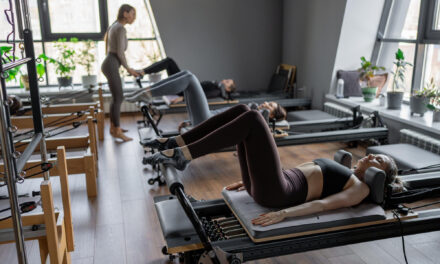
Group classes come in two broad types. Mat classes use the floor and small props, and reformer or other apparatus classes use spring-loaded equipment that adds resistance and support. A good instructor circulates, offers hands-on or verbal adjustments and offers easier or harder versions of the same movement. Spring resistance is not standardized across brands, so a “medium” setting in one studio can feel different in another; follow your instructor and the equipment manufacturer’s manual rather than any universal spring chart. For an overview of the machine itself, see reformer Pilates explained.
Private and Semi-Private Sessions
Private sessions put one teacher with one client, and semi-private sessions typically pair or group two or three people. The teacher can build a program around your history, goals and preferences, and every cue is aimed at you. These sessions are generally the most expensive per visit, which is why many people use them as periodic check-ins rather than a weekly habit. They are especially useful for learning apparatus safely, or for working with a teacher who coordinates with your clinician after an injury or surgery.
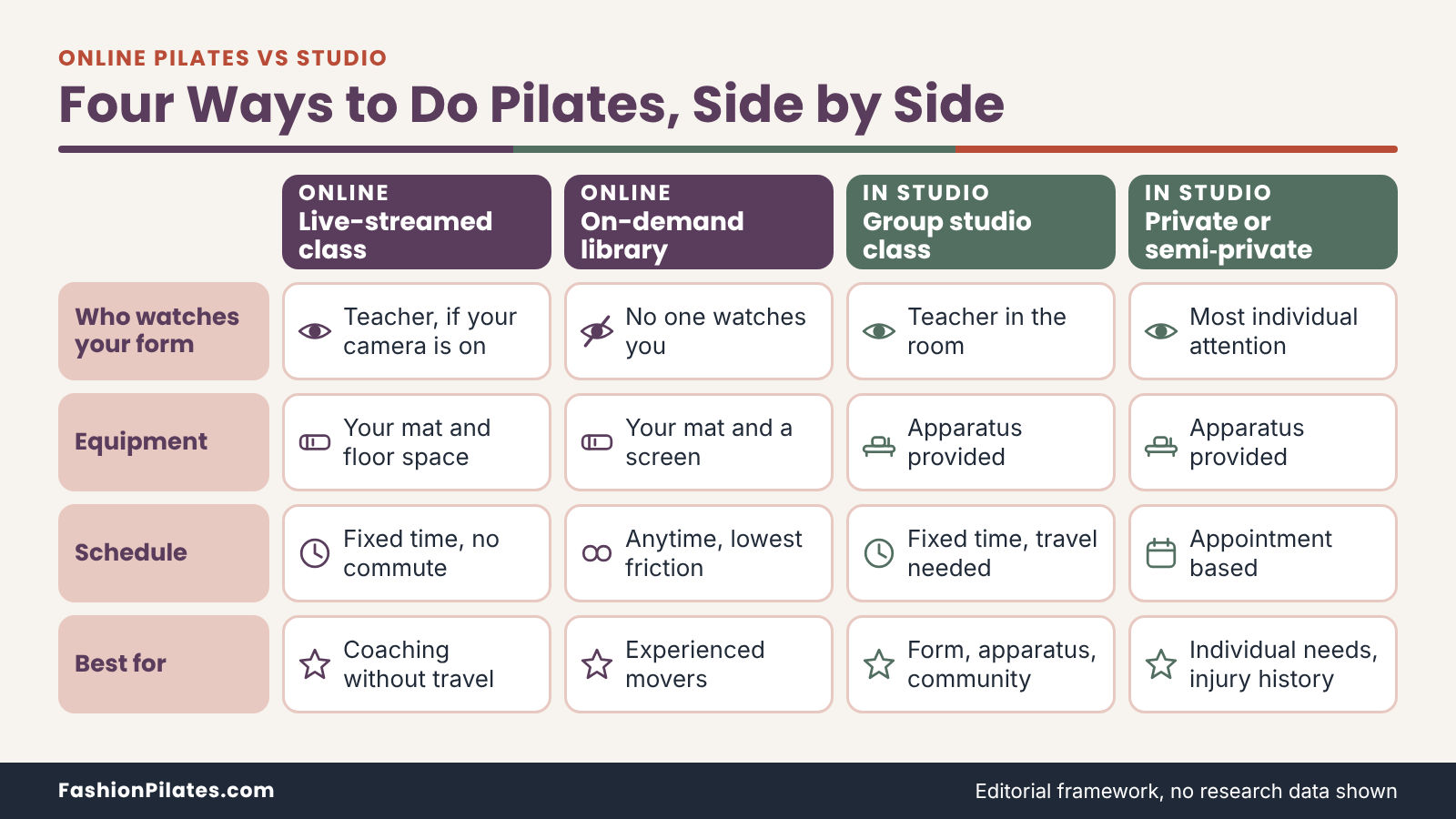
The table below puts the four formats side by side so you can see where the trade-offs sit before we get into the details.
| Format | Who watches your form | Equipment needed | Schedule | Best for |
|---|---|---|---|---|
| Live-streamed class | Teacher, if your camera is on and the class is small enough | Floor space, mat, camera angle | Fixed times, no commute | People who want coaching without travel |
| On-demand library or program | No one | Floor space, mat, screen | Anytime | Experienced movers and busy, irregular weeks |
| Group studio class | Teacher in the room | Provided, including apparatus | Fixed times, travel required | Learning form, apparatus access, community |
| Private or semi-private | Teacher focused on you or a very small group | Provided, including apparatus | Appointment based | Individual needs, injury history, skill building |
What the Research Actually Says
Online Pilates arrived in force during the pandemic, and researchers took notice. A handful of small randomized trials now compare live video classes with in-person ones. They are worth knowing, as long as you also know how far they stretch and where they stop.
Trials Comparing Live Online With In-Person Classes
Two published trials are especially useful because they put the same style of Mat Pilates on a screen and in a room, using comparable schedules and instructors. Both were short, both involved healthy adults and both are summarized here in plain English.
Zoom Versus Studio in Healthy Young Women
One randomized controlled trial, indexed in PubMed Central, assigned sedentary, healthy women aged 20 to 45 to Mat Pilates delivered over live Zoom or in a studio. Sessions ran 45 minutes, twice a week for eight weeks, taught by two certified instructors who covered both formats. Both groups improved in muscle strength and flexibility tests, with no meaningful difference between them. Reported adherence was 80 percent for the Zoom group and 74 percent for the studio group. The authors listed a small sample, young sedentary participants and self-reported data as limits.
Teams Versus Face-to-Face in a Second Trial
A second randomized trial, reported in BMC Sports Science, Medicine and Rehabilitation, split 58 healthy adults aged 25 to 40 into online Pilates over Microsoft Teams, face-to-face Pilates at a university, or a control group doing breathing and relaxation at home. The Pilates groups trained three days a week for an hour over eight weeks. Both Pilates groups improved core endurance measures, and the control group did not. The in-person group did better on one back-extension test, while the online group did better on a trunk-flexion test. The authors noted that one person taught both Pilates groups.
What the Evidence Cannot Tell You
It would be easy to read those results as a verdict that a screen is as good as a studio. That is a bigger claim than the data can carry, and a careful reader should know why.
Narrow Populations and Small Samples
Both trials were small, lasted eight weeks and enrolled healthy adults in their twenties to forties. The first one reported that it fell short of its planned statistical power, which is the study’s ability to detect a real difference. Instructors were trained and were teaching both groups, so the results describe good teaching delivered two ways, not the average app. Findings from healthy adults on simple fitness tests also say little about older adults, people with injuries, or anyone with a medical condition. Treat the results as encouraging, not definitive.
What Is Missing: Apparatus, On-Demand and Individual Needs
Neither trial tested reformer work, on-demand libraries where no one watches you, or long-term habits beyond two months. They also cannot predict whether a particular platform is any good. For context on how much movement counts overall, the CDC’s adult activity guidelines describe 150 minutes of moderate-intensity activity a week plus muscle-strengthening on at least two days, and the agency’s advice on adding activity stresses choosing activities you enjoy and that match your abilities. In plain terms, the best format is the one that fits your body and your calendar well enough that you actually keep showing up.
Cost: Doing the Math Beyond the Sticker Price
Studios and online platforms price themselves differently, so the headline numbers rarely compare cleanly. Studios tend to sell drop-ins, class packs and memberships, while platforms sell monthly or annual access. Prices also vary widely by city and by provider and change often, so this section teaches you how to compare costs rather than quoting figures that will be stale by the time you read them.
Cost per Class You Actually Attend
The most useful number is not the price on the pricing page. It is what you pay divided by what you really do, and that gap is where both formats quietly win or lose.
The Attendance-Adjusted Formula
Add up everything you pay for a month, including extras, then divide by the number of sessions you complete. Try it with round numbers that are illustrative only and not real prices. A platform costing $20 a month works out to $5 per class if you finish four sessions, and under $2 if you finish twelve. A studio plan costing $200 a month works out to $25 per class at eight visits and $50 per class at four. The format with the lower sticker price is not automatically the bargain, and the format you will actually use almost always is.
Hidden Costs on Both Sides
Studio costs that do not appear on the menu include parking or transit, childcare, time spent commuting, and the occasional fee for a missed class. Online costs include a reliable internet connection, a way to prop up a phone or tablet, a mat you like, and any props a program calls for. Accessories deserve a skeptical eye in both settings; a drawer of colorful resistance bands and a ring you used twice is a very real category of spending. Add your own hidden costs before comparing totals.
Policies That Change the Real Price
Fine print is where a fair price turns into an expensive month. Cancellation rules, credit systems and renewal terms deserve ten minutes of reading before you commit to anything.
Late-Cancel and No-Show Fees: A ClassPass Example
ClassPass is a useful illustration because it publishes its rules. According to its official cancellation policy page, reservations can generally be canceled up to 12 hours before the start time without a charge. Canceling later triggers a late-cancel fee, with the page listing a range of $10 to $56 in the United States, and a missed reservation fee ranges from $12 to $62. The page also says ClassPass has discretion to keep credits instead of charging a fee. These figures were listed as updated in August 2026, so check the current listing, and remember that individual studios outside ClassPass set their own policies.
Credits, Expiry and Auto-Renewal
ClassPass’s overview page explains that members receive a monthly credit allotment by plan. The number of credits a class costs varies by business, location, booking time and popularity, and credits cannot be transferred, refunded or exchanged for cash. Unused credits roll over monthly up to the credit amount of your next plan, and plan availability varies by location. The general lesson applies to every provider: a credit system, a class pack with an expiration date and an annual plan that renews on its own are all designed around the habits of the average customer, so find out what happens when you are not average.
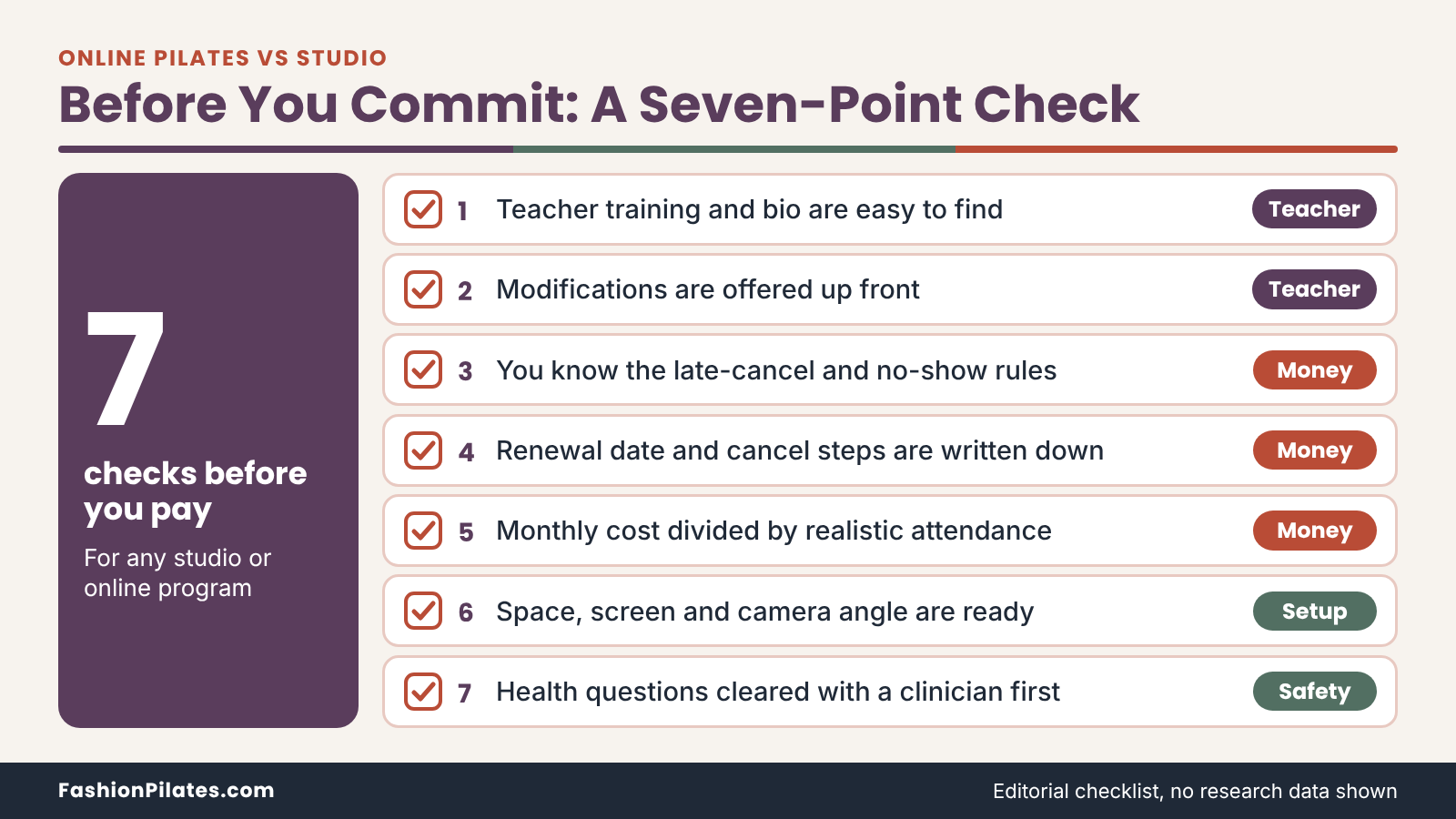
Before you subscribe to any online platform, note the trial length, the renewal date and the cancellation steps in the first five minutes, and set a reminder for two days before the trial ends. That small habit prevents a surprising amount of regret. The table below turns these cost factors into a checklist you can run for any provider.
| Cost factor | Studio classes | Online programs | What to ask or check |
|---|---|---|---|
| Base price | Drop-in, pack or membership | Monthly or annual subscription | Total per month at your real attendance |
| Travel and time | Parking, transit, commute time | None | Door-to-door minutes per session |
| Equipment | Provided, including apparatus | Your own mat and props | What a program says you need |
| Cancellation rules | Window and fee set by each studio or platform | Trial conversion, renewal date | Written policy, in plain terms |
| Expiry | Class packs and credits may expire | Annual plans renew automatically | Date to cancel before the next charge |
Coaching and Feedback: Who Is Watching You Move
Pilates is a movement method built on precision, and precision depends on feedback. This is the factor that matters most for beginners and for anyone using equipment, so it deserves the longest look.
What a Studio Teacher Can Do That a Screen Struggles With
A teacher standing in the room has two advantages a video call cannot fully copy: the ability to adjust the equipment and the body, and a three-dimensional view of what you are doing.
Hands-On Cues and Equipment Setup
On apparatus, the setup is part of the exercise. Headrest position, bar height and spring choice change how a movement feels, and a teacher who knows your proportions can set these quickly. Many instructors also offer a light tactile cue, a touch on a hip or shoulder blade to show where to direct a movement. Reasonable studios ask for consent first, and you are free to say no. Equipment details such as spring settings differ by brand, so the manufacturer’s manual and your teacher’s instructions outrank any chart you find online.
Reading the Room in Real Time
A teacher in the room sees things a flat camera view can miss: a rib cage flaring, a pelvis tipping, a leg trembling a little too early in a long hold. That last one is the classic Pilates shake, which is the body’s way of saying the set has been long enough. Seeing it lets the instructor offer an easier option before you lose control of the movement. You can also ask a question mid-class and get an answer pitched at your body, not at the average viewer.
What Good Online Coaching Looks Like
Online coaching can be good, but it is a different skill, and you can judge it before you pay. The question to ask is how a platform replaces the feedback a room gives for free.
Two-Way Video, Small Classes and Camera Angles
In live classes, look for a format where the teacher can actually see you and where class size is small enough for them to speak to individuals by name. Place your camera at floor level and at an angle that shows your whole body, preferably from the side for spine and pelvis work, so your teacher is not guessing. If you cannot make out the teacher’s alignment on your own screen, that is worth knowing too. Good online teachers also describe movements in words, because they know you may not be looking at the screen when you are on your back.
Checking a Teacher’s Training Without a Studio Tour
You cannot judge a teacher’s credentials from their ponytail, so read the bio. Look for named training programs, years of teaching and any mention of continuing education. The Pilates Method Alliance is a professional association that maintains a membership directory and accredits teacher-training programs, which can help you check a teacher’s background, though credentials vary and no single badge guarantees a good class. Then listen for the things training should produce: clear starting positions, breathing cues, modifications offered up front and plain advice to stop or skip a movement if something feels wrong.
The table below compares the kinds of feedback each format can realistically provide, which makes it easier to decide how much live coaching you need.
| Type of feedback | Group studio | Live online | On-demand |
|---|---|---|---|
| Verbal cues aimed at you | Yes, often by name | Yes, if camera is on and class is small | No, general cues only |
| Hands-on adjustment | Yes, with your consent | No | No |
| Equipment setup help | Yes | Limited to your own gear | Limited to your own gear |
| Personalized modification | Yes | Yes, verbally | Only what the video offers |
| Ability to ask a question | Yes, in the moment | Yes, via chat or voice | Rarely |
Convenience, Consistency and Motivation
The best Pilates plan on paper loses to the one that fits your Tuesday. Convenience is not a luxury feature here, because the benefits people usually want from Pilates depend on repetition over weeks and months.
Time and Schedule Reality
Time is the resource most people underestimate when they compare formats. A class is not 45 minutes long; it is the 45 minutes plus everything wrapped around it.
The Commute Math
Suppose a studio is 15 minutes away. A 45-minute class then occupies roughly 75 minutes once you add the drive each way, and a little parking or changing time pushes it higher. Three classes a week would use about 90 extra minutes just getting there and back. For context, the CDC’s adult guideline of 150 minutes of moderate activity a week means those travel minutes alone could equal more than half the weekly total. Online classes remove that overhead, which is a real advantage for anyone whose limiting factor is time and not money.
Travel, Caregiving and Shift Work
If your week changes constantly, a platform that fits into a gap between meetings, school pickups or night shifts can be the difference between practicing and not practicing. On-demand classes handle unpredictable calendars best, since there is no start time to miss. Live classes still help if your schedule is stable and you want structure. Travelers can bring a mat-based routine anywhere with a screen and a bit of floor, and a dedicated plan for hotel rooms is covered in Pilates travel plan. The studio’s advantage is the opposite one: a time and place that exist whether or not your week cooperates.
Motivation, Accountability and Community
Motivation is not a character trait; it is mostly a setup problem. The format you choose either builds in friction against skipping or leaves it entirely to willpower.
Booked Class Versus Open App
A reservation creates a small obligation. Someone is expecting you, a spot has been held and, depending on the policy, skipping costs something. An app asks nothing of you, which makes it easy to open and just as easy to ignore. If you choose online, borrow the studio’s trick: block specific times in your calendar, treat them like appointments and pick live sessions for at least part of the week. The CDC suggests using a written plan or activity diary, and that principle works for any format.
Community, Distractions and the Home Environment
Studios offer a familiar room, regular faces and a teacher who learns your name and remembers your tight hamstrings. Home practice offers privacy and zero pressure, along with a laundry basket, a curious dog and a family member who chooses that moment to ask where the scissors are. Headphones, a closed door and a quick heads-up to the household help. Many platforms offer chat or community features, though the quality of those spaces varies, so judge them by a trial week and not by the sales page.
Space, Equipment and Setup
Online Pilates is cheaper only if you can practice comfortably, and the setup does not have to be elaborate. A small, thoughtful corner beats a dedicated room you never use.
A Minimum Home Setup
Mat-based classes need very little. What they do need is a surface and a view of the teacher, and both are easy to get wrong.
Floor, Mat and Small Props
You need a clear rectangle of floor roughly the length of your mat plus an arm’s reach on each side. A firm, non-slip surface is generally more comfortable for spine and hip work than a thin rug on a slippery floor. A Pilates mat is the one product most home practitioners should buy first, and the choice of thickness and grip is covered in choosing a Pilates mat for home practice. Props such as a small ball, a band or a ring are optional, and a good class tells you in advance what to have nearby. Start without them and add only what a program actually uses.
Screen, Sound and Camera Position
Place the screen where you can see it without twisting your neck, ideally at the end of the mat or off to one side. Because you will be lying down, turn the volume up enough to hear cueing from a few feet away. For live classes, test your camera before the session so the teacher sees your whole body, and make sure the lighting shows your outline and not just a silhouette against a window. A wired connection or a spot close to the router prevents the freezes that make a teacher’s careful cue arrive three seconds late.
When Apparatus Changes the Answer
Mat Pilates, the floor-based method, is a complete practice on its own. Apparatus, by contrast, adds something distinct, and it is worth being honest about what that is before you decide a screen can substitute for it.
What Mat Work Can and Cannot Replicate
On the mat, your body weight and gravity provide the challenge, and the exercises build control, strength and mobility with no machine. A reformer adds spring resistance, a moving carriage and the ability to support or challenge the same movement in different ways, which changes how an exercise feels and what it asks of you. Some exercises exist only on apparatus. Online classes that use the floor can be an excellent practice, but they are a different experience from a reformer class, and neither is a downgrade of the other.
Home Reformers Versus Studio Access
A home reformer is a large purchase that needs floor space, clearance, regular maintenance and a safe way to learn. Because spring tension and setup are not standardized, instruction matters more, not less, when no one is next to you. Many people find it sensible to learn the equipment in a studio first, then decide whether home ownership suits them. If you are weighing that route, read home Pilates studio setup guide, and treat any claim that a machine replaces instruction with healthy suspicion.
Choosing by Your Situation
The comparison above becomes useful only when it meets your actual life. Instead of crowning a winner, this section gives you decision rules by experience, constraint and health status, followed by a quick-reference table.
Online Pilates vs Studio for Newcomers and Returners
The more you already know about how Pilates should feel in your body, the less you rely on someone else’s eyes. The reverse is also true.
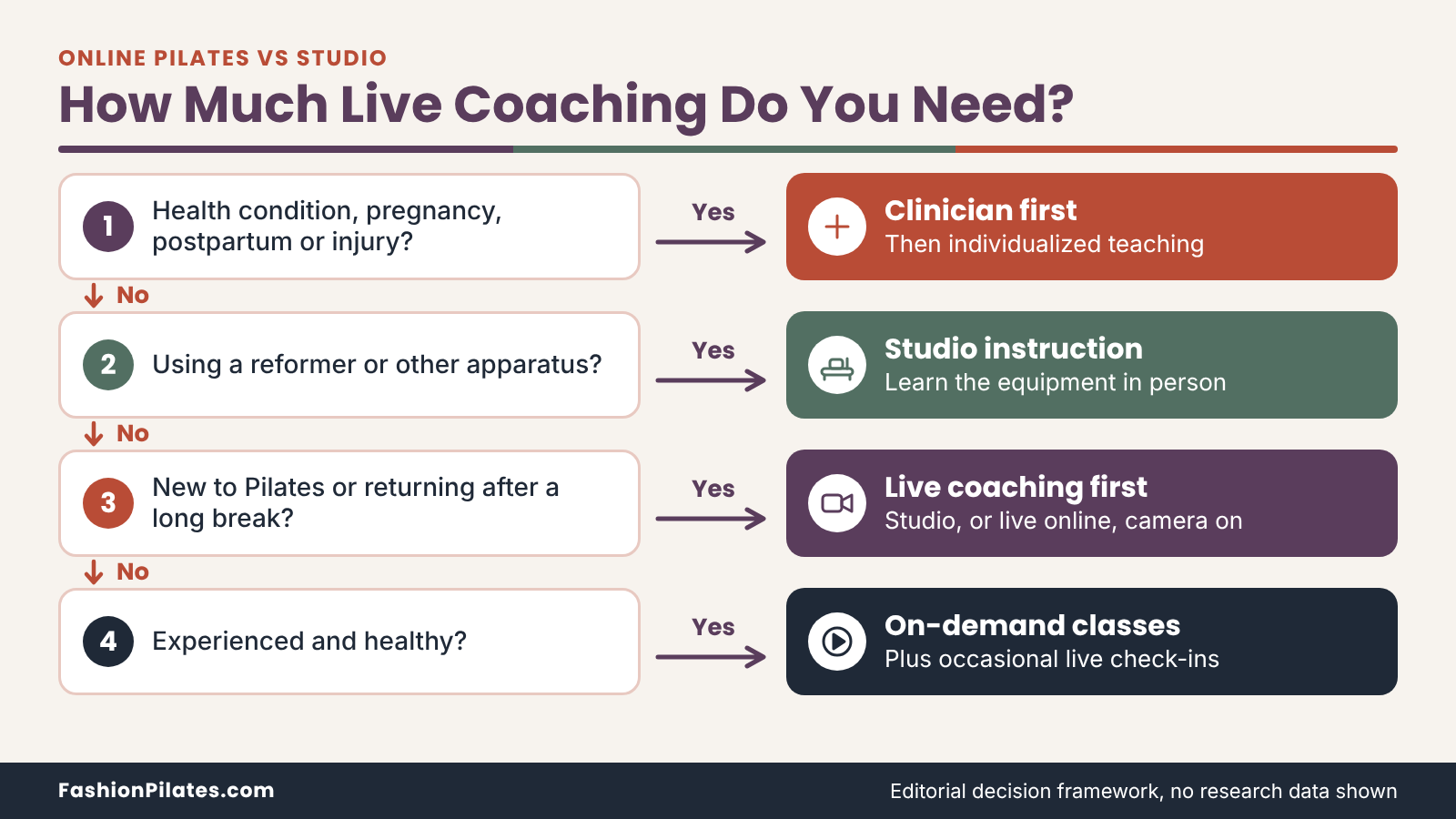
If You Are New to Pilates
New practitioners benefit from live coaching for their first several sessions, whether that means a studio class or a live online class with the camera on. The reason is practical: setup, breathing and basic alignment are easier to absorb with feedback, and early habits tend to stick. Once you can describe the starting position and the purpose of a movement in your own words, adding recorded classes becomes much less risky. If you want a plain-language starting point, see Pilates for beginners guide.
If You Are Experienced or Returning
Experienced practitioners can often use on-demand classes well because they already know how a movement should feel. A periodic private or semi-private session works as a tune-up, catching small habits that drift over time. If you are returning after a long gap, an illness or a layoff, treat yourself as newer than your résumé suggests and start with live coaching again. The point is to rebuild your self-awareness, which is what makes recorded classes safe and effective.
Choosing by Life Constraints and Health
Practical limits are real, and the right format is the one that respects them without compromising safety. Health status, in particular, should shape the decision before price does.
Budget, Schedule and Space Limits
If your budget is tight, a lower-cost online subscription plus an occasional studio drop-in or a single private session for form review can stretch a long way. If your schedule changes weekly, prioritize on-demand classes or live classes with generous cancellation terms. If your space is small, look for classes built around a single mat footprint. A modest plan you follow beats an ideal plan you resent, and you can always upgrade after a few weeks of real data about your habits.
Health Conditions and Special Circumstances
This article is general fitness education, not individualized medical advice. If you are pregnant or postpartum, have osteoporosis, are recovering from surgery or an acute injury, or live with a chronic condition, check with a qualified clinician or an experienced Pilates professional before choosing a format. Those situations generally call for a teacher who can see you, ask questions and adapt the session. The CDC also advises talking with a doctor before vigorous activity if you have been inactive or have a chronic condition. Stop any class and seek advice if you feel sharp pain, dizziness or numbness.
The table below condenses the decision rules into a quick reference for each format.
| Format | Best for | Not ideal if |
|---|---|---|
| Live-streamed class | Learning form with a teacher, when travel is the obstacle | Your internet or camera setup is unreliable, or you want hands-on adjustment |
| On-demand library | Experienced movers, unpredictable schedules, variety | You are new, returning after a long break, or managing a health condition |
| Group studio class | Apparatus access, in-person feedback, community | Commuting is a barrier or class times never match your week |
| Private or semi-private | Individual needs, injury history, learning equipment | You want a frequent, low-cost routine |
Hybrid Plans and Smart Trials
For many people the practical answer to online pilates vs studio is both, in proportions that change with the season of life. A hybrid week keeps the coaching benefits of a room while borrowing the flexibility of a screen, and a few well-run trials will tell you what mix is realistic.
Building a Hybrid Week
The goal of a hybrid plan is not to do everything. It is to give each format the job it does best, so your studio time buys feedback and your online time buys consistency.
Three Sample Patterns
One common pattern pairs a single weekly studio class with two online sessions at home. Another leans on live online classes twice a week, with one recorded class on a day that falls apart. A third keeps two studio visits and adds a short on-demand session for travel weeks. Use the CDC’s weekly guideline of muscle-strengthening on at least two days as a yardstick, not a prescription, and remember that how much any particular class counts depends on its content and intensity. The table below sets out each pattern with its trade-offs.
| Pattern | Weekly mix | Best for | Watch out for |
|---|---|---|---|
| Coach plus practice | 1 studio class, 2 online sessions | Learning form while keeping costs and commute down | Drifting from the studio and losing feedback |
| Live at home | 2 live online classes, 1 on-demand | People who want a teacher but can’t travel | Camera off, which cuts feedback |
| Studio first | 2 studio classes, 1 short on-demand | Apparatus users and people who thrive on routine | Missed commutes turning into missed weeks |
Using Studio Visits as Form Check-Ins
If most of your practice happens at home, treat each studio visit as a checkup. Arrive early, tell the teacher which movements you do online, and ask them to watch the two or three exercises you find hardest. Ask for modifications and for the cue that most improves your version of each one. Then take that cue home and use it in your online classes. A single corrected habit often does more for your practice than a month of unattended repetitions.
Trials and Exit Strategy
A trial is the cheapest research you will ever do on a Pilates purchase. Run it deliberately, with a short list of questions, and leave yourself a clean way out.
How to Trial a Studio
Many studios offer an introductory class or short package; check the current listing for terms, since offers change. Book two or three different teachers if you can, because the instructor shapes the experience as much as the room does. Tell the teacher about any injuries or conditions before the class begins. Notice whether they explain the equipment, offer modifications and make eye contact, and ask about class size, adjustment policies and cancellation rules. To see how this plays out in one city, read best Pilates studios in Los Angeles.
How to Trial an Online Program
Use a free or low-commitment trial as a one-week experiment. Take at least three classes from two different teachers, including one at a level that feels slightly easy. Judge them on cueing clarity, how well modifications are explained and whether you could repeat the movements correctly without watching the screen. Record the renewal date and the cancellation steps as soon as you sign up, and if a program makes canceling hard to find, treat that as information about the company, not about you.
Common Mistakes, Red Flags and Safety
Most regrets in this category are not about choosing the wrong format. They come from choosing the right format badly: rushing into a commitment, skipping the basics or ignoring a signal the body is sending.
Mistakes That Waste Money or Momentum
Two mistakes account for a large share of unused memberships and subscriptions, and both are easy to avoid once you know to look for them.
Buying Long Commitments Too Early
Annual plans and large class packs are priced to reward certainty, and certainty is exactly what you lack in week one. The fix is simple: start with the shortest commitment available, even if the per-class price is higher, and move to a longer one after you have kept a routine for a month or two. Check whether packs expire and whether unused sessions roll over. A discount on something you stop using is not a discount.
Treating a Video as Supervision
Following a recorded class feels like being coached, but nobody is checking whether your pelvis tilted or your neck strained. The common errors are copying a teacher’s range of motion instead of your own, skipping the easier option and holding your breath through effort. The fix is to pick a level below your ego, use the modifications on offer, pause the video when needed and cut a set short when form slips. Advanced exercises deserve an instructor, whatever the platform promises.
Red Flags and When to Stop
Good providers make it easy to see how they work. When you cannot find basic information, or when a promise sounds too tidy, the product may not be as careful as the marketing.
Red Flags in Studios and Platforms
Be cautious when teacher bios are missing, modifications are never mentioned or the marketing promises to transform your body, fix a medical issue or deliver results by a fixed date. Pilates is a form of low-impact exercise, not a treatment, and responsible providers do not suggest otherwise. Pressure to sign a long contract on the spot, cancellation rules that are hard to find and class sizes too large for any individual attention are also warning signs. Trust your read of how the provider communicates.
Stop Signs and When to Get Help
Stop and seek advice if you feel sharp pain, dizziness, numbness, chest discomfort or unusual shortness of breath. Mild effort, muscle fatigue and the shaking of a hard hold are different from those signals and usually ease when you rest. For older adults, the CDC’s activity guidance for adults 65 and older adds regular balance work to the weekly picture and says to stay as active as abilities and conditions allow. A qualified clinician or an experienced Pilates professional can help you choose a format that fits your situation, especially if balance, bone health or recovery is a concern.
Frequently Asked Questions
Is online Pilates as effective as studio Pilates?
Research on live-streamed Mat Pilates suggests it can be comparably effective to in-person classes for healthy adults over about eight weeks. Two small randomized trials found similar improvements in strength, flexibility and core endurance across formats, with a few small differences on individual tests. Those studies used trained instructors teaching live, so the findings do not automatically apply to recorded classes. They also did not study reformer work or people with health conditions. In daily life, results depend heavily on whether you keep attending.
Which is cheaper, online Pilates or studio classes?
Per session, online options are usually cheaper, but the real answer depends on how often you attend. Divide your total monthly cost, including travel and extras, by the sessions you actually complete. A low-priced subscription you rarely open can cost more per class than a pricier plan you use weekly. Studios can also add late-cancel or missed-class fees, and ClassPass lists such fees on its official policy page. Prices change, so compare current listings and not any figure you read in an article.
Can I learn Pilates from videos alone as a complete beginner?
You can, but a video-only start may carry more risk and a slower learning curve than starting with live feedback. A recorded class cannot see whether your setup or breathing is off, so small errors can repeat unnoticed. If you begin with recordings, choose clearly labeled beginner classes, use every modification offered and keep your range of motion modest. Adding even a few live or studio sessions early can speed up your understanding. If you have a health condition, check with a clinician first.
Do I need a reformer to do Pilates online?
No, you do not need a reformer, because Mat Pilates is a complete method built around floor-based exercises. A reformer adds spring resistance and a moving carriage, which changes how exercises feel and what they challenge. Most online classes are mat-based and use optional small props. If you want reformer work, a studio is the safest place to learn it first. A home machine makes more sense later, once you know how you like to work.
What equipment do I need for online Pilates at home?
For most mat classes you need a clear patch of floor, a non-slip mat and a screen you can see while lying down. Small props are optional, and a good class lists what to have nearby ahead of time. A phone stand or a shelf helps keep the screen at a useful angle. A reliable internet connection matters most for live classes. Start with the basics and add equipment only when a program asks for it.
How often should I take studio classes if I mostly practice online?
There is no universal number, but many people find that one studio visit every week or two works well as a form check. The goal is regular feedback, so bring specific questions and ask the teacher to watch your hardest movements. If you are new, returning from a break or learning apparatus, more frequent live sessions make sense at first. You can reduce the frequency as your confidence grows. Let your budget and calendar set the upper limit, and talk to your teacher if you are unsure.
Is online Pilates safe during pregnancy or with an injury?
Online Pilates may still be an option in those situations, but the decision belongs with a qualified clinician and not with a platform’s marketing. Pregnancy, postpartum recovery, osteoporosis and recent surgery all call for individualized adjustments. A teacher who can see you and ask follow-up questions is often the better choice in those cases. Look for a teacher with relevant training and share your history before class. Stop and seek advice if you feel sharp pain, dizziness or numbness.
How do I know whether an online Pilates teacher is qualified?
Start with the teacher’s bio, which should name their training programs, teaching experience and any continuing education. The Pilates Method Alliance maintains a membership directory that can help confirm professional involvement, although no single credential guarantees good teaching. Listen to the class itself for clear starting positions, breathing cues and modifications offered at the start. Be wary of providers that promise body transformation or medical outcomes. A teacher who cannot be identified at all tells you something too.


Trackbacks/Pingbacks