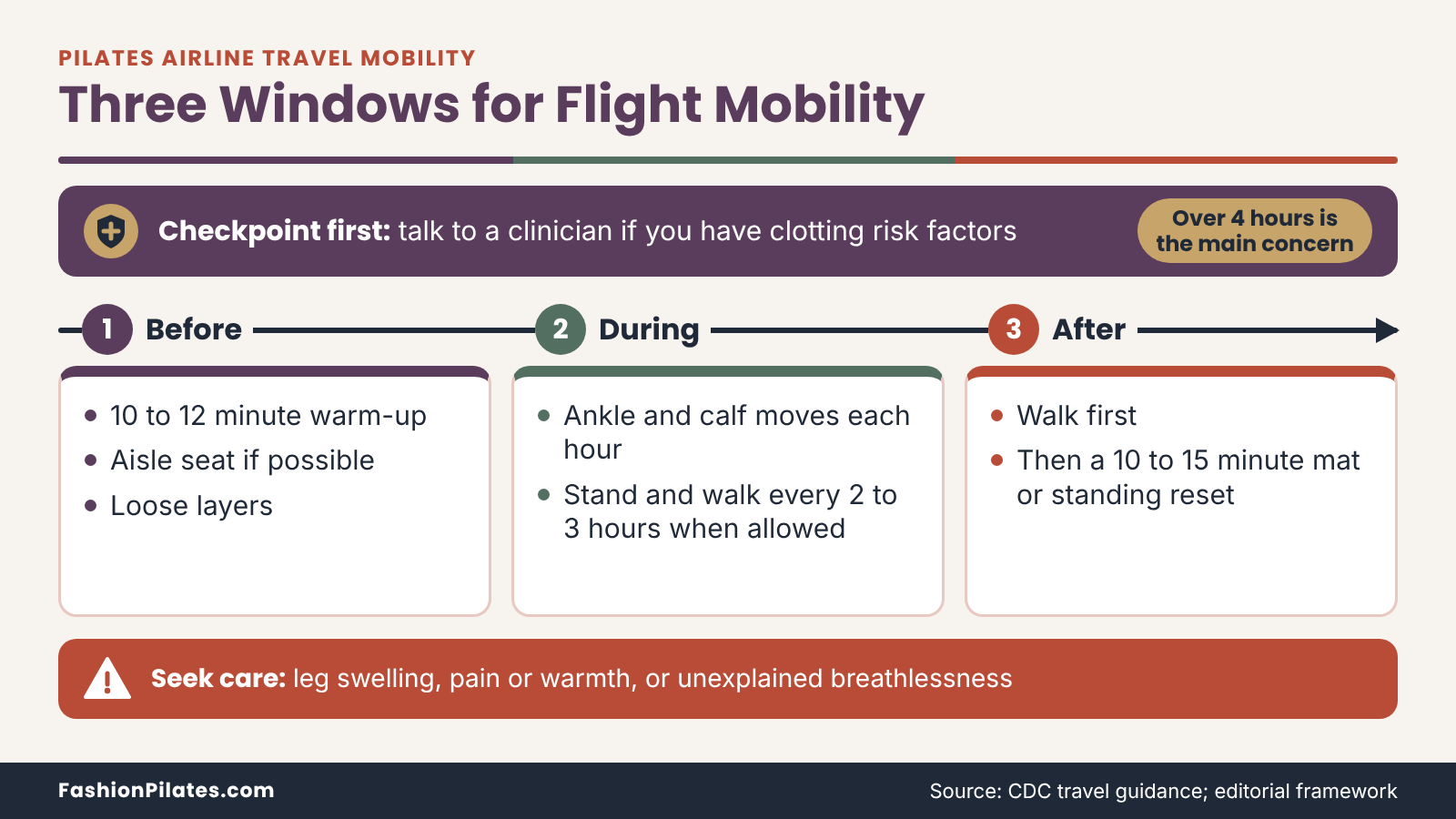
Direct answer: Pilates airline travel mobility comes down to three windows: a short warm-up before you fly, small movements every hour or so in the air, and a 10 to 15 minute reset after landing. A few well-chosen carry-on tools can make that easier, but the plan works with no gear at all. Health agencies point to walking and calf exercises as the core habits on long flights, and to a clinician conversation first if you have clotting risk factors.
This guide is for people who already love Mat or Reformer Pilates and want that body awareness to survive a six-hour cabin. It covers the sequence itself, a criteria-led way to decide what is worth packing, and the safety lines you should not cross. It is general fitness education, not individualized medical advice, and it names no specific products. For the wider picture, start with the Pilates travel and retreats hub.
What Pilates Airline Travel Mobility Really Means
Before choosing a single sock or band, it helps to be clear about the job. Flying asks your body to sit still in a cramped position for hours, and Pilates habits (controlled movement, steady breathing, attention to alignment) happen to suit that problem well.
Pilates airline travel mobility, defined in plain English
Mobility here means moving your joints through comfortable ranges and keeping your muscles gently active, not stretching hard or chasing a workout in row 31.
The three-window idea
Think of a trip as three windows. The first is preparation: a brief session on departure day that wakes up your hips, spine and calves without tiring you. The second is the flight itself, where the goal is frequent, small, low-effort movement rather than one big effort. The third is the reset, a short floor or standing sequence at your destination that returns your body to normal range.
Splitting the plan this way prevents the most common mistake, which is saving every stretch for the hotel room and doing nothing for the eight hours that created the stiffness.
What this guide covers, and how it was built
This is a research-based comparison built on public health guidance, a published systematic review summarized by a medical journal, and category criteria for travel gear. The team did not do hands-on product testing, did not fly with the routines for this piece, and does not rank brands. Where numbers appear (flight length thresholds, compression pressure ranges, risk windows), they come from the sources linked beside them, and any price or availability question is left to the current listing from the seller or manufacturer.
The exercise descriptions are standard, widely taught movements adapted for a seat. They are deliberately gentle, because a cabin is the wrong place to experiment.
Why long flights ask so much of your body
Two features of a flight matter most for mobility: how long you stay in one position and what the cabin does to your comfort.
Hours of sitting and the calf muscle pump
When you sit for a long time, your calf muscles are mostly idle, and those muscles help push blood back up the legs when they contract. That is why guidance for travelers keeps coming back to the same two habits: stand and walk periodically, and work the calves while seated. The Mayo Clinic explains that sitting for long stretches, as when driving or flying, raises the chance of deep vein thrombosis, and suggests simple heel raises when walking is not possible.
Notice what this implies for a Pilates fan. You already know how to move the feet, ankles and calves with precision. Flights are one of the few places where that skill pays off in the most literal way.
Dry air, tight seats and the stiffness that follows
Comfort is the other half. CDC clinical guidance notes that aircraft cabin air is typically dry, often 10 to 20 percent humidity, which is why dry eyes and throat are common and why staying hydrated is a sensible baseline. Add a seat designed for averages, a tray table with the structural ambition of a clipboard, and a neighbor who owns the armrest, and you get the familiar post-flight feeling of a hip flexor that has forgotten its job.
None of that is dangerous in itself. It is simply the predictable result of low movement, and it responds well to the small, frequent changes in position this guide describes.
Safety First: Risk, Clinician Checks and Warning Signs
Safety comes before sequences because the main medical concern on long flights, venous thromboembolism (a blood clot in a deep vein, or one that travels to the lungs), is the reason movement guidance exists at all. Most travelers never face it, yet a few should plan differently.
What the health agencies say about flights and blood clots
The numbers are worth knowing, mainly because they are smaller than the internet makes them sound.
The four-hour line and the size of the risk
CDC clinical guidance for travelers says long-distance travel beyond about four hours is the main concern. For flights over four hours, it describes the absolute risk of a clot as roughly 1 in 4,656 to 1 in 6,000 person-flights, and notes that air travel may raise the overall risk of clots two to four times, mostly in people who already have risk factors. It also says the risk falls over time after a flight and returns to baseline by about eight weeks, with most flight-related clots appearing in the first one to two weeks.
In plain terms, the odds for any one healthy traveler are low, but they are not zero, and they rise with flight length and personal risk factors. The table below shows how the sources change their advice as flights get longer.
| Flight length | What the sources point to | Practical movement approach |
|---|---|---|
| Under 4 hours | CDC clinical guidance describes negligible symptomatic clot risk on shorter flights | Prepare lightly, do seated ankle work, stand once if the cabin allows |
| 4 to 6 hours | The main concern begins past the four-hour mark; walking and calf exercises are the core advice | Seated circuit each hour, one aisle walk every two to three hours |
| Over 5 to 6 hours | Trials of compression stockings covered flights over five hours; CDC suggests stockings for higher-risk travelers on flights over six | Add a clinician conversation about socks if you have risk factors |
| Ultra-long or multi-leg | Total sitting time accumulates; risk window after travel lasts up to eight weeks | Break up airport time too, and watch for symptoms for weeks afterward |
Who sits in the higher-risk group
The same CDC page lists risk factors that include cancer, estrogen use, recent surgery or hospitalization, obesity, older age, pregnancy, a previous clot, inherited clotting disorders and a family history of clots. It also reports that the large majority of people who developed a travel-related clot had at least one such factor already. Height at the extremes (under about 5 feet 3 inches or over 6 feet 3 inches) was also listed.
If any of that describes you, the right first step is not a stretch routine. It is a conversation with your own clinician about whether stockings, medication or a different plan make sense for your trip.
Warning signs and who should skip or modify
A good plan includes knowing when to stop and when to call someone.
Symptoms that mean call a clinician
The CDC traveler page describes deep vein thrombosis symptoms as swelling, pain or tenderness, and warm, reddened skin in the affected area, and pulmonary embolism symptoms as trouble breathing, a fast heart rate, chest pain (especially when coughing) and possible fainting. It advises seeking care immediately if these appear. Those are not signs to stretch through. If one calf is suddenly swollen, tender or warm, or you feel unexplained shortness of breath, treat it as urgent and do not massage the area or push more movement.
Some clots cause no obvious symptoms, which is why prevention habits and risk awareness matter more than waiting to feel something.
Skip or adapt rules for this routine
Check with a qualified clinician or Pilates professional before using the sequences here if you are pregnant or postpartum, have had recent surgery, have osteoporosis, have an acute injury, or manage a chronic condition affecting circulation, balance or the heart. Stop any movement that causes sharp pain, dizziness, numbness or tingling, and sit back down. Skip standing moves entirely when the seatbelt sign is on, and follow crew instructions over anything written here.
Everything in this article is meant to be mild enough that most healthy adults could do it comfortably, but mild is not the same as universal.
Before You Fly: Preparation That Pays Off
The preparation window is short by design. You are not training for the flight; you are arriving at the gate with joints that move easily and a plan for where you will sit. A related guide on everyday carryover is covered in Pilates travel posture guide, so this section stays focused on the flight itself.
The 12-minute pre-flight mobility session
Do this at home or in the hotel before you leave for the airport, ideally with at least an hour to spare before you need to be anywhere.
The warm-up sequence, one action at a time
Start standing with feet hip-width apart and take five slow breaths, letting the lower ribs widen sideways on each inhale. Then move to hands and knees for six to eight slow cat-cow rounds, inhaling as the spine gently lengthens and exhaling as it rounds. Follow with five thread-the-needle rotations per side, sliding one arm under the chest and turning only as far as feels easy. Finish with a half-kneeling hip flexor stretch held for about 30 seconds per side, a set of 12 to 15 standing calf raises, and slow ankle circles.
That is roughly 12 minutes at an unhurried pace. If you know the shapes from a beginner Mat Pilates workout, you can borrow the same cues. If any step pinches your knee, wrist or back, skip it or shorten the range.
What to avoid on departure morning
Skip anything that will leave you sore or depleted. A hard core session or a deep, end-range hamstring stretch the morning of a flight can turn into the thing you are trying to sit through for six hours. The same goes for a brand-new exercise you have never tried; a cramped cabin is a poor place to discover that something does not agree with you.
This is editorial judgment rather than a research finding, and it follows a simple principle: use familiar movements, keep effort low, and leave energy in the tank. If you get anxious about missing a flight, a 5-minute version (breathing, calf raises, cat-cow) is better than skipping it or rushing a long one.
Seat, outfit and booking choices
Two decisions made before you leave home shape how much you can move later: where you sit and what you wear.
Seat selection and why the aisle helps
CDC clinical guidance notes that in studies, window-seat passengers had about twice the risk of a clot compared with aisle passengers, which is commonly explained by how easily people can get up. That is an association, not proof that the seat itself causes anything. Still, an aisle seat makes standing and walking easier without climbing over a neighbor, and that matters more than almost any gadget.
The trade-offs are real. Aisle seats get bumped by carts and passersby, and you give up a wall to lean against while sleeping. If the aisle is not available or costs extra, plan your breaks around the moments your neighbors stand anyway, such as meal service and landing preparation. Check the fare rules for seat selection, since policies vary by airline.
What to wear when you plan to move
The NHS suggests loose clothing and plenty of water on journeys of four hours or more, along with walking when you can. For a Pilates fan, that translates into soft, stretchy layers that let the hips and knees bend freely: a waistband that does not dig in when you sit, knee areas without tight elastic, and a cardigan or wrap because cabins can swing from stuffy to chilly.
Choose shoes you can slip on quickly and walk in, and keep them on for aisle trips. Grip socks are great on a studio floor and not a substitute for shoes in a cabin walkway or lavatory. Save the barefoot work for your destination.
The Gear Decision: A Criteria-Led Buying Guide
Here is the commercial truth of the category: almost every tool in this section is optional. The in-seat sequence later works with an empty lap. What gear can do is make the movements easier, more comfortable or more repeatable, and the useful question is which items earn their place in a bag you already struggle to close.
Compression socks: how to evaluate them
Compression socks are the one item with trial evidence behind it, which makes them the best place to be a careful shopper.
What the trial evidence supports
A summary of a Cochrane review in American Family Physician describes nine randomized trials with 2,821 participants, all on flights over five hours. Travelers wearing below-knee compression stockings had far fewer symptomless clots found on scanning, roughly 1 percent down to 0.1 percent for lower-risk travelers and 3 percent down to 0.3 percent for higher-risk ones. No deaths, pulmonary embolisms or symptomatic clots were reported in those studies.
The limits matter as much as the headline. Participants could not be blinded to wearing stockings, and it remains unclear whether stockings prevent symptomatic clots, pulmonary embolism or death, since those events were so rare. The review also could not identify an ideal pressure, with trials using 10 to 30 mmHg. The American Society of Hematology suggests stockings for higher-risk travelers on longer flights, while routine use for everyone remains debated.
Fit, pressure and fabric criteria
CDC clinical guidance describes graduated below-knee stockings with 15 to 30 mmHg of ankle pressure as the range recommended for higher-risk passengers on flights over six hours. If you decide to buy, use criteria rather than marketing:
- Pressure printed on the label: look for a stated mmHg range, not just “support” or “energizing.”
- Graduated design: tighter at the ankle, easing upward, and below-knee unless a clinician says otherwise.
- Size by measurement: follow the maker’s chart for ankle and calf circumference rather than guessing from shoe size.
- Test at home first: wear them for a few hours so you find rolled tops, pinching or numbness before the airport.
- Breathable fabric: you will wear them for many hours in dry, variable-temperature air.
Ask a clinician first if you have circulation, skin or nerve concerns, and remove them if they cause pain, numbness or tingling. Grip socks and sports socks are not compression socks, however nicely they match your set.
Small tools that earn carry-on space
Everything below is optional, and the table sorts it by the job each item actually does.
Bands, balls and towels
A light loop or flat band gives you gentle resistance for hotel-room work and a way to stretch a hamstring while lying down. A small, soft ball can add variety for foot rolling or for supporting a pelvic tilt. A hand towel can double as a lumbar roll or a strap. Be wary of anything sold as an “in-flight mobility system” with a logo and a premium tag, since the contents are often a loop band in a nicer pouch.
| Item | Its job | Choose it if | Skip it if |
|---|---|---|---|
| Graduated compression socks | Support leg circulation on long flights | You have clotting risk factors and a clinician agrees, or you fly 5+ hours often | Short hops only, or a clinician advises against them |
| Light loop or flat band | Gentle resistance and hamstring or shoulder stretching at the destination | You plan a hotel-room reset | You never exercise while traveling |
| Small soft ball | Foot rolling and pelvic support during floor work | Your feet feel tight after flying | Foot numbness or a foot condition affects you |
| Lumbar support (rolled towel or inflatable) | Makes a neutral spine easier to hold seated | Seats leave you sliding forward | Your own seat already supports your lower back |
| Compact travel mat | A clean, non-slip surface for the reset | Hotel floors are hard or you do full mat work | A towel on carpet is enough |
Packing, security and cabin etiquette
TSA publishes a searchable What Can I Bring tool for checking specific items, and it is the better authority than any article. An older ClassPass explainer that quotes a TSA spokesperson says soft items such as resistance bands and yoga blocks generally are not a security concern, and that airlines set their own carry-on and bin rules. Treat that as background and confirm current rules for your airline and airport.
Bulkier items like a foam roller or full-size mat are better in a checked or large bag; for the mat question see best Pilates mat under $100, which covers the physical product separately. Hotel-friendly small equipment is covered in best Pilates sliders. And whatever you carry, do not lay anything on the cabin floor for exercises; the aisle is not a studio.
The In-Seat Sequence: Small Moves, Real Constraints
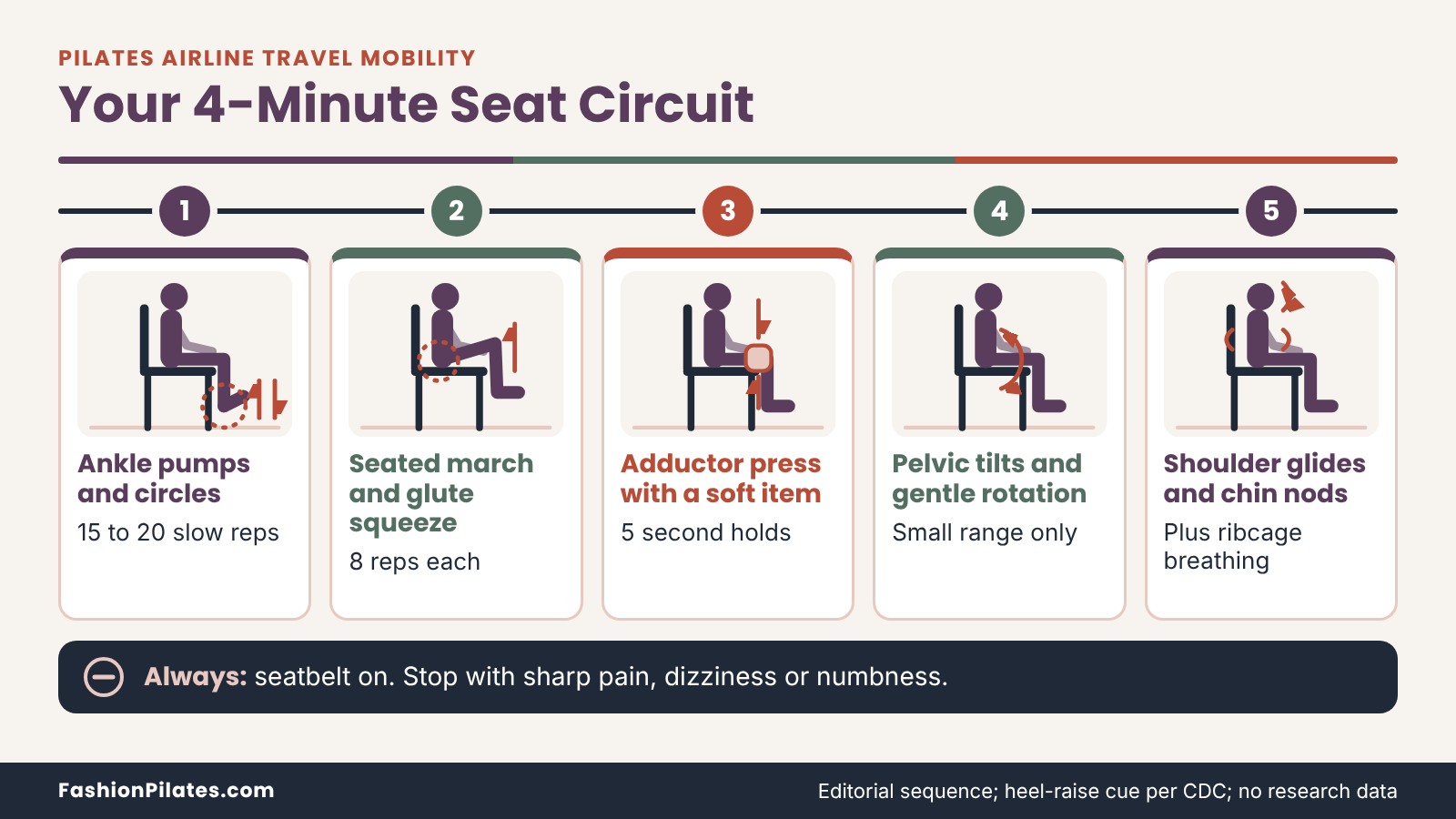
This is the heart of the plan, and it is intentionally modest. Keep your seatbelt fastened (loosely is fine), keep every movement small enough that your neighbor would not notice, and work at roughly 30 to 50 percent effort. The whole circuit takes about three to five minutes and can be repeated about once an hour, or whenever you feel stiff.
The lower-body circuit
Start with the legs, because they are where the guidance concentrates and where a seat limits you least.
Ankle pumps, heel-toe raises and circles
Sit tall with both feet flat on the floor. For ankle pumps, lift your toes while the heels stay down, then press the balls of your feet down so the heels rise, and keep alternating slowly for 15 to 20 repetitions. The CDC traveler page describes the same idea as raising and lowering your heels while your toes stay on the floor, and the reverse. Next, lift one foot an inch or two and trace slow circles, eight in each direction per foot.
Breathe normally throughout. If you feel a cramp starting, point and flex gently a few times and stand up for a moment. A sharp or lingering calf pain is not cramp to be pushed through, and it belongs in the warning-sign list from earlier.
Knee lifts, glute squeezes and adductor presses
For a seated march, lift one knee a few inches without leaning back or hiking the hip, lower it with control, and repeat eight times per side. Then squeeze the glutes gently for a count of five, release, and repeat eight times. For an adductor press, place a rolled sweater or small pillow between your knees and press inward for five seconds, eight times, much as you would with a Pilates ring in a studio.
The aim is gentle muscle activity, not a burn. If any of this strains your hips or lower back, shrink the movement or leave it out and stay with the ankle work.
Spine, shoulders and breath
Your upper body stiffens differently from your legs, usually from hunching toward a screen or leaning into a pillow.
Seated pelvic tilts and gentle rotation
Sit on your sit bones with feet flat. Slowly tip the pelvis forward to create a small arch in the lower back, then tip it back to flatten it, moving only through the comfortable middle range for eight slow rounds. Then try a gentle seated rotation: cross your arms or rest your hands on your thighs, exhale, and turn the ribcage a little to one side with the head following last. Hold for a breath, return, and do three per side.
Keep the seatbelt on and turn only as far as you can without wrenching against the seat. Skip rotation if it provokes back or rib pain, and do not use your arms to crank the twist deeper.
Shoulder glides, chin nods and ribcage breathing
Roll the shoulders back and down six times, then slide the shoulder blades gently together and apart a few times without lifting the shoulders to your ears. For the neck, make a small chin nod, as if gently saying yes, keeping the back of the neck long, for five slow repetitions. Stop if you feel lightheaded. Finish with five breaths with your hands resting on your lower ribs, feeling them widen on each inhale.
If your hands feel puffy or stiff, open and close them a few times and circle the wrists while your forearms rest on your lap or tray.
| Move | Start position | Dose | Modify or skip |
|---|---|---|---|
| Ankle pumps | Feet flat, sit tall | 15 to 20 slow reps | Shorten range if a cramp starts |
| Ankle circles | One foot lifted an inch or two | 8 each direction per foot | Stand and shake out if cramping |
| Seated march | Tall spine, hands on thighs | 8 per side | Skip if hips or back feel pinched |
| Glute squeeze | Seated, relaxed shoulders | 5 second hold, 8 times | Lower effort if it feels strained |
| Adductor press | Soft item between knees | 5 second press, 8 times | Skip with hip or groin pain |
| Pelvic tilts | On sit bones, feet flat | 8 slow rounds | Use smaller range with back sensitivity |
| Seated rotation | Arms crossed or hands on thighs | 3 per side, 1 breath hold | Skip with back or rib pain |
| Shoulder glides and chin nods | Neutral head, tall spine | 6 rolls, 5 nods | Stop if dizzy |
| Ribcage breathing | Hands on lower ribs | 5 slow breaths | Return to natural breathing if lightheaded |
Moving Through the Cabin: Timing, Aisle and Galley
Seated moves are the baseline, and standing is the upgrade. The question is how often, and how to do it without becoming the story of someone else’s flight.
How often to move
The answer has an official version and a practical version, and they point in the same direction.
A simple hourly rhythm
The CDC traveler page suggests standing and walking about every two to three hours on a plane, ideally from an aisle seat, while the Mayo Clinic says to stand or walk occasionally. A workable rhythm for most flights is the seated circuit roughly every hour and a stand-and-walk break at least every two to three hours, moving sooner if you feel stiff.
It also helps to see this against the bigger picture. The Physical Activity Guidelines for Americans emphasize sitting less and note that any amount of activity has some benefit. In-flight movement is a bridge, not a substitute for the 150 to 300 weekly minutes of moderate activity or the twice-weekly strength work they describe.
Working around turbulence, carts and sleeping neighbors
Stand only when the seatbelt sign is off, and sit promptly if it comes on or crew ask you to. Beverage and meal carts block aisles for long stretches, so the minutes right after service are often the best window. If you are in a window seat, a polite “I will be getting up a few times to stretch” at the start of the flight saves awkward climbing later.
For sleeping neighbors, the seated circuit is almost silent, which is its main advantage. Setting a vibrating timer on your phone or watch is easier than watching the clock, and it removes the temptation to say “just one more episode.”
Standing moves that fit the aisle
Stay close to your row or the galley edge, keep your hands near a seat back or handhold if you feel unsteady, and keep every move compact.
Standing calf raises and the Pilates stance
Stand beside your seat with heels together and toes turned slightly out, the foundation position in many Pilates classes. Rise onto the balls of your feet and lower slowly for 10 to 12 repetitions, with fingertips resting lightly on a seat back if needed. Repeat with feet parallel, and add six to eight small knee bends, keeping the knees tracking over the toes and the pelvis level.
If the aisle is narrow or crowded, do the calf raises in the space by your seat and keep everything else for the galley or terminal. A few slow ankle circles on each foot while standing finish the set.
Hip, chest and side-body openers
For a hip flexor stretch, take one short step back, tuck the tailbone slightly, and feel a gentle stretch at the front of the back-leg hip for 20 to 30 seconds. Switch sides. Then clasp your hands behind your lower back and open the chest a little for three breaths, followed by a gentle side bend with one arm reaching up for three breaths per side, taking care not to touch the overhead bins or lean into a seat.
Galley space is shared with crew and a line for the lavatory, so keep these brief and move on if asked. Avoid deep forward folds, since turbulence can arrive without warning and a lowered head makes it harder to brace or react.
After Landing: The Reset Sequence and Recovery
The reset has one rule: gentle first. After hours of limited movement, your tissues respond better to a progression from walking to mobility to light stretching than to a sudden deep stretch in the hotel hallway.
The first hour on the ground
What you do before you ever unroll a mat shapes how the evening feels.
Walk first, stretch second
Use the walk from the gate to baggage claim as your warm-up. Stand tall, swing your arms a little, and take the stairs if you are comfortable doing so. A 10 minute easy walk after landing, outdoors if possible, gets the legs working again and sets up a better floor session than starting cold on a hotel carpet.
If your transfer is another long ride, apply the same logic to the car: break the sitting, and do ankle pumps while you wait. The CDC traveler page advises regular breaks on car journeys for the same reason it advises them on planes.
Hydration, light and jet lag basics
If you crossed time zones, jet lag becomes part of the story. CDC guidance on jet lag says eastward travel is generally harder to adjust to than westward travel, that morning bright light tends to shift your clock earlier while evening light shifts it later, and that short daytime naps of 20 to 30 minutes help alertness without wrecking nighttime sleep. It also mentions that daytime exercise at your destination can boost alertness.
So an afternoon walk or a mat reset in daylight can do double duty. Keep fluids steady, go easy on caffeine late in the day, and ask a clinician about melatonin rather than guessing the timing or dose.
Watching the weeks after a long flight
Clot-related risk does not end at the baggage carousel. CDC clinical guidance says most flight-associated clots appear within the first one to two weeks, with risk returning to baseline by about eight weeks. That is not a reason for worry, only for awareness: if you notice leg swelling, pain, tenderness or warmth, or unexplained shortness of breath or chest pain in the weeks after a long trip, seek care and mention the flight.
Tell the clinician plainly that you recently took a long flight. It is one of the most useful pieces of context they can have.
A 12-minute mat reset
Do this on a mat, towel on carpet or any non-slip surface, once you have walked and had water. Go slowly, and stop at mild tension rather than strain.
Floor sequence: breathing, pelvic curls, cat-cow and rotation
Lie on your back with knees bent and feet flat, and take five slow ribcage breaths. Then do six to eight pelvic curls: exhale to lift the hips by peeling the spine up from the tailbone toward the mid-back, inhale at the top, then exhale to roll down one vertebra at a time. Move to hands and knees for six to eight cat-cow rounds, then do five thread-the-needle rotations per side, turning only as far as is comfortable.
These are the same families of movement taught in beginner classes, which is why a guide such as Pilates for beginners guide can help if the names are new. Skip the pelvic curl lift if it bothers your back or knees, and keep rotation small if your ribs feel sore.
Hip, hamstring and calf stretches
Finish with three gentle stretches. In a half-kneeling position, hold a hip flexor stretch for 30 to 45 seconds per side. Lying on your back, loop a band or towel around one foot and lift the leg to a mild hamstring stretch for 30 seconds per side, keeping the knee soft. Then stand facing a wall and hold a calf stretch for 30 seconds per side, heel down and back leg long.
If your legs feel heavy or tender afterward, a light self-massage or roller session is an option, covered in foam rolling after Pilates. The exception is any area that is swollen, painful or warm in one leg, which needs medical assessment, not more rolling. For a longer multi-day program in a hotel, see 7-day Pilates travel plan.
Flight Scenarios and Common Mistakes
Every trip is a different mix of length, timing and baggage allowance, so this section shows how to scale the plan up or down and where people usually go wrong.
Plans by flight type
Match the effort to the exposure rather than doing the full routine every time.
Short hops and day trips
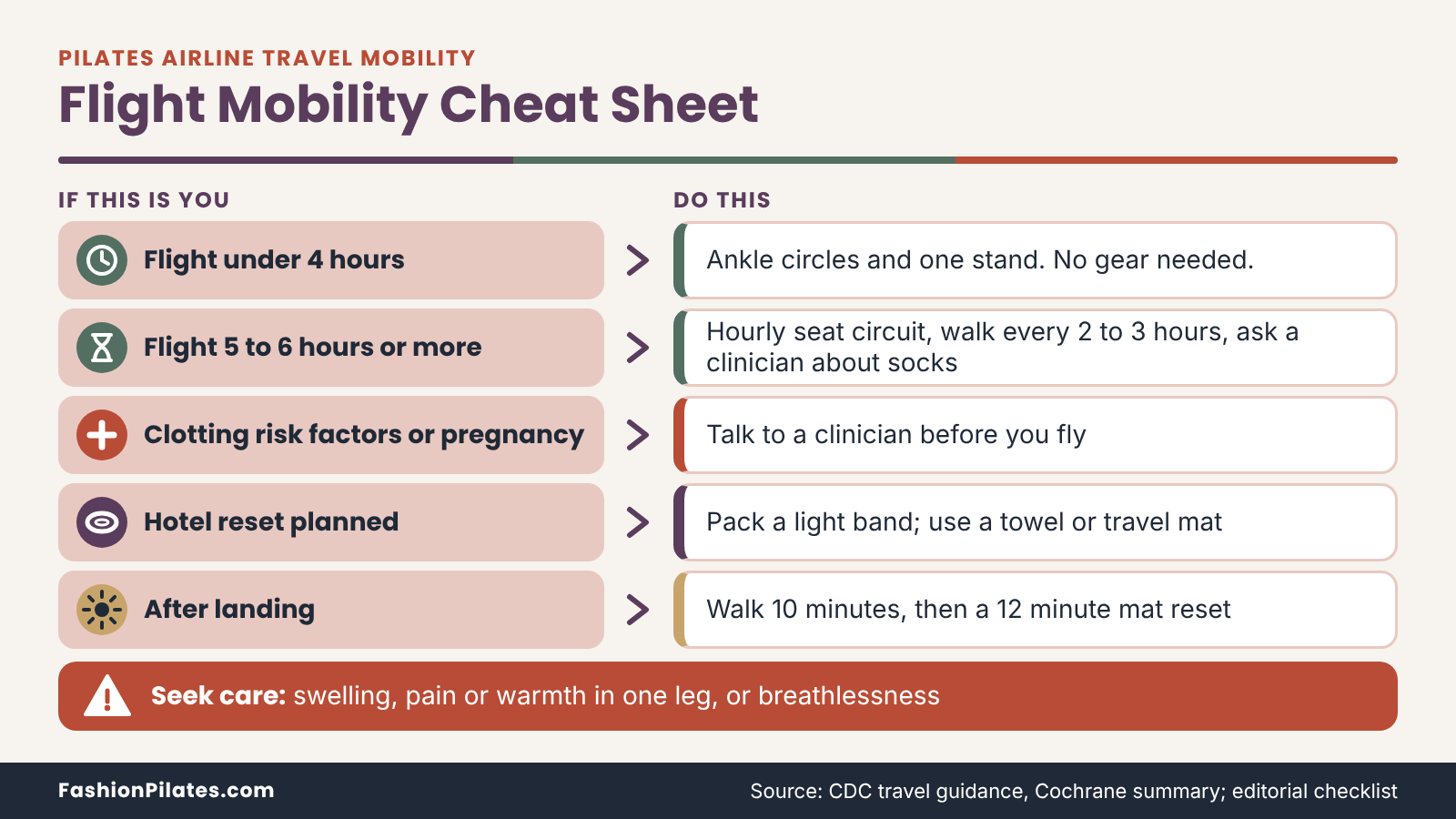
On flights under about four hours, CDC clinical guidance describes negligible symptomatic clot risk, so the plan can be light: a five-minute warm-up at home or the gate, a few ankle pumps and circles once or twice in the air, and one stand if the cabin allows. No special gear is needed. A short flight is also a good rehearsal, because it lets you learn which seated moves feel natural before a longer trip.
Use the moments around the flight, such as walking the terminal instead of sitting at the gate, to add movement without any equipment at all.
Red-eyes, ultra-long hauls and connections
Overnight flights complicate things because you will want to sleep. Choose an aisle seat where possible, do a seated circuit before settling in, and plan a stand-and-walk break whenever you wake naturally rather than setting alarms every hour. On long journeys, use connection time to walk the terminal, since sitting at the gate adds to your total sitting hours.
For flights over five or six hours, the compression sock question from earlier becomes more relevant, particularly with risk factors. After landing, give the walk and the daylight priority over a perfect mat session if you are exhausted.
| Scenario | Before | During | After | Gear |
|---|---|---|---|---|
| Under 4 hours | 5 minute warm-up | Ankle work once or twice, one stand | Short walk | None required |
| 4 to 6 hours | 10 to 12 minute session | Seat circuit hourly, walk every 2 to 3 hours | 10 minute walk, short reset | Optional light band, discuss socks if at risk |
| Red-eye | Warm-up, then seat circuit before sleep | Move on natural wake-ups | Walk, daylight, nap 20 to 30 minutes | Lumbar support if helpful |
| Ultra-long or multi-leg | Full 12 minute session | Circuit hourly, walk terminal on layovers | Walk, 12 minute reset, watch symptoms for weeks | Clinician-guided socks, band, towel |
Mistakes and smarter fixes
Most errors come from enthusiasm, not neglect. Pilates people like to do things properly, and the cabin punishes that instinct.
Overdoing the stretch, underdoing the walking
The first mistake is treating the flight as a stretching session. Deep hamstring folds, strong neck cranks and forceful spinal twists in a tight seat add strain without helping circulation. The fix is to keep seated moves small and rely on actual walking, since walking and calf work are what the health sources emphasize.
The second mistake is ignoring a warning sign because you are mid-routine. A calf that is swollen, tender or warm is not stiffness. Stop, sit, and get medical advice instead of trying a different stretch.
Gear mistakes and the packing trap
Common gear errors include buying compression socks by color instead of pressure and size, wearing them for the first time on the plane, and bringing every band, ball and roller you own. Another is tying a band to a seat frame or tray table for resistance; cabin furniture is not an anchor, so use your own hands and feet only.
The fix is a short list: wear tested socks if your clinician agrees, carry one light band and a towel, and leave the rest in the destination bag. If a product claim sounds too good, such as instant results from a gadget in row 31, close the tab.
Frequently Asked Questions
Is it safe to do Pilates-style exercises in an airplane seat?
For most healthy adults, small seated movements such as ankle pumps, gentle pelvic tilts and shoulder rolls are low risk, because they involve little range and little effort. Safety depends on keeping your seatbelt fastened, keeping the movements discreet and stopping at the first sign of sharp pain, dizziness or numbness. Larger movements like deep twists or forward folds are better left for the ground. If you are pregnant, postpartum, recovering from surgery or managing a health condition, ask a qualified clinician before you travel. This article is general fitness education and does not replace personal medical advice.
How often should I get up and move on a long flight?
CDC traveler guidance suggests standing and walking about every two to three hours on a plane. Many people find it easier to pair a short seated circuit roughly every hour with a walk whenever the seatbelt sign is off and the aisle is clear. Move sooner if your legs feel heavy or your back feels stiff. If you are in a window seat, tell your neighbors early so getting up feels routine rather than disruptive.
Do compression socks really help on flights?
A Cochrane review summarized in a medical journal found that stockings reduced symptomless clots detected by scanning on flights longer than five hours. The evidence is less clear about whether they prevent symptomatic clots, pulmonary embolism or death, because those events were rare in the studies. Guidance generally points to higher-risk travelers on longer flights as the group most likely to benefit. Look for a labeled pressure range, measure for the right size and try them at home before the trip. Ask your clinician whether they suit your situation, particularly if you have circulation, skin or nerve concerns.
Can I bring a resistance band in my carry-on?
Soft items like resistance bands are generally described as low concern at security checkpoints, but the final answer depends on current screening rules and your airline’s carry-on policy. TSA offers a What Can I Bring tool on its website for checking specific items before you pack. Airlines set their own limits for bag size and overhead space, so a band is rarely the problem and a full kit sometimes is. Pack the band where you can reach it, and be ready to take it out if an officer asks. Rules can change, so check close to your travel date.
Which seat is best for staying mobile?
An aisle seat is usually the most practical choice because you can stand and walk without disturbing anyone. CDC clinical guidance notes that window-seat passengers had a higher risk of clots in studies, which may relate to how often they get up. The trade-off is that aisle seats can be bumped by carts and passersby. If you cannot get an aisle, plan your movement breaks around meal service and tell your row neighbors what you intend to do.
Should I stretch before a flight or after?
Both help, but they do different jobs. A short, easy warm-up before you leave gets your hips, spine and calves moving without tiring you. A fuller reset after landing, after you have walked and had water, is the better time for longer holds. Avoid deep or intense stretching right before boarding, since you will be sitting still for hours afterward. Keep every stretch at mild tension and stop if anything pinches.
What symptoms after flying should I take seriously?
Swelling, pain, tenderness or warmth and redness in one leg deserve prompt medical attention. Unexplained shortness of breath, chest pain that worsens with coughing, a racing heart or fainting also need urgent evaluation. CDC guidance says most flight-related clots show up in the first one to two weeks, and risk returns to baseline by about eight weeks. Do not massage or stretch a swollen, painful leg while you wait. Tell the clinician that you recently took a long flight.
Does exercise help with jet lag?
CDC guidance on jet lag focuses mainly on light exposure, sleep timing and sometimes melatonin. It also mentions that exercise at your destination during the daytime may boost alertness. A walk or gentle mat session outdoors in daylight can therefore support your schedule without being a cure. Eastward trips tend to be harder to adjust to than westward ones. If jet lag is severe or you have a sleep condition, ask a clinician for tailored advice.