
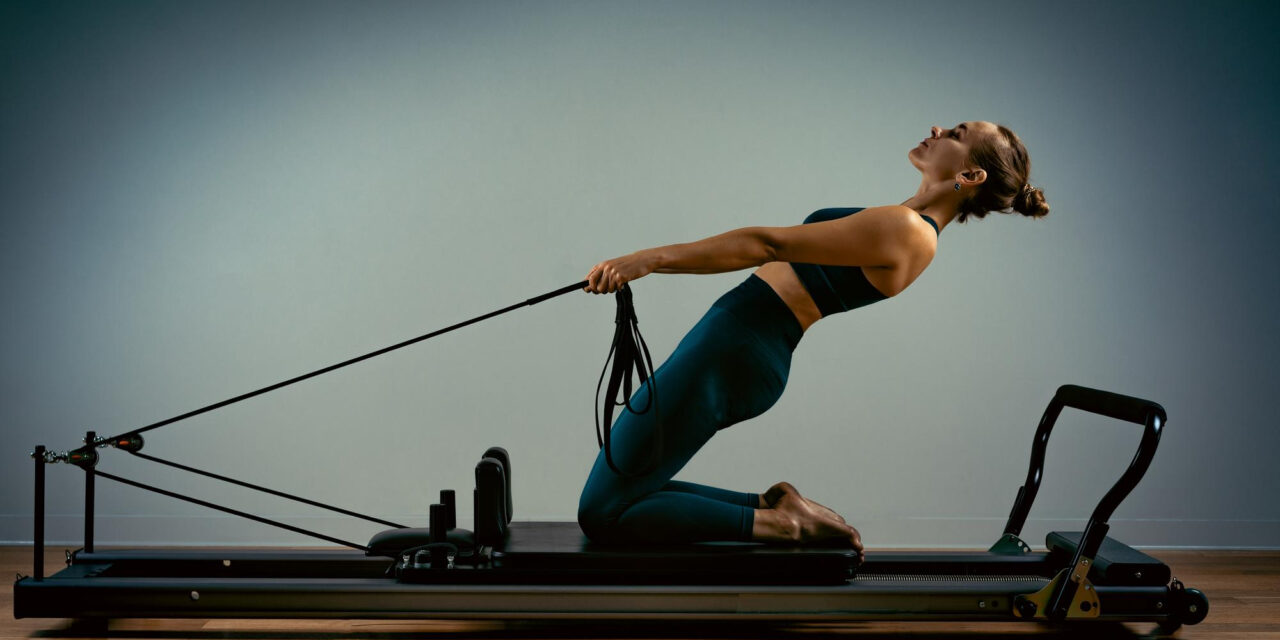
Direct answer: Reformer Pilates is Pilates exercise performed on a reformer, a sliding carriage on a frame that uses springs, a footbar, and ropes or straps to add adjustable resistance or support to movements Joseph Pilates designed. You push, pull, and glide against spring tension while an instructor guides your alignment, breathing, and control. Most people meet it in small studio classes, and no prior experience is required.
This guide explains the method rather than selling a machine or prescribing a workout. It covers where the reformer came from, what each part does, how springs actually create effort, what a first class looks like, how the major class styles differ, what research does and does not show, and how to choose a studio. Buying advice and full routines live on their own pages, linked where they fit. Everything here is general fitness education, not individual medical advice, and it is a research-based explainer built on published sources and manufacturer descriptions, not hands-on equipment testing.
What Is Reformer Pilates? Definition and Origins
Before comparing studios or spring settings, it helps to settle the basics: what the machine is, what the method adds, and how a piece of 1920s-era equipment became a fixture of modern boutique fitness. This section builds that foundation, and the rest of the guide leans on it.
The Short Definition, Without the Jargon
Plain definitions come first, since reformer vocabulary can sound like a mix of rowing and furniture shopping.
The machine in plain English
A reformer is a low, bed-like frame with a padded platform that rolls back and forth on rails. That platform is called the carriage. Springs connect the carriage to the frame, so the carriage is always being pulled toward its resting position, and you work with or against that pull. At one end sits a footbar you can push with your feet or hands, and ropes or straps with handles or loops let you move arms and legs through space while the carriage travels.
The result is a machine that can be loaded heavily, lightly, or almost not at all, by changing the springs. The same frame can support a slow, supported stretch or a demanding strength sequence. That adjustability is the core idea.
The method behind the machine
The reformer is equipment, but Pilates is the method. Pilates teachers commonly organize their cueing around ideas such as breath, concentration, control, centering, precision, and flow, and they care about how you move as much as how much resistance you use. Think of the reformer as a tool that makes those ideas easier to practice and harder to fake, because the carriage immediately shows when you are rushing or letting one side take over.
That is why a reformer class and a gym machine circuit feel different even when both use springs or weights. In a good class, the instructor is coaching quality of movement, not just counting repetitions. The Pilates Method Alliance, a professional association for the field, publishes a history page that frames the method as a system of exercise rather than a piece of gear, which is a useful way to hold the idea in your head.
Where the Reformer Came From
The history is told in many versions, some tidier than the evidence supports. The reliable outline is short, and the flourishes deserve a raised eyebrow.
Joseph Pilates and Contrology
According to the Pilates Method Alliance history page, Joseph Hubertus Pilates was born in Mönchengladbach, Germany, in 1883 and worked in physical culture and circus performance. During World War I he was interned on the Isle of Man as an enemy alien and led exercise routines in the camp. He later brought his system, which he called Contrology, to the United States in the late 1920s, and by the 1930s he had a studio in New York City that attracted dancers.
He wrote about the method in two books, Your Health (1934) and Return to Life Through Contrology (1945), and died in 1967. The name Pilates came later, as the method was carried on by students and teachers rather than by one institution. Encyclopedias such as Britannica confirm that the method was refined by his students and disciples after his death.
From early springs to the modern machine
A widely repeated account says Pilates first attached springs to hospital bed frames so bedbound patients could work against resistance while lying down. That story appears on studio history pages, but it is a retelling rather than a documented record, so treat the exact details as folklore with a plausible core. What the Pilates Method Alliance does say is that his most famous invention was the Universal Reformer, and that he held very few patents for the many devices he built.
One equipment retailer’s history of the reformer describes the design settling over several decades into a wooden frame with leather straps, an adjustable footbar, and shoulder blocks, with metal frames appearing near the end of his life. Dates on such pages vary, so use them as a sketch, not a citation. The practical point is that the reformer you see today is a descendant, not a replica, and manufacturers have kept redesigning it ever since.
Where It Sits Among Pilates Apparatus
The reformer is the most visible Pilates machine, but it is one of several. Knowing the others stops a lot of studio-menu confusion.
The other equipment in the family
Pilates designed far more than the reformer. The Pilates Method Alliance lists the Wunda Chair, the Trapeze Table (often called the Cadillac), and the Magic Circle among his other inventions, and the National Pilates Certification Program’s training requirements also name the Ladder Barrel and Spine Corrector alongside them. Each tool changes the question the body has to answer: the chair is a compact spring-loaded seat with a pedal, the tower is a bed-height frame with a trapeze structure above it, and the barrels are curved surfaces that support or challenge the spine.
Many studios, for example, will mention a “tower” or “combo” reformer. That usually means a reformer with a vertical spring frame attached, which lets a class borrow some tower-style work on the same machine. Later sections cover that format directly.
Why the reformer became the studio headliner
No single source explains why the reformer won the popularity contest, so this part is informed interpretation. It is the most adjustable of the machines for group teaching: one person can lie down, sit, kneel, or stand on it, and each can change spring load in seconds. It also supports a huge range of exercises, and a studio can fit many identical machines in one room.
The booking data fits that picture. ClassPass’s 2025 Look Back Report names reformer Pilates the most popular Pilates format on its platform, with reservations up 71 percent year over year, inside a Pilates category it says has been the most-booked workout on ClassPass for three years running. One platform’s reservations are not a census of everyone who exercises, but they do show that the reformer class has become a mainstream option, not a niche one.
Anatomy of a Reformer: Every Part Explained
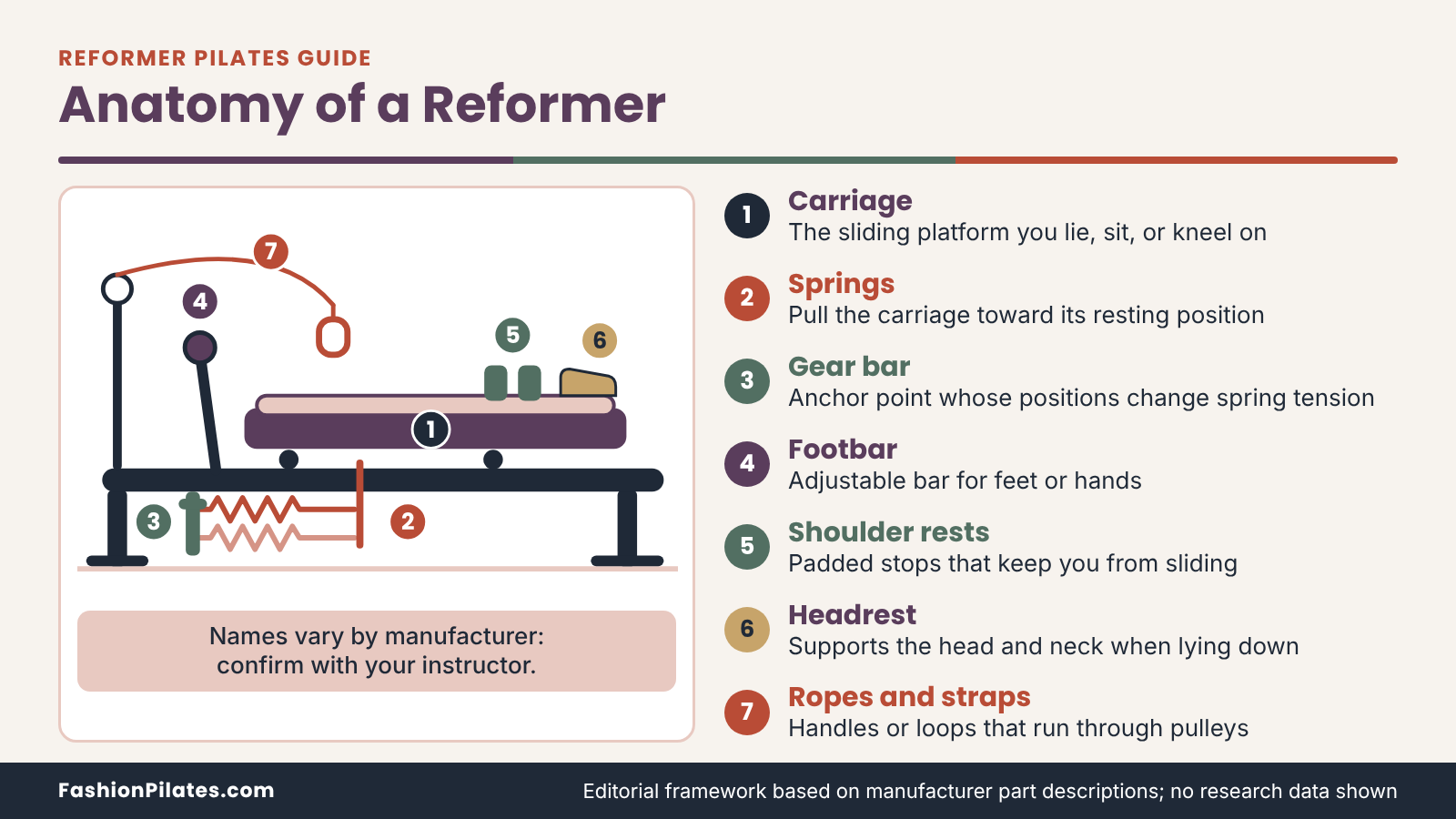
A reformer looks like a minimalist bed designed by a physical therapist and an engineer who disagreed about everything. Each part has a job, and knowing the names turns a first class from guesswork into following along. The table lists the parts you are most likely to meet, with the alternate names that cause the most confusion.
| Part | What it does | Other names you may hear | Beginner note |
|---|---|---|---|
| Frame and rails | Form the base and the track the carriage slides along | Rails, tracks | Keep fingers clear of the rail and wheel area when the carriage moves |
| Carriage | The padded platform you lie, sit, kneel, or stand on; it moves along the rails | Platform (sometimes), bed | It moves when you move, so go slowly while learning |
| Springs | Connect the carriage to the frame and pull it toward its resting position | Spring set, tension springs | Your instructor chooses and changes them; never adjust mid-exercise on your own |
| Gear bar | The bar springs hook onto; its positions change spring tension | Gearbar | Usually set by the instructor for the whole room |
| Footbar | The bar you press with feet or hands; adjustable to different heights | Foot bar | Height changes the exercise, so note your setting |
| Shoulder rests | Padded stops that keep you from sliding off the carriage while you push | Shoulder blocks, shoulder stops, pommels | They steady you; they are not handles to push on |
| Headrest | Supports the head and neck when lying down; may fold up or down | Head support, headpiece | Ask for the setting that keeps your neck comfortable |
| Ropes, straps, and loops | Let hands or feet move against spring tension via pulleys | Handles, soft loops, long loops | Keep a firm hold and return the straps under control |
| Risers | Raise or support parts of the setup, such as shoulder rests or the ropes | Shoulder risers | Often adjusted between students |
| Carriage stopper | Limits how far the carriage can travel on some models | Carriage stop, safety stop | Helpful for people who want a shorter range |
| Standing platform | The fixed surface at the footbar end where you can stand or kneel | Platform, sitting platform | Used for standing and lunge-style work |
| Jump board | An accessory that attaches to the footbar end for jumping-style work | Jumpboard | Optional; offered by some studios only |
Part names above reflect how manufacturers describe their own machines. Terms overlap and change between brands, so confirm the name with your instructor instead of assuming.
The Moving Parts
The parts that move are the ones that create the sensation of the machine, and they are the ones worth understanding first.
The carriage and rails
The carriage is the padded surface you spend most of a class on, and it glides on wheels along rails in the frame. Professional models are built for smooth, quiet travel, and manufacturers describe the rails and rolling mechanism in some detail on their product pages. For example, Merrithew describes a studio model with double C-channel rails and a patented rolling mechanism, a reminder that the glide you feel is engineered, not accidental.
What matters to you as a student is that the carriage does not stay put. It responds to every push, pull, and shift of your weight. That responsiveness is useful, because it exposes wobbles you would never notice on the floor, but it also means a beginner should treat the first few classes as practice in moving slowly and keeping contact with the surface.
Springs and the gear bar
Springs run from the carriage to the frame and keep tugging it toward its resting position. A set typically includes several springs that can be hooked on or off in combination. The gear bar is the bar they attach to, and it has more than one position so the instructor can change how much the springs are stretched at the start. Different manufacturers spell and describe it differently, but the principle is the same everywhere.
You will usually watch the instructor change springs and rarely do it yourself in an introductory class. That is deliberate. Springs are under tension, and a poorly handled one can snap back, so spring changes are best done by the person who knows the machine, or by you only after being shown.
Ropes, straps, and pulleys
Ropes run from the carriage up through pulleys to handles or loops that go around your hands, feet, or forearms, depending on the exercise. When you pull a rope while the carriage can slide, the carriage and the springs share the load, which is one reason arm work on a reformer can feel different from a cable machine. Some machines use retractable rope systems, while others use a classic cord with an adjustable length.
A practical tip is that straps tend to feel awkward for the first few attempts. Handles that feel too long or short can often be adjusted, so tell your instructor if your hands are reaching or your elbows are straining.
The Adjustment Parts
These parts do not move during a repetition, but they change how an exercise fits your body. Setting them right is half of what a good instructor does before class begins.
Footbar, headrest, and shoulder rests
The footbar is adjustable, and manufacturer pages describe several height options. Balanced Body’s Allegro 2 product page, for example, describes a footbar that adjusts to multiple positions, while the Merrithew page describes footbar positions that regulate hip and knee flexion. A higher or lower bar changes joint angles, so an exercise can become easier or more demanding without any spring change.
The headrest and shoulder rests are the contact points that keep you steady and aligned. A headrest at the wrong height can make the neck tense, and shoulder rests are there to stop you from sliding rather than to be shoved against. If something feels off, say so early. Fit problems are usually solved in seconds.
Risers, stoppers, and the standing platform
Risers elevate or support parts of the setup, and manufacturers describe some of them as easily removable pieces. A carriage stopper, offered on some models, limits how far the carriage travels, which can help people who need a shorter range or a more predictable stop. The standing platform at the footbar end provides a surface to stand or kneel on for lunge-style and balance work.
The trade-off is variety. A machine with more adjustment points offers more ways to fit different bodies, but it also gives a new student more things to learn. That is another reason instructors set up the first few exercises for you.
Why the Names Differ Between Manufacturers
If two studios use different words for the same part, nobody is wrong. Pilates equipment evolved through several makers, each with its own vocabulary.
Terms that vary and how to cope
The same shoulder-support part appears as shoulder rests on manufacturer pages, as shoulder blocks in some equipment histories, and as a shoulder stop in at least one patent title. The bar that holds the springs is called a gearbar in Merrithew’s product descriptions, while Balanced Body’s Allegro 2 page does not use that term in its feature list at all. There is no governing body that standardizes these terms, so expect overlap and the occasional argument at the front desk.
The easiest way to cope is to learn the function, not the label. If an instructor says “move your shoulder blocks” and you do not know which part that is, ask them to point at it. Asking costs nothing and avoids a wrong adjustment.
What to check on a machine you have not used
Before you start in an unfamiliar studio, do a short visual check. Make sure the footbar is locked in place, the shoulder rests are seated, the springs are attached to the positions the instructor chose, and the ropes are not twisted. Studios usually do this for you, but you are allowed to look.
If you are considering a home machine later, this is also a useful habit. Specifications, spring sets, and accessory options differ by brand and model, so read the manufacturer’s manual and follow it. A guide to buying one belongs on its own page, linked later in this article. See also our reformer Pilates parts and anatomy cheat sheet for a printable reference.
How Springs Create Resistance (and Assistance)
Springs are the reason the reformer feels unlike a mat, a dumbbell, or a gym machine. They are also the most misunderstood part, because the common shorthand “more springs equals harder” is true only some of the time. This section explains what the springs are doing so a spring change in class makes sense instead of feeling like a secret handshake.
Spring Tension in Plain English
Start with the single idea everything else depends on: the springs always pull the carriage toward its resting position, and the way you move relative to that pull decides how an exercise feels.
What a spring does to the carriage
A spring resists being stretched, and the more it stretches, the harder it pulls back. When the carriage is parked at its resting position, the springs hold it there. Move the carriage away from that spot and the springs pull harder, trying to bring it back. Hook on more springs and the combined pull gets stronger, so the carriage feels stiffer to move away and quicker to return.
That pull is the “resistance” people talk about, but it is better thought of as a force that is always present and always pointing home. You can work against it, work with it, or hold the carriage still against it. Each of those feels different.
Why your body weight and the carriage still matter
The springs are not the only load. The carriage itself has weight and some rolling friction, and your own body adds to it depending on whether you are lying, kneeling, or standing. A reformer set to a light spring load still involves moving your own limbs or torso through space, which is real work even before the spring does much.
This is why two people on the same springs can report completely different effort. Body size, limb length, the footbar setting, and how smoothly someone controls the motion all change the result. There is no universal number that equals “medium” for everyone.
| Situation | What the carriage is doing | What more spring tends to do | Why |
|---|---|---|---|
| Pushing the carriage away from the footbar | Moving away from its resting position | Adds resistance | The springs pull harder the farther you push |
| Letting the carriage return to rest | Moving toward its resting position | Adds assistance and speed, so control matters more | The springs are pulling in the direction of travel |
| Holding the carriage still while limbs move | Staying in place | Often adds stability, because the carriage is harder to move | More spring makes the carriage less likely to drift |
| Standing or kneeling with a foot or knee on a sliding carriage | Sliding under you | Often feels steadier; less spring can feel more wobbly | A stiffer carriage resists sliding out from under you |
| Pulling straps while seated on the carriage | Either held steady or allowed to move | Depends on what the instructor wants the body to do | Load can shift between arms, trunk, and legs |
These are general tendencies, not rules. Exercise setups vary by instructor and tradition, so treat the table as a way to understand what your instructor is doing, not as a set of settings to copy.
Why Heavier Does Not Always Mean Harder
This is the part of reformer class that surprises people most, so it deserves its own explanation. The short version: springs can load a movement, support a movement, or stabilize it.
When more spring means more work
In many foundational exercises, you push the carriage away from the footbar with your legs or pull it away with your arms. Here the springs act as resistance, and adding springs adds work. This is the version most people picture, and it is accurate for much of the strength-oriented work in a class.
It is also why a spring change often comes between exercises. If the goal is to challenge the legs, the instructor may add tension. If the goal shifts to arms or trunk control, they may remove some. Reading the change as “harder” or “easier” misses what they are trying to teach.
When more spring means more support
Now flip the situation. If you are moving toward the carriage’s resting position, the springs are pulling the same way you are moving. They assist, which can make the start of a movement easier while demanding more control on the way back. If you are kneeling or standing on the carriage, a stiffer set of springs can make the carriage steadier under you.
Many instructors teach that a lighter spring load can be the harder choice in balance-heavy work, because the carriage moves more freely and asks more of your stability muscles. That is a teaching convention rather than a research finding, so ask your own instructor how they use it.
The slow return and the control challenge
One more twist is the return. Even in a push-away exercise, the return phase is where the springs pull the carriage home and you manage the speed. Letting the carriage slam back toward its stop is the easiest way to skip the part of the exercise that often builds the most control.
A good rule of thumb is to move the carriage out and back at the same unhurried pace you would use if the springs were not there. If the carriage is yanking you around, the load may simply be too heavy for that exercise today, or the movement may need slowing down. Your instructor can tell which.
Spring Settings Are Not Standardized
Anyone who says “this particular combination is medium” is describing one machine, not the world. Spring systems differ, and that matters for studios and home users alike.
Different brands, different systems
Manufacturers do not share a single code. Balanced Body’s Allegro 2 page describes its spring set by color, while Merrithew’s professional reformer page describes a set with springs at different percentages of full tension. Both approaches are valid, and neither tells you how a spring will feel on another maker’s machine.
The practical consequence is that a spring recommendation from a video, a book, or a friend’s studio will not transfer cleanly. A heavier setting at one studio may be lighter than a medium one at another. Always use the settings your instructor gives you, and follow the manufacturer’s manual at home.
How to talk about springs with your instructor
You do not need brand vocabulary. Words such as light, medium, and heavier are enough in a class, and you can ask what the spring is meant to do for the exercise. A short question like “Is this spring supposed to challenge me or support me?” often produces a useful answer.
If something feels too hard, too easy, or oddly jerky, say so before you try to push through it. Tell the instructor what you feel rather than guessing at a setting. They can change one spring in a few seconds, and that is cheaper than a strained shoulder. For a deeper look at class movement, see our reformer Pilates workout for beginners.
What a Beginner Reformer Class Looks Like
Classes vary by studio and instructor, so there is no single script. Still, beginner-friendly classes tend to follow a recognizable arc, and knowing it removes most of the first-day nerves. The table sketches a typical sequence for a class of roughly 45 to 60 minutes, which is a common length but not a rule.
| Stage | What usually happens | What it is for | What you do |
|---|---|---|---|
| Arrival and setup | Check in, meet the instructor, choose a machine, learn the basic setup | Safety, fit, and flagging anything that needs a modification | Mention injuries, surgeries, pregnancy, or concerns before class starts |
| Warm-up and footwork | Slow, repeated leg presses and gentle movements on the carriage | Learning the machine and warming the body | Move slowly and notice how the carriage responds |
| Strength and control work | A series of exercises for legs, trunk, and arms, with spring changes between them | The main training portion of the class | Follow the cues and ask for modifications when needed |
| Challenge or flow segment | Sometimes a faster or more complex sequence, depending on class level | Coordination and endurance | Skip or scale anything that does not feel right |
| Stretch and finish | Lengthening movements, then a cool-down and reset | Easing out of effort and restoring comfortable range | Breathe, notice how you feel, and return the machine to neutral |
Nothing in the table is universal. Studios sequence work differently, and some skip or combine stages, so use it as a map instead of a promise.
Before the Class Begins
Most of what makes a first class go well happens in the ten minutes before the first exercise. It is also the part beginners tend to skip.
Booking, arriving, and the introduction
Book a class labeled for beginners or introductory levels if the studio offers one, and arrive early enough to meet the instructor. A short chat about your experience, goals, and any health concerns lets them set up your machine and plan modifications. Many studios have a first-timer routine of some kind, but it is worth asking when you book instead of assuming.
If you have an injury, recent surgery, pregnancy, or a medical condition, mention it directly and plan to talk to a clinician beforehand if you are unsure. The instructor can only adjust for what they know. A later section on who should check first goes into specifics.
What to wear and bring
Most studios ask you to wear fitted, stretchy clothing that will not catch on the machine, because loose fabric can snag on springs and straps. Many also ask for grip socks, since bare feet can slip on the footbar. Check the studio’s policy when you book, because some sell socks on site and some require your own pair.
Beyond that, bring water and leave jewelry, long necklaces, and bulky layers in your bag. There is a quiet comedy in watching a person arrange a gym bag for five minutes, then wrestle a strap that has caught a hoodie string, so spare yourself. See our guides to what to wear to reformer Pilates class and grip socks for Pilates for specifics.
The Class Itself, Block by Block
Once the music starts and the instructor begins, a class usually moves through a few distinct phases. The order is flexible, but the logic is consistent.
Warm-up and footwork
Many reformer classes begin with a footwork series, in which you lie on the carriage with your feet on the footbar and press out and in. It is a slow, repeated movement that lets you feel the machine, warms up the legs, and gives the instructor a chance to see how you move. The sequence also sets a rhythm that later exercises build on.
Because the movement is simple, beginners often underestimate it. The point is not to find the hardest version but to learn how the carriage responds, how the springs feel, and how to keep your effort even on the way out and the way back.
The strength and control middle
The middle of class usually mixes lying, sitting, kneeling, and sometimes standing exercises, with spring changes between them. Expect work for the legs, hips, trunk, and shoulders, with the instructor offering variations if an exercise is too much or too little. Strap work for arms and legs often appears here, and you may be shown a few unfamiliar positions that need demonstration.
This is the portion where instructors coach quality, not quantity. Slower is often harder, and a smaller range done with control is better than a bigger range done sloppily. If a movement is unclear, raise your hand or ask. Instructors expect questions from beginners, and in a room of strangers, someone else is almost certainly wondering the same thing.
The stretch and finish
Classes commonly close with lengthening movements and a calmer pace, so the body can ease out of effort. This may include a standing or seated stretch, a spinal movement, or a simple pause with breathing. The last few minutes are also when instructors tend to reset the room, so you may be asked to return the straps and footbar to a neutral position.
Take the cool-down seriously. Skipping it to catch the next appointment is how people end up feeling shaky or tight later, and it costs only a few minutes. Move off the carriage slowly, since standing up too quickly after lying down can leave some people lightheaded.
What It Should Feel Like
A first class feels unfamiliar by design. The question is whether the unfamiliarity is the healthy kind or a sign to back off.
Effort versus pain
Muscle fatigue, a mild burn in the legs, and some trembling during a long hold are normal signs of working hard. Sharp, pinching, or electric sensations, pain in a joint, numbness, tingling, or dizziness are not. If you feel any of those, stop the exercise and tell the instructor right away. Pushing through them is not toughness, and no class is worth a flare-up.
Mild muscle soreness in the day or two after is common with new exercise and generally eases on its own. If soreness feels more like pain, or lingers, it is worth checking in with a clinician. The safety section later in this guide covers when to stop in more detail.
How instructors guide and adjust
Instructors combine verbal cues, demonstrations, and, in some studios, light hands-on adjustments. Touch should always be optional. It is entirely fine to say at the start that you prefer verbal cues only, and a good instructor will respect that without fuss.
Because the class is often small, you can usually get more individual attention than in a larger fitness class. That is one of the biggest practical differences. A good instructor watches the room, offers variations, and checks in with new students, so do not hesitate to let them know it is your first time.
Class Formats and Styles
Walk into three studios and you may get three different answers to “what is a reformer class?” Styles, class sizes, and add-on equipment all vary. This section sorts the main differences so the schedule page makes sense and you can book the format that matches what you want.
| Format | What it usually involves | Often a good fit if | Ask before booking |
|---|---|---|---|
| Classical-style group class | A set order of exercises based on Joseph Pilates’ original repertoire, taught with consistent structure | You like predictable structure and learning a fixed sequence | How the studio defines classical and how its teachers trained |
| Contemporary group class | Varied sequences, modified exercises, and often a theme or goal chosen by the instructor | You like variety and a more personalized feel | Whether the class is aimed at beginners and what the pace is like |
| Semi-private or duet | Two to a few people with an instructor, often with more individual attention | You want some guidance without a fully private session | Maximum class size and how the instructor divides attention |
| Private session | One-on-one instruction tailored to your goals and limits | You have specific needs, an injury history, or want to learn the basics | The instructor’s training and experience with your situation |
| Jump board class | Reformer work that includes a padded board for jumping-style movements | You want more cardio-style work in a Pilates setting | Whether it suits your joints and what modifications are available |
| Tower or combo class | Reformer work paired with a vertical spring frame attached to the machine | You want variety on a single machine | What equipment is used and whether there is a beginner version |
The names in this table are descriptive, not official. Studios label classes in their own ways, so treat the labels as starting points and read the class descriptions.
Classical and Contemporary Styles
The most common style debate in Pilates is classical versus contemporary. It sounds like a fight, but for most beginners it is closer to a choice of teaching accent.
What classical usually means
Classical Pilates generally refers to teaching that keeps close to Joseph Pilates’ original exercises and, importantly, their order. An explainer on classical versus contemporary Pilates by Alice Porter describes classical work as a specific set of exercises in a precise sequence, based on the original mat and equipment, with the order treated as essential so students build skills before moving on.
The appeal is structure. If you like knowing what comes next and enjoy mastering a repertoire over time, a classical class can feel satisfying. The trade-off is that it can feel rigid if you want variety or modifications chosen for a particular goal.
What contemporary usually means
Contemporary Pilates is a broader label for teaching that keeps core ideas but changes the order, modifies exercises, borrows from other fitness systems, or targets specific goals. The same explainer quotes one instructor describing contemporary Pilates as often redefined or modernized, which captures how wide the category is.
The appeal is flexibility and variety. A contemporary class can be easier to adapt for different bodies or interests, and it may feel less like a repertoire and more like a workout. The trade-off is that quality varies widely, because the label alone says very little about how a teacher was trained.
How to tell what a studio really teaches
There is no regulatory body that polices the words classical and contemporary, so the label tells you less than the teacher does. Ask the studio how it defines its style, what training its instructors have, and whether a beginner class is available. A good studio can answer plainly.
It is also fine to try both and decide by feel. Neither is automatically better, and plenty of studios blend them. For a deeper comparison, see our classical vs contemporary Pilates guide.
Group, Semi-Private, and Private Formats
Class size changes the experience as much as style does. How much attention you get, and how fast the class moves, depends largely on who else is in the room.
Group classes
Group classes are the standard way to meet the reformer. They are usually the most affordable per session, and they bring a social, energizing atmosphere. The instructor teaches the whole room, so individual adjustments are limited by the number of students and the pace of the class.
For beginners, the main risk of a large group is being unnoticed. If a class feels crowded or fast, ask the studio about beginner sessions or smaller class caps. A lighter room often means better coaching.
Semi-private and duet sessions
Semi-private sessions usually involve a small number of people, sometimes two, with an instructor. They sit between group and private formats: more attention than a full class, often at a lower price per person than a fully private session. They can work well for friends who want to learn together or for people who want guidance without the intensity of one-on-one instruction.
Because small groups vary in how they are run, ask what the format actually looks like. Some are tailored sessions, while others are simply small classes under a different name.
Private sessions
A private session means one instructor focused on you. It is the most flexible option for learning the basics, working around an injury history, or addressing specific goals. The instructor can adjust the machine, the pace, and the exercise choices to fit your body.
Many people take a few private sessions before moving into group classes, simply to learn the machine and the vocabulary. Whether that is worth the cost depends on your budget and comfort, and the cost factors section later in this guide explains what shapes the price.
Add-Ons and Hybrid Classes
Beyond style and size, studios add equipment and themes to keep classes fresh. These variations can be fun, but they are worth understanding before you commit.
Jump board classes
A jump board is an accessory that attaches to the footbar end of the reformer so you can do jumping and other cardio-style work against spring resistance. Balanced Body’s jumpboard product page describes its padded version as combining cardio with spring resistance, designed for low-impact movements and soft landings.
Jump work is a different kind of effort than the slow, controlled strength sections of class, and it is not necessarily right for everyone. If you have joint concerns, balance issues, or are returning from injury, ask whether jump work is optional and whether the studio offers a version without it.
Tower and combo classes
Some studios pair a reformer with a tower, a vertical spring frame attached to the machine, or run classes that use both a reformer and separate equipment. The idea is to borrow tower-style work, such as springs for the arms and legs while lying down, on the same machine as reformer work.
These classes can feel busier for a beginner, because there are more settings and more things to learn at once. If you are new, a straightforward reformer class is usually the gentler place to start, and you can add the combo format later.
Fusion, themed, and high-intensity classes
Studios also offer reformer classes with labels like sculpt, flow, cardio, or high-intensity. These labels are marketing terms with no standard definition, so read the description and ask what the pace and exercise mix actually are. ClassPass’s 2025 report lists High-Intensity Pilates as a distinct fast-growing category, which shows the market is experimenting.
A fair rule is to master the basics first. A class that is faster or more athletic than you are ready for is an easy way to learn the wrong movement habits. Come back to the louder classes once you can control the carriage without thinking about it.
Reformer vs Mat Pilates
Most beginners eventually ask whether to start on the machine or on the floor. Both are legitimate ways to practice the same method, and neither is a lesser version of the other. The comparison below focuses on how the experiences differ, so you can match the format to your goals, budget, and comfort.
| Factor | Reformer Pilates | Mat Pilates |
|---|---|---|
| Equipment | A reformer with springs, footbar, and straps, usually in a studio | Floor space and a mat; small props are optional |
| Source of resistance | Adjustable spring tension plus body weight | Mostly body weight, sometimes with small props |
| Support and feedback | The carriage gives immediate feedback and can support or challenge movement | The floor provides a stable base; feedback comes mostly from the instructor and your own awareness |
| Adjusting difficulty | Change springs, footbar position, or body position | Change leverage, range, or add a prop |
| Learning curve | More to learn at first: parts, springs, and setup | Fewer things to learn, though the movements are still technical |
| Access | Typically requires a studio or a home machine | Can be done in a class or at home with little equipment |
| Cost and logistics | Often priced higher per class; class sizes are limited by machine count | Often more affordable and easier to fit into a schedule |
| Best known for | Adjustable, equipment-based strength and control work | Learning the foundations of the method with body weight |
The rows describe typical patterns, not guarantees. Individual classes and instructors differ, so a gentle reformer class and a demanding mat class can both exist.
How the Two Actually Differ
The table gives the headline contrasts. This section explains the ones that matter most in practice.
Resistance, support, and feedback
On the mat, your body weight is the main load, and the floor is a fixed surface. That makes the work simple to describe but sometimes hard to scale, because difficulty usually comes from leverage and range rather than a dial. On the reformer, springs let the instructor add load, take it away, or turn it into support, and the moving carriage gives you instant information about how steadily you are moving.
That feedback is a double-edged sword. It can help you notice that one side pushes harder than the other, but it can also feel disorienting if you are used to a stable floor. Neither effect is better; they simply teach different things.
Learning curve and vocabulary
Mat Pilates asks you to learn movements and breathing. Reformer Pilates asks for that plus a working knowledge of the machine, including springs, footbar settings, and straps. In a good beginner class, instructors handle the setup, so the extra vocabulary becomes manageable within a few sessions.
Many instructors say that learning the basics of Mat Pilates first can help on the reformer, because the same principles of control and alignment apply. That is a teaching view, not a rule. Plenty of people start on the machine and do fine with good instruction.
Access, schedule, and cost
Mat Pilates can be done in a studio, a gym, or at home, which makes it easier to fit into a week. Reformer Pilates usually requires a studio with enough machines or a home machine, and that tends to affect price and scheduling. The cost factors section covers what shapes the difference.
If you want to try Mat Pilates at home, our beginner Mat Pilates workout page is a natural next stop. The point is not to pick a winner but to understand what each format asks of your budget and calendar.
Which to Start With
There is no universal answer, but there are clear situations that tilt the decision one way or the other.
When the reformer is a good first choice
The reformer tends to suit people who like equipment-based strength work, want an adjustable level of challenge, or prefer the small-class studio setting with an instructor close by. It can also suit people who find floor work awkward, because the carriage can support certain positions and the machine can be set to a manageable level.
It is a sensible choice if a studio near you offers a true beginner series and you are comfortable with the cost. Starting with a private session or an introductory class can make the machine feel less foreign.
When Mat Pilates is a good first choice
Mat Pilates tends to suit people who want a lower-cost, more flexible way to learn the foundations, or who are not sure Pilates is for them yet. It is also practical if studio access is limited, because you can learn the basic movements with a video or a local class.
The bridge between the two is physical: floor work uses a Pilates mat, which is a separate shopping topic from the method itself. If you are choosing equipment for home practice, our how to choose a Pilates mat page covers thickness and material, while this guide stays focused on the method.
Using Both Together
Many practitioners do not choose one forever. They use the two formats for different reasons at different times.
How the formats complement each other
Mat work builds familiarity with the movements and the idea of moving from the center of the body. Reformer work lets you load and refine those movements with springs and straps. The two reinforce each other because the ideas overlap, even though the equipment differs.
A common pattern is a studio reformer class once or twice a week, with a short mat session at home on other days. That is a convenience-driven pattern, not a research-backed prescription, and it should be adapted to your schedule and budget.
Do the research results change the choice?
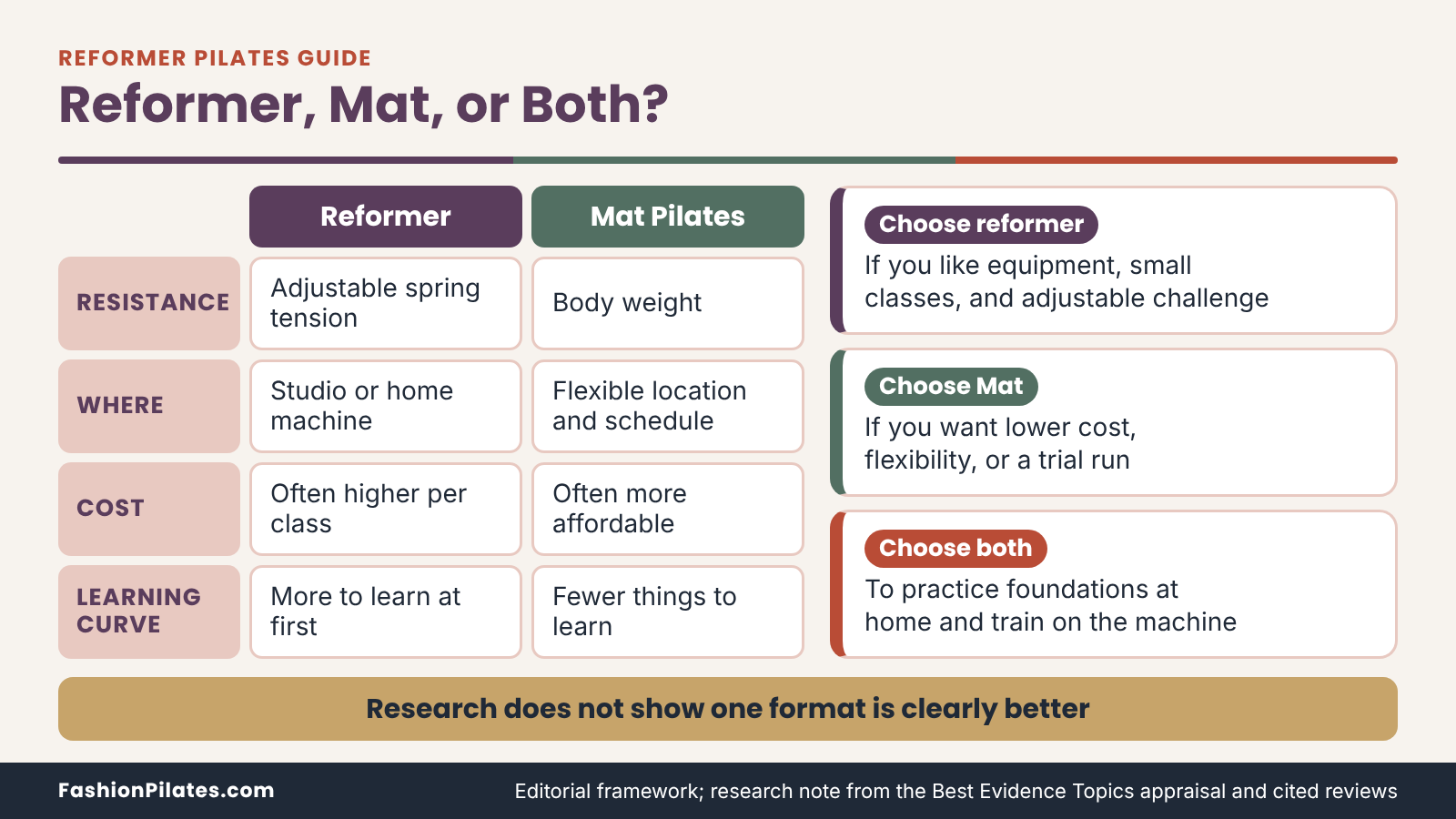
Not much. As the research section explains, studies that directly compare reformer with mat work are limited and mixed, and many reviews do not separate the two formats. A Best Evidence Topics appraisal of four trials comparing equipment-based and mat Pilates for low back pain found results that favored different formats in different studies.
The honest takeaway is that the best choice is usually the one you will do consistently with a good instructor. Pick the option you can afford, reach, and enjoy enough to repeat.
What the Research Does and Does Not Show
Reformer Pilates has plenty of enthusiasts and an even larger supply of marketing adjectives, but the research is thinner and messier than the buzz suggests. That does not mean the exercise is ineffective. It means you should hold claims loosely and know what kind of evidence stands behind them. This section summarizes published reviews in plain language, with their limits stated up front.
| Source | Design and population | What it reported | Main limits |
|---|---|---|---|
| Cruz-Ferreira and colleagues, 2011 | Systematic review of 16 randomized trials in healthy people | Strong evidence for flexibility and dynamic balance; moderate evidence for muscular endurance | Low study quality; average score of 4.1 on the PEDro scale |
| Pinto and colleagues, 2022 | Systematic review; 11 studies in the meta-analysis, 689 participants | Very low to low certainty that Pilates is no different from other exercise for strength, balance, and flexibility | Did not separate mat from apparatus Pilates |
| Cardiorespiratory fitness review, 2023 | Meta-analysis of 12 randomized trials, 569 participants | Large effect reported when programs totaled at least 1,440 minutes; similar for mat or equipment | Very low to low quality; only 3 of 12 studies rated high quality |
| Cochrane review, 2015 | 10 randomized trials, 510 people with chronic low back pain | Pilates probably better than minimal intervention; no conclusive advantage over other exercise | No high-quality evidence; follow-up no longer than six months |
| Best Evidence Topics appraisal | Four trials comparing equipment-based and mat Pilates for low back pain | Mixed results, with different formats favored in different trials | Small studies; the appraisal’s own bottom line is stronger than its evidence |
| Fibromyalgia review, 2024 | Meta-analysis of six trials, 265 patients | Improved quality-of-life scores; mixed results on some pain measures | Small, mostly female samples; one trial used reformer equipment |
The table is a selection rather than a full literature review, and the findings apply to the populations studied. None of these papers is a guarantee of what a class will do for you.
What the Evidence Base Looks Like
Before any single finding, it helps to see the shape of the whole body of work. It is smaller, more varied, and more cautious than a studio promotion would suggest.
Mostly Pilates in general, not the reformer specifically
Many studies study Pilates as a category, and some use mat, some use equipment, and some mix. The Pinto review published in Heliyon says outright that it did not separate mat from apparatus Pilates, and notes that differences in exercise sequences between formats could affect results. A research explainer in The Conversation likewise notes that very few studies compare reformer Pilates directly with other types of exercise.
So when someone says “research shows reformer Pilates does X,” the honest follow-up is “which study, which population, and was it actually on a reformer?” Often it was Pilates in general, or a small trial of one group.
Quality and size problems
The older systematic review by Cruz-Ferreira and colleagues concluded that Pilates showed strong evidence for flexibility and dynamic balance in healthy people, but it also reported low scientific rigor, with an average quality score of 4.1 on the PEDro scale. The authors recommended improved blinding, allocation concealment, and follow-up in future work.
Later reviews report similar patterns. A 2023 meta-analysis on cardiorespiratory fitness described its evidence as very low to low quality, with only three of twelve trials rated high quality. Small samples, short durations, and inconsistent methods are recurring themes, so the findings are worth reading as suggestive, not settled.
What Published Reviews Have Found
With those limits in mind, here is what the better-known reviews report, grouped by the question a beginner usually asks.
Fitness outcomes in healthy adults
For healthy people, the evidence is generally encouraging but modest in certainty. Cruz-Ferreira’s review found strong evidence for flexibility and dynamic balance, and the 2022 Pinto review found very low to low certainty evidence that Pilates is no different from other exercise for strength, balance, and flexibility. That second finding is easy to misread: it means Pilates appears comparable to other exercise, not that it fails to work.
The 2023 cardiorespiratory review reported a large effect when programs reached a total of at least 1,440 minutes, with similar results from mat and equipment programs. Even so, the authors flagged low quality, so the finding should be treated as a hypothesis rather than a promise that a class will build aerobic fitness.
Low back pain and other conditions
The best-known review for back pain is the Cochrane review of Pilates for low back pain, which included 10 randomized trials with 510 participants who had chronic non-specific low back pain. It concluded that Pilates is probably more effective than minimal intervention in the short and intermediate term, but found no conclusive evidence that it is superior to other forms of exercise and no high-quality evidence for any comparison. An American Family Physician summary reaches a similar conclusion and describes adverse effects as uncommon and mild.
Evidence for other conditions is thinner still. A 2024 meta-analysis of Pilates for fibromyalgia, published in the Journal of Clinical Medicine, included six small trials and reported improved quality-of-life scores but inconsistent results across pain measures, with only one trial using reformer equipment. If you have a medical condition, ask your clinician what is appropriate for you instead of relying on a general review.
Mat versus equipment
The direct comparison is the weakest part of the evidence. The Best Evidence Topics appraisal found four trials comparing equipment-based and mat Pilates for low back pain, with results that favored different approaches in different studies. Small sample sizes and varied programs make it hard to draw a firm line.
The practical reading is that the research does not currently support a claim that the machine itself is superior. It is reasonable to choose the reformer because you enjoy it, like the adjustable resistance, or benefit from the studio setting, and it is reasonable to choose mat work for the same kinds of reasons.
How to Read Claims You See Online
Health and fitness marketing often borrows the vocabulary of research without the caution. A few habits protect you from the most common traps.
Association, cause, and big promises
Most of the findings above describe averages in specific groups over specific periods. They do not show that a reformer class will change your pain, posture, body composition, or mood. Claims about weight loss, posture correction, or mental health deserve extra skepticism, because the studies behind them are often small, short, or about Pilates in general.
Calibrated language is a good sign. Words like “may support” or “is associated with” show that someone is respecting the limits of the evidence. Absolute promises are a reason to look for the original source.
Popularity is not evidence
ClassPass’s 2025 Look Back Report says Pilates reservations rose 66 percent year over year, with reformer Pilates up 71 percent and Mat Pilates up 114 percent, and that Pilates exceeded 15 million reservations on the platform. Those are real and interesting figures about booking behavior on one platform. They do not show that either format works better, and a larger percentage increase says nothing about absolute totals, since percentages depend on the starting size.
Popularity is not proof that a format works better. Treat popularity as a sign that studios are widely available and that many people enjoy the format. Then judge the format on how it feels for you, how well it is taught, and what the evidence honestly supports.
How reformer work fits into overall activity
The US Physical Activity Guidelines for Americans recommend that adults get at least 150 to 300 minutes of moderate-intensity aerobic activity each week and do muscle-strengthening activity at least two days a week, according to the federal guidelines summary. A class built around controlled strength and mobility may contribute to the muscle-strengthening side, depending on how hard the muscles work, but most reformer classes are not designed primarily around sustained aerobic effort.
Many people therefore combine reformer classes with walking, cycling, or another way of raising the heart rate. That is an editorial suggestion drawn from the guidelines, not a claim from any single Pilates study, and a clinician or qualified professional can help tailor it to you.
Who Reformer Pilates Suits and Who Should Check First
Reformer classes are often described as gentle and adaptable, and that can be true. They are also real exercise on a moving machine, which means a few groups should get individual guidance before they start. The table below is an editorial guide for orientation, not a screening tool, and it does not replace advice from a clinician who knows your history.
| Situation | Why reformer may suit | Check with a clinician first? | Tell the instructor |
|---|---|---|---|
| New to structured exercise | Adjustable load and close coaching in a small class | If you have a health condition or have been inactive for a long time | That it is your first class |
| Active, wanting variety | Adds equipment-based strength and control work to other training | Usually not, unless you have an injury | Your other training and any soreness |
| Low bone density or osteoporosis | Low-impact work can be adapted when taught by someone trained in it | Yes, before starting | Your diagnosis and any restrictions |
| Pregnant or postpartum | Some studios offer specially trained instructors | Yes, with your obstetric care provider | Your stage, symptoms, and clearance |
| Back, neck, or joint problems | Supported positions and adjustable load may help some people | Yes, especially if there is pain, numbness, or a recent flare-up | What movements are restricted and what to avoid |
| Recent surgery or acute injury | Rehabilitation settings sometimes use equipment under supervision | Yes, and wait for clearance | Surgery date, restrictions, and clinician instructions |
If you are unsure whether you fall into one of these categories, ask your clinician. A short conversation is cheaper than a setback.
People Who Often Find It a Good Fit
No exercise suits everyone, but certain situations line up well with what a reformer class offers.
Beginners and cautious starters
A small class with an instructor who adjusts the machine and offers variations can be a comfortable way to begin structured exercise. The adjustable load means the same exercise can be done at different levels, and the supported positions, like lying down, can feel less intimidating than standing exercise. That does not make the work trivial, and beginners should still expect to feel tired.
The key ingredient is instruction. A beginner in a crowded, fast class may not get the guidance that makes the format approachable, so choose the class carefully, a topic the studio section covers.
Active people who want a different kind of training
Runners, cyclists, lifters, and other active people sometimes add reformer classes for variety, focusing on slow control, mobility, and trunk work that complements other training. It can be a useful change of pace because the pace and the feedback are different from a typical gym session.
A research explainer in The Conversation notes that people with specific goals, such as marathon training or building significant strength, may get more from targeted programs. Reformer work can sit alongside those goals, but it should not be treated as a substitute for them.
Who Should Talk to a Clinician First
Some situations call for a conversation with a qualified clinician before the first class, and for a Pilates instructor who is trained to work with them.
Pregnancy and postpartum
Pregnancy and the postpartum period change how the body responds to exercise, and positions or pressures that were fine before may not be fine now. Talk with your obstetric care provider before starting, and look for an instructor with specific prenatal or postnatal training instead of relying on a general class. Tell the instructor about your stage and any clearance or restrictions.
This guide does not give pregnancy-specific exercise advice. If you are already attending classes and become pregnant, ask your provider and instructor how to adjust, and do not assume that familiar exercises remain appropriate.
Osteoporosis and low bone density
The Bone Health and Osteoporosis Foundation’s exercise and safe movement guidance emphasizes correct body position for people at increased risk of fracture, and advises avoiding activities that involve spinal flexion, twisting, or impact that could trigger vertebral fractures. It also recommends consulting healthcare providers and working with exercise specialists.
That matters because some Pilates exercises involve rounding or twisting the spine. If you have osteoporosis or low bone density, get clinician guidance first and choose an instructor trained to modify for it. Do not rely on a general class to know your limits.
Back and neck pain, recent surgery, and chronic conditions
Harvard Health’s article on Pilates for older adults recommends checking with a doctor before starting and notes that a doctor may advise avoiding certain exercises if you have back pain or spine problems. The same logic applies to recent surgery, acute injury, joint instability, and chronic conditions that affect exercise tolerance.
If you have numbness, radiating pain, or a recent injury, do not use a group class to find out what hurts. Get individual advice first, then bring the instructor into the loop.
Age and Fitness Level
Age and fitness matter less than the specifics of your health and how well the class is taught. Still, a couple of points come up often.
Older adults
Harvard Health describes Pilates as a low-impact form of exercise and offers gentler formats, such as chair Pilates, as options for older adults, while also advising a doctor check first. It is worth noting that the article states its benefits without citing studies, so it should be read as general guidance rather than a research summary.
For older adults, the biggest variables are instruction quality and individual health history. A teacher who is comfortable with adjusting the machine, slowing the pace, and offering modifications is worth more than any promotional claim about a specific format.
Very fit people and athletes
Being strong or fit does not automatically make reformer work easy. The unfamiliar machine, the slow tempo, and the emphasis on control often humble experienced athletes in the first few classes, and that is a normal part of learning. Beginners with high fitness sometimes push too hard to prove something.
A better approach is to treat the first sessions as skill practice. Move slowly, focus on control, and let your fitness show up later in how well you manage the carriage, not in how fast you rush it.
Safety on the Machine
A reformer is a moving machine with tensioned springs, so a few safety habits are worth learning from day one. None of them is complicated, and most are habits a good instructor will coach. This is general safety information, not individualized medical advice.
| What you notice | Usually a normal training sensation? | What to do |
|---|---|---|
| Muscle fatigue or a mild burn | Yes, in working muscles | Slow down or take a short rest if needed |
| Shaking during a slow hold | Often, as muscles tire | Reduce the range or rest, and tell the instructor |
| Mild soreness a day or two later | Common with new exercise | Gentle movement; rest if needed |
| Sharp, pinching, or electric pain | No | Stop and tell the instructor |
| Numbness or tingling | No | Stop and seek advice from a clinician |
| Dizziness or feeling faint | No | Stop, sit or lie down, and tell the instructor |
| Chest pain or severe shortness of breath | No | Stop and seek urgent medical care |
The table is a simple orientation. If something feels wrong, trust that signal over any desire to finish the set.
Safe Habits on the Machine
These are the habits instructors repeat so often that they become background noise. They matter most when you are new.
Getting on, off, and controlling the carriage
Get on and off the machine slowly and deliberately. Many instructors teach students to step or sit with control, and to keep a stable hand on the frame while the carriage is steady. Never let the carriage slam back to its stop, and keep fingers and loose clothing clear of the rails, wheels, and springs.
If you feel unsteady getting on, ask for help or a different setup. It is a common concern, and instructors are used to it.
Handling springs, straps, and the footbar
Let the instructor change springs, especially at the start. Springs are under tension, and unhooking one carelessly can cause it to snap or strike. Hold straps firmly through the whole exercise, and return them slowly instead of dropping them, so the carriage and your joints are not jolted.
Make sure the footbar is locked in place before pushing against it. If it feels loose or a part looks damaged, stop and tell the staff. A machine in good repair should not surprise you.
When to Stop or Modify
The most important safety skill is knowing when to back off. It is also the one most beginners resist.
Stop signs and what to do next
Stop if you feel sharp pain, numbness, tingling, dizziness, chest pain, or unusual shortness of breath, and tell the instructor. If symptoms are severe or do not settle, seek medical care. Do not wait for the end of the class to say something, because most instructors would much rather pause than manage a bigger problem later.
After class, notice how you feel. If something persists or worsens over the next day or two, check in with a clinician rather than trying to train through it.
Modifying without pushing through
Modifications are a normal part of teaching, not a sign of failure. A smaller range of motion, a different footbar setting, a different position, or a pause can make an exercise manageable. Ask the instructor what to do instead of guessing at spring changes yourself, since a lighter or heavier spring does not always make an exercise easier, as the springs section explains.
A sensible attitude is to treat the first month as learning the machine. Progress comes from showing up consistently with good form, not from proving anything in week one.
Studio-Level Safety
Some safety depends on the studio, not on you. A few simple questions reveal a lot about how seriously a studio takes it.
Equipment condition and setup
Machines should be clean, stable, and in good repair, with straps and ropes that are not frayed and springs that are properly attached. You are not expected to be an engineer, but you can notice visible wear, loose parts, or a footbar that will not lock. If something looks off, ask.
A well-run studio checks its equipment and fixes problems promptly, and staff usually welcome questions about it. A studio that seems defensive about maintenance is giving you information.
Class size and supervision
Safety is partly a function of attention. In a small class, the instructor can see each student and notice problems early. In a large or fast class, a beginner may drift into poor form or an uncomfortable setting without anyone noticing.
Ask about maximum class size and whether the instructor offers a beginner orientation. If a studio cannot answer, that is worth noting before you commit.
Choosing a Studio and Instructor
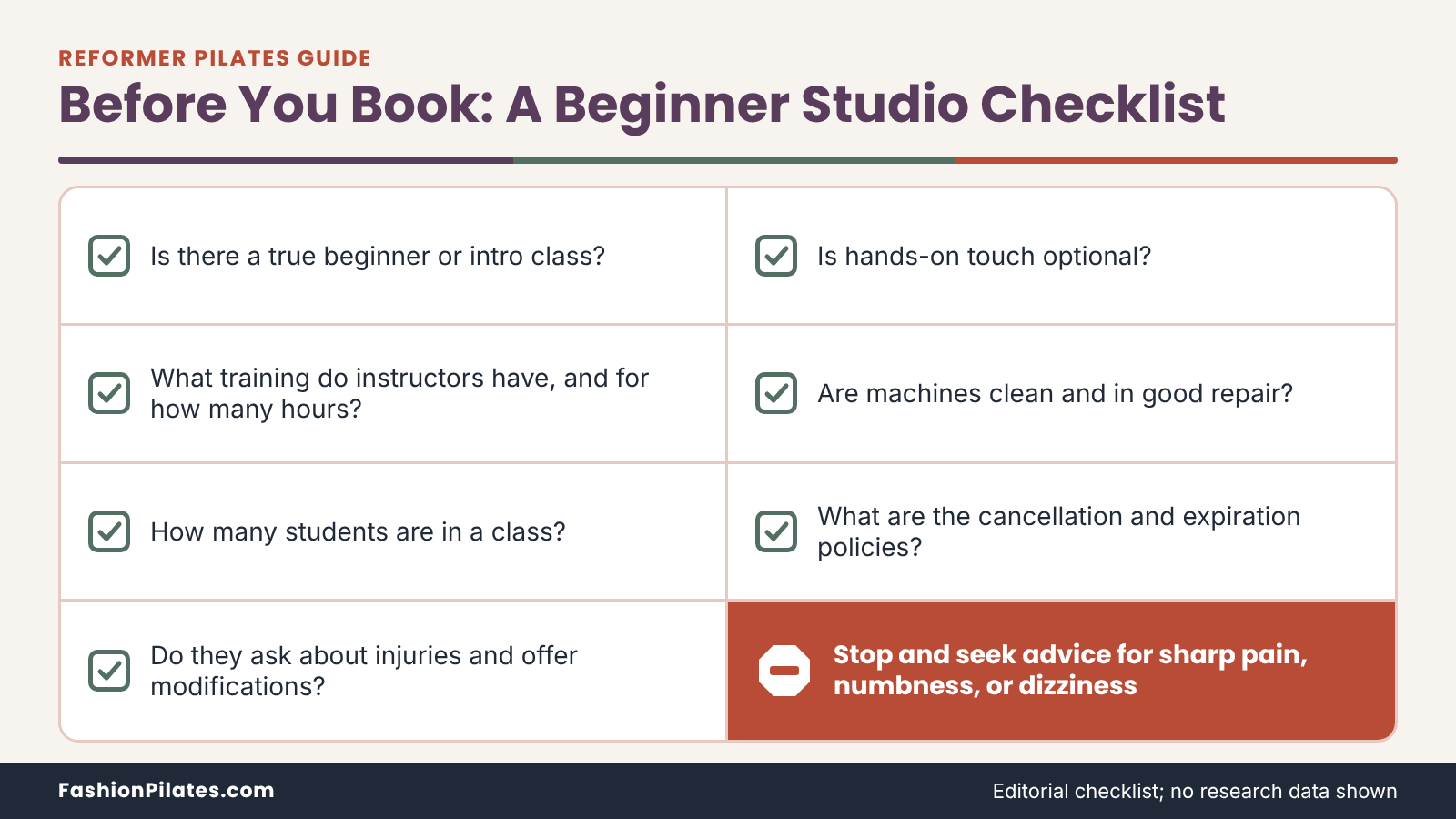
The instructor and the studio shape your experience more than the logo on the machine does. Pilates teaching is not regulated the way some professions are, so quality varies, and a few smart questions can separate a careful, well-trained teacher from a weekend-course teacher with a good playlist. The table collects questions worth asking, along with what a good answer tends to sound like.
| Question | Why it matters | What a good answer sounds like |
|---|---|---|
| What training do your instructors have? | Training length and depth vary widely | Names the program, the number of hours, and whether it covered reformer and special populations |
| Is there a beginner or intro class? | Starting in an advanced class can build poor habits | Describes a specific introductory class or orientation |
| What is the maximum class size? | Attention drops as classes grow | Gives a number and explains how instructors manage the room |
| How do you handle injuries and health conditions? | Modifications depend on the instructor’s knowledge | Asks about your history and explains how they adapt exercises |
| Are springs and equipment maintained regularly? | Worn parts can be a safety issue | Describes a routine and replaces worn parts promptly |
| What is the cancellation policy and what does it cost? | Fees can add up and surprise new members | States the policy clearly, with deadlines and fees |
| Is hands-on touch optional? | You should control how you are corrected | Confirms that verbal-only cueing is always an option |
You do not need to ask every question in one visit, but the first three tend to reveal the most.
Instructor Qualifications
Qualifications are not everything, but they are a useful first filter, especially when you are new and cannot judge technique yourself.
What certification can and cannot tell you
There are multiple Pilates teacher training programs and credentials, and they differ in length and rigor. The National Pilates Certification Program, a credentialing body for Pilates teachers, describes itself as accredited by the National Commission for Certifying Agencies and says it exists to set standards for teacher credentialing and continuing education. Its published requirements for its comprehensive exam describe a program of at least 450 hours covering mat, reformer, and other apparatus, with updated eligibility rules scheduled to take effect on January 1, 2027. Check the current page, because requirements can change.
An independent explainer on classical and contemporary Pilates also notes that training lengths vary and suggests asking how long your teacher has trained. A credential is a reasonable signal, not a guarantee of teaching skill. Experience, observation, and fit still matter.
Questions that reveal teaching quality
Credentials aside, you can learn a lot from how an instructor behaves. A good one asks about injuries and goals, explains what an exercise is for, demonstrates clearly, offers modifications, and notices when you are struggling. They talk about quality of movement more than reps.
Red flags include pushing students through pain, ignoring questions about injuries, using vague or exaggerated health promises, and insisting on hands-on corrections after you have declined them. If a teacher makes you feel unsafe, you are allowed to leave and try another class.
Studio Fit
A great instructor in a poorly run studio can still be a frustrating experience, and the reverse is true too. A few practical factors decide whether a studio works for you.
Beginner pathways and class structure
Look for a studio with a clear route for beginners, such as an intro class, a small-group series, or a private session to learn the machine. Ask whether classes are labeled by level and whether those labels mean something. A class called “all levels” can still be fast, so ask about the actual pace.
Also consider scheduling. A studio with class times that fit your life will get used, while one that requires a long trip at an awkward hour will not. Consistency beats perfection.
Equipment, atmosphere, and policies
Look at the room. Machines should be clean and in good repair, the space should feel manageable, and staff should be willing to answer questions. Notice whether the atmosphere feels supportive or competitive, because that will affect whether you keep going.
Read the policies before you commit. Late-cancel and no-show rules, membership terms, and expiration dates on class packs can matter as much as the sticker price. A studio that explains these clearly is usually easier to deal with later.
Making the Most of a Trial Class
A first class is partly a test of the studio, and you are allowed to evaluate it. A little preparation makes the trial more informative.
Before you go
Check the class description, confirm that it is a beginner-friendly level, and arrive early to introduce yourself. If you have injuries or conditions, mention them in advance, and talk to a clinician beforehand if you are unsure. If the studio offers a way to watch a class, take it.
Bring water, wear fitted clothing, and check the sock policy. Showing up prepared makes it easier to focus on the class itself instead of logistics.
What to notice during and after
Notice whether the instructor checks in, explains the setup, offers modifications, and keeps the room under control. Notice whether you understood what you were doing by the end, and whether the pace left room to learn. Soreness is normal. Feeling lost or unsafe is not.
Afterward, ask yourself whether you would book again, and whether the studio answered your questions. If not, try another one. Studios differ a great deal, and finding the right one can take a couple of attempts.
Cost Factors and the Home-Machine Question
Reformer classes are widely known for costing more than many other group fitness options, and the question of whether to buy a machine for home comes up quickly. This section explains what drives the cost and how to think through the decision. It deliberately uses no prices, because they vary by market, studio, and time, and they change quickly. Check current studio pricing and manufacturer listings for numbers.
| Cost factor | How it tends to affect price | What to ask |
|---|---|---|
| Class format | Private sessions generally cost more per person than group classes | What is included in each format? |
| Class size | Smaller classes tend to cost more because fewer people share one instructor | What is the maximum number of students? |
| Location and market | Rent and local demand influence prices | Are there off-peak or neighborhood differences? |
| Payment structure | Drop-in, class packs, and memberships price classes differently | Which option fits how often I will actually come? |
| Introductory offers | Many studios discount a first class or short series | What happens after the intro period ends? |
| Policies and fees | Late-cancel or no-show fees add to the effective cost | What are the deadlines and fees? |
| Extras | Grip socks, accessories, and travel add small costs | Does the studio sell or loan socks? |
The table is a list of questions, not prices. Studios differ, so compare them on structure as well as sticker price.
Understanding Studio Costs
Studio pricing can feel opaque because of the mix of packs, memberships, and intro deals. Breaking it down helps you compare fairly.
Pricing structures and what they reward
Drop-in prices are usually the highest per class but the most flexible. Class packs and memberships tend to lower the per-class price in exchange for commitment, and packs often come with expiration dates. A research explainer in The Conversation noted that paying for two or three classes a week is a significant outlay, which is a useful reminder to match the plan to your real attendance, not your best intentions.
Do the math with your own schedule. A membership that looks like a bargain at four visits a week is expensive if you realistically go once a week. A pack with a short expiry is only a deal if you can use it in time.
Hidden and ongoing costs
Beyond class fees, watch for late-cancel charges, no-show fees, grip socks, parking, and travel time. None of these is large alone, but together they change the true cost. They also reward the studio that communicates them clearly.
If cost is a constraint, ask about intro series, off-peak classes, or community classes. Many studios have flexible options, and asking is free. Our Pilates studio class cost and membership guide goes deeper on comparing options.
Studio Classes or a Home Machine
The decision comes down to instruction, frequency, space, and budget. Neither choice is wrong, and many people start in a studio before deciding.
When studio classes make sense
A studio gives you instruction, feedback, a machine that is maintained for you, and the chance to try before committing money to equipment. That matters most when you are new, because the early classes are about learning the machine and building safe habits. A studio is also the practical choice if you lack space or do not want to store or maintain equipment.
The trade-off is recurring cost and schedule. You pay per class and must fit your week around studio times.
When a home machine may make sense
A home machine can make sense if you will use it frequently, have space, and have access to instruction, whether in-person lessons or a good program. For frequent users, the per-session cost can fall over time. The convenience of practicing without travel is real.
The trade-offs are upfront cost, space, and the risk of an unused machine, plus less in-person feedback. If you are unsure, take studio classes for a few months first, so you learn what you like. See our best home Pilates reformers guide for buying criteria.
If You Are Considering a Home Reformer
This guide does not recommend products, but it can point you to the questions that matter before you buy.
Criteria worth checking
Look at the footprint and storage, because a reformer takes real room. Look at stability and the manufacturer’s stated weight capacity, the spring system and how it is described, and which accessories are included or optional. Some manufacturers publish detailed pages. For example, Merrithew’s SPX Max bundle page lists included parts and a stated weight capacity, which shows the kind of specification you can compare across makers.
Check warranty terms and whether the maker publishes a manual or instruction resources. Specifications and prices change, so verify them on the manufacturer’s current listing before relying on any number.
Learning safely at home
Home use raises the stakes on instruction, because nobody is watching your form or the machine’s condition. If you are new, consider a few in-person or live lessons first, and follow the manufacturer’s manual for assembly, spring handling, and weight limits. Do not copy spring settings from social media videos, because spring systems differ.
Start with simple, supported movements, move slowly, and stop if something feels wrong. If you have a health condition, check with a clinician before beginning. For routines, see our reformer Pilates at home for beginners page.
Beginner Mistakes and a Glossary
Almost every beginner makes a few of the same mistakes, and almost all of them are fixable with a bit of awareness. This final section covers the common ones, then closes with a glossary so the vocabulary stops feeling like a foreign language.
Mistakes About the Machine
The reformer invites a few specific misunderstandings, mostly because it looks like gym equipment and behaves differently.
Treating spring count as a score
Newcomers often assume that more springs means a better workout, then feel puzzled when an instructor takes springs off and the exercise gets harder. As the springs section explained, tension can load, support, or stabilize a movement depending on the setup. The fix is to ask what the spring is meant to do for each exercise, and to resist the urge to compare your setup with your neighbor’s.
Spring settings are not standardized across brands, so a setup that looks light on one machine may feel quite different on another. Your own comfort and control are better guides than the number of springs on the bar.
Letting the carriage control you
The carriage will happily move faster than you can manage if you let it. Slamming it back to the stop, rushing through repetitions, or letting momentum do the work removes much of the control the method is built around. If the carriage feels like it is driving, slow down and shorten your range.
A useful habit is to keep the same tempo out and back. That quiet, unglamorous consistency is what instructors mean by control, and it tends to be harder than it looks.
Not saying when something feels off
Many beginners stay silent when a headrest, footbar, or strap feels wrong, assuming that discomfort is part of learning. Fit problems are some of the easiest things to fix, and they can change how an exercise feels dramatically. A single sentence to the instructor usually solves it.
The same goes for pain, dizziness, or numbness. Mention them straight away rather than waiting to see if they pass.
Mistakes About the Classes
The other group of mistakes involves how people choose, schedule, and think about classes.
Starting in a class that is too advanced
It is tempting to book the most popular or intense class on the schedule, especially if you are already fit. For a first class, that usually backfires, because the pace leaves little room to learn the machine. A beginner or introductory class gives you time to ask questions and build habits.
If the schedule has no beginner option, ask the studio what it recommends. A private session or a small intro series can be a smart first step.
Expecting instant transformation
Marketing sometimes implies quick, dramatic results. The research summarized earlier suggests modest, gradual effects in the populations studied, with low-quality evidence in many areas, so expectations should match. Notice smaller wins, like understanding the machine, moving more smoothly, or feeling more comfortable in your body.
Judge the practice by how it feels and whether you can keep it up, not by an overnight change. A routine you actually keep is worth more than a perfect plan you drop.
Ignoring rest and the rest of your week
Some people go all in on classes, then feel sore, tired, or discouraged. Others forget that a single hour of exercise a few times a week does not cover all of their activity needs. Recovery and variety matter.
Balance classes with walking, other movement you enjoy, and rest days. If soreness lingers or turns into pain, scale back and check with a clinician. Consistency over months matters more than intensity in week two.
A Beginner’s Glossary
Reformer vocabulary mixes equipment names with teaching language. The table gives short definitions you can scan, and the notes below explain how to use them.
| Term | Plain-English meaning |
|---|---|
| Reformer | The spring-loaded sliding-carriage machine at the center of reformer classes |
| Carriage | The padded platform that slides along the rails |
| Springs | The tension elements that pull the carriage toward its resting position |
| Gear bar | The bar springs attach to; its positions adjust tension |
| Footbar | The adjustable bar you push or hold with feet or hands |
| Shoulder rests | Padded stops that keep you from sliding while you push |
| Headrest | The support for the head and neck when lying down |
| Straps or loops | Handles or loops, attached to ropes, used by hands or feet |
| Footwork | A common opening series of leg presses with feet on the footbar |
| Contrology | The name Joseph Pilates gave his method |
| Classical | Teaching that stays close to the original exercises and their order |
| Contemporary | Teaching that modifies or reorders exercises or blends in other approaches |
| Jump board | An accessory for jumping-style work against spring resistance |
| Tower or combo | A vertical spring frame attached to a reformer for added variety |
| Modification | A change that makes an exercise easier, shorter, or safer |
Machine terms you will hear first
The first words that matter are carriage, springs, footbar, and straps, because instructors use them constantly. If you learn only those four, you can follow most cues, and the rest will accumulate. Remember that brands name parts differently, so a term that sounds unfamiliar may simply be another name for something you already know.
When you are not sure which part is meant, ask the instructor to point to it. That small habit prevents wrong adjustments and builds confidence faster than guessing.
Class and teaching terms
Terms like classical, contemporary, modification, and footwork describe how the class is taught instead of what the machine is. Treat them as descriptions, since studios use them loosely, and ask for clarification if a class description is vague.
Words that sound clinical or athletic can also be marketing. If a class description promises a lot in one phrase, ask the studio what actually happens in the room. A good studio can explain it plainly.
Frequently Asked Questions
Is reformer Pilates good for beginners?
Yes, reformer Pilates can work well for beginners when the class is taught at an introductory level by a well-trained instructor. The adjustable springs let the same exercise be set at different levels, and a small class usually offers more individual attention than a large one. The machine does add vocabulary to learn, so an orientation or beginner class helps. Anyone with a health condition, injury, or pregnancy should check with a clinician before starting.
How is reformer Pilates different from Mat Pilates?
The main difference is the equipment and where the resistance comes from. Reformer work uses a sliding carriage with springs, a footbar, and straps, while Mat Pilates mostly uses body weight on the floor. Both teach the same method of controlled, precise movement, and neither is a lesser version of the other. Research directly comparing the two is limited, so the best choice is often the one you can afford, reach, and enjoy enough to repeat.
How often should a beginner take reformer classes?
There is no research-backed ideal number for beginners. Many people start with one or two classes a week and adjust based on how their body feels, their budget, and their instructor’s advice. Muscle soreness after new exercise is common, but sharp pain or soreness that lingers is a reason to scale back. Consistency over several months usually matters more than packing classes into the first few weeks.
What should I wear to a reformer Pilates class?
Fitted, stretchy clothing that stays put when you lie down and move is the usual advice. Loose fabric and long strings can catch on springs, straps, and the carriage. Many studios also ask for grip socks because bare feet can slip on the footbar. Check the studio’s policy when you book, since some sell socks and some require your own.
Does reformer Pilates help with weight loss?
The research summarized in this guide does not establish reformer Pilates as a weight-loss method. Any exercise uses energy, but the amount depends on the class, your effort, and your body, and no class can promise a specific result. Weight changes also depend on eating patterns, sleep, medical conditions, and other factors beyond a single activity. If weight is a health goal, a clinician or registered dietitian can give individualized guidance.
Is reformer Pilates safe during pregnancy or with osteoporosis?
It can be adapted in some cases, but it depends on the individual, so talk with your clinician first. Pregnancy and postpartum bodies respond differently to exercise, and an instructor with prenatal or postnatal training is a better fit than a general class. People with osteoporosis are advised by the Bone Health and Osteoporosis Foundation to avoid movements that involve spinal flexion, twisting, or impact. Share your situation with the instructor so they can modify exercises and skip what is not appropriate.
Why do instructors change the springs so often?
Springs change the way a movement feels, and different exercises call for different loads. Adding tension can increase work in some exercises, while in others it can make the carriage steadier or help it return. Instructors change springs to match the goal of each exercise, not to judge how strong you are. If a setting feels wrong, tell the instructor instead of guessing at a change yourself.
Can I do reformer Pilates at home?
Yes, some people practice at home with their own machine, but it raises the importance of good instruction and careful setup. Spring systems and specifications differ between manufacturers, so follow the manual for your machine and do not copy settings from videos. A few in-person or live lessons first can help you learn safe habits. People with health conditions should check with a clinician before starting.
How do I find a good reformer Pilates instructor?
Start with the instructor’s training, then judge how they teach. Ask which program they completed, how many hours it involved, and whether it covered reformer work and modifications. A good instructor asks about injuries, explains what each exercise is for, offers variations, and respects your choice about hands-on correction. If you feel rushed, ignored, or pushed through pain, try another class or studio.

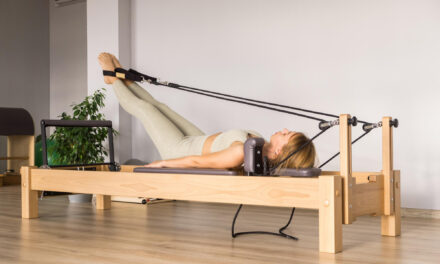


Trackbacks/Pingbacks